
AI in SAP GRC Process Control: Joule and Continuous Control Monitoring
The era of spreadsheet-driven compliance checks and annual audit snapshots is officially ending. As we move through 2026, regulatory landscapes are shifting at breakneck speed—with over 300 regulatory changes occurring daily according to analyst firms like AccessHub and Riscomp. For governance, risk, and compliance (GRC) teams, the "volume problem" has become the primary barrier to effective oversight. Manual testing cycles that took weeks now take months, and the cost of non-compliance has never been higher, with global fines exceeding $10 billion annually across regulated industries.
Enter SAP GRC 2026, the next-generation suite built natively on SAP HANA. With the integration of generative AI and the Joule copilot, SAP is fundamentally altering how process control operates—moving from reactive testing to intelligent, continuous compliance. This article explores the specific, real-world features of AI in SAP GRC Process Control (PC) available today and how they automate control monitoring, detect anomalies, and transform compliance teams from manual testers into strategic risk advisors.
Definition Box :
AI in SAP GRC Process Control refers to the use of generative AI, machine learning, and intelligent automation within SAP GRC Process Control 2026 to automate control testing, detect anomalies in real time, and continuously monitor 100% of business transactions — replacing manual sampling and enabling compliance teams to shift from data gathering to strategic decision-making.
Quick Facts: The Compliance Volume Crisis
- 300+ regulatory changes occur globally per day
- 60% of GRC team time spent on manual data gathering
- 5% average transaction coverage in manual sampling vs. 100% with AI-driven CCM
- $15M average annual compliance spend for Fortune 500 companies
Why AI is Transforming Process Control
The volume problem in compliance
Traditional compliance models rely on sampling. A team might test 20 invoices out of 20,000 to verify a control. While statistically standard, this method misses the other 99.9% of transactions. As audit scrutiny increases and regulations like the EU AI Act demand data lineage, sampling is no longer defensible. Regulators are increasingly asking, "How do you know the 19,980 untested transactions are compliant?" Without AI, the honest answer is often, "We don't."
Manual processes cannot scale to the velocity of modern SAP S/4HANA transactions, which can process over 1 million line items per hour. The result is "compliance debt"—where the gap between required assurance and actual coverage widens every quarter. According to a 2025 Riscomp survey, 68% of GRC leaders report that their teams spend more than 60% of their time on manual data gathering, leaving less than 40% for actual analysis. This imbalance is unsustainable.
A typical Fortune 500 company spends an average of $15 million annually on compliance activities, with process control testing representing roughly 30% of that spend. By automating even half of those tests through AI-driven continuous monitoring, organizations can save millions while simultaneously improving coverage from 5% to 100%. This is the business case driving rapid adoption of AI in SAP GRC PC.
SAP's AI strategy for GRC
SAP's strategy for GRC is not to replace human judgment but to augment it with AI co-pilots and autonomous agents. With the release of SAP GRC for HANA 1.0 (2026), SAP has unified Access Control, Process Control, and Risk Management onto a single HANA database. This unification allows AI to analyze data across silos without latency.
SAP has established five core principles for AI in GRC: transparency, reliability, privacy, security, and human agency. Every AI-generated recommendation must be explainable, and every automated action must be reversible by a human compliance officer.
The core of this strategy is Joule, SAP's generative AI assistant, embedded directly into the GRC user experience (Fiori). Unlike generic LLMs, Joule understands SAP's metadata and security context, allowing compliance officers to interact with their control environment via natural language without exposing sensitive financial data to external models.
Definition Box: SAP Joule
Joule is SAP's natural language, generative AI copilot. Embedded across the SAP cloud portfolio, it understands business context, automates complex workflows, and provides intelligent recommendations specific to your SAP environment. Unlike generic LLMs, Joule never trains on customer data.
SAP Joule Integration in GRC PC
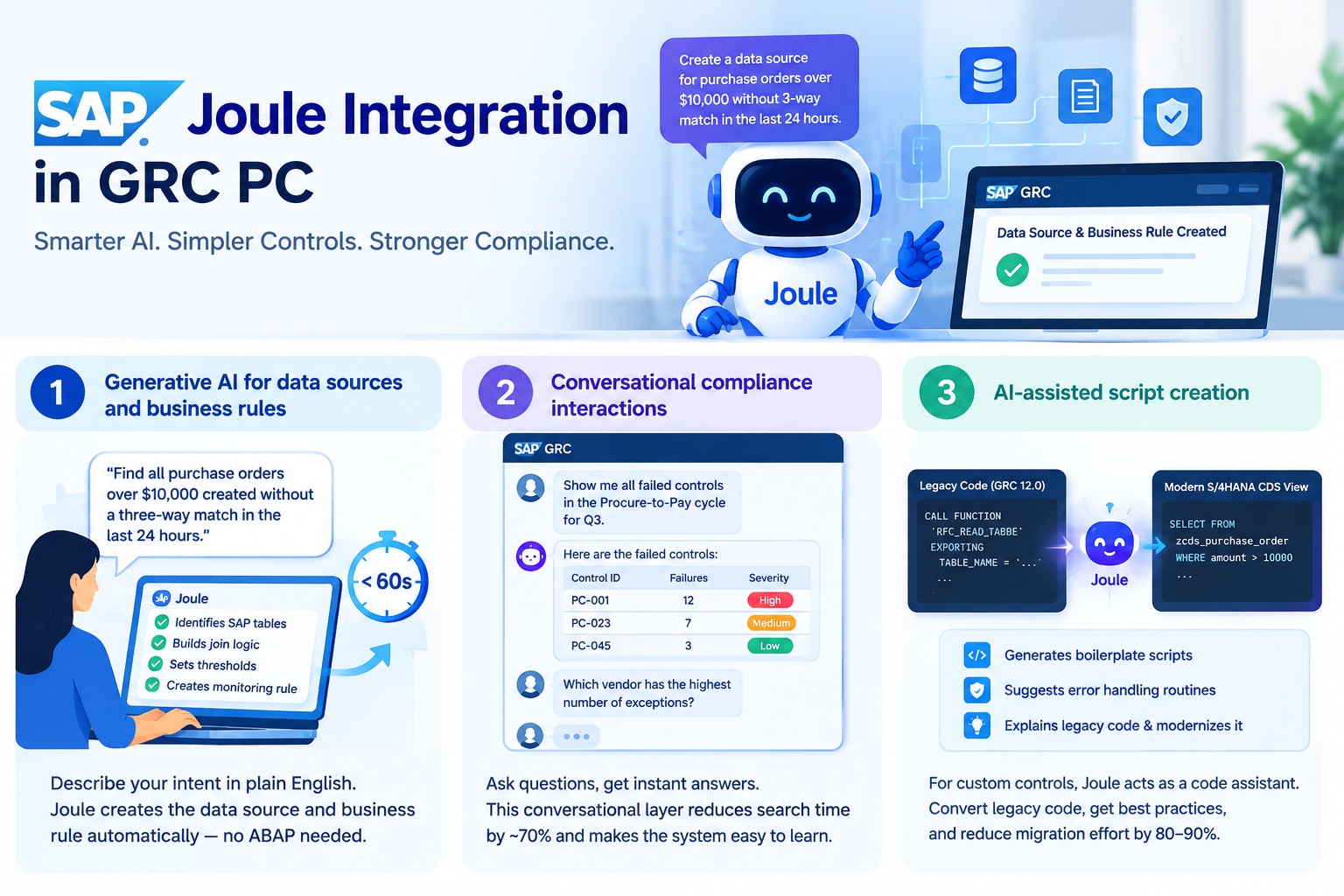
Generative AI for data sources and business rules
One of the most time-consuming aspects of GRC Process Control is the technical configuration of data sources and business rules. In the SAP GRC 2026 release, Joule dramatically accelerates this via generative AI. What used to require a certified ABAP developer can now be accomplished by a compliance manager with basic process knowledge.
Instead of manually writing SQL queries, users can describe their intent in plain English. For example, a compliance manager can type, "Find all purchase orders over $10,000 created without a three-way match in the last 24 hours." Joule translates this into the necessary data source definition and business rule within Process Control. It automatically identifies the relevant SAP tables, constructs the join logic, defines thresholds, and creates the monitoring rule. This process, which previously took 2-3 hours per rule, now takes under 60 seconds.
This democratization allows business owners to define controls without deep technical SAP expertise. A procurement director can create a control for "urgent PO approvals" without writing a line of code.
Conversational compliance interactions
Joule fundamentally changes the GRC user interface. Instead of navigating complex menus, users interact conversationally. An auditor can ask Joule: "Show me all failed controls in the Procure-to-Pay cycle for Q3." Joule retrieves the information and presents a summary including control IDs, failure counts, and severity levels. If the auditor asks, "Which vendor has the highest number of exceptions?" the AI maintains context and refines the query instantly.
This conversational layer reduces time spent searching for data by an estimated 70%. It also lowers the barrier to entry for new team members, who can learn the system by asking natural questions rather than memorizing transaction codes.
AI-assisted script creation
For custom controls requiring specific scripting, Joule acts as a code assistant. It can generate boilerplate scripts, suggest error handling routines, or explain existing legacy code during migrations from GRC 12.0 to 2026.
Consider a legacy control using an outdated function module. An analyst can paste the old code into Joule and ask, "Convert this to a compatible S/4HANA CDS view." Joule analyzes the logic, identifies deprecated elements, and generates a modern replacement. This reduces migration effort by 80-90%.
AI-Driven Continuous Control Monitoring (CCM)
Continuous Control Monitoring is the flagship capability of AI in GRC. Unlike periodic testing, CCM runs 24/7, evaluating 100% of transactions.
How AI automates control testing
In the new architecture, SAP Financial Compliance Management (FCM) and Process Control work in tandem. Automated procedures query the S/4HANA database in real-time, evaluating every transaction against predefined rules and AI-generated baselines.
AI enhances this by automating test data validation. Previously, if control logic changed, a technician manually updated the query over several days. Now, AI analyzes the control objective and suggests modifications automatically. If a new field is added to a vendor master record, the AI alerts the control owner and offers to update relevant monitoring rules.
AI can also perform self-healing of data quality issues. If a control fails because a required field is missing, the AI logs a ticket and may apply a temporary default value to allow evaluation to continue.
Anomaly detection patterns
While rule-based controls catch known violations, AI-driven anomaly detection catches unknown risks.
Comparison Table: Manual vs. AI-Driven CCM
- Feature: Manual Testing — Scope: 5% sample; AI-Driven CCM — Scope: 100% of transactions
- Detection: Manual Testing — Rules-based only; AI-Driven CCM — Pattern & anomaly
- Timing: Manual Testing — Monthly/Quarterly; AI-Driven CCM — Real-time
- Evidence: Manual Testing — Screenshots & Excel; AI-Driven CCM — Digital audit trails
- Analyst Role: Manual Testing — Data gathering; AI-Driven CCM — Strategic validation
Machine learning models establish baselines of normal behavior. If a user suddenly posts journal entries at 2:00 AM from an unusual IP address—deviating by three standard deviations—the AI flags this as an anomaly even if no specific rule is violated. The system generates an alert: "Unusual activity detected. This behavior is 99.7% outside historical norms."
Real-time exception alerts
Integration with SAP Build Process Automation allows AI-triggered exceptions to initiate workflows instantly. If CCM detects a duplicate payment attempt, the system automatically "parks" the invoice, sends an alert to the AP manager via Teams or email, and creates a remediation ticket—all before payment leaves the system. This prevents fraud and errors in milliseconds rather than discovering them at month-end.
Issue Analytics with AI
Smart issue analysis
When a control fails, the "why" often takes longer to solve than the "what." AI aggregates failed instances across similar control IDs and identifies root cause clusters. Instead of 50 individual failures, the compliance officer sees one systemic issue: "Vendor master changes are failing because the 'Approval' field is missing in 30% of cases for subsidiary X."
The AI uses natural language processing to analyze free-text comments from past remediations, identifying common themes and solution patterns. It automatically tags issues by root cause category and recommends preventive actions.
AI-driven resolution recommendations
Leveraging a knowledge base of past remediations, Joule suggests specific steps to fix an issue. For an SoD violation, it might recommend: "To resolve this conflict, consider removing access to transaction code F-02 from the finance clerk role. 85% of similar issues were resolved this way, with average remediation time of 2 hours."
This reduces Mean Time to Remediate from 7 days to under 24 hours for common issues.
Risk Pattern Detection with ML
Automated risk identification
SAP GRC 2026 introduces Regulatory Insights, a BTP service that uses LLMs to read legal documents like SEC rulings and EU AI Act guidelines. The AI parses the document, extracts control requirements, and maps them to existing controls. If a gap exists, the system automatically recommends creating a new control with suggested test procedures.
This transforms regulatory change management from reactive to proactive. Instead of waiting for external consultants, your GRC system continuously monitors the regulatory landscape.
Pattern analysis from historical data
Machine learning excels at finding invisible fraud patterns. AI can analyze years of audit data to discover that control failures are 40% more likely when a specific senior manager approves expenses over a weekend, or that duplicate payments are 500% more common for vendors added in the last 30 days.
These insights allow dynamic adjustment of control frequency. When risk factors align, the control moves to real-time monitoring; when they don't, it runs less frequently—optimizing both coverage and performance.
Real-World AI Use Cases in GRC PC
SOX compliance automation
AI automates Operating Effectiveness testing for SOX controls. By continuously monitoring key financial accounts, the AI generates audit-ready evidence packages. When auditors request a walkthrough, the system provides a digital log of every control instance tested, complete with pass/fail status and attachments. Early adopters report reducing SOX costs by 30-40% and shortening the audit cycle from 12 weeks to 4 weeks.
Continuous monitoring across multi-system landscapes
Most enterprises run complex landscapes (SAP, Salesforce, Workday). AI Agents orchestrate evidence gathering across these sources. For a control requiring SAP inventory reconciliation to a warehouse system, the AI logs into both systems via APIs, compares data sets, and flags only mismatches for human review—eliminating days of manual data merging.
Exception management
In the Procure-to-Pay cycle, price block exceptions cause payment delays. An AI model predicts which price blocks are likely false positives based on historical patterns. The system automatically approves low-risk blocks while escalating high-value or unusual blocks to the procurement manager. This reduces AP workload by 50-70%.
Third-party risk management
AI can ingest external data—credit ratings, sanctions lists, cybersecurity scores—and automatically adjust monitoring for third-party vendors. If a critical supplier's credit rating drops, the AI flags all purchase orders for enhanced review. If a supplier appears on a sanctions list, the system blocks new orders and escalates to legal.
How to Prepare Your Team for AI in GRC
Adopting AI in GRC requires change management. Compliance teams often fear automation will replace their jobs. In reality, AI automates manual tasks, allowing teams to focus on judgment and strategy.
Step 1: Data Hygiene
AI models are only as good as their data. Clean up master data and define clear process ownership before enabling CCM.
Step 2: Upskilling to Prompt Engineers
Train staff to interact with Joule effectively. Moving from menu navigation to intent-driven prompts is a skill. Create internal prompt libraries for common GRC tasks.
Step 3: Trust but Verify
Start with read-only AI. Let AI detect anomalies and suggest resolutions, but require human sign-off for 90 days. As accuracy improves, gradually increase automation. Document every override so the AI learns.
Step 4: Govern the AI Itself
Establish an AI risk committee. Document AI use cases and conduct regular bias and performance audits. SAP's Responsible AI dashboard can assist.
Future AI Capabilities Roadmap
Looking beyond 2026, SAP has hinted at Agentic AI for GRC—autonomous agents that detect and self-remediate risks.
- Self-Healing Controls (2027): If a configuration drift is detected, the AI agent automatically reverts the change and notifies the security team.
- Predictive Risk Scoring (2026 H2): "Based on current system load and behavior, there is an 85% probability the financial close will be delayed by 3 days."
- Generative Audit Reports (2027-2028): Joule drafts complete audit reports from CCM evidence, requiring only partner review.
- Cross-Tenant Learning (2028): Anonymized learning across SAP customers to detect emerging fraud patterns.
FAQ: AI in SAP GRC PC
Q: Is AI in SAP GRC Process Control available today?
A: Yes, foundational capabilities (Joule integration, anomaly detection) are available in SAP GRC 2026 (GA Q3 2026). Regulatory Insights rolls out incrementally on BTP.
Q: Do I need S/4HANA to use AI in GRC PC?
A: AI services via BTP can connect to ECC systems, but real-time CCM performance is significantly better on HANA.
Q: How does SAP ensure compliance with EU AI Act?
A: SAP's transparent AI approach provides audit trails of AI conclusions. Regulatory Insights ensures no "black box" decisions.
Q: Does Joule replace the traditional GRC UI?
A: No. Joule acts as a copilot overlaying Fiori. You can still navigate manually, but Joule offers faster natural language alternatives.
Q: Will AI eliminate compliance jobs?
A: No. AI eliminates manual tasks, allowing professionals to focus on analysis, strategy, and advisory roles. Demand for AI-literate GRC professionals will grow.
Q: How much does AI in GRC cost?
A: Pricing varies. Cloud customers typically have AI in premium editions. On-premise may require additional BTP AI service licensing. Contact SAP for quotes.
Conclusion
The shift from manual, periodic compliance to AI-driven Continuous Control Monitoring represents a tectonic shift in the risk landscape. With SAP GRC 2026 and Joule, SAP provides the toolkit to not only keep pace with regulatory change but to get ahead of it.
By adopting AI in SAP GRC PC, companies move from reactive firefighting to predictive risk management. The result is not just lower compliance costs, but a more resilient, trustworthy enterprise. Compliance becomes a competitive advantage rather than a cost center.
The future of compliance is intelligent, conversational, and continuous. Organizations that embrace this future today will lead their industries tomorrow.
For a deeper understanding of this transformation, explore the complete guide to SAP GRC PC for HANA 2026, which provides detailed insights into next-generation process control and AI-driven compliance strategies.
— TechBrainz Team
TechBrainz Team delivers expert insights on AI-driven SAP GRC transformations, helping organizations automate continuous control monitoring and leverage Joule for intelligent compliance. Their practical guidance turns regulatory complexity into strategic advantage.
Integrating SAP Joule into your continuous control monitoring fundamentally changes how your business flags financial anomalies and processes risk data. To master these predictive analytics and manage AI-driven compliance setups flawlessly, the TechBrainz team is providing advanced, hands-on SAP GRC PC training. Learn how to configure automated control monitors and leverage AI assistants directly from active enterprise governance consultants. Join our course today to secure your career upgrade and lead this technological shift.