
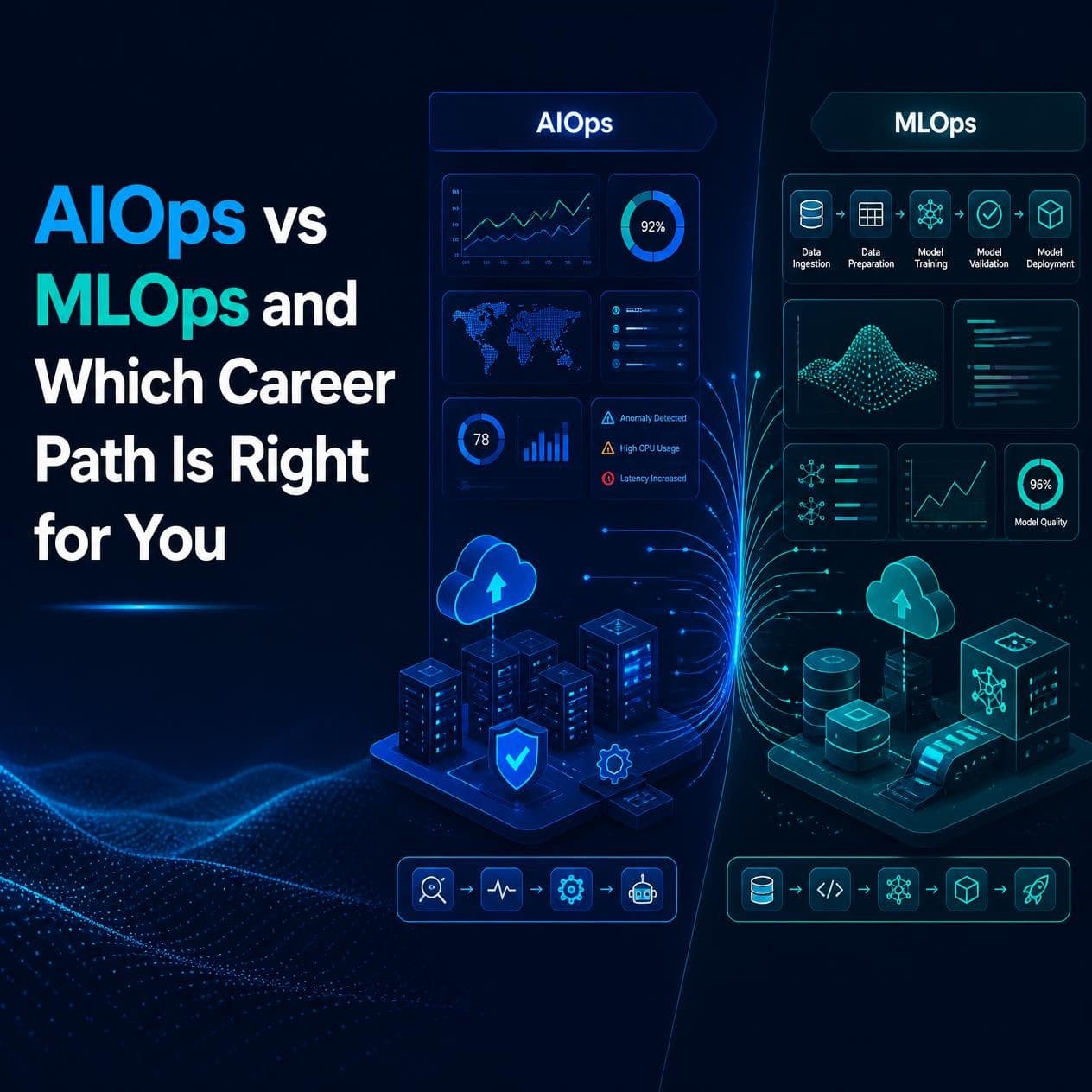
AIOps vs MLOps and Which Career Path Is Right for You
Artificial intelligence is reshaping IT, and two fast-growing specializations sit at the center of that change: AIOps and MLOps.
Their names look almost identical, and many beginners and working professionals treat them as the same thing. They are not. Understanding AIOps vs MLOps is the first step toward choosing a career that fits your skills, interests, and long-term goals. This guide breaks down both fields in plain language, compares the roles side by side, and helps you decide which path to take.
What Are AIOps and MLOps? (Definitions)
AIOps (Artificial Intelligence for IT Operations) uses machine learning, big data, and automation to monitor, analyze, and manage IT infrastructure and applications. Its job is to detect anomalies, reduce alert noise, find root causes quickly, and automate fixes so that systems stay reliable.
MLOps (Machine Learning Operations) is a set of practices that brings DevOps principles to machine learning. It covers building, deploying, monitoring, and retraining ML models in production so that models stay accurate, scalable, and reproducible.
In one line: AIOps uses AI to run IT operations better, while MLOps makes sure AI models themselves run well in production.
Quick Facts: AIOps vs MLOps
AIOps vs MLOps: Key Differences
1. Purpose and Focus
AIOps is about improving IT operations. The AI is a tool applied to infrastructure, networks, and applications. MLOps is about improving the machine learning lifecycle. The AI model is the product being managed.
2. Daily Work
An AIOps professional spends time tuning anomaly detection, correlating alerts, building automation playbooks, and reviewing incidents. An MLOps professional spends time building training pipelines, versioning models, deploying them through CI/CD, and watching for model drift.
3. Tools and Technologies
AIOps work revolves around observability and monitoring platforms, event correlation engines, and automation tools. MLOps work revolves around pipeline orchestration, experiment tracking, model registries, containers, and cloud ML services.
4. Where They Overlap
Both fields rely on automation, cloud platforms, scripting, and monitoring mindsets. Both reward people who like solving production problems. In fact, AIOps platforms are often themselves ML models that need MLOps practices to stay healthy, so the two fields support each other.
Side-by-Side Comparison Table
Career Paths in AIOps
An AIOps career suits people who enjoy keeping complex systems running and solving real-time problems. Common roles include:
- AIOps Engineer: Configures and tunes AI-driven monitoring and automation platforms.
- Site Reliability Engineer (SRE): Uses AIOps tools to improve availability and performance.
- Observability Engineer: Designs data collection and monitoring strategies across the stack.
- IT Operations Analyst / Manager: Leads teams moving from reactive to proactive operations.
Growth path: from monitoring or support roles, to AIOps engineer, then senior SRE, platform lead, or IT operations architect.
Career Paths in MLOps
An MLOps career suits people who like building pipelines and bridging data science with engineering. Common roles include:
- MLOps Engineer: Automates training, deployment, and monitoring of ML models.
- ML Platform Engineer: Builds internal platforms that data science teams use to ship models.
- ML Infrastructure Engineer: Manages the compute, storage, and serving layers for ML workloads.
- AI Solutions Architect: Designs end-to-end production AI systems.
Growth path: from software, data, or DevOps roles, to MLOps engineer, then senior ML platform engineer or AI infrastructure lead.
Which Career Path Is Right for You?
There is no universal winner. The right choice depends on your background and what energizes you. Use this quick guide:
Tip: You do not have to choose forever. The skills overlap enough that many professionals start in one field and move into the other as their careers grow.
How to Get Started
- Step 1: Learn the fundamentals: Linux, cloud basics, scripting, and version control.
- Step 2: Pick a direction based on your background and the table above.
- Step 3: Build hands-on projects, such as an alerting setup for AIOps or a deployment pipeline for MLOps.
- Step 4: Take structured training and earn certifications to validate your skills.
- Step 5: Apply for entry or transition roles and keep learning new tools.
Frequently Asked Questions (FAQs)
Q1. Is AIOps the same as MLOps?
A: Not at all. AIOps applies AI to manage IT operations, while MLOps manages the lifecycle of machine learning models. They share automation ideas but solve different problems.
Q2. Which is easier to learn: AIOps or MLOps?
A: If you already work in IT operations or DevOps, AIOps feels more natural. If you have coding and ML experience, MLOps will feel easier. Your starting point decides the learning curve.
Q3. Do I need to be a data scientist for an AIOps career?
A: No. Most AIOps roles focus on using and tuning AI-driven tools, not building algorithms from scratch. Strong monitoring, scripting, and troubleshooting skills matter more.
Q4. Do I need coding skills for MLOps?
A: Yes. Python is the core language, and you should be comfortable with Git, containers, and CI/CD. Basic ML knowledge helps you collaborate with data scientists.
Q5. Which field has better job growth?
A: Both are expanding as companies scale AI and cloud systems. AIOps grows with IT complexity, and MLOps grows with the number of ML models in production. Neither is a bad bet.
Q6. Can I switch from AIOps to MLOps later (or the reverse)?
A: Absolutely. Cloud, automation, monitoring, and scripting skills transfer well. A short upskilling period is usually enough to move across.
Q7. I am a fresher. Where should I begin?
A: Start with Linux, cloud fundamentals, and Python. Then explore both fields through small projects and choose the one that excites you more.
Q8. Can I learn both AIOps and MLOps together?
A: Yes, and it can make you stand out. Many teams need people who understand both how to run models and how to use AI to run systems. Just build one strong foundation first, then add the other.
Conclusion
The AIOps vs MLOps debate is not about which field is better; it is about which one fits you. If you enjoy keeping systems stable and solving operational puzzles, an AIOps career is a natural fit. If you like building and deploying machine learning pipelines, an MLOps career will suit you better. Either way, both paths offer strong demand, good growth, and exciting work at the heart of modern technology.
The smartest move is to start learning with a clear plan. Enrolling in AIOps training can help you master intelligent monitoring, automation, and incident management, while MLOps skills will prepare you to deploy and maintain machine learning models at scale. Choose your path, build hands-on experience, and keep growing.
About the Author
The TechBrainz AIOps Team has written this article. Our team of IT operations specialists and AI practitioners shares practical insights on AIOps, MLOps, DevOps, and intelligent automation to help professionals build future-ready careers.