
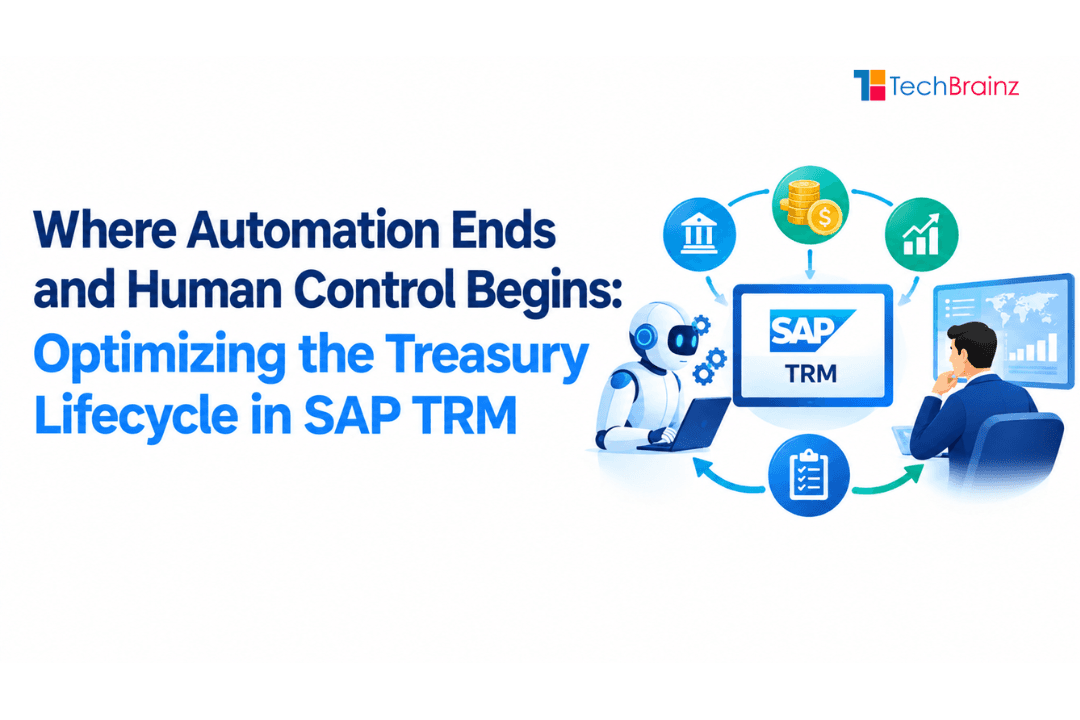
Where Automation Ends and Human Control Begins: Optimizing the Treasury Lifecycle in SAP TRM
Automation has transformed how treasury functions operate. With tools like SAP Treasury and Risk Management (SAP TRM), organizations can process thousands of transactions, manage risks, and generate insights in real time. But here's the critical question:
Can automation fully replace human decision-making in treasury?
The answer isn't as straightforward as many believe.
While automation enhances efficiency and accuracy, treasury is not just about processing transactions—it's about interpreting risks, making strategic decisions, and ensuring compliance. This is where human control becomes indispensable.
This article explores the balance between automation and human intelligence in SAP TRM, helping you understand where automation ends—and where human judgment must take over.
Definition Box
Automation in SAP TRM: The use of system-driven processes to execute treasury operations such as deal processing, cash flow tracking, risk calculations, and reporting without manual intervention.
Human Control in Treasury: The application of human judgment, validation, and decision-making to oversee automated processes, especially in areas involving risk, compliance, and strategic financial planning.
Context Setting
Modern treasury departments are under constant pressure to:
- Reduce operational costs
- Improve accuracy
- Respond quickly to market changes
SAP TRM addresses these challenges by automating core treasury activities such as:
- Transaction processing
- Cash management
- Risk analytics
- Financial reporting
However, automation operates based on predefined logic. It lacks the ability to:
- Understand context
- Interpret ambiguity
- Respond to unexpected scenarios
This creates a crucial gap—one that only human expertise can fill.
The Mainstream View
The dominant belief in the industry is clear:
👉 "More automation equals better efficiency and fewer errors."
And to an extent, this is true. Automation:
- Eliminates repetitive manual tasks
- Reduces human errors
- Speeds up operations
But this view often ignores a key reality:
👉 Automation executes—but humans decide.
Treasury is not just operational; it is strategic. Blind reliance on automation can introduce risks that are difficult to detect until it's too late.
Supporting Evidence Point 1: Automation Excels in Repetitive Processes
Automation performs exceptionally well in:
- High-volume transactions
- Standardized workflows
- Routine reporting
In SAP TRM, processes like:
- Interest calculations
- Payment scheduling
- Data consolidation
are handled efficiently with minimal errors.
Result: ✔ Faster processing, ✔ Lower operational costs, ✔ Improved consistency
However, these benefits apply only when processes are predictable and rule-based.
Supporting Evidence Point 2: Automation Lacks Contextual Intelligence
Automation works on predefined rules. It cannot:
- Interpret market sentiment
- Understand unusual financial patterns
- Adjust to sudden economic shifts
For example:
- A sudden currency fluctuation may require strategic intervention
- A large transaction may need contextual validation
- A risk alert may require deeper investigation
Without human oversight, automation may: ❌ Process incorrect assumptions, ❌ Miss hidden risks, ❌ Escalate financial exposure
Supporting Evidence Point 3: Compliance Requires Human Oversight
Regulatory compliance is one of the most critical aspects of treasury management.
Automation can:
- Track transactions
- Generate audit logs
- Flag anomalies
But it cannot:
- Interpret regulatory nuances
- Ensure ethical decision-making
- Take accountability
Human involvement ensures: ✔ Governance, ✔ Accountability, ✔ Audit readiness
The Critical Balance: Designing a Hybrid Treasury Model
The most effective treasury systems today are not fully automated—they are intelligently hybrid.
This means:
- Automation handles execution
- Humans handle validation and decision-making
A hybrid model ensures:
- Speed without compromising accuracy
- Efficiency without losing control
- Scalability without increasing risk
Organizations that adopt this approach gain a significant competitive advantage.
Counter Arguments Addressed
"Automation is more accurate than humans"
Yes, in repetitive tasks. But accuracy depends on correct inputs and logic. If the system is configured incorrectly, automation will: 👉 Repeat mistakes at scale
"AI will replace human decision-making"
AI can assist—but not replace. Treasury decisions involve: strategic judgment, risk appetite, business context. These elements cannot be fully automated.
"Human intervention slows down processes"
Unnecessary intervention does. But strategic control points improve outcomes. Smart treasury teams: automate operations, intervene only when needed.
Real Examples Supporting This View

Example 1: Incorrect Risk Assessment
An automated system calculates risk exposure based on historical data. However, it fails to account for a sudden geopolitical event.
Outcome: 👉 Underestimated risk
Human intervention: ✔ Adjusts assumptions, ✔ Prevents financial loss
Example 2: Duplicate Transaction Processing
Automation processes two similar transactions without identifying duplication.
Outcome: 👉 Financial discrepancy
Human control: ✔ Detects anomaly, ✔ Corrects error
Example 3: Compliance Failure
Automated workflows process transactions without manual approval checks or context validation.
Outcome: 👉 Regulatory violation
Human control ensures: ✔ Governance, ✔ Audit compliance
Implications if Your View is Correct
If we accept that automation must be balanced with human control:
1. Treasury Roles Will Evolve — Less manual work, more strategic responsibilities
2. Skills Will Shift — Professionals must focus on data interpretation, risk analysis, decision-making
3. System Design Will Change — Organizations will adopt hybrid workflows, exception-based approvals, intelligent alert systems
👉 The future treasury professional is a strategic thinker, not just a system user.
What Readers Should Do Differently
To optimize your SAP TRM treasury lifecycle:
1. Automate the Right Processes
Focus on: repetitive tasks, high-volume activities, standard workflows
2. Define Control Points
Introduce human checks in: high-value transactions, risk analysis stages, exception scenarios
3. Build Hybrid Workflows
Combine: ✔ Automation for execution, ✔ Human control for validation
4. Invest in Skill Development
To truly master this balance, professionals must go beyond system usage and understand how treasury processes, analytics, and decision-making work together in real-world scenarios. That's where structured learning like SAP TRM Training becomes critical—not just for system knowledge, but for developing the judgment required to control automated environments effectively.
5. Use Analytics as a Guide—Not a Decision Maker
Let SAP TRM: provide insights, highlight risks. But let humans: make final decisions, take responsibility.
Advanced Insight: The Risk of Over-Automation in Treasury
One often overlooked challenge in modern treasury systems is over-automation. While organizations aim to maximize efficiency, excessive reliance on automation can create hidden vulnerabilities. Systems configured to handle every scenario may fail when encountering exceptions that fall outside predefined logic. This leads to blind spots in risk detection and delayed responses to critical financial events.
Over-automation can also reduce human engagement, making treasury teams overly dependent on system outputs without questioning underlying assumptions. Over time, this weakens analytical thinking and reduces the ability to respond proactively during financial disruptions.
A balanced approach ensures that automation supports—not replaces—human expertise. Treasury teams must remain actively involved in reviewing outputs, questioning anomalies, and validating system-driven decisions. By maintaining this equilibrium, organizations can leverage automation's speed while preserving the strategic intelligence that only humans bring to treasury management.
Continuous Monitoring Enhances Control — Even with strong automation in place, continuous monitoring is essential to maintain accuracy and reliability in treasury operations. Real-time tracking of transactions, risk exposure, and system outputs ensures that anomalies are quickly identified and addressed. This proactive approach strengthens control mechanisms and supports better, faster financial decision-making.
Conclusion
Automation in SAP TRM is powerful—but incomplete without human intelligence.
The goal is not to: ❌ Replace humans, ✔ Empower them
The most successful treasury functions:
- Automate efficiently
- Control intelligently
- Decide strategically
👉 Because in treasury, speed without judgment is risk.
FAQs
1. What is the role of automation in SAP TRM?
Automation in SAP TRM streamlines treasury operations such as transaction processing, risk calculations, and reporting, improving efficiency and reducing manual errors.
2. Why is human control still important in treasury management?
Human control is essential for decision-making, risk assessment, and compliance, as automation cannot interpret context or handle complex financial scenarios.
3. Can SAP TRM function without human intervention?
While SAP TRM can automate many processes, complete independence is risky. Human oversight is necessary for validation, strategic decisions, and exception handling.
4. What are hybrid workflows in treasury?
Hybrid workflows combine automation for execution with human intervention for validation and decision-making, ensuring both efficiency and control.
5. How does automation impact treasury roles?
Automation reduces manual work, allowing treasury professionals to focus on strategic tasks like risk management, forecasting, and financial planning.
6. What risks are associated with over-automation?
Over-automation can lead to missed anomalies, reduced human oversight, and increased vulnerability to unexpected financial or market changes.
Invite Debate
What do you think?
👉 Should treasury aim for full automation? 👉 Or will human control always remain essential?
Have you experienced situations where automation failed—or where human intervention made the difference? Let's discuss.
Call to Action
If you want to become a treasury professional who doesn't just use SAP TRM—but truly understands where to trust automation and where to take control:
👉 Start building real-world expertise today and position yourself ahead in the evolving treasury landscape.
About the Author
TechBrainz Consulting
TechBrainz is a leading SAP training and consulting provider with deep expertise in Treasury and Risk Management. Our team of certified consultants helps professionals and organizations master SAP TRM through practical, project-based learning.
© 2025 TechBrainz. All rights reserved. | www.techbrainz.in