
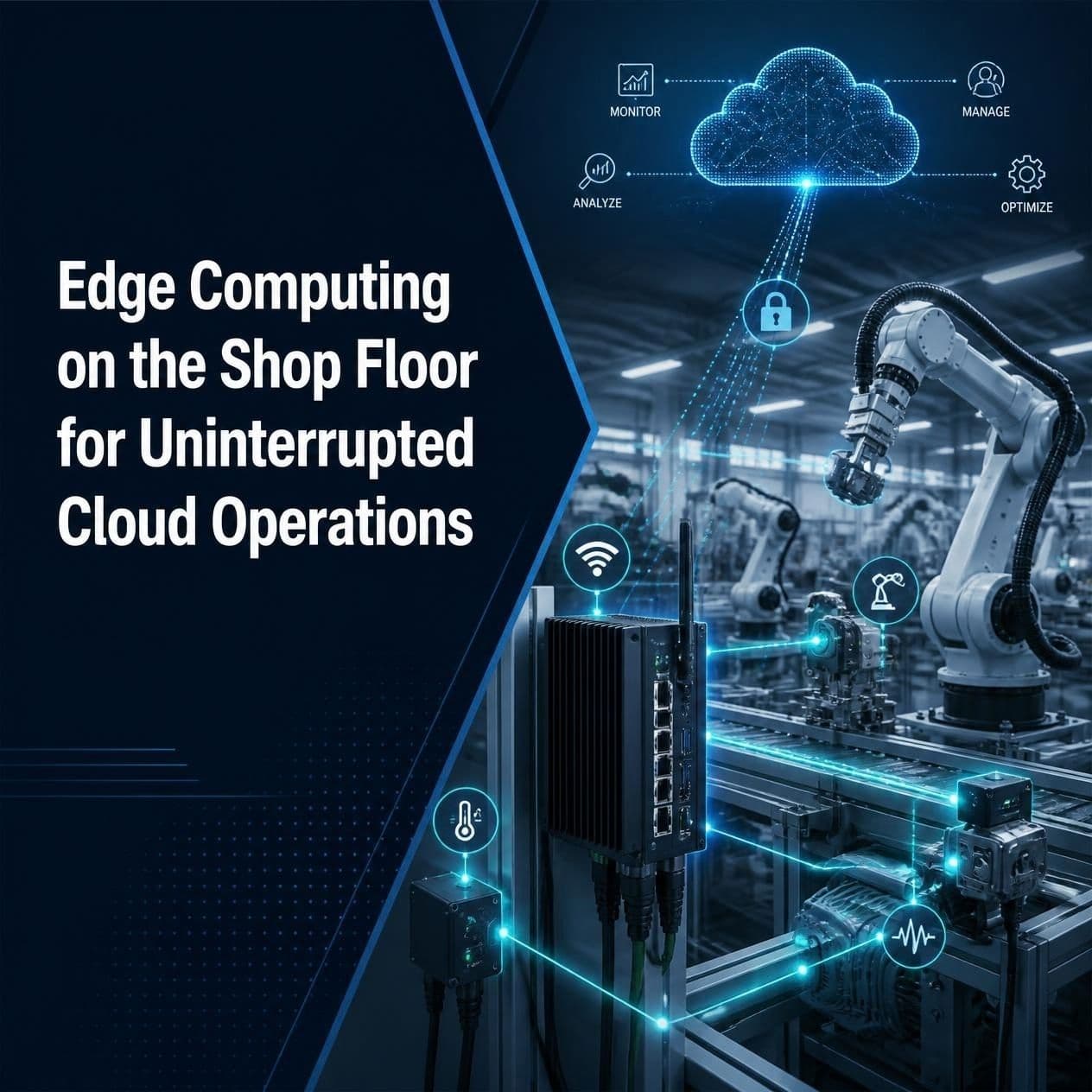
Edge Computing on the Shop Floor for Uninterrupted Cloud Operations
Walk onto almost any modern factory floor and you will find machines talking to each other constantly: sensors on a stamping press, vibration monitors on a compressor, cameras checking weld quality frame by frame. For years, all of that data flowed straight to the cloud for processing. That worked fine until the day the plant's internet connection dropped for eleven minutes and a paint line kept running without its quality checks, coating parts that should have been pulled for rework. Nobody noticed until a supervisor walked the line an hour later and found a rack of defective panels.
That kind of gap is exactly what edge computing is built to close. Instead of sending every reading to a data center hundreds of miles away and waiting for a response, edge computing places processing power right on the shop floor – inside a control cabinet, on a gateway sitting next to the PLC, or sometimes built into the machine itself. When the cloud connection is solid, the edge device and the cloud work as a pair. When the connection drops, the edge keeps the line running on its own
and catches the cloud up once the network is back.
This article looks at why that setup matters for plants running cloud-based manufacturing execution and quality systems, what a workable edge deployment actually involves, and how it fits alongside platforms such as SAP Digital Manufacturing Cloud. Along the way, it covers what Edge Computing in Manufacturing looks like in practice, not just in theory.
What Edge Computing on the Shop Floor Actually Means
Edge computing, in a factory context, is simply moving some of the thinking closer to the equipment that generates the data. Rather than treating every PLC tag, sensor reading, or camera frame as something that must travel to a remote server before anything useful happens with it, an edge node – a small industrial PC, a ruggedized gateway, or a programmable edge controller – does the first pass of work right there on site.
That first pass can include filtering out noise, converting raw signals into engineering units, running a quality check against a tolerance band, triggering an alarm, or holding a machine at a safe state until a condition clears. Only the meaningful results, not the raw firehose of data, get forwarded to the cloud. Think of it as a local decision-maker that never sleeps and never waits on a network handshake.
This is different from traditional plant historians, which mostly just store data. An edge node is active. It can reject a part, stop a conveyor, or hold a batch record open until an operator confirms a step, all without checking in with anything outside the four walls of the plant.
Why Cloud-Only Manufacturing Systems Struggle
Cloud platforms are genuinely good at the things they were designed for: cross-plant reporting, long-term trend analysis, machine learning models trained on months of history, and giving a plant manager in Ohio the same dashboard as one in Chennai. The trouble starts when a plant treats the cloud as the only brain in the operation.
- Latency adds up. A round trip to a cloud region and back rarely finishes in under 100 milliseconds once you include network hops, load balancers, and application processing. For a press that cycles every 400 milliseconds, that delay is too slow to catch a defect before the next part is already formed.
- Networks fail more often than people expect. Rural plants, older buildings with thick concrete walls, and facilities sharing bandwidth with office IT all see outages – sometimes daily blips, sometimes hours-long drops during storms or carrier maintenance.
- Bandwidth costs climb fast. A single vision inspection station can generate several gigabytes an hour. Multiply that across forty stations and the data transfer bill becomes a real budget line, not a rounding error.
- Safety and compliance rules often require a local decision. Many industries need proof that a hold, an interlock, or a rejection happened at the machine, in real time, regardless of what the network was doing at that moment.
None of this means the cloud is the wrong choice for manufacturing IT. It means the cloud works best as the second layer of a two-layer system, not the only layer.
How Edge Computing Keeps Cloud Operations Uninterrupted
The phrase 'uninterrupted cloud operations' sounds like a contradiction once you know networks fail. What it actually means, in practice, is that the plant's core processes never stop just because the cloud connection did. A well-designed edge layer takes over three jobs during any gap in connectivity.
1. Local execution continues
Production, quality checks, and material tracking keep running on the edge node using the same rules that were synced down from the cloud during the last good connection. Operators see no difference on the screen except perhaps a small status icon showing the system is in offline mode.
2. Data is queued, not lost
Every transaction – a completed operation, a scrapped part, a machine parameter reading – is written to a local buffer with a timestamp. Nothing is thrown away because the network is down. This buffering is really the heart of the whole approach; it is what turns a network outage from a data-loss event into a minor delay.
3. Reconciliation happens automatically
Once connectivity returns, the edge node pushes the queued records up to the cloud in the correct order, and the cloud platform reconciles timestamps so reports and dashboards look exactly as if the outage never happened. Good edge platforms also flag any records that need manual review, such as a batch that closed while offline and needs a supervisor's sign-off.
This three-part pattern is what shop floor connectivity is really about. It is not about eliminating the cloud – it is about making sure the plant does not depend on a network cable for its ability to make and check parts.
Cloud-Only vs. Edge + Cloud: A Side-by-Side Look
The table below summarizes the practical differences plant teams tend to notice once they move from a cloud-only architecture to a combined edge and cloud model.
| Factor | Cloud-Only Setup | Edge + Cloud Setup |
|---|---|---|
| Response time for a machine event | 200 ms – 2 seconds, depending on network hops | Under 10 ms, handled locally |
| Behavior during an internet outage | Data collection pauses or is lost | Line keeps running; data is queued and synced later |
| Bandwidth usage | Every raw data point leaves the plant | Only summarized or exception data leaves the plant |
| Where quality decisions are made | Centralized, after a round trip to the cloud | At the machine, with cloud used for trends and reporting |
| Typical hardware cost | Lower on-site cost, higher recurring data cost | Higher upfront cost, lower recurring cost |
| Best suited for | Reporting, long-term analytics, cross-plant dashboards | Real-time control, safety interlocks, quality gating |
Edge Computing and SAP Digital Manufacturing Cloud
SAP Digital Manufacturing Cloud is one of the more widely adopted cloud MES platforms in discrete and process manufacturing, and it is a good example of how a modern cloud system is meant to pair with an edge layer rather than replace it. SAP Digital Manufacturing Cloud handles the things a cloud platform does well – order management, standardized work instructions, cross-site KPIs, and integration with ERP and quality systems – while relying on edge services for the moment-to-moment work on the
floor.
SAP's own edge offering, distributed as part of the Digital Manufacturing Cloud stack, runs locally on the plant network and keeps a synchronized copy of routings, specifications, and master data. If the connection to the SAP cloud tenant drops, the edge service keeps executing production orders, capturing genealogy data, and enforcing quality holds using the last known good configuration. Once the tenant is reachable again, the edge service pushes the accumulated transactions back up and the cloud instance catches up automatically.
Plants that implement this combination usually see two practical benefits. First, shift supervisors stop treating a network hiccup as an emergency, because production simply continues. Second, IT teams get a cleaner story to tell auditors and customers about data integrity, since every transaction is timestamped and reconciled rather than silently dropped.
Real-World Cases
Case 1: An Automotive Stamping Plant in the American Midwest
A Tier 1 automotive supplier running six stamping lines had been sending press cycle data straight to a cloud analytics service for predictive maintenance. During a regional fiber cut that lasted just under four hours, the plant lost visibility into die wear trends for that window. More importantly, an operator had no local alert when a die showed early signs of galling, because the alert logic lived entirely in the cloud. The result was a short but costly unplanned changeover two shifts later.
After the incident, the plant deployed edge gateways at each press that ran the same anomaly-detection thresholds locally, syncing new thresholds down from the cloud whenever connectivity allowed. In the eight months since, two further network outages occurred, and in both cases the local alerts still fired, catching one early-stage die issue before it caused scrap.
Case 2: A Pharmaceutical Packaging Line in Southern India
A contract packaging facility running SAP Digital Manufacturing Cloud for batch execution needed to prove, for regulatory purposes, that electronic batch records were never interrupted, even during the monsoon season when local ISPs routinely lost service for stretches of thirty minutes or more. The plant's compliance team was initially worried that any gap in connectivity would invalidate a batch record.
By deploying the SAP edge service on-site, the line continued capturing every step – weighing, sealing, labeling, and inspection results – locally during outages, with each record time-stamped and later synchronized to the cloud tenant. Internal audits since the rollout have shown zero gaps in batch genealogy, and the compliance team now references the edge architecture directly in their standard operating procedure for network resilience.
Building a Practical Edge Strategy
Plants that get real value from edge computing tend to follow a similar sequence, rather than trying to edge-enable everything at once.
- Start with the processes that cannot tolerate a delay – safety interlocks, quality gating, and anything tied to a regulatory hold.
- Pick hardware rated for the actual plant environment: temperature swings, vibration, dust, and electrical noise all matter more on a shop floor than in a server room.
- Keep the edge logic simple and auditable. An edge node that is hard to troubleshoot at 2 a.m. defeats the purpose.
- Plan the reconciliation process before deployment, not after the first outage. Decide who reviews flagged records and how disputes over timestamps get resolved.
- Involve the people who will actually maintain the equipment – maintenance technicians and controls engineers usually understand the failure modes better than a central IT team does.
It also helps to treat the rollout as a phased program. A single pilot line, run for a full quarter including at least one real network disruption, tells a plant far more than a spreadsheet estimate ever will.
Common Challenges and How Plants Work Around Them
Edge computing is not a plug-and-play fix, and it is worth being honest about the friction points.
- Keeping master data in sync across dozens of edge nodes can drift over time if version control is not enforced centrally.
- Local hardware still needs patching, backups, and physical security, which adds work for plant IT teams that may already be stretched thin.
- Not every legacy machine has a clean way to expose its data, so some plants still need protocol converters or retrofit sensors before an edge node can do anything useful.
- Budgeting for edge hardware often competes with other capital projects, so a clear cost-of-downtime case tends to be the strongest argument for approval.
None of these are reasons to avoid edge computing. They are simply the ordinary cost of building anything that has to work reliably in a real factory, not a lab.
Where This Is Headed
The next few years will likely bring smaller, cheaper edge hardware with more built-in AI inference, meaning more of the quality and predictive maintenance work that used to require a cloud round trip will happen locally by default. Cloud platforms, including SAP Digital Manufacturing Cloud, are already shifting toward this pattern – shipping more capability to the edge and reserving the cloud tier for the things that genuinely benefit from centralization, like fleet-wide benchmarking
and long-range forecasting.
For plant teams, the practical takeaway is straightforward: treat the network as something that will occasionally fail, design the shop floor so that failure does not stop production, and let the cloud do what it is genuinely good at once the connection is back.
Frequently Asked Questions
1. What is the simplest way to explain edge computing to someone on the shop floor?
It is a small computer near the machine that makes quick decisions on its own, instead of asking a distant server for permission every time something happens.
2. Does adding edge computing mean a plant no longer needs the cloud?
No. The cloud is still where reporting, cross-plant comparisons, and long-term analytics happen. Edge computing simply keeps day-to-day production running when the connection to that cloud is temporarily unavailable.
3. How much does an edge deployment typically cost for a mid-sized plant?
Costs vary widely depending on the number of lines and the ruggedness of the hardware required, but most mid-sized plants budget for edge gateways per critical line rather than per machine, which keeps the initial investment manageable.
4. Can edge computing work with an existing SAP Digital Manufacturing Cloud implementation?
Yes. SAP Digital Manufacturing Cloud is designed to pair with a local edge service that keeps production and quality data flowing during network interruptions, then synchronizes everything once connectivity returns.
5. What happens to data collected while the plant is offline?
It is stored locally with a timestamp and automatically pushed to the cloud once the connection comes back, so nothing is lost and the timeline stays accurate.
6. Is edge computing only useful for large factories?
Not at all. Smaller plants often feel network outages more sharply because they usually have a single internet connection with no backup, which makes local resilience just as valuable, if not more so.
7. How does edge computing affect audit readiness in regulated industries?
It generally improves it, since every transaction is captured and timestamped locally regardless of network status, giving auditors a continuous record instead of gaps during outages.
8. What skills does a plant team need to manage edge devices?
A working knowledge of industrial networking, basic Linux or embedded operating systems, and the specific MES or quality platform in use is usually enough to maintain a modest edge deployment, with vendor support covering the rest.
Conclusion
Edge computing on the shop floor is not about replacing the cloud – it is about making sure production never has to wait on a network cable to do its job. Plants that pair a solid edge layer with a cloud platform like SAP Digital Manufacturing Cloud end up with the best of both: fast, local decision-making where it matters most, and centralized visibility where it counts. For teams looking to build this capability properly, structured SAP DMC Training is one of the most practical
starting points, giving plant IT and controls staff the hands-on skills needed to configure, deploy, and maintain an edge architecture that keeps operations running no matter what the network is doing that day.