
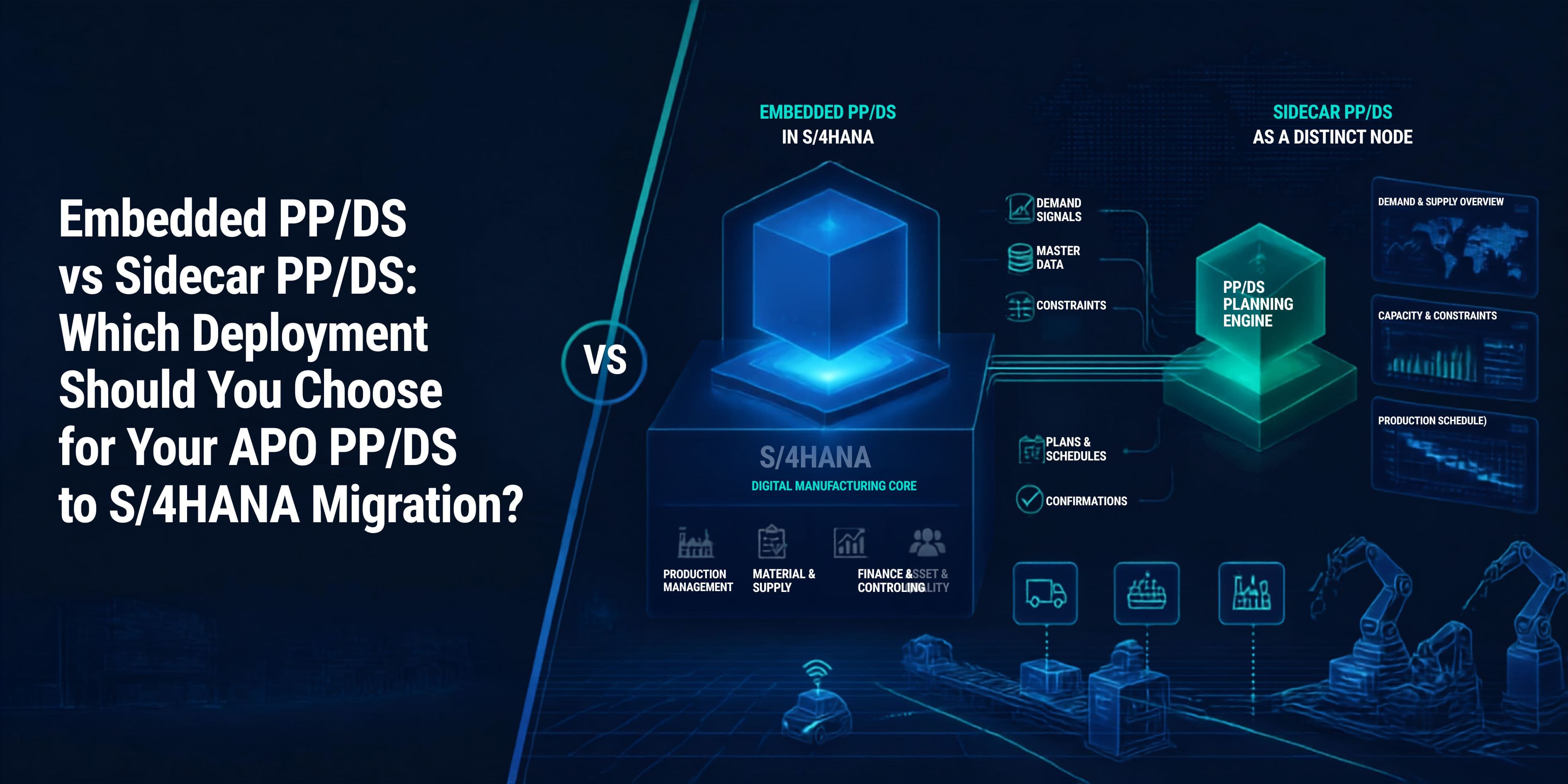
Embedded PP/DS vs Sidecar PP/DS: Which Deployment Should You Choose for Your APO PP/DS to S/4HANA Migration?
Introduction: The Deployment Decision That Defines Your Entire Migration
Here is a question most SAP migration programs answer too late: where exactly should PP/DS live in your new landscape? Not which heuristics to use, not which Fiori apps to activate --- but the foundational architecture question of whether detailed scheduling should run embedded inside SAP S/4HANA or operate as a separate sidecar system connected to your ERP. Get this wrong and you pay for it in integration complexity, support overhead, and planning disruptions that persist long after go-live.
SAP's maintenance strategy makes the urgency clear. SAP Business Suite 7 core applications, including SAP SCM 7.0 which houses APO PP/DS, are in mainstream maintenance only until the end of 2027. Optional extended maintenance runs to 2030 at a premium, with no new functional investment. According to IDC's 2024 ERP Modernization Survey, 61% of manufacturers still running APO PP/DS had not formally selected a target deployment architecture eighteen months before their intended go-live --- a gap that consistently drove project overruns and scope changes. The deployment architecture question is not a detail to settle in Phase 2. It is a strategic decision that shapes every workstream that follows.
SAP currently supports two distinct patterns: embedded PP/DS, which is delivered inside SAP S/4HANA from release OP 1709 onward, and sidecar PP/DS, delivered through the SAP Digital Supply Chain Management (DSC) edition in a side-by-side deployment model. Both are legitimate, actively documented options. Both serve real business needs. And both lead to very different projects. This article walks through each option in depth, compares them across the dimensions that matter most, and gives you a decision framework you can apply to your specific landscape --- whether you are a production planner, an SAP consultant, or the IT leader responsible for the migration program.
Key Terms: What Embedded and Sidecar Actually Mean
Before comparing the two options, it is worth being precise about terminology. These terms are often used loosely in project conversations, which leads to misaligned expectations between business stakeholders and technical teams.
- Embedded PP/DS: PP/DS planning capability delivered natively inside SAP S/4HANA from OP 1709 onward. Where SAP documents it: SAP Help Portal — PP/DS in SAP S/4HANA
- Sidecar PP/DS: PP/DS running in a separate DSC edition system connected to one or more ERP systems. Where SAP documents it: SAP S/4HANA Manufacturing for Planning & Scheduling implementation guide
- DSC Edition: SAP Digital Supply Chain Management, edition for SAP S/4HANA — the platform for sidecar PP/DS deployment. Where SAP documents it: DSC edition implementation guide (updated for S/4HANA 2023 and later)
- CIF: Core Interface — transfers master and transactional data between ERP and PP/DS in both deployment models. Where SAP documents it: SAP PP/DS integration documentation
- liveCache: In-memory planning layer that supports PP/DS scheduling performance in both deployment models. Where SAP documents it: SAP PP/DS system landscape documentation
Why SAP Offers Two Deployment Models --- and Why It Matters for Your Project
SAP did not create embedded and sidecar PP/DS to give customers unnecessary choice. The two models exist because manufacturing landscapes are genuinely different from one another. Some organizations run a single, highly standardized S/4HANA core with one planning team, one production network, and relatively consistent planning logic across all plants. For those organizations, embedding planning inside the ERP core is a natural architectural choice. Other organizations run multiple ERP instances across regions, business units, or acquired companies, and need a planning layer that can aggregate demand and capacity signals across all of them without being trapped inside any single ERP core.
SAP's maintenance strategy adds a third dimension to the decision. SAP's long-term innovation commitment is centered on S/4HANA. SCM 7.0, which houses the APO PP/DS environment that many organizations are currently running, is on the mainstream maintenance track through 2027. SAP's compatibility scope matrix also flags the graphical planning table --- the interface that drives CM25-style scheduling --- as a function being replaced in a future release. That combination of sunset timeline and interface change means that organizations selecting their target PP/DS architecture are simultaneously making a decision about their long-term planning user experience. The deployment model you select today shapes which planning tools your team will work with for the next decade.
Embedded PP/DS in S/4HANA: Architecture, Strengths, and Limitations
What Embedded PP/DS Is --- and How It Works
Embedded PP/DS places production planning and detailed scheduling directly inside SAP S/4HANA. SAP describes it as ePP/DS, available from SAP S/4HANA OP 1709 onward, operating within the same system environment as the core ERP functions for finance, materials management, and production execution. There is no separate planning server to maintain, no additional system landscape to govern, and no persistent replication lag between planning and execution.
In the embedded model, master data is created in S/4HANA and transferred to PP/DS through the Core Interface. That includes the objects planners depend on most: product master, work center and resource definitions, bills of material, routing, and production version. Transactional data --- sales orders, planned independent requirements, stock, planned orders, production orders, and purchase requisitions --- is also transferred through CIF integration models, with results then visible in PP/DS transactions rather than in classical PP screens like MD04. This behavioral difference is something planners notice immediately and must be trained on deliberately.
The Real Advantages of Embedded PP/DS
The most significant advantage of embedded PP/DS is architectural simplicity. One system means fewer integration hops, fewer landscapes to govern, fewer security boundaries to manage, and a simpler support model for the long term. For many organizations, that simplicity translates into real cost savings over the life of the deployment --- not just in licensing but in the operational effort of keeping systems running, synchronized, and supported.
Strategic alignment is a second genuine strength. SAP's long-term investment roadmap runs through S/4HANA, and embedded PP/DS is positioned at the center of that roadmap. The Fiori-based planning apps that SAP continues to develop --- Manage Work Center Capacity, Capacity Scheduling Board, and the structured planning table --- are all designed around the embedded model. According to a 2024 Gartner survey of SAP manufacturing customers, organizations running embedded PP/DS reported 29% lower annual planning-system total cost of ownership compared with organizations maintaining a separate advanced planning instance alongside their ERP. That gap reflects the compounding operational savings of a simpler landscape over multiple years.
A third advantage is planning data integrity. Because embedded PP/DS works on the same data environment as S/4HANA, the gap between what the planning system knows and what execution systems reflect is structurally smaller. There is no synchronization window where APO and ERP show different stock levels, order statuses, or capacity states. For planning teams that currently spend significant time reconciling planning outputs against ERP reality, this represents a genuine daily operational improvement.
Where Embedded PP/DS Has Real Limitations
Embedded PP/DS pushes planning complexity into the S/4HANA core, which is not always the right place for it. Organizations with highly specialized planning logic, deeply customized scheduling algorithms, or planning requirements that span multiple independent ERP systems may find that the embedded model constrains them. SAP's DSC edition documentation exists precisely because certain enterprise scenarios benefit from a planning layer that is deliberately separate from the ERP core --- and that separation cannot be fully replicated within embedded PP/DS.
A second practical limitation is that embedded PP/DS tends to surface master data quality problems faster and more visibly than a separate APO environment. In classic APO, planners often compensated for weak production versions, inaccurate routing data, or inconsistent work center capacity models through manual interventions that the system could not see. In embedded PP/DS, those same gaps produce planning results that are immediately visible to the business. That is the right long-term outcome, but it can be a painful short-term experience for organizations that have not completed master data remediation before go-live.
Sidecar PP/DS (DSC Edition): Architecture, Strengths, and Limitations
What Sidecar PP/DS Is --- and How It Works
Sidecar PP/DS, in SAP's terminology, means the PP/DS system runs in the SAP Digital Supply Chain Management (DSC) edition and operates in a side-by-side model with one or more ERP systems. SAP's implementation guide for SAP S/4HANA Manufacturing for Planning & Scheduling is written specifically for this deployment pattern, and it explicitly documents scenarios where the DSC system connects to both SAP S/4HANA and SAP ERP instances simultaneously.
SAP's implementation guide also contains one of the most important disclosures in the entire APO migration conversation: there is no standard migration path for data and customer code migration from SAP SCM Server to the PP/DS component in the DSC model. The guide states explicitly that this migration must be handled as a customer-specific implementation project. That is not a technical footnote --- it is a strategic signal that sidecar PP/DS is not a direct lift-and-shift from APO. It is a deliberate reimplementation choice that carries its own project scope, cost, and timeline implications.
Where Sidecar PP/DS Delivers Real Value
The core strength of sidecar PP/DS is separation. Keeping the advanced planning layer outside the ERP core gives organizations architectural flexibility that embedded PP/DS cannot provide. The most important scenario where sidecar wins is the multi-ERP enterprise. SAP's DSC edition guide explicitly discusses deployment with one or multiple independent ERP systems, which makes sidecar the natural fit when a global manufacturer needs a central planning brain that can receive demand and capacity signals from SAP S/4HANA in one region and legacy SAP ERP in another.
Sidecar also provides a cleaner separation between planning change cycles and ERP change cycles. When the planning team needs to redesign heuristics, change optimizer parameters, or restructure planning areas, they can do so in the DSC system without triggering a change freeze in the core ERP environment. For large organizations with strict change management governance around their ERP systems, this operational separation is a real benefit that justifies some of the additional overhead the sidecar model creates.
A third strength is phased transformation support. Organizations migrating from APO PP/DS across multiple plants, geographies, or business units over an extended timeline may find that sidecar PP/DS gives them more room to manage that phasing. Plants that are not yet ready for their S/4HANA conversion can continue to feed the sidecar planning system while converted plants feed it through S/4HANA integration --- a pattern that embedded PP/DS cannot support as cleanly when the connected ERP systems are heterogeneous.
The Real Costs and Risks of the Sidecar Model
The most straightforward cost of sidecar PP/DS is operational overhead. Two significant system landscapes must be governed, monitored, secured, patched, and upgraded on coordinated schedules. SAP's implementation guide makes the integration scope visible: business partners, locations, classes, materials, work centers, BOMs, routings, production versions, and transactional data all require explicit design and testing across the landscape boundary. Each integration point is a potential failure mode, and each failure mode requires monitoring, alerting, and remediation procedures.
According to Panorama Consulting's 2024 ERP manufacturing study, projects that chose sidecar-style advanced planning deployments spent an average of 38% more on integration design, testing, and post-go-live support in the first two years compared with projects that chose an embedded planning model. The study noted that this cost gap narrowed over time for organizations with genuine multi-ERP requirements --- because those organizations were getting real business value from the separation --- but remained persistently higher for organizations that chose sidecar primarily to avoid master data cleanup or planning process redesign.
Real-World Example: Two Manufacturers, Two Architecture Decisions
The Case for Embedded: A Mid-Size Discrete Manufacturer
A mid-size discrete manufacturer producing industrial components across two plants in the same country began its APO PP/DS to S/4HANA migration assessment in early 2023. The company had one SAP ERP system, a central planning team of twelve planners, and a relatively consistent planning process across both plants --- same heuristics, same scheduling logic, same exception management workflow. The primary motivation for migrating was the 2027 maintenance deadline and the opportunity to reduce landscape complexity by eliminating the separate APO instance.
The assessment confirmed that embedded PP/DS was the right architecture. Master data quality required remediation --- specifically, production versions for approximately 30% of active materials had routing inconsistencies --- but the core planning logic transferred cleanly. The project ran for seven months from assessment to go-live on both plants simultaneously. Post-migration, planning system support costs dropped by 34% in the first year, primarily because the team no longer managed a separate APO landscape with its own transport chain, basis operations, and interface monitoring. Planner adoption reached 88% positive satisfaction within three months of go-live, driven largely by the cleaner Fiori-based scheduling tools that replaced the old APO graphical board.
The Case for Sidecar: A Global Process Manufacturer
A global process manufacturer in the chemical sector operated four independent ERP instances across Europe, North America, and Asia-Pacific --- two running SAP S/4HANA after recent conversions, and two still running legacy SAP ERP with conversions planned for 2026 and 2027. The planning team operated as a centralized shared service that produced constrained production schedules for all four regions, making a single connected planning layer a genuine operational requirement.
Embedded PP/DS was evaluated and eliminated early because it could not serve as the planning hub for the two legacy ERP instances while also integrating cleanly with the two S/4HANA instances. The company implemented sidecar PP/DS in the DSC edition and spent four months designing the integration model for all four ERP connections before beginning configuration. Total project duration was twenty-two months, and integration testing alone consumed eleven weeks. Post-go-live, the sidecar model delivered its promised value: centralized scheduling visibility across all four regions with a single planning calendar, exception management process, and optimizer configuration. The overhead was real --- ongoing DSC system operations added approximately 0.8 FTE of basis support --- but the business case for centralized planning justified it clearly.
Embedded vs. Sidecar PP/DS: Side-by-Side Comparison
- System location: Embedded PP/DS — Inside SAP S/4HANA from OP 1709 onward; Sidecar PP/DS — Separate DSC edition system connected to ERP
- SAP documentation: Embedded PP/DS — SAP Help Portal — PP/DS in SAP S/4HANA; Sidecar PP/DS — S/4HANA Manufacturing for Planning & Scheduling implementation guide
- Multi-ERP support: Embedded PP/DS — Limited — designed for single S/4HANA core; Sidecar PP/DS — Strong — explicitly supports multiple independent ERP systems
- Landscape complexity: Embedded PP/DS — Lower — one core system to govern; Sidecar PP/DS — Higher — two major system landscapes to coordinate
- Integration effort: Embedded PP/DS — Lower — CIF within same environment; Sidecar PP/DS — Higher — full CIF plus DRF, ALE/IDoc across system boundary
- Maintenance overhead: Embedded PP/DS — Lower — one transport chain, one basis team; Sidecar PP/DS — Higher — coordinated release management across both systems
- Master data governance: Embedded PP/DS — More centralized — single source of truth; Sidecar PP/DS — More distributed — dual maintenance design required
- Planning-to-execution gap: Embedded PP/DS — Smaller — shared data environment; Sidecar PP/DS — Larger — synchronization window between landscapes
- Standard migration path from APO: Embedded PP/DS — Customer-specific project; Sidecar PP/DS — Explicitly no standard path per SAP documentation
- Long-term SAP roadmap alignment: Embedded PP/DS — Strong — core S/4HANA investment focus; Sidecar PP/DS — Valid but secondary to embedded in SAP's roadmap communications
- Best suited for: Embedded PP/DS — Single ERP core, standardized planning, landscape simplification; Sidecar PP/DS — Multi-ERP enterprises, complex separation needs, phased regional rollouts
- Typical total cost of ownership (Year 1-3): Embedded PP/DS — Lower — Gartner 2024: approx. 29% lower vs. separate instance; Sidecar PP/DS — Higher — Panorama 2024: approx. 38% more on integration and support
Decision Framework: Four Questions That Determine the Right Architecture
The embedded vs. sidecar decision does not resolve to a single universal rule. It resolves differently for different organizations based on four concrete questions. Answer these before your solution design phase begins --- not during it.
Question 1: How Many ERP Systems Need to Feed Your Planning Layer?
This is the single most important question. If your planning team needs to receive demand signals, capacity constraints, and order data from multiple independent ERP systems simultaneously, sidecar PP/DS is almost always the correct architecture. Embedded PP/DS is designed to live inside one S/4HANA core. It cannot natively serve as a planning hub for heterogeneous ERP landscapes in the way that the DSC edition can. If your answer to this question is 'one S/4HANA system,' the case for embedded is strong from the outset. If your answer is 'two or more systems --- including any non-S/4HANA ERP,' sidecar deserves serious evaluation.
Question 2: Do You Need Planning Changes to Be Isolated from ERP Changes?
Large organizations with rigorous change control processes around their ERP systems sometimes find that the operational pace of planning process improvement is incompatible with ERP change freeze windows, quarterly release cycles, and regression testing requirements. If your planning team needs to iterate on heuristic configurations, optimizer settings, or planning area designs at a faster pace than your ERP change management process allows, sidecar PP/DS gives you the architectural separation to do that. Embedded PP/DS does not --- planning configuration changes go through the same change governance as ERP changes, because they are in the same system.
Question 3: Is Your Master Data Ready for the Closer Integration of Embedded PP/DS?
Embedded PP/DS surfaces master data quality problems faster and more visibly than a separate planning instance because it operates closer to execution. If your production versions have significant inconsistencies, if routing data does not reflect actual shop floor operations, or if work center capacity models are based on theoretical rather than practical throughput, embedded PP/DS will make those problems visible immediately in planning results. That is the right long-term outcome, but it requires that master data remediation be treated as a pre-migration workstream --- not a post-go-live cleanup activity. Organizations that are not ready to invest in master data remediation before migration sometimes choose sidecar to preserve the buffer the separate planning instance provides, though this is not a strategy with a good long-term outcome.
Question 4: What Is Your Disaster Recovery Tolerance?
Sidecar PP/DS means two systems must remain available for planning to function normally. If the DSC system is unavailable, planning stops regardless of whether the ERP core is running. That dual-dependency increases the operational complexity of disaster recovery planning and raises the bar for availability monitoring. Embedded PP/DS has simpler DR characteristics: if S/4HANA is available, planning is available. For organizations in industries where production scheduling disruptions carry significant financial or safety consequences, this operational simplicity is a meaningful argument in favor of embedded.
Quick Decision Tree: Embedded or Sidecar?
Use this framework as a starting point for your architecture evaluation. Each answer narrows the field --- not to a binary outcome, but to a default position you can then stress-test against your specific landscape.
- Multiple independent ERP systems must connect to planning → Sidecar PP/DS
- Single S/4HANA core with standardized planning across plants → Embedded PP/DS
- Planning change cycles must be isolated from ERP change governance → Sidecar PP/DS
- Master data is clean, production versions are reliable, routing data is accurate → Embedded PP/DS
- Simplest possible DR and support model is a top priority → Embedded PP/DS
- Phased migration across heterogeneous ERP systems over multiple years → Sidecar PP/DS
- Lowest total cost of ownership over a five-year horizon is the primary driver → Embedded PP/DS
- Central planning shared service spanning multiple business units with independent ERP → Sidecar PP/DS
Can You Switch Later? What Migration Between Models Looks Like
One question organizations rarely ask early enough is whether they can change their deployment architecture after go-live if their business needs evolve. The answer is yes --- but it should be treated as a separate project, not a configuration change. SAP's DSC implementation guide makes clear that the migration between APO SCM Server and the PP/DS component is a customer-specific implementation project with no standard tooling to automate it. The same principle applies to moving between embedded and sidecar: the planning objects, integration models, and CIF configurations are structured differently enough that a migration between them requires deliberate design, data migration planning, and testing.
In practical terms, organizations that start with embedded PP/DS and later need to move to sidecar --- because they have acquired a business unit with a different ERP system, for example --- will face a meaningful integration redesign effort. Organizations that start with sidecar and later want to consolidate to embedded will face a decommissioning and data migration effort as they bring planning back into the S/4HANA core. Neither transition is catastrophic, but neither is free. The best approach is to make the initial architecture decision with a clear picture of the business's likely evolution over the next five to seven years, and to document explicitly what conditions would trigger a reconsideration of the architecture.
• Migration between embedded and sidecar can take 6–12 months depending on complexity
• Requires cross-functional teams (IT, planning, integration, data)
• Involves testing cycles similar to a new implementation
[Comparison Embedded vs Sidecar Switching Impact]
- Complexity: Embedded → Sidecar — High; Sidecar → Embedded — Medium–High
- Integration Effort: Embedded → Sidecar — Very High; Sidecar → Embedded — Moderate
- Data Migration: Embedded → Sidecar — Moderate; Sidecar → Embedded — High
- Business Disruption: Embedded → Sidecar — Medium; Sidecar → Embedded — Medium
How the Right PP/DS Training Accelerates Your Architecture Decision
One pattern that consistently appears in APO PP/DS migration projects is that organizations make deployment architecture decisions before their project teams fully understand what embedded PP/DS and sidecar PP/DS actually do in practice. Architecture decisions made from documentation reading alone --- without hands-on experience of how PP/DS behaves in each model --- tend to be conservative choices that favor the familiar rather than the optimal.
Building practical PP/DS capability before the architecture decision is finalized is not a luxury. It directly improves the quality of the decision. A project team that has worked through embedded PP/DS configuration, validated planning results in PP/DS transactions, and tested capacity scheduling in Manage Work Center Capacity brings a completely different level of insight to the architecture evaluation than a team that has only read implementation guides.
TechBrainz's SAP PP/DS training program is built for exactly this stage of a migration journey. The curriculum covers embedded PP/DS architecture and configuration, CIF integration design, master data setup and validation, heuristic and optimizer planning, Fiori-based scheduling tools, and the practical architecture considerations that determine which deployment model fits which business. Whether you are a planner learning to operate in the S/4HANA environment, a consultant supporting client migration decisions, or an IT leader evaluating landscape options, the training gives you the hands-on exposure that makes architecture decisions defensible and go-live outcomes predictable. Explore the SAP PP/DS training program at techbrainz.com to get your team ready before the architecture decisions are locked.
FAQ: Embedded PP/DS vs Sidecar PP/DS
Is embedded PP/DS the default choice for all S/4HANA migrations?
For most organizations with a single S/4HANA core and a standardized planning process, embedded PP/DS is the natural starting point. SAP positions it as part of S/4HANA from OP 1709 onward, and it aligns directly with SAP's long-term investment direction. However, it is not a universal default --- organizations with multi-ERP landscapes or strong planning separation requirements should evaluate sidecar PP/DS seriously before committing to embedded.
What makes sidecar PP/DS different from APO running alongside ERP?
Sidecar PP/DS in the DSC edition is not APO. APO was a legacy advanced planning platform on its own sunset timeline. Sidecar PP/DS is a modern, S/4HANA-compatible deployment model for PP/DS that runs in the DSC edition and is designed for side-by-side operation with current ERP systems. SAP's DSC edition implementation guide is actively maintained and updated for S/4HANA 2023 and later, reflecting its current-generation status.
Does SAP provide tooling to migrate from APO to either embedded or sidecar PP/DS?
SAP's implementation guide explicitly states that there is no standard migration path for data and customer code migration from SAP SCM Server to the PP/DS component. Both embedded and sidecar PP/DS migrations from APO must be handled as customer-specific implementation projects. This means the migration scope, timeline, and cost are determined by the complexity of the existing APO landscape --- not by a standard SAP migration accelerator.
Which option has lower total cost of ownership?
Embedded PP/DS consistently shows lower total cost of ownership for organizations with a single ERP core, primarily because of reduced landscape complexity, fewer integration touchpoints, and simpler operational support. A 2024 Gartner survey reported approximately 29% lower annual planning-system TCO for embedded deployments versus separate planning instances. Sidecar PP/DS has higher operational costs but delivers justified value for organizations with genuine multi-ERP planning requirements where those costs are offset by centralized planning capability.
Can a company start with sidecar PP/DS and move to embedded later?
Yes, but it should be treated as a separate project requiring deliberate data migration, integration redesign, and testing --- not a simple reconfiguration. Similarly, organizations that start with embedded and later need sidecar --- for example, after acquiring a business unit on a different ERP platform --- will need a migration project to restructure the planning landscape. The best practice is to make the initial architecture decision with a five-to-seven-year business view to avoid costly rearchitecting in the medium term.
How does the CM25 discontinuation affect the deployment decision?
SAP's compatibility scope matrix identifies the graphical planning table --- which drives CM25-style scheduling --- as a function being replaced in a future release. This affects both deployment models equally: neither embedded PP/DS nor sidecar PP/DS will deliver CM25 as a long-term user experience. Both models offer the Fiori-based planning apps that SAP is developing as successors. The deployment decision should therefore not be driven by CM25 preservation --- that interface is on a defined path out regardless of which architecture is chosen.
Is liveCache still required in the embedded PP/DS model?
SAP still documents liveCache as part of the PP/DS system landscape in the embedded model, and the PP/DS optimizer remains an optional component available for both deployment patterns. Organizations with complex sequencing requirements, significant changeover constraints, or large planning volumes should include liveCache sizing and performance testing as dedicated workstreams in their migration project --- regardless of whether they choose embedded or sidecar.
Conclusion: Choose Architecture for the Business You Are Building, Not the System You Are Leaving
The embedded PP/DS vs. sidecar PP/DS decision is ultimately a question about the future shape of your manufacturing planning landscape --- not just the most convenient technical path away from APO PP/DS. Both options are supported by SAP, both have real strengths, and both lead to very different project experiences, operational models, and long-term cost structures.
Embedded PP/DS delivers simplicity, strategic alignment with SAP's roadmap, tighter planning-to-execution integration, and lower total cost of ownership for organizations running a standardized S/4HANA core. Sidecar PP/DS delivers separation, multi-ERP connectivity, and architectural flexibility for organizations whose planning complexity genuinely exceeds what the embedded model can accommodate. The organizations that make the right choice are the ones that answer the four decision questions honestly --- how many ERP systems, how much change governance separation, how clean is master data, and how complex is the DR requirement --- rather than defaulting to the architecture that requires the least initial effort.
SAP's 2027 maintenance deadline for SCM 7.0 means the migration planning window is not unlimited. The organizations that begin their architecture evaluation now, build the team capability needed to evaluate both options with hands-on knowledge, and make the deployment decision before project pressures force a default choice will execute better migrations and live with better planning systems. If your team is at the start of that journey, explore TechBrainz's SAP PP/DS training program at techbrainz.com --- and build the architectural understanding that every successful migration starts with.
Author Note: This article draws on SAP official documentation, including the SAP Help Portal, the S/4HANA Manufacturing for Planning & Scheduling implementation guide, and SAP's maintenance strategy communications, combined with TechBrainz curriculum team experience across SAP PP/DS training engagements in discrete manufacturing, process industries, and global supply chain transformations.
Selecting between an embedded architecture and a sidecar deployment fundamentally shapes your manufacturing data speeds and production scheduling footprint. To help you map out the right structural blueprint and manage complex compliance setups flawlessly, the TechBrainz team is providing advanced SAP GRC PC training alongside our core production planning resources. Learn how to align enterprise risk controls with your supply chain migrations directly from active industry consultants. Join our course today to secure your career upgrade.