
Greenfield vs. Brownfield: Designing a Modern Bank Account Management (BAM) Workflow for S/4HANA TRM
The Decision That Quietly Shapes Your Entire Treasury Future If you're working in treasury, finance transformation, or SAP TRM implementation, one decision quietly shapes everything that follows: Do you go Greenfield or Brownfield for Bank Account Management (BAM)?
This is not just a technical choice. It directly impacts cost, speed, risk exposure, audit readiness, and how future-ready your treasury actually becomes.
By the end of this guide, you will clearly understand:
- What Greenfield and Brownfield really mean in BAM
- When each approach works (and fails)
- How to design a scalable BAM workflow in SAP TRM
- A practical decision framework you can actually use
There is a moment in every organization's digital transformation journey that does not look dramatic on the surface—but ends up defining everything that follows.
It is not the go-live.
It is not the tool selection.
It is not even the budget approval.
It is the moment when leadership must decide:
Do we rebuild... or do we carry forward?
In the context of Bank Account Management (BAM) in S/4HANA TRM, this moment appears as a simple choice between Greenfield and Brownfield implementation.
But beneath that simplicity lies a far more important reality.
This decision is not about systems.
It is about operating philosophy.
It determines whether your treasury function becomes:
- A modern, intelligent, real-time decision engine OR
- A digitally upgraded version of its past limitations
And what makes this decision dangerous is not its complexity—it is how easily it is underestimated.
Because many organizations don't fail at BAM implementation due to lack of capability.
They fail because they start with the wrong foundation.
Definition Box: What is BAM in SAP TRM?
Bank Account Management (BAM) in SAP TRM is the centralized process of managing bank accounts across their lifecycle—from creation and approval to usage, monitoring, and closure—while ensuring compliance, visibility, and control over liquidity and financial risk.
BAM in S/4HANA: Not a Module, But a Control Philosophy
To truly understand why Greenfield vs Brownfield matters, we need to shift how we view BAM itself.
BAM is often described as a tool for managing bank accounts.
That description is technically correct—but strategically incomplete.
In reality, BAM is a governance layer.
It defines how financial authority flows across the organization.
It determines who can create, modify, approve, and close bank accounts.
It establishes the control mechanisms that protect liquidity, ensure compliance, and reduce risk.
When implemented effectively in S/4HANA, BAM becomes something much more powerful:
- It becomes a single source of truth for all banking relationships.
- It becomes a real-time visibility engine.
- It becomes a compliance enforcer without friction.
And perhaps most importantly, it becomes predictable—which is something treasury teams value more than anything else.
But here is the uncomfortable truth:
If BAM is built on weak processes, messy data, or inherited inefficiencies, it does not fail loudly.
It fails silently.
Approvals get delayed.
Reports lose credibility.
Compliance gaps widen.
And over time, the system becomes something teams work around—not with.
That is why the implementation approach is not a technical detail—it is the foundation of trust in your treasury system.
This is exactly why professionals who undergo SAP TRM training develop a deeper understanding of how BAM acts as a control mechanism, helping them design systems that balance compliance, visibility, and operational efficiency.
Industry Insight: Why BAM Modernization Matters
- According to Gartner, organizations with centralized treasury and banking visibility improve cash visibility by up to 30%, enabling better liquidity decisions.
- A SAP Treasury study shows that structured BAM workflows can reduce manual account lifecycle activities by 40–60%, improving operational efficiency.
- As per MHI (Material Handling Institute), digital transformation in financial operations leads to 20–25% faster decision-making cycles, especially in cash and liquidity management.
Greenfield: The Courage to Redesign, Not Just Replace

Greenfield implementation is often described as "starting from scratch."
But that phrase does not fully capture what it actually represents.
Greenfield is not about starting over—it is about thinking differently.
It forces organizations to ask uncomfortable but necessary questions:
- Why does this approval exist?
- Why is this workflow so complex?
- Why do we maintain data that no one trusts?
Instead of assuming that existing processes are correct, Greenfield challenges them.
And that is where its real power lies.
Because most inefficiencies in treasury systems are not caused by technology—they are caused by years of layered decisions, quick fixes, and inherited practices.
Greenfield breaks that cycle.
It allows organizations to rebuild BAM in a way that is:
- Structured
- Logical
- Scalable
- Aligned with current regulatory expectations
There is a certain clarity that emerges from this approach.
Workflows become simpler—not because they are reduced, but because they are intentional.
Data becomes cleaner—not because it is filtered, but because it is relevant.
Approvals become faster—not because controls are removed, but because they are designed properly.
But none of this comes easily.
Greenfield demands alignment across business and IT.
It requires time for process discovery.
It forces organizations to confront internal resistance.
And yet, organizations that go through this process often reach a point where something shifts.
Treasury stops being reactive.
It becomes proactive, controlled, and strategically valuable.
Greenfield is not just a system implementation.
It is a reset of operational discipline.
Brownfield: Stability, Speed, and the Weight of the Past
If Greenfield is about transformation, Brownfield is about preservation with progress.
It respects a reality that many organizations face:
Not everything is broken.
Not every process needs redesign.
Not every team is ready for disruption.
Brownfield offers a way forward that feels controlled.
You migrate your existing system into S/4HANA.
You retain configurations.
You preserve historical data.
You maintain operational familiarity.
From a business perspective, this approach reduces anxiety.
There are fewer unknowns.
Fewer changes to manage.
Faster time to value.
And in many cases, this is exactly what organizations need.
But Brownfield comes with a subtle trade-off—one that is often underestimated.
It does not distinguish between what is valuable and what is outdated.
It carries both forward.
Which means that alongside your working processes, you also bring:
- Inefficiencies that were never fixed
- Data inconsistencies that were tolerated
- Approval structures that were never optimized
Over time, these inherited elements begin to limit the potential of the new system.
Not immediately.
But gradually.
And that is what makes Brownfield tricky.
It succeeds quickly—but may plateau early.
The Hidden Layer: What Most Comparisons Fail to Address
Most discussions around Greenfield vs Brownfield stay at the surface level—cost, timeline, and risk.
But the real difference lies deeper, in something less visible:
System behavior over time.
Greenfield systems tend to improve with use.
Because they are built with clarity, they adapt well to scale and complexity.
Brownfield systems tend to reveal limitations over time.
Because they inherit past structures, they struggle when new demands are introduced.
This is not a flaw—it is a consequence of design philosophy.
Greenfield optimizes for future adaptability.
Brownfield optimizes for present continuity.
And that distinction becomes critical when organizations begin to grow, expand, or face new regulatory pressures.
Data, Compliance, and Control: The Real Decision Drivers
When treasury leaders reflect on system performance years after implementation, they rarely talk about implementation cost.
They talk about:
- Whether they trust their data
- Whether approvals are smooth or painful
- Whether audits are stressful or predictable
- Whether reporting is insightful or reactive
These are not technical outcomes.
They are design outcomes.
Greenfield directly addresses these areas by building them correctly from the start.
Brownfield preserves them and improves them gradually.
So the real decision is not about technology—it is about control versus convenience.
Hybrid Thinking: When Strategy Becomes Practical
In reality, many organizations are no longer choosing strictly between Greenfield and Brownfield.They are choosing intelligently between both.
A hybrid approach recognizes that transformation is not binary.
Some areas demand redesign.
Others benefit from continuity.
By selectively applying Greenfield principles to high-impact processes while retaining stable components through Brownfield, organizations create a system that is both modern and manageable.
This is not compromise.
It is strategic precision.
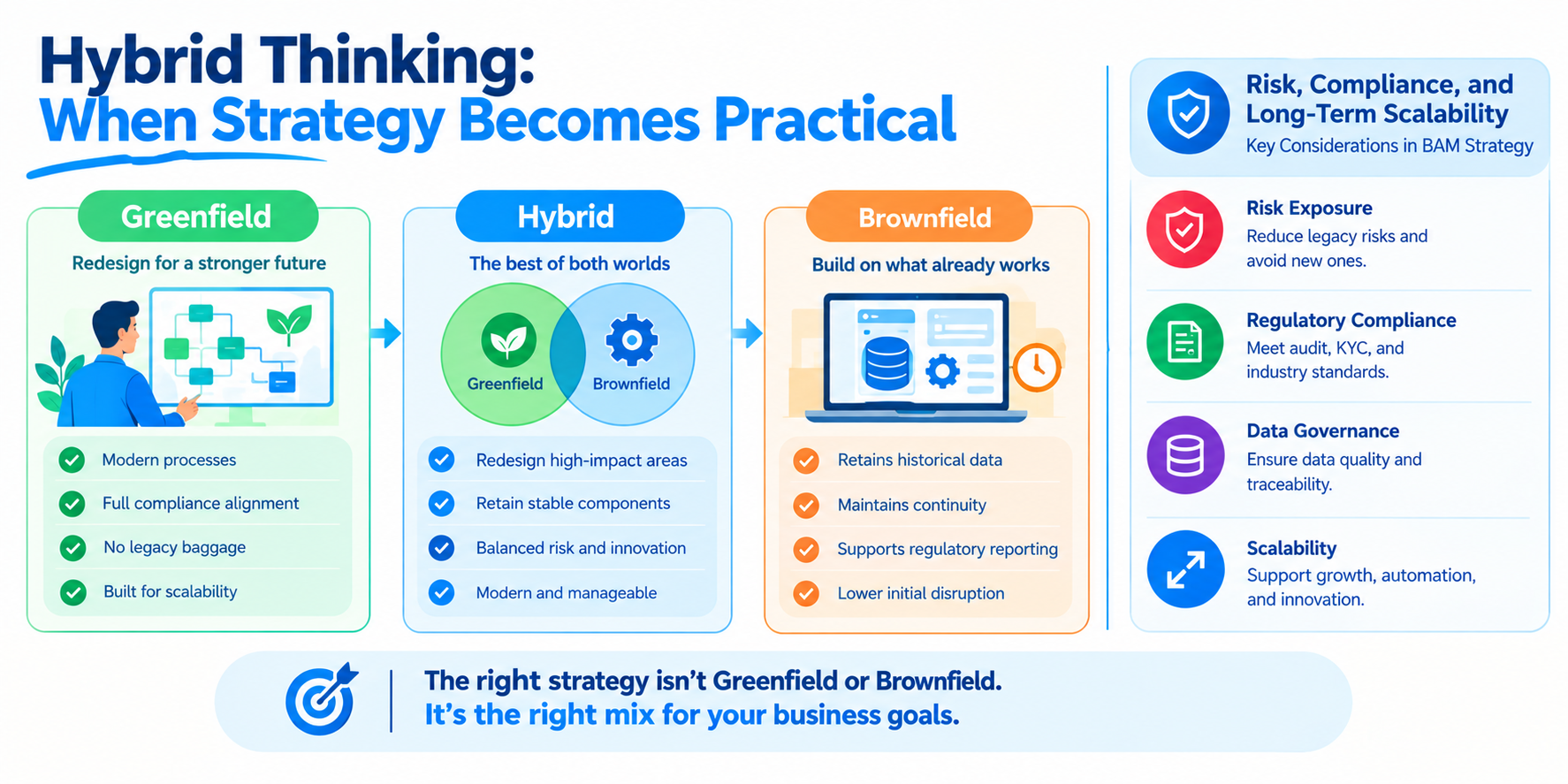
Risk, Compliance, and Long-Term Scalability Considerations in BAM Strategy
In real-world SAP S/4HANA TRM implementations, the decision between Greenfield and Brownfield approaches extends far beyond technical migration—it directly impacts risk exposure, regulatory compliance, and long-term scalability of Bank Account Management (BAM). Organizations operating in highly regulated industries must carefully evaluate how each approach handles audit trails, approval workflows, and data governance requirements.
A Greenfield strategy provides a clean slate, enabling companies to design BAM processes that are fully aligned with modern compliance standards such as segregation of duties, real-time approvals, and centralized bank account visibility. This approach significantly reduces legacy risks and ensures that outdated or non-compliant workflows are not carried forward into the new system. However, it requires strong governance during implementation to avoid misalignment with existing financial controls.
On the other hand, a Brownfield approach retains historical data and existing configurations, which can be beneficial for audit continuity and regulatory reporting. But this also introduces the risk of carrying forward inefficiencies, redundant bank accounts, or outdated approval hierarchies. Without proper optimization, these legacy elements can limit scalability and hinder digital transformation initiatives.
Ultimately, organizations must align their BAM strategy with long-term business goals. If scalability, automation, and innovation are top priorities, Greenfield offers a future-ready foundation. If stability and continuity are critical, Brownfield may be the safer choice—but only with careful refinement. A hybrid approach is increasingly emerging as the most practical solution, balancing innovation with risk control.
Practical Decision Framework: Choosing the Right Approach
To move from theory to execution, use this simple checklist:
Choose Greenfield if:
- Your current BAM processes are inconsistent or unstructured
- You face compliance or audit challenges
- There are duplicate or inactive bank accounts
- You want long-term scalability and automation
Choose Brownfield if:
- Your existing system is stable and trusted
- You need faster migration with minimal disruption
- Budget and timelines are constrained
- Business users prefer continuity over change
Choose Hybrid if:
- Some processes are optimized while others are outdated
- You want to modernize high-impact areas only
- You need a balance between innovation and risk control
👉 This framework ensures the decision is practical, not just conceptual.
FAQs
1. What makes BAM critical in S/4HANA TRM?
BAM centralizes control over all bank accounts, ensuring better governance, compliance, and real-time visibility. It reduces dependency on manual processes and helps treasury teams make faster, more accurate financial decisions.
2. Why do Greenfield projects take longer?
Greenfield implementations involve complete process redesign, data cleansing, and alignment across business teams. This takes more time but results in a cleaner, more scalable system.
3. Is Brownfield risky in the long term?
Brownfield can introduce long-term risks if legacy inefficiencies are carried forward. Over time, these can limit scalability, increase manual work, and create compliance challenges.
4. Can data issues be fixed after Brownfield migration?
Yes, but it requires additional effort, system adjustments, and often higher costs. Fixing data post-migration is always more complex than cleaning it before implementation.
5. Why is change management important in Greenfield?
Greenfield introduces new workflows and governance models, requiring teams to adapt. Without proper change management, even well-designed systems may fail in adoption.
6. What is the smartest approach for most enterprises today?
A hybrid approach is often the most practical, allowing organizations to retain stable components while modernizing critical processes for better performance and scalability.
Conclusion: The Decision Is Not About Systems—It's About Direction
At some point, every organization must decide what kind of treasury function it wants to build.
One that reflects its past.
Or one that is designed for its future.
Greenfield offers clarity, control, and long-term strength.
Brownfield offers speed, familiarity, and short-term efficiency.
Neither is universally right.
But one will always align better with your ambition.
And that is the real question you need to answer:
Are you upgrading your system... or redefining your treasury?
About the Author
TechBrainz Consulting
TechBrainz is a leading SAP training and consulting provider with deep expertise in Treasury and Risk Management. Our team of certified consultants helps professionals and organizations master SAP TRM through practical, project-based learning.
© 2025 TechBrainz. All rights reserved. | www.techbrainz.com