
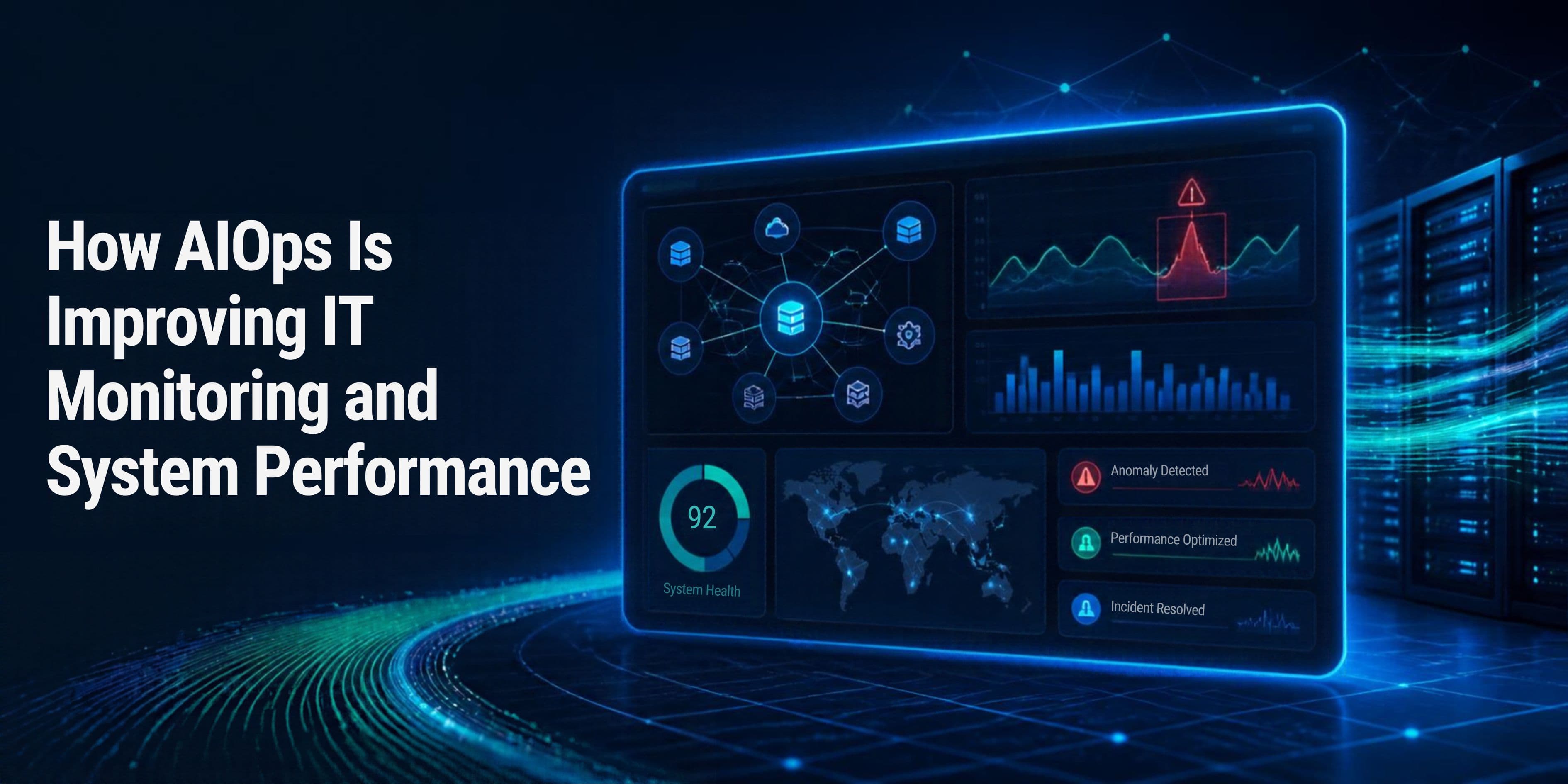
How AIOps Is Improving IT Monitoring and System Performance
Modern IT environments are bigger, faster, and more complicated than ever.
Cloud platforms, microservices, containers, and hybrid networks generate millions of logs, metrics, and events every day. Traditional tools simply cannot keep up. This is where AIOps steps in, bringing artificial intelligence and machine learning into everyday IT operations. In this article, we explore how AIOps is transforming IT monitoring and system performance, and why more organizations are adopting it.
What Is AIOps?
AIOps (Artificial Intelligence for IT Operations) is the use of machine learning, big data analytics, and automation to monitor, analyze, and manage IT systems. It collects data from across the technology stack, detects patterns and anomalies in real time, identifies the root cause of problems, and can automatically trigger fixes, helping IT teams move from reactive firefighting to proactive operations.
Quick Facts About AIOps
Why Traditional IT Monitoring Falls Short
Conventional IT monitoring relies on fixed thresholds and manual analysis. An alert fires when CPU usage crosses 80 percent, for example, whether or not that spike actually matters. As infrastructure grows, teams face several recurring problems:
- Alert fatigue: Thousands of notifications bury the few that truly matter.
- Data silos: Different tools monitor networks, servers, and applications separately, so nobody sees the full picture.
- Slow troubleshooting: Engineers spend hours correlating logs by hand to find one root cause.
- Reactive approach: Teams learn about problems only after users are already affected.
How AIOps Improves IT Monitoring
1. Intelligent Anomaly Detection
Instead of fixed thresholds, AIOps learns what normal behavior looks like for each system, including daily and seasonal patterns. It then flags genuine deviations automatically. This makes IT monitoring far more accurate and removes a large share of false positives.
2. Event Correlation and Noise Reduction
AIOps platforms group related alerts into a single incident. A hundred alerts triggered by one failing database become one actionable ticket, so teams can focus on what needs attention instead of sorting through noise.
3. Faster Root Cause Analysis
By analyzing topology, dependencies, and historical incidents, AIOps pinpoints the likely source of an issue within minutes. This sharply reduces Mean Time to Detect (MTTD) and Mean Time to Resolve (MTTR).
4. Full-Stack Visibility
AIOps unifies data from applications, infrastructure, networks, and cloud services into one view. With this end-to-end visibility, teams understand how a small issue in one layer affects the entire service.
How AIOps Boosts System Performance
Predictive Analytics
Machine learning models forecast problems before they occur, such as disk space running out, memory leaks, or traffic surges. Teams can act early, which protects system performance and avoids costly outages.
Automated Remediation
AIOps can trigger self-healing actions: restarting a service, scaling resources, clearing a cache, or rerouting traffic. Routine incidents get resolved without human involvement, freeing engineers for higher-value work.
Smarter Capacity Planning
By studying usage trends, AIOps recommends the right amount of compute, storage, and network capacity. Organizations avoid both over-provisioning, which wastes money, and under-provisioning, which hurts performance.
Better User Experience
Fewer outages, faster responses, and quicker fixes translate directly into smoother applications and happier customers.
Traditional Monitoring vs. AIOps
Key Components of an AIOps Platform
Real-World Use Cases
- E-commerce: Predict traffic spikes during sales and scale infrastructure automatically.
- Banking and finance: Detect unusual transaction-system behavior and keep critical services available.
- Telecom: Spot network degradation early and reroute traffic before customers notice.
- Healthcare: Keep patient-facing and records systems reliable and responsive.
- DevOps teams: Link deployments to performance changes and speed up incident reviews.
Best Practices for Adopting AIOps
- Start with clear goals: Pick measurable targets such as lower MTTR or fewer alerts.
- Clean your data: Quality data from logs, metrics, and traces drives accurate insights.
- Begin small: Pilot one application or service, then expand.
- Keep humans in the loop: Review automated actions until you trust the models.
- Invest in skills: Train teams so they can use and tune AIOps tools effectively.
Frequently Asked Questions (FAQs)
Q1. What exactly is AIOps in simple words?
A: Think of AIOps as a smart assistant for your IT team. It watches all your systems around the clock, spots unusual behavior, finds the cause, and often fixes the issue on its own.
Q2. How is AIOps different from regular IT monitoring?
A: Regular IT monitoring tells you something broke, usually using fixed rules. AIOps learns what normal looks like, predicts trouble in advance, and explains why it happened.
Q3. Can AIOps really reduce alert fatigue?
A: Yes. By correlating related alerts into a single incident and filtering out noise, AIOps lets your team focus on a handful of meaningful issues instead of thousands of pings.
Q4. Will AIOps replace IT engineers?
A: No. It removes repetitive tasks so engineers can focus on design, strategy, and improvement. Skilled people are still needed to guide, tune, and trust the system.
Q5. How does AIOps improve system performance?
A: It predicts capacity problems, detects slowdowns early, automates fixes, and recommends optimal resource allocation, all of which keep applications fast and stable.
Q6. Is AIOps only for large enterprises?
A: Not anymore. Many cloud-based AIOps tools scale to mid-sized businesses too. If you run multiple services and struggle with alerts or downtime, AIOps can help.
Q7. What data does an AIOps platform need?
A: Mainly logs, metrics, traces, events, and incident tickets. The more complete and clean the data, the sharper the insights.
Q8. How do I get started with AIOps?
A: Pick one pain point, such as noisy alerts or slow incident resolution, run a small pilot, measure results, and expand. Building team skills through structured learning also speeds up success.
Conclusion
AIOps is changing the way organizations handle IT monitoring and system performance. By replacing static rules with machine learning, cutting alert noise, speeding up root cause analysis, and automating fixes, it helps teams prevent outages instead of reacting to them. The result is more reliable services, lower operational costs, and a better experience for users.
As IT environments keep growing in complexity, adopting AIOps is becoming a necessity rather than a luxury. The best way to begin is by building the right skills. Enrolling in AIOps training gives your team practical knowledge of the tools, workflows, and best practices needed to implement intelligent, automated operations with confidence.
About the Author
The TechBrainz AIOps Team has written this article. Our team of IT operations specialists and AI practitioners shares practical insights on AIOps, DevOps, cloud monitoring, and intelligent automation to help professionals and organizations build smarter, more resilient IT systems.