
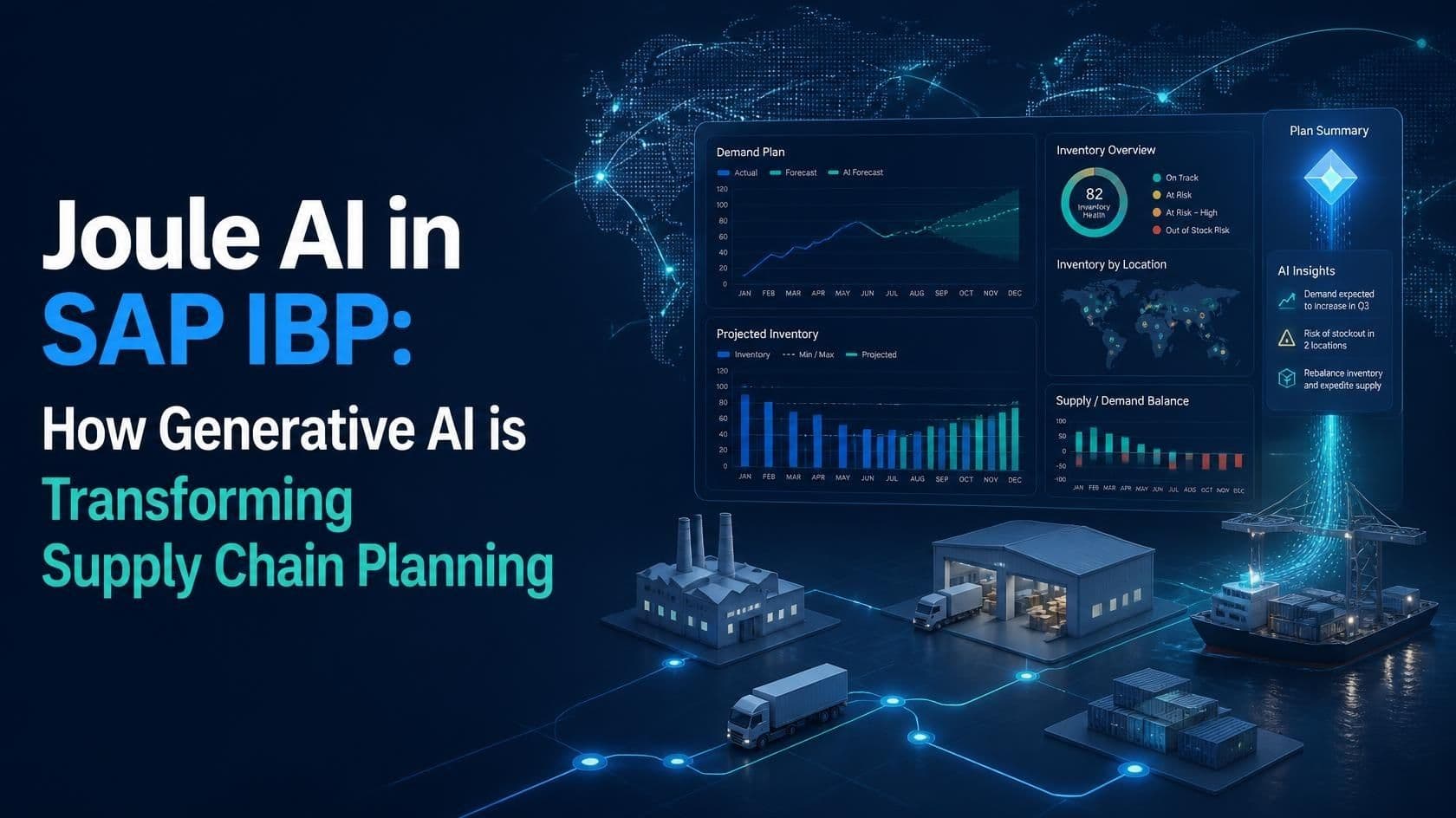
Joule AI in SAP IBP: How Generative AI is Transforming Supply Chain Planning
Joule is SAP's conversational AI copilot integrated into SAP IBP that allows planners to interact with the system using natural language. In practical terms, it helps users ask questions, run checks, analyze planning data, and move through planning activities faster without leaving the IBP workflow. SAP's latest UX enhancements and 2026 updates show that Joule in IBP is rapidly evolving from a concept into a real-time planning assistant for modern supply chain operations.
With Joule, planners can quickly retrieve insights, identify supply shortages, monitor demand fluctuations, check forecast accuracy, and access planning recommendations using simple conversational commands instead of navigating multiple screens and transactions. This significantly improves planner productivity, reduces manual effort, and accelerates decision-making across supply chain processes.
The integration of AI within SAP IBP also supports more intelligent planning by combining automation, predictive analytics, and real-time visibility. As organizations increasingly adopt digital supply chain strategies, tools like Joule help businesses improve responsiveness, collaboration, and operational efficiency. Features such as guided recommendations, contextual insights, and conversational reporting make planning more user-friendly and accessible even for non-technical users.
For professionals looking to build expertise in modern supply chain planning, understanding AI-driven capabilities like Joule is becoming increasingly important. A structured SAP IBP training program or advanced SAP IBP course can help learners gain practical knowledge of demand planning, supply planning, response management, and AI-enabled planning workflows used in real-world business environments.
What is SAP Joule and Why It Matters for IBP
Joule matters for SAP IBP because planning teams spend a surprising amount of time on small, repetitive actions: checking data quality, opening the right app, validating a forecast, reviewing inventory drivers, or creating a formatting rule from scratch. Joule turns those tasks into a conversation. According to SAP, Joule is designed to understand requests, retrieve information, and complete tasks in a conversational way across SAP applications. In IBP, that means less clicking and more planning.
Quick Facts
- SAP's public IBP documentation says Joule in SAP IBP can help users navigate to apps, run and monitor jobs, share content, and ask questions about IBP apps and processes.
- SAP's 2026 UX update says users can ask Joule to run a master data health check for any master data type they specify.
- SAP Help Portal says Joule can compare forecast results in natural language and summarize the results of optimizer runs.
- SAP Help Portal also says planners can use natural language to generate SAP IBP formulas and formatting rules.
- SAP's H2 2025 innovation guide introduces three Joule Agents for production planning, change management, and supplier onboarding.
- To use Joule in SAP IBP, SAP says additional entitlement and authorization may be required.
Joule as SAP's conversational AI copilot
The easiest way to think about Joule is as a planner's front door into IBP. Instead of hunting through menus, a planner can ask Joule to find an app, monitor a job, or explain a result. SAP's IBP integration guide says Joule gives users conversational access inside the planning environment and can support tasks such as navigation, job execution, content sharing, and questions about IBP processes. That is a real productivity shift, not a cosmetic one.
Joule's role across SAP applications
Joule is not an IBP-only feature. SAP positions it as a cross-application copilot that works across the SAP ecosystem, with SAP Help Portal describing Joule as a unified assistant experience across SAP solutions. The important implication for supply chain teams is continuity: the same assistant pattern can show up in planning, procurement, logistics, and ERP workflows, which reduces the learning curve as people move between systems.
What is Joule?
Joule is SAP's AI copilot layer. In plain language, it lets users interact with business software the way they would ask a smart colleague for help. SAP says Joule is grounded in business data, can retrieve information, and can help complete tasks. For IBP, that means planners can ask for support in natural language rather than translating every request into app navigation or technical settings.
The important point is that Joule is not just a chat box. SAP's help pages show it tied to specific business tasks and authorized actions, which is why setup includes identity, authorization, and platform prerequisites. That makes Joule a business copilot, not a general-purpose chatbot sitting loosely beside the system.
How does Joule work in IBP?
In SAP IBP, Joule sits on top of planning capabilities that already exist and makes them easier to access. SAP's integration guide says Joule in IBP can help users navigate to apps, run and monitor jobs, share content, and ask process questions. The 2026 UX update goes further by showing Joule-assisted actions like master data health checks, while the Help Portal also documents natural-language support for forecast analysis, inventory analysis, job scheduling, and planning assistance.
That combination is what makes Joule valuable. It does not replace the planner's judgment, but it does reduce the time spent on setup, searching, and interpretation. In other words, Joule helps the planner spend more time deciding and less time decoding. That is an inference from SAP's documented capabilities, but it fits the product design very closely.
Joule Capabilities Available in SAP IBP Today
Master data health check via natural language
This is one of the clearest "today" features. SAP's 2026 UX update says users can ask Joule to run a master data health check for any master data type they specify. SAP Help Portal also documents that the digital assistant can run a master data health check and that the Master Data Health Check job keeps master data consistent with model requirements. For planners, this is useful because master data problems often hide in plain sight and only show up after a planning cycle is already under pressure.
A practical example is simple. A planner can ask Joule to check whether product, location, or customer master data is aligned with model rules before a planning run. Instead of opening multiple screens, the planner gets a focused result set. That shortens the gap between finding a data issue and acting on it.
AI-assisted forecast results analysis
SAP Help Portal says AI-assisted forecast results analysis helps users understand how each algorithm in the forecast model calculated the result, including the impact of independent variables and related features. Another SAP page says that with a Joule Premium for Supply Chain Management license, users can run an AI-assisted forecast results analysis directly from the planning UI. This is a major step for planners who need to defend a forecast, not just publish it.
This is where Joule begins to change planning conversations. Instead of asking, "What number did the system give us?" planners can ask, "Why did the system calculate it that way?" That helps forecast review meetings become more analytical and less speculative. SAP's own wording supports that move toward explainability.
Generative AI for formula creation
SAP Help Portal says planners can use natural language to ask planning assistance to generate SAP IBP formulas. This is one of those features that sounds small until you use it. Formula design usually consumes valuable time, especially for power users who know what they want but still need to translate business logic into model syntax. Joule shortens that translation step.
A useful example is asking Joule to draft a formula for a rolling average, a seasonal comparison, or a business-specific ratio. The planner still reviews and validates it, but Joule removes the blank-page problem. That means faster prototyping, faster model changes, and fewer delays when a planning team needs to react to a new business requirement.
AI-assisted formatting rule generation
SAP's 2508 release blog says the SAP IBP Excel add-in now uses AI to help create formatting rules using natural language. SAP Help Portal later says planning assistance can generate formatting rules and then apply them to the current planning view worksheet. This is a practical feature because formatting rules are often used by planners to surface exceptions, highlight thresholds, and make complex views readable at a glance.
This matters because good planning is not only about calculations. It is also about making exceptions visible quickly. When Joule helps create the formatting rule, the planner can move from idea to visual control much faster.
The Three New Joule Agents for Supply Chain
SAP's H2 2025 innovation guide introduces three new Joule Agents for supply chain management. SAP says these agents are designed to automate time-consuming tasks in production planning, change management, and supplier onboarding. That is a meaningful signal: SAP is not only adding AI assistance, it is also adding AI-native workflow automation.
Production planning agent
SAP says the Production Planning and Operations Agent can automate prerequisite checks for releasing production orders, including material, capacity, and scheduling availability. It can recommend workarounds and release orders when conditions are met. SAP also says general availability is planned for Q1 2026.
For planners, this means fewer manual validation loops and fewer delays before production starts. The value is not merely speed; it is consistency. When the same rule check is repeated every day by the agent, planners spend less time policing prerequisites and more time handling exceptions.
Change management agent
SAP says the Change Record Management Agent reasons over problem reports, change requests, and change notices, then recommends next steps and initiates the change process. That is designed to reduce fragmentation and improve traceability. GA is planned for Q2 2026.
In supply chain planning, this is important because change is rarely isolated. A material change can affect forecasts, supply plans, inventory settings, and downstream commitments. An agent that reasons over change data can help teams keep the planning model aligned with the real business.
Supplier onboarding agent
SAP says the Supplier Onboarding Agent helps buyers orchestrate invitations, monitor supplier progress, and handle escalations. It also automates data validation and compliance checks, with GA planned for Q2 2026.
This is relevant to IBP because supplier readiness influences planning quality. If supplier data is late, incomplete, or inconsistent, the supply plan inherits that weakness. A faster onboarding flow can improve the quality of the inputs that planners rely on.
Inventory Explainability with GenAI
SAP Help Portal says AI-assisted inventory analysis can generate insights that identify and interpret the key drivers of safety stock values. Another page notes that the analysis can help users understand safety stock results for multi-stage inventory optimization. In simple terms, Joule helps explain why the inventory model is recommending a certain level, not just what the level is.
How AI explains inventory recommendations
This is especially useful for planners who need to justify inventory decisions to finance, procurement, or operations. Instead of presenting a black-box result, the planner can point to the drivers behind the recommendation. SAP's documentation makes it clear that the feature is about insight generation and interpretation, which is exactly what most inventory discussions need.
Reading explainability outputs
The key is not to treat the output as a final answer. Treat it as a decision aid. If Joule explains that demand variability, supply lead time, or service-level assumptions are driving the result, the planner still has to decide whether those assumptions match reality. That is where planning expertise stays central. The AI explains the model; the planner owns the business call.
Pattern Detection in Master Data Using AI
SAP Help Portal has long documented pattern discovery in master data, and its 2026 UX update shows Joule now being used to run health checks more directly. Together, those sources show a clear trend: SAP is bringing data-quality checks closer to the user, not keeping them buried in configuration tools.
This matters in real projects because master data problems usually do not announce themselves. They appear as unexplained forecast exceptions, supply mismatches, wrong hierarchies, or inconsistent attributes. AI support helps planners spot patterns earlier, which is often the difference between a clean planning cycle and a messy one.
Real-World Use Cases of Joule in IBP
Daily planner workflow
A typical planner day can now start with a question instead of a menu. The planner asks Joule to check master data, review a forecast, open the relevant app, and schedule a job. SAP's IBP integration guide explicitly says those are the kinds of tasks Joule supports. That reduces friction at the point where planning work actually begins.
A practical example would be: "Check the product master data health for the North America demand area and show me anything inconsistent." Joule can handle the request in natural language, and the planner can act on the result without jumping across multiple screens. That is the everyday value of copilot-style planning.
Forecast accuracy improvement
SAP's public documentation focuses more on explainability and planning support than on publishing one universal accuracy uplift number. That is important to understand, because forecast performance depends on data quality, model design, hierarchy structure, and planner discipline. Joule helps by making forecast analysis easier to run and easier to understand.
A good way to measure impact is to compare forecast accuracy before and after Joule adoption over the same product families, the same review cadence, and the same exception thresholds. That is a project KPI decision rather than a SAP-published promise. In other words, Joule can improve the process; your organization still has to prove the number.
Anomaly detection
Joule is especially useful when a planner suspects something is off but cannot immediately find it. Master data health checks, forecast explainability, and inventory analysis all support anomaly detection by narrowing the search space. SAP's IBP pages show that this is now a built-in pattern rather than a custom workaround.
How Does Joule Compare to Traditional IBP Workflows
| Task | Traditional IBP workflow | Joule-supported workflow |
|---|---|---|
| Find an app | Search menus manually | Ask Joule to navigate to the app. |
| Run a job | Open job scheduling screens | Ask Joule to run or schedule the job. |
| Check master data | Use master data apps or jobs | Ask Joule to run a master data health check. |
| Review forecast | Inspect forecast details manually | Ask for AI-assisted forecast results analysis. |
| Understand inventory output | Read result fields and infer drivers | Use AI-assisted inventory analysis to interpret safety stock drivers. |
| Create formulas | Build them manually | Ask planning assistance to generate formulas. |
| Create formatting rules | Configure them manually | Ask planning assistance to generate formatting rules. |
| Interpret optimizer results | Compare runs manually | Ask Joule to summarize supply optimization analysis. |
The real shift is not just speed. It is cognitive load. Traditional IBP workflows force planners to know exactly where to click. Joule reduces that burden by letting the planner describe the intent first and the system figure out the path. That is why the feature feels useful so quickly.
How to Enable Joule in Your IBP Environment
SAP says Joule integration for IBP requires technical, identity, and authorization prerequisites. The guide also says you need the same email address in SAP IBP and SAP Cloud Identity Services, plus an SAP BTP global account with the required entitlements. SAP adds that Joule is a BTP-based solution, so teams also need working knowledge of BTP concepts like entitlements, subaccounts, boosters, and system registration.
At a practical level, the setup also involves SAP Build Work Zone, standard edition, because SAP says it needs to be part of the same formation to use Joule for navigation to IBP apps. SAP's guide further says you may need to maintain the content security policy in SAP IBP so the Joule icon loads correctly.
The readiness checklist should therefore include three questions: Do we have the required entitlement? Are identity and authorization aligned? Is the planning team ready to use Joule in a real workflow? If any of those answers is no, the rollout should stay in pilot mode. SAP's own documentation makes clear that access and setup matter just as much as feature availability.
What is the Future of AI in SAP IBP?
SAP's 2026 innovation guidance suggests that IBP is moving toward a more integrated AI experience, with harmonized planning area support, planner workspace centralization, harmonized scenario simulations, embedded AI for forecasting and inventory, and natural-language assistance through Joule. SAP says AI capabilities in that broader wave were in beta and planned for GA in Q2 2026, while the other enhancements were generally available. That tells us the direction is already set.
The likely future is not a world without planners. It is a world where planners supervise more, type less, and make decisions faster. SAP's supply chain messages point to AI-native orchestration, explainable planning, and better cross-functional flow. That means the planner role becomes more analytical and more strategic, not less important.
Can Joule replace planners?
No. Joule can assist planners, accelerate routine steps, and explain results, but SAP documents it as a copilot and assistant, not a replacement for business ownership. It can run checks, summarize information, navigate apps, and help generate rules or formulas. It does not own the trade-offs, exception policy, or final planning judgment. That conclusion follows directly from the scope of the documented capabilities.
That is actually the right design. Supply chain planning still needs human accountability, especially when demand changes, supply constraints, or service-level decisions affect the business. Joule makes planners faster and better informed; it does not remove the need for planners.
FAQ: Joule AI in SAP IBP
1) What is Joule in SAP IBP?
Joule in SAP IBP is SAP's conversational AI copilot that helps users interact with planning tasks using natural language. SAP says it supports navigation, job monitoring, content sharing, and process questions.
2) What Joule features exist today in IBP?
Today, SAP documents master data health checks, AI-assisted forecast results analysis, AI-assisted inventory analysis, job scheduling, formula generation, and formatting rule generation.
3) Can Joule help with forecast analysis?
Yes. SAP says users can run AI-assisted forecast results analysis and understand how the forecast model calculated its result.
4) Does Joule help with master data quality?
Yes. SAP says users can ask Joule to run a master data health check for a specified master data type.
5) Can Joule generate IBP formulas and formatting rules?
Yes. SAP Help Portal says natural language can be used to generate SAP IBP formulas and formatting rules.
6) How do I know my organization is ready for Joule?
Check entitlement, identity, authorization, and BTP setup first. SAP also says Joule in IBP may require additional entitlement and authorization.
Scale of Joule across enterprise users
SAP's generative AI copilot SAP Joule is designed to support around 300 million enterprise users across SAP cloud applications, highlighting its massive potential impact on business processes, including supply chain planning.
Rapid expansion of AI agents in SAP ecosystem
SAP announced more than 40 Joule AI agents to automate and support business processes, showing how generative AI is scaling toward autonomous decision-making in planning and operations.
Shift from decision support to autonomous planning (2026 trend)
In 2026, SAP supply chain AI (including IBP) is evolving from dashboards to autonomous decision execution, where AI agents can identify risks, trigger actions, and adjust plans without human intervention.
Conclusion
Joule AI in SAP IBP has moved far beyond theoretical potential and is now becoming a practical driver of supply chain efficiency and intelligent planning operations. Its real strength lies in optimizing high-frequency planning tasks that traditionally consume significant manual effort and slow down decision-making. By integrating real-time capabilities such as master data validation, forecast explainability, exception monitoring, automated job scheduling, and conversational analytics directly into the planner's workflow, Joule transforms complex planning activities into faster, simpler, and more data-driven processes.
Instead of relying on multiple dashboards, spreadsheets, or manual checks, planners can use natural language interactions to retrieve insights, identify risks, analyze forecast deviations, and respond to supply chain disruptions more efficiently. This reduces operational bottlenecks, improves planning accuracy, and enables organizations to make faster business decisions with greater confidence. As SAP continues expanding Joule's capabilities, planning teams are beginning to experience a more intelligent and proactive supply chain environment powered by AI-assisted workflows and predictive analytics.
The 2026 SAP roadmap further strengthens this transformation by introducing advanced agent-driven automation, contextual recommendations, and autonomous planning assistance. These innovations are expected to support more dynamic demand sensing, real-time collaboration, and automated resolution of planning exceptions. As a result, businesses can achieve shorter planning cycles, improved forecast reliability, cleaner master data, and greater agility in responding to market fluctuations and customer demands.
For organizations adopting digital supply chain strategies, the focus should not simply be on implementing AI for innovation alone, but on using Joule strategically to improve measurable business outcomes. Companies that successfully integrate Joule into their SAP IBP processes will gain a significant competitive advantage through better visibility, faster execution, and more resilient supply chain operations.
Professionals looking to build expertise in these next-generation planning technologies can benefit greatly from enrolling in a structured SAP IBP Course or advanced SAP IBP training program. Learning how AI-powered planning, demand forecasting, supply optimization, and analytics work within SAP IBP helps consultants and planners prepare for the future of intelligent supply chain management and modern enterprise planning environments.
Author bio:
The TechBrainz Team is a collective of SAP consultants and digital strategists dedicated to delivering human-centric insights for enterprise transformation and supply chain excellence.