
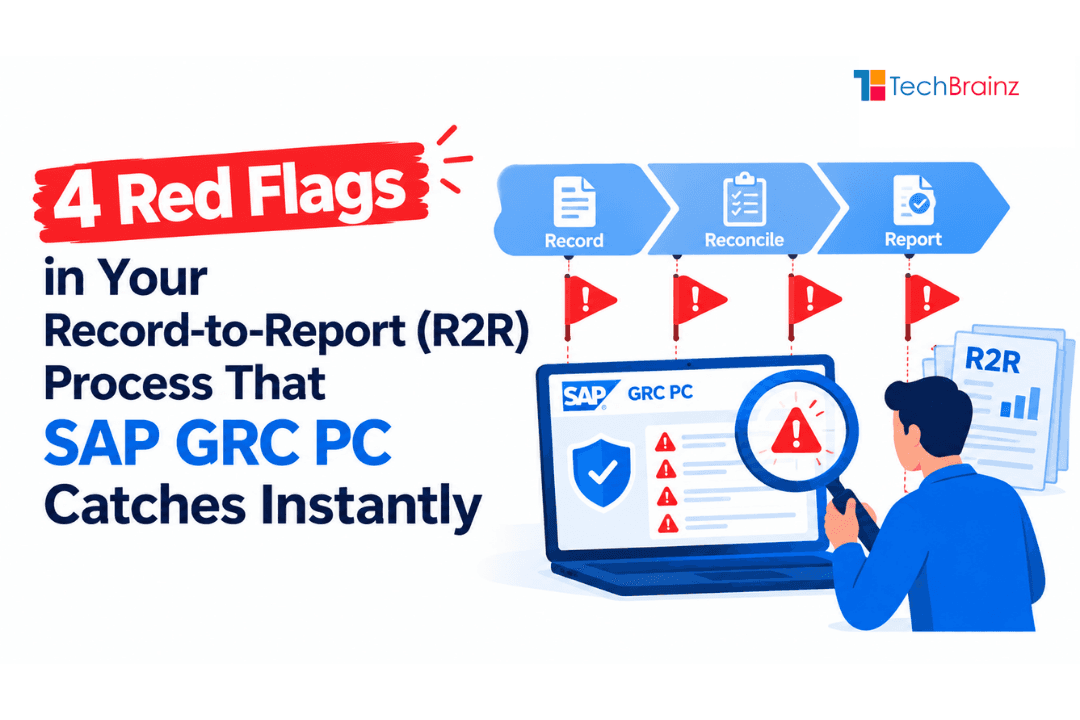
4 Red Flags in Your Record-to-Report (R2R) Process That SAP GRC PC Catches Instantly
What is the Record-to-Report R2R Process?
The Record-to-Report R2R Process is an enterprise-wide financial management lifecycle that encompasses collecting, processing, and presenting accurate financial data. It spans from daily transactional logging through period-end closing up to final regulatory reporting, verified automatically under corporate governance rules by tools like SAP GRC PC.
Why Modern R2R Oversight is Crucial for Financial Integrity
Corporate financial accounting pipelines have grown increasingly complex, exposing companies to hidden compliance blind spots. According to a global financial compliance study by Gartner (2025), 67% of large enterprises plan to modernize their internal compliance workflows by 2027 to eliminate manual monitoring gaps and mitigate financial misstatement risks. Relying on disjointed spreadsheet trackers or legacy point solutions leaves the core ledger vulnerable to compliance errors and unauthorized journal adjustments.
In a traditional ecosystem, the Record-to-Report R2R Process frequently suffers from high background latency. Because transactional records are split across separate operational databases, financial analysts spend critical closing periods manually validating account totals. This separation between sub-ledger details, closing tasks, and compliance checks delays regulatory timelines and makes it easy for control breaches to slip through unnoticed.
Deploying SAP GRC PC solves this problem by embedding automated continuous monitoring directly into your financial processes. It acts as a digital watchdog, analyzing data streams in real time to catch unauthorized actions, transaction anomalies, and process bottlenecks before they escalate into audit failures.
For career changers, business analysts, and beginners entering the enterprise risk space, mastering these automated process controls is an exceptionally valuable professional skill set. As businesses globally modernize their internal control frameworks, trained specialists who can confidently implement compliance automation enjoy excellent career progression and strong demand across international markets.
At TechBrainz, our risk and compliance consulting teams regularly guide global corporations through end-to-end control transformations. Based on our experience training 500+ SAP professionals, a common mistake entry-level analysts make is looking at enterprise risk setups as simple IT logging tools. In reality, successful configuration requires understanding how automated rules map directly onto core database fields like the Universal Journal ledger.
Architectural Shifts: Universal Journal Integration and Process Automation
The Single Source of Truth
The technical core of modern financial tracking relies on the consolidation of business entries inside the unified Universal Journal, managed via the central ACDOCA table. In legacy platforms, the closing pipeline requires pulling records from separate sub-ledgers and running long batch programs to verify the general ledger. In an upgraded environment, every transaction writes straight to the ACDOCA table as a native line item.
This structural layout removes the need for tedious manual period-end balance reconciliations. Every journal entry, asset depreciation adjustment, or intercompany clearing balances instantly across the system. This absolute clarity gives tools like SAP GRC PC immediate access to valid data points for real-time control testing.
How Configuration Access Drives Automated Monitoring Controls
Traditional compliance relies heavily on manual control testing, where auditors look at a small sample of historical documents weeks after the period has closed. SAP GRC PC replaces this sampling method with continuous automated monitoring controls. The system uses direct ABAP queries and database views to analyze 100% of the transaction volume passing through the core ledger, triggering immediate alerts the moment a predefined risk threshold is crossed.
Real-Time Risk Data Gathering
Ingesting external business realities—such as regulatory parameter changes, corporate policy updates, and security risk definitions—is smooth inside an integrated system. Instead of relying on manual spreadsheet uploads or offline check sheets, the process control framework leverages real-time data collection scripts. This technical setup ensures your compliance rules stay active across all connected business units, maintaining high data integrity.
4 Process Red Flags That SAP GRC PC Catches Instantly

An unmonitored financial pipeline can expose an organization to severe compliance risks. Process Control helps you spot these four critical red flags immediately.
Red Flag 1: Unauthorized Journal Voucher Postings Directly to the ACDOCA Table
Manual journal entries passed at the close of a quarter represent a significant fraud and error risk vector. In an unmonitored setup, users might post adjustments that exceed their approved thresholds or bypass secondary review steps. Process Control automatically flags any entry created and approved by the same user ID, or any manual adjustment posted to a reconciliation account outside standard operating hours.
Red Flag 2: Fragmented General Ledger Reconciliation Cycles
When business units use manual spreadsheets to reconcile sub-ledgers to the general ledger, data latency increases quickly. This delay obscures visibility over cash balances and outstanding liabilities. Process Control continuously monitors reconciliation status across different company codes, raising an automated alert if a sub-ledger balance differs from the central ledger by even a small percentage.
Red Flag 3: Bypassing Segregation of Duties (SoD) During Financial Closings
A serious internal control breakdown occurs when a single user can maintain vendor master data and also approve vendor payments during the period-end closing rush. Process Control integrates with access analysis tools to scan active user roles continuously. It flags conflicting authorization profiles before a user can exploit an over-privileged access right.
Red Flag 4: Unexplained Variances in Intercompany Balances
Intercompany clearings are a frequent source of balance sheet errors for multinational organizations. When entities record asymmetrical transfer amounts, the consolidated reporting view becomes distorted. Process Control automatically analyzes intercompany trading transactions, flagging unaligned balances before they reach the final consolidation stage.
Real-World Case Study: Securing the Financial Pipeline
Reviewing a real-world implementation example highlights the tangible impact of deploying automated oversight tools.
The Challenge
A large industrial equipment manufacturer operating across several regional production facilities managed their Record-to-Report R2R Process using an older ERP setup without automated compliance tracking. Because their compliance teams relied on manual control testing, their audits only covered a fraction of their transactions. This lack of visibility led to several unapproved journal adjustments and unresolved intercompany variances, resulting in audit delays and a restatement error that cost the firm roughly $140,000 in regulatory penalties.
The Solution
To address these vulnerabilities, the company's compliance directors implemented SAP GRC PC as part of a wider system modernization effort. They set up automated monitoring controls to track manual postings to the general ledger, established automated alerts for user authorization conflicts, and linked the compliance engine directly to their main accounting tables.
The Measurable Results
The deployment delivered clear operational and financial improvements within six months:
- Control Oversight: Manual tracking errors dropped from multiple occurrences per quarter to zero due to continuous validation against the ACDOCA table.
- Audit Readiness: The time required to gather evidence for internal audits fell by 60%, removing significant operational strain during closing weeks.
- Compliance Precision: Real-time visibility into process exceptions allowed the enterprise to catch and resolve 100% of unapproved journal variations before final consolidation.
Implementation Limitations and Compliance Challenges
While automated process control tools provide clear long-term advantages, project teams should prepare for specific technical constraints and implementation challenges.
Alert Fatigue and Control Over-Configuration
A frequent pitfall for teams deploying compliance systems is configuring their alert thresholds too tightly during the initial phase. If the system triggers an alert for minor, expected operational variances, compliance officers become overwhelmed by notifications. This noise can cause teams to overlook critical risk indicators. Optimization teams must balance their rule criteria to align closely with actual material risk levels.
Legacy Custom Enhancements and Data Ingestion Friction
Organizations that rely heavily on custom code, specialized operational workarounds, or non-standard database structures often face friction during implementation. Legacy custom code can block standardized data scripts from reading transaction records accurately. To avoid data gaps, implementation consultants must review custom enhancements and ensure they align with the clean core architecture guidelines of modern systems.
Practical Checklist for Internal Audit Readiness
Use this step-by-step technical framework during the preparation and testing phases of your compliance modernization project.
| Implementation Phase | Control Verification Task | Target System Component / Code | Operational Status |
|---|---|---|---|
| Preparation | Audit transaction logs to find and resolve manual clearing discrepancies. | Financial Posting Logs / Balance Reports | Evaluated |
| Configuration | Map automated data scripts to track manual adjustments to the general ledger. | ACDOCA table / Central Ledger Views | Evaluated |
| Master Data | Establish clear segregation of duties rules across all closing transaction roles. | GRC Rule Architect / Access Matrix | Evaluated |
| Execution | Deploy continuous automated monitoring controls for intercompany clearings. | SAP GRC PC Rule Engine | Evaluated |
| Validation | Cross-check active exception logs against independent system audit registers. | Core Ledger Reports / Balance Lists | Evaluated |
Conclusion
Modernizing your Record-to-Report R2R Process with automated tools is a critical step toward safeguarding financial data integrity and ensuring smooth regulatory compliance. While managing custom code rewrites and balancing alert thresholds requires careful planning, the benefits of automated oversight and real-time risk visibility make this transition essential for modern enterprise finance operations.
For professionals and beginners aiming to build a high-paying career in enterprise compliance, mastering these automated process control frameworks offers excellent career stability. Take the next step in your professional development by exploring our comprehensive SAP GRC PC training at TechBrainz. Our training program is specifically designed to provide you with deep, hands-on experience covering real-world configuration scenarios, technical transaction codes, and full system compliance strategies.
Frequently Asked Questions (FAQs)
1. What exactly is the Record-to-Report (R2R) process, and why is it so vulnerable to risks?
The R2R process involves collecting, processing, and delivering relevant, timely, and accurate financial information—essentially taking raw transactional data and turning it into finalized financial statements. Because it involves heavy manual inputs, complex reconciliations, and tight deadlines, it is highly vulnerable to: human error and manual workarounds, unauthorized journal entries, and data manipulation or delayed reporting.
2. What are the "4 red flags" that SAP GRC Process Control (PC) can catch instantly?
While specific pain points vary by organization, the four most common and damaging R2R red flags caught by SAP GRC PC include: Segregation of Duties (SoD) Violations (the same user creating and approving their own journal entries), Unreconciled Balance Sheet Accounts (high-value accounts left unreconciled past the period-end deadline), Duplicate or Manual Postings (unusual, large-scale manual overrides that bypass standard automated workflows), and Inadequate Audit Trails (changes made to master data or financial configurations without proper authorization logs).
3. How does SAP GRC PC "instantly" catch these flags compared to traditional audits?
Traditional audits are reactive—they look backward at a sample of historical data weeks or months after the period close. SAP GRC PC utilizes Continuous Control Monitoring (CCM). It runs automated scripts directly against your live ERP data, triggering real-time alerts the moment an anomaly, unauthorized transaction, or control deviation occurs. This shifts your posture from detecting errors after the fact to preventing them entirely.
4. Can SAP GRC PC help speed up our month-end closing cycle?
Yes, significantly. One of the biggest bottlenecks in the month-end close is chasing down errors, investigating unmatched reconciliations, and fixing compliance issues under tight deadlines. By catching and flagging these discrepancies automatically throughout the month, SAP GRC PC ensures cleaner data leading up to the close, reducing stress and shrinking the financial closing timeline.
5. We already use SAP S/4HANA. Do we still need SAP GRC Process Control for R2R?
While SAP S/4HANA has excellent built-in operational controls and validation rules, it doesn't offer the robust, independent oversight required for comprehensive governance. SAP GRC PC acts as an overarching governance layer. It centralizes control documentation, automates testing across multiple systems (even non-SAP legacy platforms), and provides the formal, audit-ready evidence that external auditors require for SOX or local compliance.
6. What is the first step to implementing SAP GRC PC to secure our R2R process?
The first step is to perform a Control Mapping exercise. You need to align your current R2R risk matrix with SAP GRC's automated control capabilities. Identify your highest-risk manual controls (like manual journal entry approvals) and use SAP GRC PC's pre-built content accelerators to automate those specific workflows first, yielding the fastest return on investment.
About the Author — The TechBrainz Team
The TechBrainz Team delivers expert technical guidance on complex SAP migrations, financial transformation strategies, and corporate risk management frameworks. Specializing in Governance, Risk, and Compliance (GRC) modules, their step-by-step technical action plans help global enterprises navigate structural database transitions and shifting ERP architectures with complete, audit-ready precision.