
SAP Autonomous Enterprise: When Processes Run Themselves
Introduction: What If Your Business Processes Could Think Ahead?
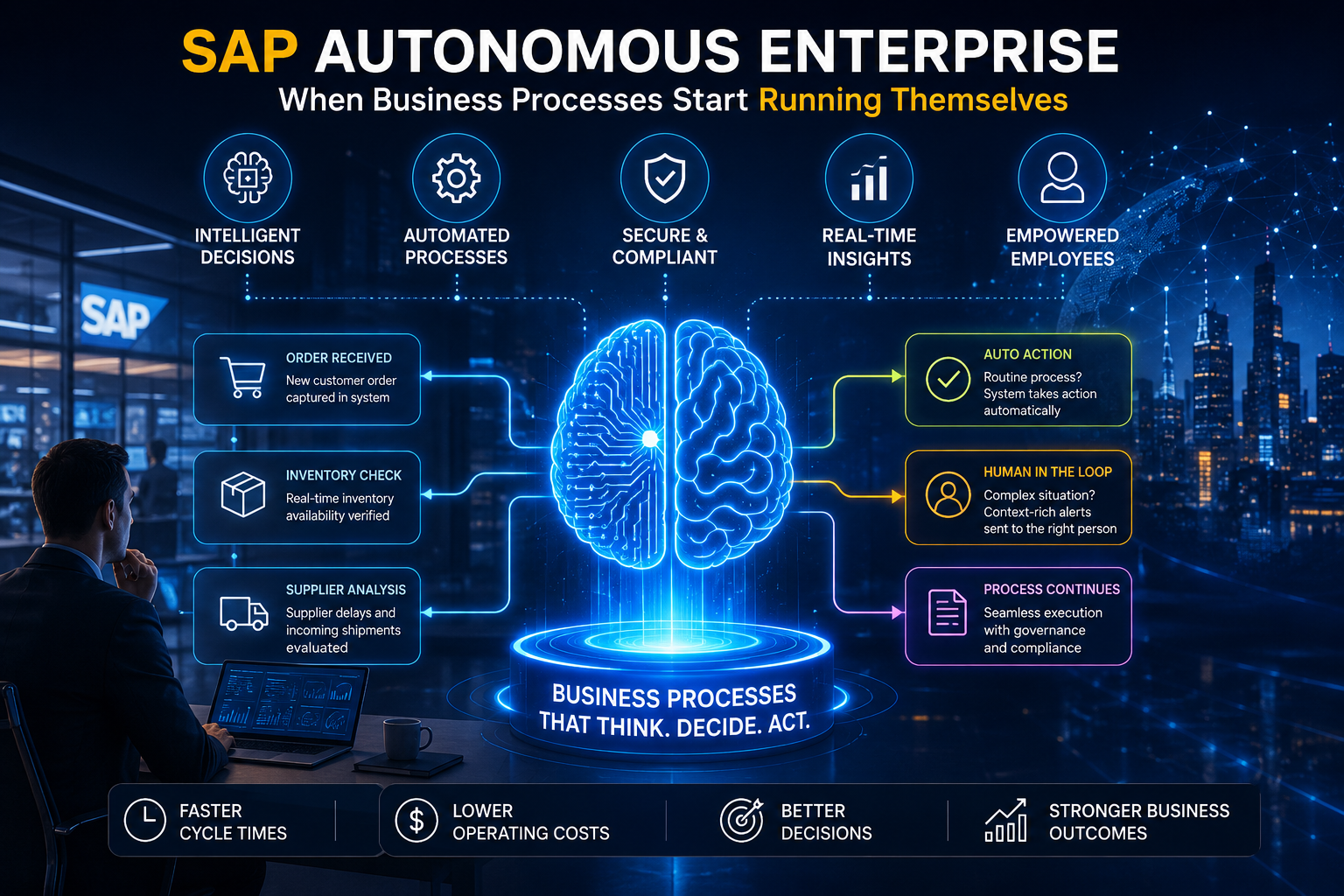
Imagine a customer placing a high-value order on a Friday afternoon. The order enters the system, but several things are already happening behind the scenes. Inventory is lower than expected, a supplier has delayed an incoming shipment, and the requested delivery date is unusually tight. In a traditional enterprise, different employees may need to check different systems, exchange messages and decide what should happen next. The technology helps them complete the work, but the process still depends heavily on people connecting the dots.
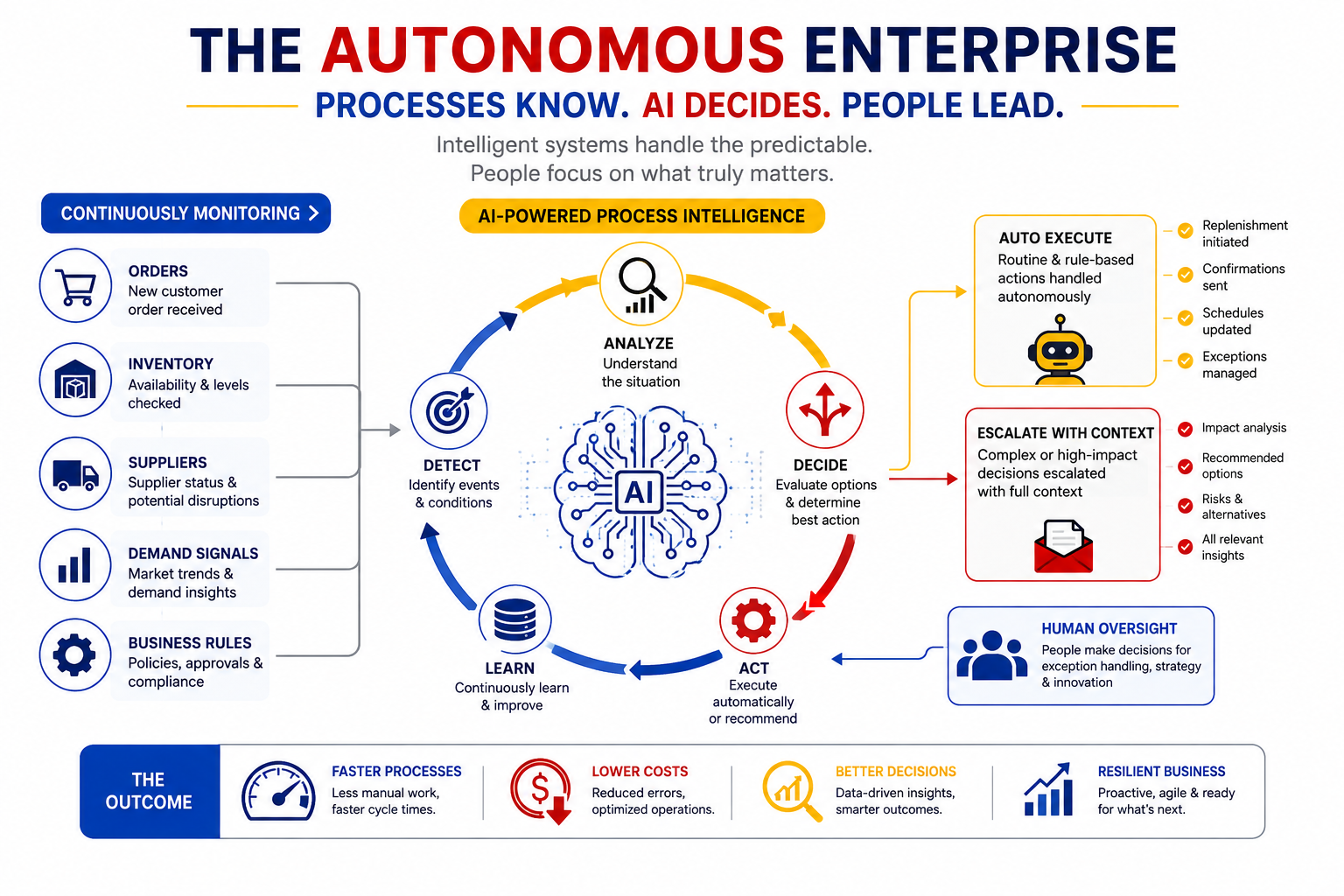
Now imagine the same situation in a more intelligent enterprise. The system recognizes the order, checks inventory, understands the supplier situation, considers the customer's requirements and identifies the potential impact. If the situation is routine and falls within approved business rules, the process can continue automatically. If something requires judgment, the responsible employee receives the situation with the relevant context already prepared.
This is the idea behind the SAP Autonomous Enterprise. It is not simply another name for automation. Businesses have been automating repetitive tasks for years. The bigger shift is toward business processes that can understand what is happening, evaluate available information, determine an appropriate next step and, when permitted, take action with less human intervention.
That creates a more interesting question for modern businesses. Instead of asking whether another individual task can be automated, organizations can start asking whether an entire process can become intelligent enough to recognize what needs to happen next.
Definition: What Is SAP Autonomous Enterprise?
SAP Autonomous Enterprise is an approach that combines artificial intelligence, enterprise data, automation and connected business applications to enable business processes to operate with increasing levels of autonomy while remaining within defined business, security and governance boundaries.
The word "autonomous" does not mean that a business hands complete control to artificial intelligence. Enterprise autonomy needs boundaries. Systems must operate according to permissions, policies, business rules and security controls, while people remain responsible for decisions that require experience, accountability or judgment.
The difference is that technology can increasingly handle more of the routine coordination surrounding those decisions. Instead of employees constantly searching for problems, gathering information and manually moving processes forward, intelligent systems can identify situations and bring the right action or recommendation to the right person.
Why Are Businesses Moving Beyond Traditional Automation?
Automation solved an important business problem by allowing software to perform repetitive activities without requiring an employee to execute every step manually. A purchase requisition can be generated automatically, an invoice can be matched automatically and a notification can be sent automatically when a condition occurs.
The limitation appears when the business situation becomes more complicated than the rule that was created for it. A company may automatically order more inventory when stock falls below a certain level, but that rule may not know that customer demand has suddenly increased, a supplier has delayed delivery or another shipment is already expected tomorrow.
The transaction is automated, but the decision surrounding it may still require human investigation.
This is where autonomous enterprise thinking becomes different. Instead of reacting to one isolated condition, an intelligent process can potentially consider multiple signals and understand their relationship. It can recognize that low inventory means something different when demand is stable than when demand is increasing rapidly.
Modern organizations produce enormous amounts of business information every day. Orders change, suppliers experience disruptions, inventory moves, customer requirements shift and financial transactions continue across multiple systems. Asking employees to monitor every combination of these events is becoming increasingly impractical.
Autonomous processes can take responsibility for more of that monitoring and coordination. Employees can then concentrate on situations that actually need human attention instead of spending their time searching for them.
From Automated Tasks to Autonomous Processes
The journey toward autonomy can be viewed as a gradual evolution rather than a sudden technological change. Traditional enterprise applications primarily record transactions and support employees in performing business activities. Automation removes some repetitive manual work by executing predefined instructions.
Artificial intelligence adds another layer by helping systems analyze information, recognize patterns, summarize situations and generate recommendations. The next step is controlled autonomy, where a system can potentially move from identifying an appropriate action to actually performing that action when it has the required authority.
These capabilities do not need to exist at the same level across every business process. A routine process involving predictable, low-risk transactions may be highly suitable for autonomous execution. A major financial decision, strategic customer issue or sensitive compliance activity may require a person throughout the process.
The goal is therefore not to make every process completely autonomous. The goal is to determine where autonomy creates value and where human involvement remains essential.
How Do Data, AI and Business Applications Come Together?
An autonomous enterprise cannot be built from artificial intelligence alone. The foundation is enterprise data.
An AI system may know that a customer order exists, but that information becomes much more useful when the system can also understand the customer's history, product availability, delivery commitments, supplier conditions and financial context.
Consider a warehouse containing 500 units of a product. That number by itself does not explain whether the business has enough inventory. If demand is stable and another shipment is arriving tomorrow, the situation may be perfectly healthy. If demand has suddenly increased and the supplier has announced a delay, the same 500 units could represent a serious risk.
The difference is context.
Enterprise applications already contain much of this information. ERP systems manage transactions, supply-chain systems manage planning and inventory, procurement systems contain supplier information and finance systems contain financial activity. The challenge is making this information available in a connected form that intelligent systems can understand.
This is why data quality and integration are so important to autonomous enterprise strategies. AI can only make useful decisions when the information supporting those decisions is reliable, relevant and available at the right time.
What Role Does SAP Business AI Play?
SAP Business AI represents the broader movement toward embedding artificial intelligence directly into enterprise processes instead of keeping AI as a separate technology layer. SAP has been developing AI capabilities around Joule and AI agents with the aim of bringing intelligence closer to business applications and workflows.
This changes how employees can interact with enterprise technology. Instead of using software only to search for information or complete transactions, users can increasingly use intelligent capabilities to understand situations, receive recommendations and support decisions.
The more important shift is that AI can become part of the business process itself. A system can potentially identify an exception, understand the relevant information and help determine what should happen next.
AI agents make this idea even more interesting because they can potentially coordinate several activities toward an objective rather than simply responding to one question. However, greater capability requires stronger governance. An agent that can only provide information presents a different risk from an agent that can modify records or initiate business transactions.
The future of enterprise AI will therefore depend not only on what an AI system can do, but also on what the organization allows it to do.
Could an Autonomous Order-to-Cash Process Work?
Order-to-cash provides a useful example of how autonomy could change an everyday business process. In a conventional environment, a customer order enters the system and follows a predefined sequence. Employees become involved when exceptions occur or when information needs to be checked across different systems.
An increasingly intelligent process could examine the customer, product, inventory, pricing and delivery context together. If the order is normal, the process can continue without unnecessary intervention.
Now consider a customer requesting an urgent delivery when the required product is already affected by a supply shortage. Instead of waiting for someone to discover the problem later, an intelligent process can potentially identify the risk immediately and determine whether the situation falls within an approved response.
If the situation is routine, the process can continue automatically. If it involves a significant business decision, the system can escalate it to the appropriate employee with the relevant information already available.
The employee is no longer starting the investigation from zero. The technology has already connected the information and highlighted the issue.
That is an important difference between a simple alert and an intelligent process.
Could Procurement Become More Autonomous?
Procurement is another area where autonomous capabilities can potentially create significant value. Imagine that inventory for a critical component is falling while customer demand is increasing and the primary supplier has delayed the next shipment.
A traditional process may require a procurement professional to discover the shortage, check open orders, review supplier information and decide what action should be taken.
An intelligent process can potentially bring these signals together. It can examine inventory, demand, supplier conditions and existing purchase orders before determining whether action is required.
The organization could allow the system to prepare a procurement request or initiate a predefined workflow while keeping higher-value purchasing decisions under human approval.
This gradual model is important because autonomy does not have to mean unrestricted authority. Companies can begin with recommendations, move toward controlled automation and eventually allow autonomous execution for carefully selected scenarios.
How Could Autonomous Supply Chains Change Daily Work?
Supply chains generate an enormous number of events. Orders change, inventory moves, suppliers experience delays, transportation schedules shift and forecasts are continuously updated.
No supply-chain professional can realistically investigate every possible combination of these events manually.
Autonomous capabilities can shift supply-chain management from constant monitoring toward intelligent exception management. Instead of employees searching through multiple dashboards for potential problems, the system can potentially identify significant situations and bring them forward.
A manager might receive information showing that a supplier delay could affect several important customer orders, together with the available alternatives and the recommended response.
The manager remains responsible for the decision, but much of the information-gathering work has already been completed.
This can change the role of the employee from someone who constantly watches systems to someone who focuses on the exceptions that genuinely need expertise.
What Could Autonomous Finance Look Like?
Finance is another area where intelligent automation can reduce repetitive work. Invoice processing, reconciliation, anomaly detection and financial analysis all contain activities that can potentially benefit from AI.
An intelligent system can help identify unusual transactions, compare information and route exceptions to the appropriate employee without requiring finance teams to manually inspect every record.
However, finance also demonstrates why autonomy must be carefully controlled. A system that recommends a financial action is very different from one that is authorized to execute it.
Financial processes involve money, compliance and accountability. Organizations therefore need clear boundaries around which activities can happen automatically and which require human approval.
The most practical approach is not to remove financial professionals from the process. It is to reduce the amount of repetitive investigation they need to perform while keeping important decisions under appropriate human control.
Why Does SAP Signavio Matter Before Autonomy?
Before an organization tries to make a process autonomous, it needs to understand how that process actually works.
This can be more difficult than it sounds. Enterprise processes often contain variations, manual workarounds and unnecessary steps that have developed over many years. Different departments may follow different approaches even though they appear to be working with the same process.
Automating such a process without understanding it can create an unfortunate outcome: the organization simply automates inefficiency.
SAP Signavio is relevant because process transformation begins with understanding business processes and identifying opportunities for improvement. Process intelligence can help organizations examine how work happens in practice and where processes can be simplified or improved.
This creates a logical sequence toward autonomy. Businesses can understand their processes first, improve unnecessary complexity, automate suitable activities and then introduce intelligence where it creates additional value.
This is also where professionals interested in the relationship between enterprise processes, data and intelligent technologies can benefit from SAP Autonomous Enterprise Training, particularly when building a broader understanding of how business context can support enterprise AI.
Why Is Context So Important for Enterprise AI?
One of the biggest challenges for enterprise AI is understanding relationships.
A customer is connected to orders. Orders are connected to products. Products are connected to inventory. Inventory is connected to suppliers. Suppliers may be connected to contracts, purchase orders and delivery commitments.
When AI sees these entities individually, it has only part of the business picture.
When it can understand the relationships between them, the same event becomes much more meaningful.
Suppose an intelligent system identifies a delayed order. Knowing that the order is delayed is useful, but knowing that the customer is strategically important, the product depends on a particular supplier and several other orders could also be affected provides a much richer understanding of the situation.
This is why knowledge graph technologies can become valuable within enterprise AI architectures. They can help represent relationships between business entities and provide context that supports more meaningful analysis.
The broader lesson is simple. Data tells an intelligent system what exists. Relationships help explain how those things connect. Context helps the system understand what the information means for the business.
Where Does SAP BTP Fit Into an Autonomous Enterprise?
Autonomous processes cannot work effectively when business applications remain isolated.
Modern organizations may operate SAP applications alongside custom applications, cloud services and third-party systems. An intelligent process may need information from several of these environments before it can determine what should happen.
SAP Business Technology Platform can support this broader architecture through capabilities associated with integration, application development, data and automation.
This becomes important when intelligent processes need to move across business systems. AI without access to relevant enterprise information has limited practical value. Data without connected processes cannot easily produce business outcomes. Automation without intelligence may continue following predefined rules even when circumstances change.
An autonomous enterprise therefore depends on these capabilities working together rather than existing as disconnected technologies.
Why Does Security Become More Important?
Security becomes increasingly important when AI moves from providing recommendations to performing actions.
An assistant that tells an employee that a supplier may be risky creates one level of operational exposure. An AI agent that can create a purchase order, change a business record or trigger a workflow creates a much greater one.
Autonomous enterprise architecture therefore needs strong identity and access controls. Intelligent agents should have only the permissions required for their assigned activities. Sensitive information needs appropriate protection, and important actions should be logged and monitored.
High-risk decisions may require explicit human approval. Organizations also need clear governance defining which processes can operate autonomously and which actions must remain under human control.
Least-privilege access is especially important. An AI agent should not receive broad permissions simply because broad access makes implementation easier.
The principle is straightforward: the more an intelligent system can do, the more carefully the organization must control what it is allowed to do.
What Are the Main Challenges?
The autonomous enterprise is promising, but organizations should not assume that introducing AI automatically creates intelligent operations.
Data quality is one of the biggest challenges. Incomplete, outdated or inconsistent information can reduce the reliability of intelligent decisions.
Process complexity creates another challenge. Large organizations often have workflows that have evolved over many years and contain exceptions, manual steps and departmental variations.
Integration can also become difficult when intelligent processes need to communicate with multiple systems. Governance is equally important because organizations need to decide which actions can be automated, which require approval and who remains accountable for outcomes.
Trust is another major factor. Employees need confidence that intelligent systems will behave predictably, business leaders need evidence that the technology creates measurable value and security teams need assurance that AI agents operate within defined boundaries.
This is why autonomous enterprise transformation should be viewed as a business transformation rather than simply an AI implementation.
How Should Organizations Begin?
A company does not need to make its entire enterprise autonomous at once.
A more practical approach is to select a repetitive, measurable and relatively low-risk process. The organization can first understand how the process works, identify unnecessary complexity and improve it before introducing additional automation.
AI can then be introduced where it provides useful analysis, prediction or recommendations. Once the organization understands how the technology behaves, selected actions can be allowed to happen automatically within carefully defined boundaries.
The results should be measured. If the process becomes faster, more reliable and easier to manage without creating unacceptable risk, the same approach can be expanded to other areas.
This makes autonomy a gradual journey rather than a single technology project.
The objective is to build trust step by step.
What Skills Will SAP Professionals Need?
The autonomous enterprise is changing the skills expected from SAP professionals. Understanding individual SAP applications will remain important, but professionals increasingly need to understand how applications connect with AI, data, automation and business processes.
Process knowledge is particularly valuable because intelligent automation should solve genuine business problems rather than simply demonstrate technology.
Data knowledge is also becoming more important because AI depends on reliable enterprise information. Professionals who understand integration, automation, AI fundamentals and security can increasingly connect different parts of the enterprise technology landscape.
This creates an opportunity for SAP professionals to move beyond traditional system-focused responsibilities and become contributors to intelligent business transformation.
The valuable professional of the future may not simply know how to configure an application. They may understand how to turn a business process into an intelligent, automated and secure operation.
What Could the Autonomous Enterprise Look Like?
Imagine starting the workday without opening several dashboards simply to discover what needs attention.
Business systems have already been monitoring important conditions. A major customer order arrives, the system checks availability and identifies a supplier disruption. It evaluates which orders could be affected and identifies possible alternatives.
A routine replenishment activity falls within approved rules, so the system initiates it automatically. Another decision involves a significant financial commitment, so the system does not act independently. Instead, it provides the responsible manager with the situation, relevant context and recommended options.
The manager makes the decision while routine activities continue moving in the background.
This is a more realistic vision of the autonomous enterprise.
It is not a business without people. It is a business where people no longer need to manually coordinate every predictable activity.
The Bigger Picture: When Processes Know What Happens Next
Enterprise software has traditionally been very good at recording what happened. An order was created, inventory changed, an invoice was posted and a payment was processed.
The autonomous enterprise introduces a more interesting question: What should happen next?
That question changes the role of enterprise technology.
A supply-chain system can potentially identify the impact of a delayed shipment instead of simply displaying the delay. A procurement process can potentially recognize that low inventory combined with increasing demand requires attention. A finance system can potentially identify an unusual transaction and route it to the right person with the relevant context.
The process becomes more responsive because it can increasingly understand what is happening around it.
That is the real significance of autonomous enterprise technology. It is not about removing humans from every workflow. It is about giving technology responsibility for predictable work while allowing people to concentrate on situations where experience, judgment and creativity matter.
The most intelligent enterprise may therefore not be the one that automates everything. It may be the one that understands what to automate, what to delegate to AI and what should always remain human.
Frequently Asked Questions
What is SAP Autonomous Enterprise?
SAP Autonomous Enterprise describes an approach where AI, enterprise data, automation and business applications work together to enable selected processes to operate with increasing levels of autonomy. Intelligent systems can potentially recognize situations, recommend actions and execute approved activities while humans remain involved when judgment is required.
What is the difference between automation and autonomy?
Automation generally follows predefined instructions and conditions to perform specific tasks. Autonomy introduces greater contextual intelligence, allowing a system to potentially evaluate a broader business situation, determine an appropriate response and perform an authorized action within established business and security boundaries.
Will SAP Autonomous Enterprise replace human employees?
The purpose of autonomous enterprise technology is not simply to remove people from business processes. Instead, it can reduce repetitive monitoring and manual coordination so employees can spend more time on strategic decisions, complex problems, customer relationships and situations that require human judgment.
What role do AI agents play in an autonomous enterprise?
AI agents can potentially understand objectives, analyze business information, coordinate multiple activities and interact with enterprise applications. Because they may perform actions rather than only provide information, organizations need appropriate permissions, monitoring, governance and escalation mechanisms.
Why is security important for autonomous enterprise systems?
Security becomes especially important when intelligent systems can execute business actions. Organizations need appropriate identity management, authorization, least-privilege access, monitoring and auditability. Sensitive or high-risk activities may also require human approval before execution.
How can an organization begin its autonomous enterprise journey?
Organizations can start with a repetitive, measurable and relatively low-risk business process. The process should first be understood and improved before introducing automation and AI. After testing and establishing governance, selected autonomous actions can be introduced gradually.
Conclusion: The Business That Knows What Happens Next
For decades, enterprise software has helped businesses record what happened. The next evolution is about helping businesses understand what is happening and determine what should happen next.
That is what makes the SAP Autonomous Enterprise so significant. AI can provide intelligence, enterprise applications provide business capabilities, data provides information, process intelligence helps organizations understand how work actually happens, and automation provides execution. Security and governance ensure that execution remains controlled.
When these capabilities work together, business processes can become increasingly responsive. A process can potentially recognize an exception before an employee manually discovers it, understand the context around the situation and determine whether it can safely continue or needs human attention.
The goal is not to create a business where humans disappear. It is to create a business where employees no longer spend their time manually monitoring every transaction, coordinating every predictable handoff and investigating every routine exception.
The future enterprise may therefore be one where technology handles the predictable while humans focus on the meaningful.
When business processes start running themselves, the real transformation is not that machines are doing more work. It is that people finally have more time to do the work only people can do.
About the Author
TechBrainz Consulting
Helping professionals build practical SAP skills for modern enterprise technology and business transformation.