
SAP BTP + CAP + Kyma: The Full-Stack Power Trio
Introduction: Three Technologies, One Bigger Development Story
There was a time when building an SAP application often meant staying close to the core system. Developers worked inside established application landscapes, extended existing functionality, and focused heavily on the capabilities available within the SAP environment itself.
Cloud development has changed that picture.
Modern SAP projects increasingly involve APIs, external applications, cloud services, events, microservices, containers, AI capabilities, and integrations that extend far beyond a single ERP system. Developers are expected to create applications that are not only functional but also scalable, secure, loosely coupled, and ready to evolve.
This is where SAP BTP, CAP, and Kyma become particularly interesting.
Rather than thinking about them as three competing technologies, think of them as three different layers of a modern development strategy.
SAP BTP provides the broader platform. CAP provides a development model for enterprise applications and services. Kyma provides a cloud-native Kubernetes runtime for containerized workloads, microservices, and extensions. SAP's documentation specifically supports CAP development on both the BTP Cloud Foundry and Kyma runtimes, showing how these technologies can fit into the same application landscape.
The real power comes from understanding where each technology belongs.
A developer who understands only CAP can build business applications. A developer who understands only Kubernetes can build cloud-native services. But someone who understands how BTP, CAP, Kyma, integration, security, and business processes work together can approach much larger enterprise problems.
That is the idea behind the full-stack power trio.
Definition Box: What Are SAP BTP, CAP and Kyma?
SAP BTP: SAP Business Technology Platform is the broader platform for application development, integration, data and analytics, automation, AI, and other technology capabilities.
SAP CAP: SAP Cloud Application Programming Model is a framework of languages, libraries, and tools for building enterprise-grade services and applications. SAP describes CAP as a framework focused on domain-oriented development and reusable solutions to common application requirements.
Kyma: SAP BTP, Kyma runtime is a fully managed Kubernetes-based application runtime designed for cloud-native applications, including containerized microservices and extensions.
Simple way to remember it:
BTP = Platform
CAP = Business application development
Kyma = Cloud-native runtime and extensions
SAP BTP: The Foundation Beneath the Application
Before talking about CAP or Kyma, it helps to understand the bigger environment they operate in.
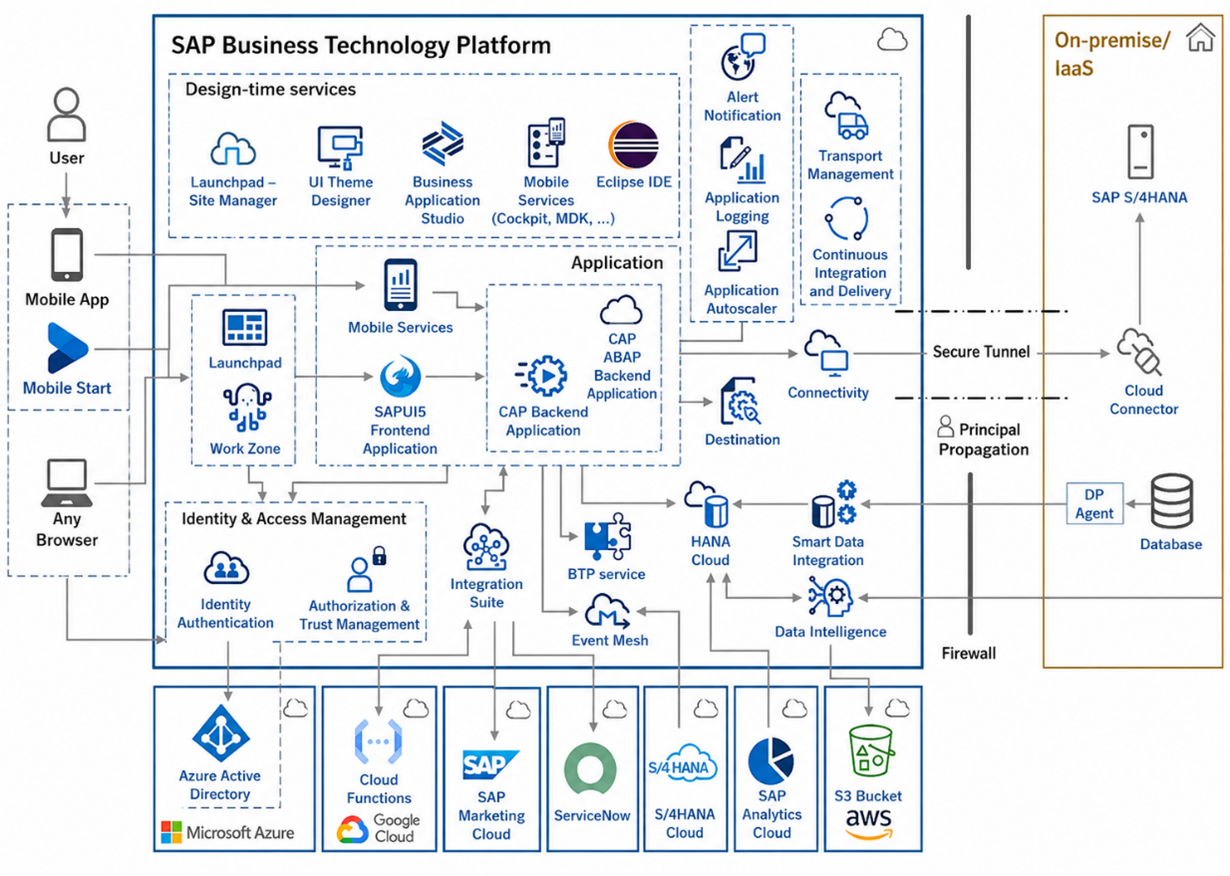
SAP BTP is not simply another application server. It provides a collection of platform capabilities that developers can use to build and extend enterprise applications. SAP describes BTP as supporting multiple environments and giving developers flexibility in choosing technologies and runtimes based on their use case and skills.
That flexibility is important because enterprise applications rarely live in isolation.
A custom application may need to communicate with SAP S/4HANA, retrieve information from another business system, authenticate users through an identity service, store application data, publish or consume events, and expose APIs to another application.
Instead of building every supporting capability from scratch, developers can use services provided through the broader BTP ecosystem.
This is why BTP should be viewed as the foundation of the architecture, rather than simply another item in the technology stack.
It creates the environment in which the rest of the application can operate.
SAP CAP: Where Business Application Development Gets Interesting
Now imagine that the business asks for a custom procurement application.
They don't simply want a screen. They need business entities, relationships, services, authorization, persistence, APIs, validations, and integration with existing SAP processes.
This is where CAP becomes valuable.
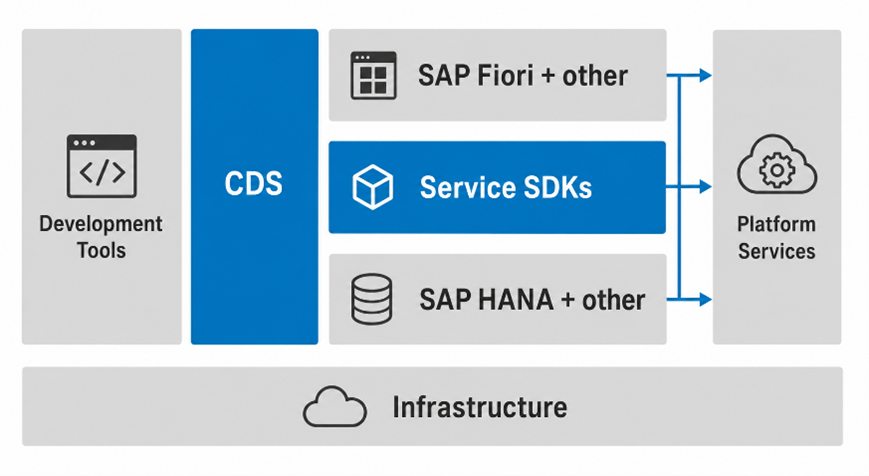
SAP Cloud Application Programming Model provides languages, libraries, and tools for building enterprise-grade services and applications. Its Core Data Services, or CDS, are central to modeling data and services, while CAP provides runtimes and SDKs for Node.js and Java.
Instead of starting with a blank project and manually creating every layer, developers work from a structured development model.
The focus shifts from: "How do I build every technical component?" to: "What business problem am I modeling and how should the application expose it?"
That is a significant difference.
CAP encourages developers to think in terms of domains, services, entities, business rules, and APIs. This can make application development more consistent while reducing the amount of repetitive infrastructure code developers need to create themselves.
Kyma: Where Cloud-Native Development Enters the Picture
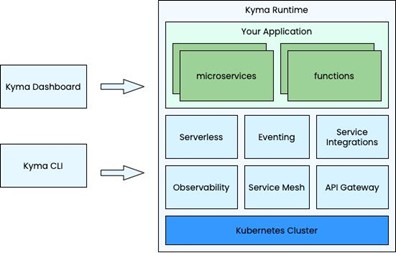
Now take the same application and imagine that it needs something more specialized.
Perhaps the application must process a large number of events. Maybe it needs a custom microservice written in a particular programming language. Perhaps an external service needs to run inside a container, or a specialized workload needs independent scaling.
This is where Kyma becomes interesting.
SAP BTP, Kyma runtime is a managed Kubernetes runtime based on the open-source Kyma project. SAP positions it for cloud-native workloads, including containerized microservices and serverless functions, while also supporting SAP and non-SAP applications.
Kyma therefore gives developers a different kind of flexibility.
You can build and deploy:
- Containerized microservices
- Functions
- Event-driven workloads
- API-based extensions
- Cloud-native services
SAP's documentation also notes that Kyma supports CAP, SAP Cloud SDK, application router, and HTML5 deployer capabilities.
So Kyma isn't sitting outside the SAP ecosystem. It can become an important part of a modern SAP extension architecture.
The Real Power: CAP + Kyma
This is where the three technologies start to make sense as a complete architecture.
CAP and Kyma should not automatically be viewed as alternatives.
They can solve different problems in the same application.
Imagine a procurement application again.
The CAP application could handle the core business domain. It could model purchase requests, suppliers, approval states, and business services.
A Kyma-based microservice could handle a specialized workload such as event processing or communication with an external cloud service.
BTP provides the broader platform capabilities needed to connect, secure, operate, and integrate those components.
The architecture starts looking like this:
SAP S/4HANA → SAP BTP → CAP application → APIs/events → Kyma microservices → External services
The important point is that each component has a purpose.
You are not adding Kyma simply because Kubernetes is popular. You are using it where cloud-native capabilities solve a genuine architectural requirement.
The Full-Stack Architecture: How the Three Fit Together
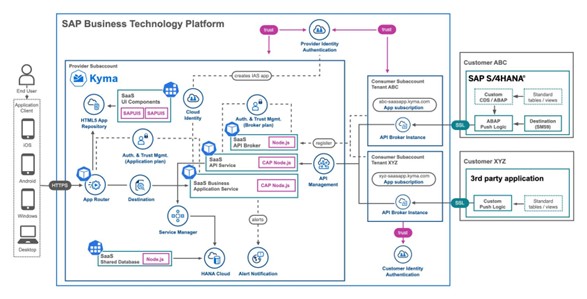
A useful way to understand the architecture is to visualize it in layers.
Layer 1: Business Systems
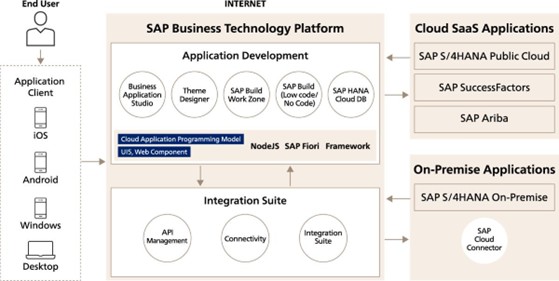
At the bottom are the systems containing business data and processes. Examples could include SAP S/4HANA, SAP SuccessFactors, SAP Ariba, or other SAP and non-SAP applications. These systems remain important because the custom application usually exists to extend or connect business capabilities rather than operate independently.
Layer 2: SAP BTP
BTP provides the broader cloud platform around the application. This is where developers can use platform services for application development, integration, security, data, messaging, and other requirements.
Layer 3: CAP Application
CAP becomes the business application layer. This is where developers model the domain, define services, implement business logic, and expose APIs.
Layer 4: Kyma Workloads
Kyma can host containerized microservices and other cloud-native workloads that complement the application. For example, a specialized service could process events independently from the main business service.
Layer 5: User and External Applications
Finally, users and other applications consume the functionality through appropriate interfaces and APIs.
The result is an architecture that separates responsibilities rather than putting everything into one large application.
BTP provides the platform. CAP organizes the business application. Kyma expands the cloud-native capabilities.
CAP vs. Kyma: When Should You Use Each?
One of the easiest mistakes is asking which technology is "better."
That is usually the wrong question.
The better question is: "Which technology is the right fit for this workload?"
| Requirement | CAP | Kyma |
|---|---|---|
| Enterprise business application | Strong fit | Can host it |
| Domain modeling | Strong fit | Not its primary purpose |
| Business services | Strong fit | Can support services |
| Kubernetes workloads | Not its main purpose | Strong fit |
| Containerized microservices | Possible through deployment architecture | Strong fit |
| Event-driven extensions | Can participate | Strong fit |
| Cloud-native workloads | Supported | Strong fit |
| SAP business application development | Strong fit | Useful runtime |
SAP's own developer guidance recognizes both Cloud Foundry and Kyma as BTP runtime choices for CAP development, reinforcing that the runtime decision should be driven by the application's architecture and requirements rather than by a simple technology ranking.
So if you're building a domain-focused business application, CAP may be the natural starting point. If the workload needs Kubernetes-based microservices, containers, or specialized cloud-native capabilities, Kyma becomes more compelling. And if you need both? Use both where appropriate.
A Real-World Scenario: Building an Intelligent Procurement Extension
Let's make the architecture practical.
Imagine a company wants to improve its procurement process without rebuilding its existing SAP core.
The business wants a custom application that allows employees to submit purchase requests, automatically evaluates certain conditions, communicates with external services, and triggers additional processing when an important business event occurs.
The requirements quickly become broader than a simple application.
The architecture could approach the problem like this:
SAP S/4HANA remains the core business system.
CAP provides the custom procurement application and business services.
SAP BTP services provide supporting capabilities such as integration, identity, persistence, and messaging where required.
Kyma handles specialized microservices or event-driven workloads that benefit from a Kubernetes-based environment.
This architecture also creates separation. A change to one specialized microservice does not necessarily require rebuilding the entire business application. A new event consumer can potentially be introduced independently. A workload that needs additional scaling can be treated according to its own requirements.
That is one of the biggest advantages of modern cloud architecture: complexity is separated into manageable pieces.
Event-Driven Development: Where Kyma Gets Particularly Interesting
Traditional applications often rely heavily on direct requests. One application asks another application for information, waits for the response, and continues processing.
Event-driven architecture changes the conversation.
Instead of constantly asking whether something happened, an application can react when an event occurs.
Consider this simplified flow:
Purchase order created → event published → Kyma service receives event → business processing occurs → CAP application or another service is updated
This approach can create more loosely coupled architectures.
SAP's Kyma runtime documentation highlights event- and API-based extensions as one of its use cases, alongside scalable workloads and containerized applications.
For developers, this opens the door to architectures where individual services can evolve without turning every change into a modification of the entire application.
Security: The Layer You Cannot Add at the End
A full-stack architecture is only successful if security is designed from the beginning.
When CAP applications, Kyma workloads, APIs, SAP systems, and external services communicate with each other, there are multiple trust boundaries.
Developers need to think about authentication, authorization, service-to-service communication, credentials, secrets, network access, and least-privilege principles.
The security conversation should therefore begin during architecture design rather than after development is complete.
Ask questions such as:
- Who can access the application?
- Which APIs can each user or service call?
- How are credentials stored?
- Which service is allowed to communicate with SAP?
- What happens if a service is compromised?
- Which actions need stronger authorization?
- How will security events be monitored?
A secure architecture doesn't simply protect the front end. It protects the connections between every component.
Performance, Scalability and Cost: Don't Add Complexity Without a Reason
Kyma is powerful, but powerful does not mean mandatory.
One of the most important architectural skills is knowing when not to introduce another technology.
If a straightforward CAP application satisfies the business requirement, adding multiple microservices and Kubernetes workloads may create unnecessary operational complexity.
On the other hand, if the application needs independently scalable workloads, containerized services, event-driven processing, or specialized cloud-native components, Kyma may provide significant architectural value.
The decision should consider:
- Workload characteristics
- Expected traffic
- Scaling requirements
- Team expertise
- Operational responsibilities
- Integration requirements
- Security requirements
- Long-term maintenance
SAP's runtime guidance emphasizes choosing the environment based on the application architecture, business requirements, and developer skill set. That is a much better approach than choosing a technology simply because it is fashionable.
Common Architecture Mistakes to Avoid
Modern technology stacks can become complicated very quickly. The biggest mistakes often happen when teams focus on technology first and business requirements second.
Using Kyma for Everything — Not every workload needs Kubernetes. Start with the business requirement and introduce cloud-native components where they provide measurable value.
Treating CAP as Just Another Backend Framework — CAP is designed around enterprise application and service development, with domain modeling and reusable patterns at its core.
Ignoring Integration Architecture — A beautiful application is not useful if it cannot communicate reliably with the business systems it depends on.
Creating Too Many Microservices — Microservices can provide flexibility, but unnecessary fragmentation can increase deployment, monitoring, testing, and troubleshooting complexity.
Designing Security at the End — Identity, authorization, API security, secrets, and service communication should be architectural concerns from day one.
The Skill Stack for the Modern SAP Full-Stack Developer
The technology stack is changing, and so is the developer skill set.
A modern SAP developer increasingly benefits from understanding both SAP business processes and cloud-native development concepts.
The most useful skills include:
- SAP BTP fundamentals
- CAP development
- CDS
- Node.js or Java
- REST and OData APIs
- SAP integration
- Cloud security
- Event-driven architecture
- Containers
- Kubernetes fundamentals
- Kyma
- Git and CI/CD
- Application monitoring
The goal isn't necessarily to become an expert in every technology immediately. The more important ability is understanding how the pieces connect.
For professionals who want structured, practical exposure to BTP application development, SAP BTP Full Stack Training can be a useful way to build experience across application development, integration, APIs, cloud services, and modern SAP extension patterns.
From SAP Developer to Full-Stack BTP Developer: A Practical Roadmap
The transition does not need to happen all at once.
Start with BTP fundamentals. Understand environments, services, identity, destinations, integration, and application deployment.
Then move into CAP. Build a small application, model a business domain with CDS, expose services, and connect it to persistence.
Once that foundation is comfortable, explore integration and event-driven patterns.
Then move deeper into Kyma. Learn the concepts behind containers, Kubernetes, deployments, services, scaling, and cloud-native operations.
Finally, combine everything into a project.
A useful progression looks like this:
BTP fundamentals → CAP → APIs & integration → events → containers → Kyma → full-stack project
This approach makes learning much more practical because every new technology has a purpose within the architecture.
What the Future Looks Like: Beyond Traditional SAP Development
SAP development is increasingly moving toward extensibility, APIs, events, cloud-native services, automation, and AI.
That does not mean traditional SAP knowledge is becoming irrelevant. Quite the opposite.
The strongest developers are increasingly those who can combine deep SAP business understanding with modern cloud development skills.
A developer who understands S/4HANA but cannot work with APIs may struggle to build modern extensions. A developer who understands Kubernetes but doesn't understand SAP business processes may struggle to create useful enterprise solutions.
The valuable combination is both.
That is why the BTP + CAP + Kyma model is worth understanding. It represents a broader architectural mindset where SAP business capabilities and cloud-native development can work together rather than being treated as separate worlds.
FAQs
1. What is SAP BTP?
SAP Business Technology Platform is SAP's broader platform for developing, integrating, extending, and operating business applications. It brings together capabilities across application development, integration, data, analytics, automation, and other technology areas. The specific services used depend on the application's business and technical requirements.
2. What is SAP CAP?
SAP Cloud Application Programming Model is a framework for building enterprise-grade services and applications. CAP provides development tools, CDS-based modeling, runtimes and SDKs for Node.js and Java, helping developers focus on business domains and application logic rather than repeatedly implementing common technical patterns.
3. What is Kyma in SAP BTP?
SAP BTP, Kyma runtime is a managed Kubernetes-based runtime for cloud-native applications. It supports containerized microservices, serverless functions, APIs, and event-driven extensions, and can be used with SAP and non-SAP applications.
4. What is the difference between SAP CAP and Kyma?
CAP is primarily a framework for developing enterprise business applications and services, while Kyma is a Kubernetes-based runtime for running cloud-native workloads. They address different architectural concerns, which means they can be used together rather than being treated as direct alternatives.
5. Can SAP CAP and Kyma be used together?
Yes. CAP applications can be deployed to SAP BTP, Kyma runtime, and SAP provides documentation and deployment tooling specifically for this scenario. CAP can provide the business application layer while Kyma provides the Kubernetes-based runtime and capabilities for cloud-native workloads.
6. Is SAP BTP + CAP + Kyma a good full-stack combination?
It can be an effective combination when the application requires enterprise business logic together with cloud-native capabilities. The best architecture depends on the workload, integration requirements, security model, scalability needs, and development team's skills rather than using all three technologies by default.
Conclusion: The Power Is in Knowing Where Each Piece Fits
The real story behind SAP BTP + CAP + Kyma isn't that three technologies have been placed together to create a trendy technology stack.
It is about architectural separation.
BTP provides the platform. CAP provides a structured approach to building enterprise applications. Kyma provides a cloud-native Kubernetes runtime for workloads that need containers, microservices, functions, events, and independent scalability.
Once you understand that distinction, the architecture becomes much easier to reason about.
You don't need to force every workload into Kubernetes. You don't need to put every business rule into a microservice. And you don't need to choose between SAP development and cloud-native development.
Instead, you can choose the right capability for the right problem.
That is the real full-stack power trio.
The future-ready SAP developer is not simply someone who knows how to code an application. It is someone who can look at a business requirement, understand the SAP landscape, select the appropriate BTP services, model the application with CAP, introduce Kyma where cloud-native capabilities are needed, and build the entire solution with security and scalability in mind.
That is where SAP development becomes architecture.
About the Author
TechBrainz Consulting
Helping professionals build practical SAP and cloud development skills for modern, enterprise-ready technology careers.