
SAP BTP Security: 10 Gaps That Can Put Your Cloud at Risk
Introduction: Your BTP Environment May Be More Exposed Than You Think
A company can have a modern SAP BTP landscape, carefully configured applications, identity management, APIs, integrations, and security policies and still have a serious security problem.
Why?
Because cloud security rarely fails because an organization has no security controls at all.
More often, it fails because of the small gaps between those controls.
A developer receives a broader role than necessary. An old user account remains active. A service credential is never rotated. An API is exposed more widely than expected. Logs are collected but nobody actively monitors them.
None of these issues necessarily causes an immediate incident.
That is what makes them dangerous.
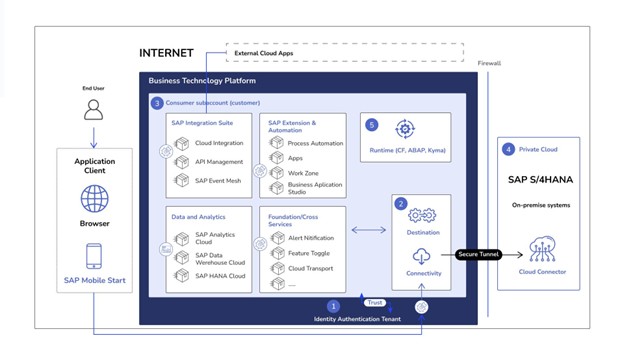
As organizations expand their SAP environments into cloud-based architectures, SAP BTP becomes an important layer for applications, integrations, APIs, data, automation, and extensions. This also means the security boundary becomes broader.
The important question is no longer simply:
"Is our SAP BTP environment secure?"
A better question is:
"Where are the gaps that could make our environment less secure?"
This article examines 10 SAP BTP security gaps that organizations should actively look for. More importantly, it explains why each gap matters, what it can lead to, and how security teams can approach remediation.
Definition Box: What Is SAP BTP Security?
SAP BTP Security is the combination of identity controls, authentication, authorization, application security, API protection, secure connectivity, data protection, monitoring, and governance used to protect applications and services running on SAP Business Technology Platform.
A strong security strategy doesn't depend on a single control. It creates multiple layers of protection around users, applications, APIs, data, integrations, and cloud infrastructure.
The objective is simple: Give the right identity the right access to the right resource for the right reason, while continuously monitoring what happens afterward.
The 10 Security Gaps at a Glance
Before examining each gap, here's the bigger picture:
| # | Security Gap | What Could Go Wrong? |
|---|---|---|
| 1 | Excessive permissions | Users gain unnecessary privileges |
| 2 | Weak identity governance | Former or unauthorized users retain access |
| 3 | Poor role design | Privilege escalation and access conflicts |
| 4 | Exposed APIs | Unauthorized data or service access |
| 5 | Unmanaged credentials | Credentials can be stolen or misused |
| 6 | Insecure applications | Application vulnerabilities become attack paths |
| 7 | Connectivity blind spots | Untrusted systems gain unwanted access |
| 8 | Weak monitoring | Security incidents go undetected |
| 9 | Poor data protection | Sensitive information can be exposed |
| 10 | Weak governance | Security gaps repeatedly return |
Now let's look beneath the surface.
1. Excessive Permissions: The "Everyone Has Access" Problem
Imagine a developer needs permission to deploy an application.
Instead of receiving only the access required for deployment, they receive a broad role collection containing additional administrative capabilities.
The application works. The developer gets their job done. And everyone moves on.
This is exactly how excessive permissions survive.
The problem isn't always that someone intentionally grants dangerous access. It can happen because broad permissions are easier to administer than carefully designed access.
But every unnecessary permission increases the potential impact of a compromised account.
This is where the principle of least privilege becomes important.
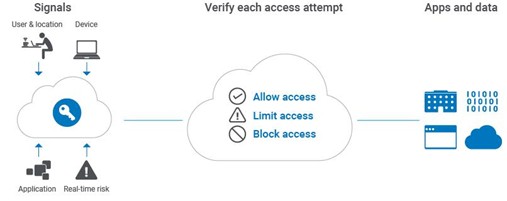
Users and services should receive only the permissions required to perform their responsibilities. Access should also be reviewed as responsibilities change.
A useful security review should ask:
- Which users have administrative permissions?
- Which roles are rarely used?
- Are developers accessing production environments?
- Are temporary permissions still active?
- Are service accounts overprivileged?
The key lesson is simple: Unused access isn't harmless access. It is additional attack surface.
2. Weak Identity Governance: When Old Access Becomes a Security Problem
Identity is one of the most important security boundaries in a cloud environment.
Employees join organizations, change departments, move into new positions, become administrators, or leave the company entirely.
Their access should change with them.
But what happens when identity lifecycle management isn't properly connected to cloud access?
An employee may move from development to another department while retaining old permissions. A contractor's account might remain active after a project ends. A former employee's access might not be removed quickly enough.
This creates unnecessary exposure.
Strong identity governance should cover the entire identity lifecycle:
- Joiner
- Mover
- Leaver
- Privileged user
- External user
- Technical identity
Organizations should also review dormant accounts and enforce appropriate authentication controls.
One question every security team should be able to answer is: If a privileged employee leaves today, exactly how quickly is their BTP access removed? If the answer is unclear, there may already be a governance gap.
3. Poor Role Design: When Permissions Combine Into a Bigger Risk
Not every access problem is caused by one dangerous permission.
Sometimes the risk appears when several individually reasonable permissions are combined.
Consider a user who can create a business transaction, approve it, and modify the related configuration.
Each permission might have a legitimate purpose. Together, however, they could create a serious control weakness.
This is where role design and Segregation of Duties (SoD) become important.
A mature access model separates responsibilities based on business risk rather than simply copying roles from one user to another.
Good role design should consider:
- Job responsibility
- Business process
- Required access
- Administrative privilege
- Production versus non-production access
- Conflicting responsibilities
The goal isn't to make roles as restrictive as possible. The goal is to make them appropriate and explainable. If an auditor asks why a user has a particular privilege, the organization should be able to explain the business reason.
4. Exposed APIs: The Door You Forgot Was Open
Modern SAP architectures depend heavily on APIs.
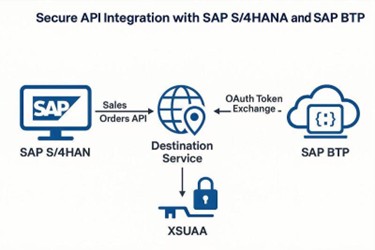
Applications need to communicate with SAP systems, mobile applications need backend services, partner applications need integrations, and cloud services need access to business capabilities.
But every API introduces another potential entry point.
An API can expose:
- Business data
- Application functionality
- Internal services
- Integration capabilities
The mistake is assuming that an API is secure simply because the application behind it is secure.
API security should consider authentication, authorization, input validation, access scopes, traffic controls, and monitoring.
Security teams should ask: Who can call this API? Then ask a more important question: What can that caller actually do after authentication?
Authentication establishes identity. Authorization determines what that identity is allowed to do. Those are not the same thing. A properly authenticated attacker with excessive API permissions can still become a serious security problem.
5. Unmanaged Credentials: Small Secrets, Large Consequences
One of the most avoidable cloud security problems is poor credential management.
A client secret appears in source code. A password gets copied into a configuration file. A technical credential is shared among several developers. A credential is created for testing and forgotten after deployment.
These situations can become dangerous because credentials often provide direct access to applications or services.
Security teams should establish clear practices for:
- Secret storage
- Credential rotation
- Technical user management
- Service authentication
- Access separation
- Credential revocation
The important point is that credentials have a lifecycle too. Creating a credential is only the beginning. You also need to know: Who owns it? Where is it used? When was it last rotated? What happens when it is no longer required? If nobody can answer those questions, the credential becomes a potential blind spot.
6. Insecure Applications: BTP Security Cannot Fix Every Code Problem
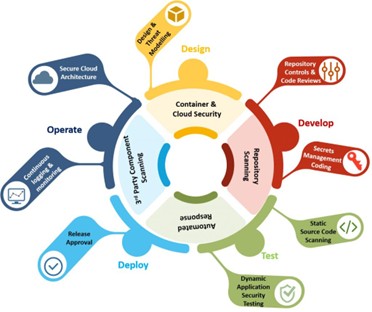
SAP BTP provides powerful platform capabilities, but developers still have responsibility for the security of the applications they build.
A secure cloud platform does not automatically make insecure application logic safe.
Consider an application that correctly authenticates users but fails to properly check whether they are authorized to access a particular business record. The platform may know who the user is. The application still needs to decide whether that user should access the requested resource.
Application security should therefore be built into the development lifecycle.
Developers should consider:
- Input validation
- Authorization checks
- Secure API consumption
- Dependency security
- Error handling
- Secure configuration
- Security testing
The strongest architecture can still be weakened by insecure code. Platform security and application security need to work together.
7. Connectivity Blind Spots: Every Connection Creates Trust
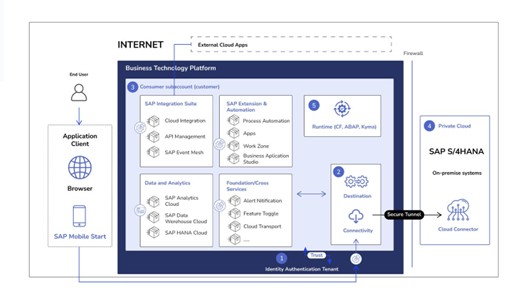
SAP BTP environments rarely operate alone.
They connect with SAP S/4HANA, databases, third-party applications, SaaS platforms, partner systems, and other cloud services.
Every connection creates a relationship that needs to be understood and controlled.
A security review should therefore map: Who connects → to what → through which mechanism → using which identity → with which permissions?
This is particularly important in hybrid environments. A connection that was necessary two years ago may no longer be required today. Yet if nobody reviews it, it can remain active indefinitely.
Organizations should periodically review destinations, trust relationships, connectivity configurations, and integration paths. The objective is not to eliminate connectivity. It is to ensure that every connection has a legitimate purpose and appropriate security controls.
8. Logging Exists, But Nobody Is Watching
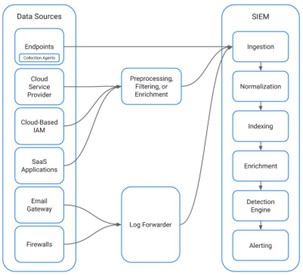
Many organizations collect logs. That sounds reassuring.
But collecting logs and detecting threats are two different things.
A log can record that an administrator changed a security configuration. The security team still needs to know whether that change was expected.
A log can show repeated failed authentication attempts. Someone still needs to determine whether they indicate an attack.
This creates an important distinction: Logging records activity. Monitoring interprets activity.
Effective monitoring should help identify:
- Suspicious authentication activity
- Unexpected administrative changes
- Repeated failed access attempts
- Unusual application behavior
- Privilege changes
- Potential security incidents
The ultimate goal isn't to collect the largest possible amount of data. It's to collect useful security signals and act on them. A security event that nobody notices can remain an active threat for far too long.
9. Poor Data Protection: Access Control Isn't the Whole Story
Security doesn't end once a user successfully logs in.
The next question is: What data can they access, and how is that data protected?
SAP environments can contain highly valuable business information, including financial information, customer data, employee information, operational data, and confidential business processes.
Organizations should therefore think about data protection across its entire lifecycle.
That includes:
- Data classification
- Data access
- Encryption
- Data transmission
- Storage
- Data retention
- Development and test environments
- Data sharing
A common mistake is treating all data equally. A public piece of information doesn't require the same controls as sensitive employee or financial information. Security becomes much more effective when organizations understand what data matters most and where it moves.
10. Weak Governance: The Gap That Brings All the Others Back
The final gap is perhaps the most important.
An organization can fix its permissions today. It can rotate credentials. It can secure APIs. It can configure monitoring.
But what happens six months later?
New employees join. Applications are deployed. Roles change. New integrations are created. Temporary access becomes permanent.
This is why security cannot be treated as a one-time configuration project. It needs governance.
Strong SAP BTP security governance should establish clear ownership for:
- Identity
- Authorization
- Applications
- APIs
- Integrations
- Monitoring
- Data
- Compliance
- Incident response
The objective is to make security repeatable. Security is not a checkbox that gets marked after implementation. It is an operating model that has to keep working as the environment changes.
How to Perform an SAP BTP Security Gap Assessment
After identifying these 10 gaps, the next step is to turn them into an actual review process.
Start with identity. Ask who has access, why they have it, and whether their current responsibilities still justify that access.
Then move into authorization and role design. Look for excessive privileges, administrative access, conflicting permissions, and unused roles.
Next, examine the application and integration landscape. Map APIs, destinations, external connections, technical identities, and service-to-service communication.
Finally, examine monitoring and governance. Ask whether important security events are being detected and whether someone is responsible for responding to them.
A simple assessment can be organized into five areas:
Identity
- Are inactive accounts removed?
- Are privileged users reviewed?
- Is authentication appropriately protected?
Access
- Is least privilege applied?
- Are roles reviewed?
- Are conflicting permissions identified?
Application and API
- Are applications securely developed?
- Are APIs protected?
- Are authorization checks implemented?
Infrastructure and Connectivity
- Are integrations documented?
- Are trust relationships reviewed?
- Are unnecessary connections removed?
Monitoring and Governance
- Are security events monitored?
- Are incidents investigated?
- Are security policies periodically reviewed?
This approach turns a broad security topic into a practical assessment.
Which Security Gaps Should You Fix First?
Not every security issue has the same risk level.
A useful approach is to prioritize based on: Risk = Likelihood × Impact
For example, an unused low-privilege account may not deserve the same urgency as an exposed API connected to sensitive business data.
Prioritize issues based on factors such as:
- Privilege level
- Data sensitivity
- External exposure
- Business criticality
- Number of affected identities
- Exploitability
- Compliance requirements
🔴 Critical — Issues involving privileged access, exposed sensitive systems, leaked credentials, or serious authorization weaknesses should receive immediate attention.
🟠 High — Significant role, API, connectivity, application, or monitoring weaknesses should enter a defined remediation cycle.
🟢 Controlled — Lower-risk configuration improvements can be tracked and addressed through normal security governance.
The important thing is to avoid treating every finding as equally urgent. Risk-based prioritization helps security teams focus resources where they matter most.
Building a Strong SAP BTP Security Operating Model
Technology alone cannot maintain security.
Different teams need to understand their responsibilities.
The security team may define security policies and risk requirements. The IAM team can manage identity lifecycle and access governance. SAP administrators can manage platform configuration and roles. Developers are responsible for secure application behavior. Business owners should validate whether users actually need the access assigned to them.
This shared responsibility model creates accountability. It also prevents a common problem: Everyone assumes somebody else owns security.
A mature operating model answers three questions for every important control:
- Who owns it?
- How often is it reviewed?
- What happens when something fails?
Those questions are simple, but they can expose major governance weaknesses.
The Future of SAP BTP Security: From Reactive to Continuous
Cloud environments change too quickly for organizations to depend only on annual security reviews.
Applications change. Users change. Permissions change. APIs change. Integrations change.
That means security also needs to become continuous.
Organizations are increasingly focusing on concepts such as:
- Continuous monitoring
- Zero Trust principles
- Automated compliance
- Identity-centric security
- Security automation
- DevSecOps
- AI-assisted threat detection
The future isn't simply about adding more security tools. It is about making security part of the entire application and identity lifecycle.
The Skills Modern SAP Security Professionals Need
SAP security professionals who want to work with modern cloud environments need to expand beyond traditional authorization concepts.
The skill set increasingly includes:
- SAP BTP architecture
- Identity and access management
- Cloud authorization
- API security
- Application security
- Integration security
- Security monitoring
- Compliance
- DevSecOps
- Cloud governance
For professionals looking to develop practical knowledge across these areas, SAP BTP Security Training can provide exposure to application development, APIs, integration, cloud services, and the broader BTP ecosystem.
The important career shift is from simply managing permissions to understanding how identity, applications, APIs, integrations, data, and cloud infrastructure work together. That broader perspective is becoming increasingly valuable.
SAP BTP Security Checklist: 10 Questions to Ask Today
Use this checklist as a quick security health check:
- Who has privileged access to our BTP environment?
- Are inactive and former-user accounts removed promptly?
- Are role collections based on least privilege?
- Are conflicting or excessive permissions reviewed?
- Are APIs properly authenticated and authorized?
- Are credentials and secrets securely managed and rotated?
- Are applications tested for security weaknesses?
- Are BTP connectivity and trust relationships regularly reviewed?
- Are important security events monitored and investigated?
- Who is accountable for ongoing BTP security governance?
If your team cannot confidently answer several of these questions, that doesn't necessarily mean the environment is insecure. It does mean there is an opportunity to investigate.
FAQs
1. What is SAP BTP Security?
SAP BTP Security is the collection of controls used to protect identities, applications, APIs, data, integrations, and workloads on SAP Business Technology Platform. It includes authentication, authorization, access management, secure development, monitoring, connectivity, and governance. A strong approach combines these controls rather than relying on a single security mechanism.
2. What are the biggest SAP BTP security risks?
Common risks include excessive permissions, weak identity lifecycle management, poorly designed roles, exposed APIs, unmanaged credentials, insecure application code, connectivity blind spots, inadequate monitoring, weak data protection, and poor governance. These gaps can increase the likelihood or impact of unauthorized access and security incidents.
3. How can organizations improve SAP BTP Security?
Organizations should begin with identity and access reviews, then assess roles, APIs, credentials, applications, connectivity, data, and monitoring. Applying least privilege, securing application development, regularly reviewing access, and establishing clear security ownership can significantly strengthen the overall security posture.
4. Why is IAM important in SAP BTP?
IAM determines who can access BTP resources and helps organizations manage authentication, identities, and authorization. Without effective identity governance, former employees, overprivileged users, or unmanaged technical identities can become security risks. Strong IAM is therefore one of the foundational elements of cloud security.
5. How often should SAP BTP Security be reviewed?
Security should be continuously monitored rather than reviewed only once a year. Formal access, role, configuration, API, and connectivity reviews should also be scheduled periodically and whenever significant organizational or architectural changes occur. The exact review frequency should depend on risk and business requirements.
6. Is SAP BTP Security important for cloud transformation?
Yes. Moving applications and integrations to the cloud changes the security landscape by introducing new identities, APIs, services, integrations, and access paths. A strong BTP security strategy helps organizations manage these changes while maintaining appropriate access control, monitoring, data protection, and governance.
Conclusion: Don't Wait for the Audit to Find the Gap
The most dangerous SAP BTP security problem may not be an obvious vulnerability.
It could be a role that nobody reviewed. A former employee who still has access. A credential that was never rotated. An API that was exposed for a temporary project and never closed. A security log that exists but nobody monitors. Or a policy that looks perfect on paper but has no clear owner.
That is why effective SAP BTP Security is not about configuring a platform once and declaring the environment protected.
It is about continuously asking difficult questions.
Who has access? Why do they have it? What can they do? Which systems can communicate? What data can they reach? What changes are happening? And who is watching?
The organizations that answer those questions consistently are better positioned to reduce security exposure as their BTP landscapes grow.
The goal isn't to eliminate every possible risk. The goal is to find the gaps before they become incidents.
And in a constantly changing cloud environment, that mindset may be the most important security control of all.
About the Author
TechBrainz Consulting
Helping professionals build practical SAP and cloud security skills for modern, enterprise-ready technology environments.