
SAP BTP Training: The Trending Skill Powering Enterprise Cloud Transformation in 2026
A complete guide to SAP BTP Training — definition, architecture, real-time use cases, and career roadmap
Enterprises across the globe are racing to modernize their SAP landscapes, and at the center of this transformation sits SAP Business Technology Platform, popularly known as SAP BTP. As organizations move from legacy ECC systems toward S/4HANA and cloud-native architectures, the demand for professionals skilled in SAP BTP has grown sharply. This is exactly why SAP BTP Training has become one of the most searched and most trending topics in the SAP ecosystem today.
SAP BTP Training equips functional consultants, ABAP developers, integration specialists, and fresh IT graduates with the skills needed to build extensions, integrate systems, manage data, and deploy AI-driven automation on a single unified cloud platform. Unlike traditional SAP modules that focused on a single functional area, SAP BTP spans integration, extension, data management, analytics, and artificial intelligence — making it a multi-disciplinary skill set that is highly valued by employers.
In this article, we take a deep dive into SAP BTP Training: what it means, why it is trending, the core architecture behind it, quick facts every learner should know, real-time industry use cases, and a clear learning roadmap represented through flowcharts. Whether you are a beginner planning your first SAP certification or an experienced consultant upskilling for cloud projects, this guide will help you understand why SAP BTP Training is currently one of the most valuable investments in the SAP career landscape.
What Is SAP BTP?
SAP Business Technology Platform (SAP BTP) is an integrated cloud platform offered by SAP that combines database and data management, analytics, application development, integration, and artificial intelligence capabilities into a single environment. It allows businesses to connect SAP and non-SAP systems, build custom applications, automate processes, and derive real-time insights without disrupting their core ERP systems.
In simple terms, SAP BTP acts as the digital backbone that connects an organization's core SAP systems (like S/4HANA) with cloud applications, third-party tools, and emerging technologies such as machine learning and generative AI. It is built on four major pillars:
- Database and Data Management — powered by SAP HANA Cloud for real-time data processing.
- Analytics — using SAP Analytics Cloud (SAC) for dashboards, planning, and predictive analysis.
- Application Development and Integration — through SAP Build, SAP Integration Suite, and API Management.
- Artificial Intelligence and Automation — via SAP AI Core, AI Foundation, and intelligent RPA capabilities.
SAP BTP Training, therefore, refers to structured learning programs — covering theory, hands-on labs, and certification preparation — that teach professionals how to design, build, integrate, and deploy solutions on this platform. Training providers typically break the curriculum into modules aligned with each of BTP's core pillars, so learners can specialize based on their career goals, whether that is integration development, extension building, or data and AI engineering.
Why Is SAP BTP Training Trending Right Now?
Several converging factors have pushed SAP BTP Training to the top of search trends and corporate learning agendas:
- RISE with SAP and the shift to S/4HANA Cloud have made BTP the default extension and integration layer for new implementations.
- SAP's 'clean core' strategy discourages custom code inside S/4HANA, pushing all customizations onto BTP instead.
- Growing enterprise interest in embedding generative AI and automation into business processes using SAP AI Core and Joule.
- A widening skills gap — many experienced SAP consultants trained in legacy ABAP and on-premise tools now need BTP skills to stay relevant.
- Rising project demand from system integrators (Accenture, Deloitte, Capgemini, TCS, Infosys) actively hiring BTP-certified professionals.
Recruiters and staffing agencies also report that job postings mentioning 'SAP BTP' have multiplied over the past two years, often appearing alongside traditional module skills such as SD, MM, or FI as an added requirement rather than a standalone role. This trend signals that BTP is no longer viewed as a niche specialization — it is becoming a baseline expectation for SAP professionals working on modern cloud landscapes. Training academies have responded by launching dedicated SAP BTP Training tracks, bootcamps, and certification-prep courses, further fueling search interest and enrollment numbers around the topic.
Core Modules Covered in a Typical SAP BTP Training Program
Most structured SAP BTP Training curricula are organized around the platform's four pillars, with each module building practical, job-ready skills:
- Integration Module: Building integration flows using Cloud Integration (CPI), configuring adapters, and managing APIs through API Management.
- Extension Module: Developing side-by-side extensions and in-app extensions using SAP Build, ABAP Cloud, and SAP Business Application Studio.
- Data & Database Module: Provisioning and managing SAP HANA Cloud instances, data modeling, and data replication techniques.
- Analytics Module: Creating dashboards, planning models, and predictive scenarios in SAP Analytics Cloud.
- AI & Automation Module: Working with SAP AI Core, AI Foundation, and intelligent RPA bots to automate repetitive business tasks.
- Security & Administration Module: Managing subaccounts, entitlements, roles, and identity authentication within the BTP cockpit.
Training providers typically combine these modules with guided labs on a live SAP BTP trial account, so learners can practice deploying integration flows, publishing extension apps, and configuring analytics stories in a realistic sandbox environment rather than relying purely on slides and theory.
Quick Facts About SAP BTP Training
| Attribute | Detail |
|---|---|
| Full Form | SAP Business Technology Platform |
| Launch Year | 2021 (evolved from SAP Cloud Platform) |
| Core Pillars | Database & Data Management, Analytics, Application Development & Integration, AI/Automation |
| Deployment Models | Public Cloud, Private Cloud, Hybrid |
| Popular Certifications | SAP Certified Associate - Integration Developer, SAP BTP Extension Suite, SAP HANA Cloud |
| Average Training Duration | 6 to 12 weeks (varies by module depth) |
| Career Roles | BTP Consultant, Integration Developer, Cloud Architect, ABAP Extensibility Developer |
| Industries Using SAP BTP | Manufacturing, Retail, Banking, Pharma, Utilities, Logistics |
SAP BTP Training Learning Path
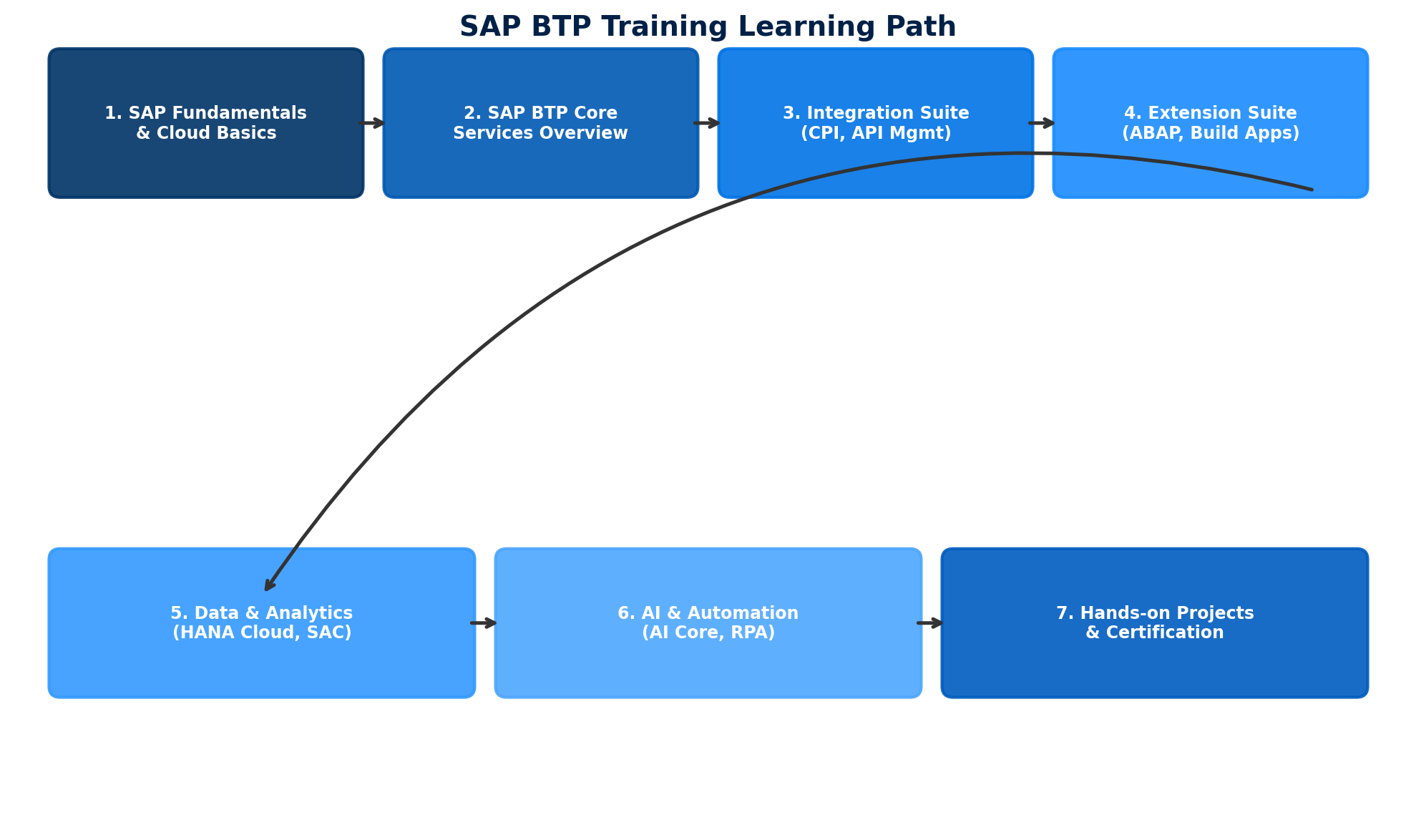
One of the most common questions among beginners is: 'Where do I start with SAP BTP Training?' The flowchart below outlines a structured, step-by-step learning path recommended by most training academies and corporate learning programs. This path is designed to be progressive. Learners first build a foundation in cloud computing and SAP basics, then move into the BTP cockpit and core services, followed by specialization in integration or extension development. Advanced learners then explore data engineering, analytics, and AI-driven automation before finishing with hands-on capstone projects and certification exams.
SAP BTP Architecture Flow
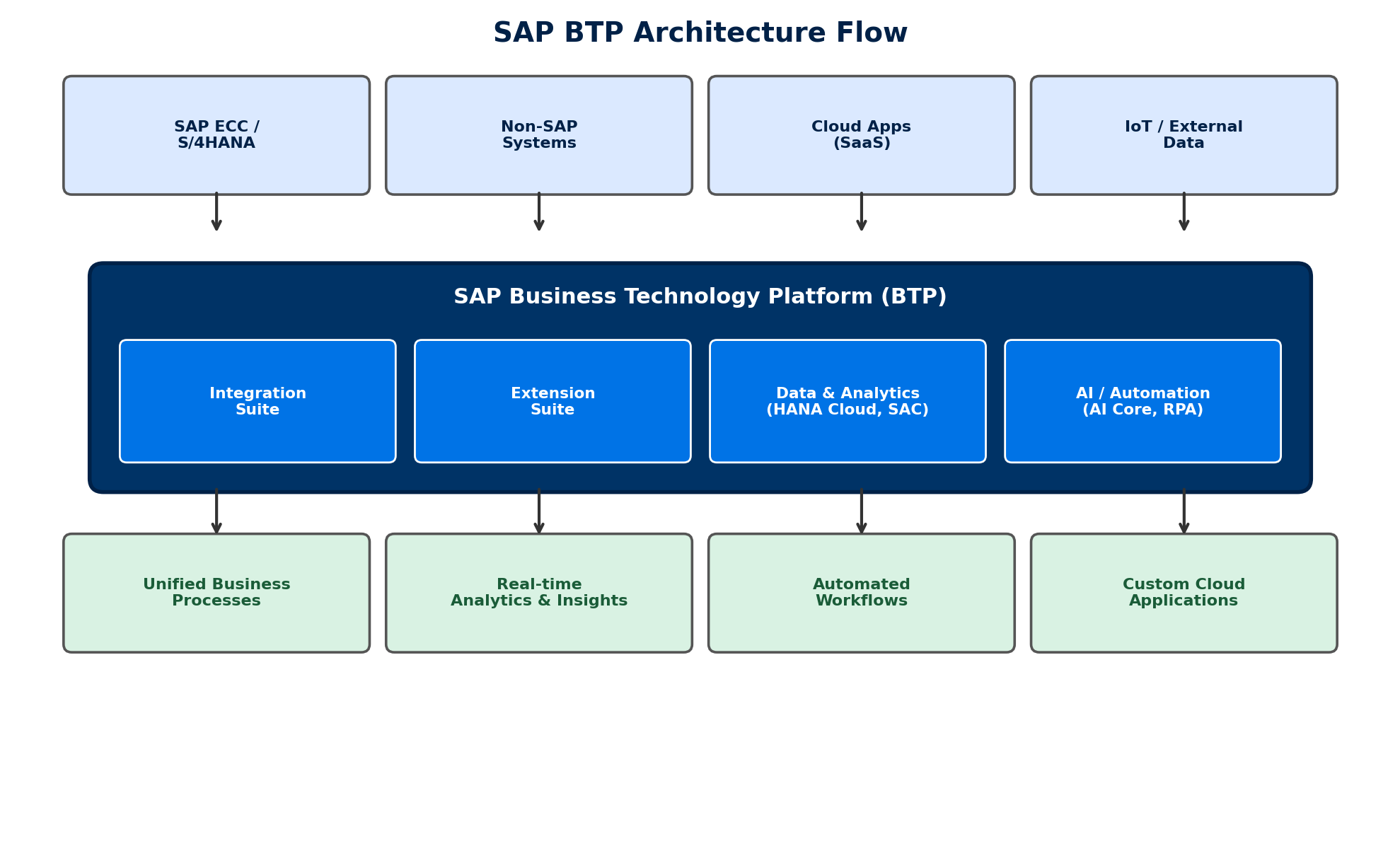
Understanding the architecture is central to any SAP BTP Training program. The diagram below shows how data flows from source systems, through the BTP core services, into meaningful business outcomes. As shown above, SAP BTP does not operate in isolation. It pulls data from SAP ECC or S/4HANA, non-SAP systems, third-party SaaS applications, and IoT devices. This data passes through the four core service groups — Integration Suite, Extension Suite, Data & Analytics, and AI/Automation — before producing tangible business outcomes such as unified processes, real-time insights, automated workflows, and custom cloud applications. SAP BTP Training programs typically dedicate separate modules to each of these four service groups.
Real-Time Use Cases of SAP BTP
Theory alone does not make SAP BTP Training valuable — what makes it powerful is its application in real enterprise scenarios. Below are numbered real-time use cases commonly covered in advanced training programs and case studies.
1. Retail: Real-Time Inventory Synchronization
A global retail chain used SAP Integration Suite on BTP to synchronize inventory data between its S/4HANA backend and multiple third-party e-commerce marketplaces in real time. Previously, stock updates took hours through batch jobs; after implementing BTP-based integration flows, updates happened within seconds, reducing overselling incidents and improving customer satisfaction.
2. Banking: Fraud Detection Using AI Core
A banking institution leveraged SAP AI Core and AI Foundation on BTP to build a machine learning model that scores transactions for fraud risk in real time. The model was trained on historical transaction data and deployed as a microservice, flagging suspicious transactions before they were finalized, cutting fraud losses significantly.
3. Manufacturing: Predictive Maintenance with SAP HANA Cloud
A manufacturing company connected IoT sensors on factory equipment to SAP HANA Cloud through BTP's data management services. Real-time sensor data combined with SAP Analytics Cloud dashboards allowed maintenance teams to predict equipment failures before they occurred, reducing unplanned downtime and maintenance costs.
4. Pharmaceuticals: Clean Core Extensions Using SAP Build
A pharmaceutical company adopted the 'clean core' approach during its S/4HANA Cloud migration. Instead of modifying the core ERP, its developers used SAP Build and the Extension Suite on BTP to create custom approval workflows for batch release processes, keeping the core system upgrade-safe while still meeting compliance-specific business requirements.
5. Logistics: Automated Document Processing with RPA
A logistics and freight company integrated SAP Intelligent RPA (part of the BTP automation suite) to automatically extract data from shipping documents and invoices, feeding it directly into their SAP system. This reduced manual data entry effort by a large margin and minimized human error in customs documentation.
6. Utilities: Unified Customer Experience via API Management
A utilities provider used SAP API Management on BTP to expose secure APIs that connected its billing system, customer mobile app, and call center software. This gave customer service agents and self-service app users a single, consistent view of account and billing data, improving first-call resolution rates.
These real-time cases illustrate why organizations prioritize hiring and upskilling talent through SAP BTP Training — the platform is not a theoretical concept but an active enabler of measurable business outcomes across industries. In each case, the underlying pattern is similar: a business problem that legacy, on-premise customization could not solve efficiently was addressed by combining BTP's integration, data, or AI services with the existing SAP core — exactly the kind of scenario-based problem solving that quality SAP BTP Training programs are designed to teach.
Challenges Organizations Face Without Proper SAP BTP Training
Skipping structured training and attempting to learn SAP BTP purely on the job often leads to avoidable setbacks. Common challenges include:
- Misconfigured subaccounts and entitlements, leading to licensing overruns or blocked service access.
- Poorly designed integration flows that fail under production data volumes, causing performance bottlenecks.
- Security gaps from incorrect role and authorization setup in the BTP cockpit.
- Extensions built without following clean core principles, resulting in upgrade conflicts down the line.
- Underuse of available AI and automation services simply because teams are unaware of their existence or capabilities.
Formal SAP BTP Training directly addresses these gaps by teaching best practices, governance standards, and architectural patterns recommended by SAP itself, reducing costly trial-and-error during live client projects.
Benefits of Taking SAP BTP Training
- Higher employability — BTP skills are increasingly listed as mandatory in SAP job postings, especially for RISE with SAP projects.
- Cross-functional exposure — learners gain knowledge across integration, extension, data, analytics, and AI, rather than a single narrow module.
- Future-proofing careers — as SAP pushes clean core adoption, BTP becomes the only supported place for custom development.
- Certification value — SAP-recognized certifications from BTP training carry strong weight in consulting and enterprise hiring.
- Higher compensation — BTP-certified consultants often command premium rates compared to traditional functional-only consultants.
- Access to emerging technology — hands-on exposure to generative AI tools like Joule and SAP AI Core keeps professionals technologically current.
Who Should Enroll in SAP BTP Training?
- SAP ABAP developers transitioning to cloud-based extensibility.
- SAP functional consultants (SD, MM, FI, etc.) looking to add integration or automation skills.
- Fresh graduates in computer science or IT aiming to enter the SAP consulting ecosystem.
- Enterprise architects designing hybrid landscapes involving SAP and non-SAP systems.
- Data engineers and analytics professionals wanting to specialize in SAP HANA Cloud and SAP Analytics Cloud.
How to Choose the Right SAP BTP Training Program
With so many training providers offering SAP BTP courses, selecting the right one matters. Look for programs that include hands-on lab access to a live BTP trial or enterprise account, real-world project simulations similar to the use cases described above, instructor experience with actual client implementations, and a clear mapping to official SAP certification exam objectives. Programs that only cover theory without practical BTP cockpit navigation, integration flow building, or extension deployment tend to leave learners underprepared for real project work.
It is also worth checking whether a training program updates its content regularly. SAP BTP evolves quickly, with new services and AI capabilities such as Joule being added frequently. A course built two or three years ago may not reflect the platform's current cockpit layout, service names, or recommended architecture patterns, so recency of course material is just as important as the depth of its content.
Typical SAP BTP Training Duration and Format
Most SAP BTP Training programs are delivered as a mix of instructor-led sessions and self-paced labs, spanning roughly six to twelve weeks depending on how many pillars are covered. Beginner-friendly tracks that focus only on integration or only on extension development can often be completed in four to six weeks, while comprehensive programs covering all four pillars plus certification preparation typically run closer to three months. Corporate training often compresses this timeline into intensive bootcamps of two to four weeks for teams that already have SAP background knowledge.
Frequently Asked Questions
Yes. As more companies move their SAP systems and business applications to the cloud, SAP BTP skills are becoming increasingly useful. Learning BTP can help you understand how businesses connect applications, manage data, build extensions, and use modern cloud services.
SAP consultants, developers, administrators, data professionals, and IT professionals can all benefit from SAP BTP training. Even if you are new to SAP, BTP can be a good skill to add if you want to build a career around SAP cloud technologies.
Not necessarily. Having experience with SAP systems can make some concepts easier to understand, but beginners can also start with the fundamentals. A good training program should gradually explain BTP architecture, services, security, integration, and development.
You can learn areas such as application development, SAP integration, data management, security, cloud application extensions, APIs, and SAP BTP services. The exact topics depend on the training program and the learning path you choose.
Think of SAP BTP as a platform that helps businesses connect and extend their SAP environment without changing the core system unnecessarily. Companies can integrate different applications, build new solutions, work with business data, and develop extensions using cloud-based services.
It can certainly strengthen your profile, especially when combined with practical SAP experience. Employers looking for SAP cloud, integration, development, and transformation skills may value candidates who understand how BTP fits into a modern SAP landscape.
It can feel complex at first because BTP covers several areas rather than one single technology. The good news is that you don't have to learn everything at once. Starting with the platform basics and then moving into areas such as integration, development, or data can make the learning process much easier.
Look for training that goes beyond theory. Practical exercises, real-world business scenarios, hands-on projects, integration examples, and guidance on commonly used BTP services can make the training much more valuable. Also check whether the course matches the career path you want to follow.
Conclusion
SAP's technology ecosystem is shifting decisively toward the cloud, and SAP Business Technology Platform sits at the heart of that shift. From real-time inventory synchronization in retail to AI-driven fraud detection in banking, the real-time use cases discussed in this article prove that BTP is already delivering measurable value across industries. As more organizations adopt RISE with SAP and the clean core strategy, the demand for professionals who understand integration, extension, data management, analytics, and AI on a single platform will only continue to grow.
This is precisely why SAP BTP Training has become such a trending and valuable investment for both new and experienced SAP professionals in 2026. Whether your goal is to switch careers into SAP consulting, add cloud skills to an existing ABAP or functional background, or future-proof your role against clean core mandates, structured SAP BTP Training gives you the architecture knowledge, hands-on experience, and certification readiness needed to succeed. Investing in SAP BTP Training today is not just about learning a new tool — it is about aligning your career with the direction SAP itself is heading.