
SAP Business AI Platform: AI That Thinks Like Business
Introduction: What If AI Could Understand Your Business, Not Just Your Question?
Imagine a procurement manager opening the laptop on Monday morning and asking a simple question: "What could put this week's production schedule at risk?" In a traditional enterprise environment, answering that question can turn into a small investigation. The manager may need to check supplier performance, open purchase orders, inventory levels, production schedules, material availability and customer commitments. The information is available, but it is spread across different places. The real challenge is not finding data. It is understanding what that data means for the business.
Now imagine a different experience. The system already understands that a particular supplier is becoming less reliable. It knows that the supplier is responsible for a material needed in an important production order. It can see that current inventory may not cover the expected delay and that another supplier may be available. Instead of simply displaying another warning on a dashboard, the system can explain the situation and help the employee decide what should happen next.
That is where the idea behind SAP Business AI Platform becomes interesting.
Artificial intelligence is moving beyond the stage where impressive answers are enough. Businesses increasingly want AI that understands their data, processes, roles, relationships, rules and objectives. They want intelligence that fits into the way work is actually performed.
This creates a much more important question than "Can AI answer my question?"
The question is: Can AI understand why the answer matters to my business?
That is the thinking behind Business AI. It is not simply about putting generative AI inside enterprise applications. It is about bringing intelligence closer to business processes so that AI can help people understand situations, make decisions and, where appropriate, take action.

Definition Box: What Is SAP Business AI Platform?
SAP Business AI Platform refers to SAP's enterprise AI foundation for bringing together AI capabilities, business data, business context, applications, agents and governance. The goal is to enable AI experiences that are grounded in how an organization actually operates rather than relying only on generic AI knowledge.
Why Does Enterprise AI Need Business Context?
The biggest difference between general-purpose AI and enterprise AI becomes visible when the question involves a real business decision.
Suppose someone asks an AI system, "Why did our delivery performance decline this month?" A general AI model can explain possible reasons for poor delivery performance. It can discuss transportation delays, inventory shortages, supplier problems or production bottlenecks. That answer might sound intelligent, but it is still general.
An enterprise wants something different. It wants to know why its delivery performance declined.
That answer could require customer orders, inventory records, supplier information, production capacity, logistics data, historical performance and business priorities. It may also depend on the difference between a minor customer order and a strategically important customer commitment.
This is why business context matters so much.
Enterprise information is connected through relationships. A supplier is connected to materials. Materials are connected to production. Production is connected to customer demand. Customers are connected to contracts and revenue. Employees are connected to roles and authorizations. Financial transactions are connected to organizational structures and business rules.
When AI can work with those relationships, the nature of the interaction changes.
Instead of saying, "Here is what the data says," AI can increasingly help answer, "Here is what is happening, why it matters and what you might want to consider next."
That is a much more valuable role for AI inside an enterprise.
What Exactly Makes SAP Business AI Different?
It is easy to think of SAP Business AI as another generative AI offering. That interpretation misses the bigger picture.
The important idea is not the AI model alone. The value comes from connecting intelligence with the environment in which business decisions are made.
A finance employee does not work with "data" in isolation. The employee works with invoices, payments, customers, suppliers, financial controls and reporting requirements. A supply-chain professional does not simply analyze numbers. That person works with demand, inventory, suppliers, transportation, production and customer commitments. A human resources professional works with employees, organizational structures, policies, skills and workforce processes.
AI becomes significantly more useful when it understands those environments.
This is where SAP's broader Business AI approach becomes relevant. SAP brings AI capabilities into its business application landscape and connects them with business context, data and workflows. The intention is to make AI part of the work rather than another separate technology employees have to learn.
That creates an important progression.
At the beginning, AI could simply answer a question. Then it became capable of generating content and summarizing information. The next stage is AI that understands the context surrounding a request. From there, AI can provide recommendations and, in controlled situations, participate in business processes.
The technology is therefore moving from answering questions to understanding situations.
That is a far more interesting transformation.
How Does SAP Joule Fit Into the Business AI Story?
When people discuss SAP Business AI, Joule naturally enters the conversation because it represents one of the ways users interact with SAP's AI capabilities.
Think about how enterprise applications have traditionally worked. Employees often need to know which application to open, which transaction or screen to find, which filter to apply and which report to run. Experienced users become extremely efficient at navigating these systems, but there is still a learning curve and considerable time can be spent searching for the right information.
A conversational AI experience changes that interaction.
Instead of beginning with an application screen, the employee can begin with an intention. The employee might want to understand why a particular business metric changed, find information about a customer or investigate an operational issue.
Joule is positioned within SAP's AI strategy as an AI experience that can help users interact with business information and processes more naturally. The broader evolution toward Joule agents and assistants also points toward a model where AI is not limited to answering questions but can help coordinate work.
The important point is that the conversation is not really about replacing enterprise applications.
It is about making those applications easier to use.
The user should not have to think like the software. Increasingly, the software should understand what the user is trying to accomplish.
How Does SAP Business AI Platform Turn Data Into Business Intelligence?
The journey from raw data to useful business intelligence is more complicated than simply connecting an AI model to a database.
First, the AI needs access to relevant information. Then it needs to understand what that information represents. A number such as "15%" means very little without context. Is it a 15% increase in sales? A 15% decline in inventory? A 15% increase in supplier lead time? The meaning depends on the business object and process surrounding it.
After understanding the information, AI needs to connect relevant pieces together.
Imagine that inventory for a particular material has declined by 15%. On its own, that may not be alarming. But suppose demand for the same material has increased, a supplier is reporting delays and an important production order is scheduled for next week. Suddenly, the same inventory number has a completely different meaning.
This is where context becomes powerful.
The general flow can be understood as data, context, intelligence, decision and action. Data provides the raw material. Business context gives that information meaning. AI helps identify patterns and relationships. People or AI systems can then determine what should happen next, subject to appropriate controls.
This is also why the foundation underneath AI matters so much. Good AI requires relevant, reliable and accessible business information.
An organization cannot simply place an AI model on top of disconnected or poor-quality data and expect intelligent business outcomes.
Why Is Business Context More Valuable Than Another Dashboard?
Businesses have never had a shortage of dashboards.
In fact, many organizations have the opposite problem. Employees have too many dashboards, too many reports and too many notifications.
The challenge is deciding which information deserves attention.
Consider a sales manager who receives a dashboard showing that revenue in one region has decreased. The dashboard is useful, but the manager still needs to investigate. Which customers changed their purchasing behavior? Is the decline seasonal? Did a major contract end? Are competitors gaining market share? Is there a supply issue? Is the problem temporary or structural?
A context-aware AI experience can potentially bring those questions closer together.
The important transformation is not that AI creates another visualization. It is that AI can help connect information and explain the significance of what the business is seeing.
This changes the relationship between people and enterprise systems.
Instead of employees constantly asking, "Where can I find the information?", they can increasingly ask, "What is happening here?"
That sounds like a small change.
It is not.
It changes enterprise software from something people primarily navigate into something that can increasingly participate in understanding the work.
Where Can SAP Business AI Create Real Business Value?
The strongest Business AI opportunities are not necessarily the flashy ones. They are often found in repetitive situations where employees spend significant amounts of time collecting information, comparing records, investigating exceptions and coordinating with other teams.
Finance is a good example. Financial professionals frequently need to understand unusual transactions, investigate changes, prepare reports and interpret financial information. AI can help reduce the amount of manual searching and summarization required before a person can make a decision.
Procurement offers another strong opportunity. A procurement professional may need to investigate supplier performance, understand purchasing history, identify delays and determine whether alternative options exist. An AI-enabled environment can help connect those pieces instead of forcing the employee to investigate each one independently.
Supply chain is particularly interesting because business problems rarely remain inside one department. A supplier delay can become an inventory problem. An inventory problem can become a production problem. A production problem can become a customer problem. The ability to connect those relationships is where AI can provide value beyond simple reporting.
Human resources also presents opportunities. Employees frequently need answers about policies, processes, workforce information and routine requests. AI can make those interactions more natural while reducing the administrative burden on HR teams.
Across all these examples, the same pattern appears.
The business does not necessarily need AI to make every decision.
It needs AI to reduce the time between something happening and the business understanding what it means.
Are AI Agents the Next Step Beyond AI Assistants?
This is where enterprise AI becomes even more interesting.
A traditional assistant generally waits for a request. You ask a question and it responds.
An AI agent can be designed around an objective.
Imagine that a procurement employee asks, "Find out why this purchase order is delayed."
An assistant might help locate the relevant information.
An agent-oriented system could potentially investigate the situation across connected information sources, identify the cause, evaluate available options and coordinate approved next steps.
The difference is not simply technical. It changes how work can be organized.
Instead of AI being a destination where employees go to ask questions, AI can become part of the workflow itself.
This is why agentic AI is receiving so much attention in enterprise technology. Agents can potentially handle multi-step tasks rather than generating a single response.
However, autonomy needs boundaries.
An agent that can read information is one thing. An agent that can change records, approve transactions or trigger financial activity is something entirely different.
The more capable the AI becomes, the more important governance becomes.
What Does Security Mean When AI Can Take Action?
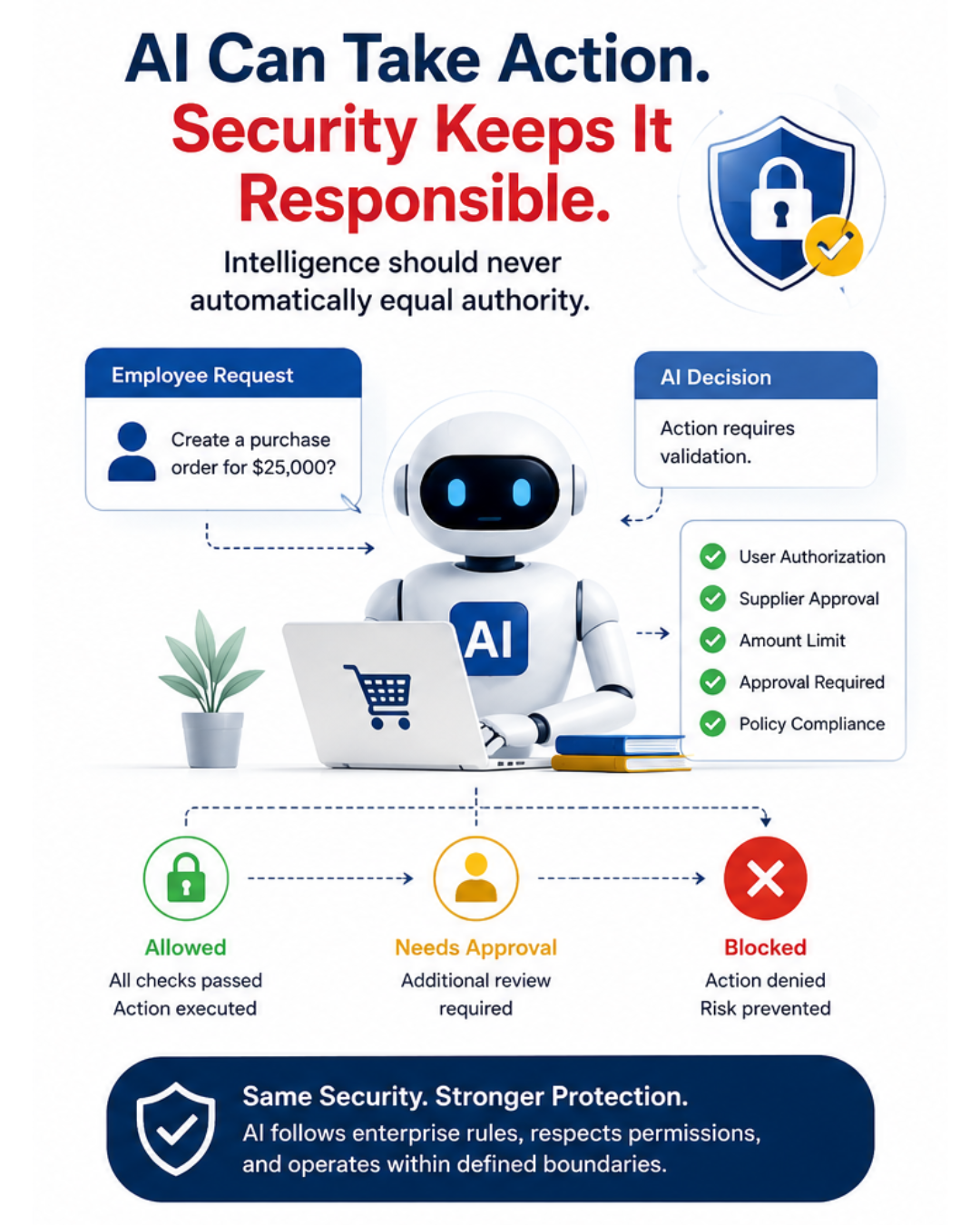
Security becomes especially important when AI moves from providing information toward performing actions.
Imagine an employee asking an AI system to create a purchase order. Should the system simply do it?
The answer depends on several factors.
Does the employee have the required authorization? Is the supplier approved? Is the amount within the employee's permitted limit? Does the transaction require another approval? Is the request consistent with organizational policies?
AI should not bypass these controls.
In fact, the opposite should happen. AI-enabled processes need to respect the same enterprise security principles that govern traditional applications, while also addressing new risks created by AI interactions.
Identity, authorization, data access, auditability and human oversight therefore become part of the Business AI conversation.
This is an important principle for organizations adopting enterprise AI:
Intelligence should never automatically equal authority.
An AI system can be highly capable while still operating within carefully defined permissions.
That distinction will become increasingly important as organizations move from AI assistants toward AI agents and more autonomous workflows.
Can AI Be Trusted With Business Decisions?
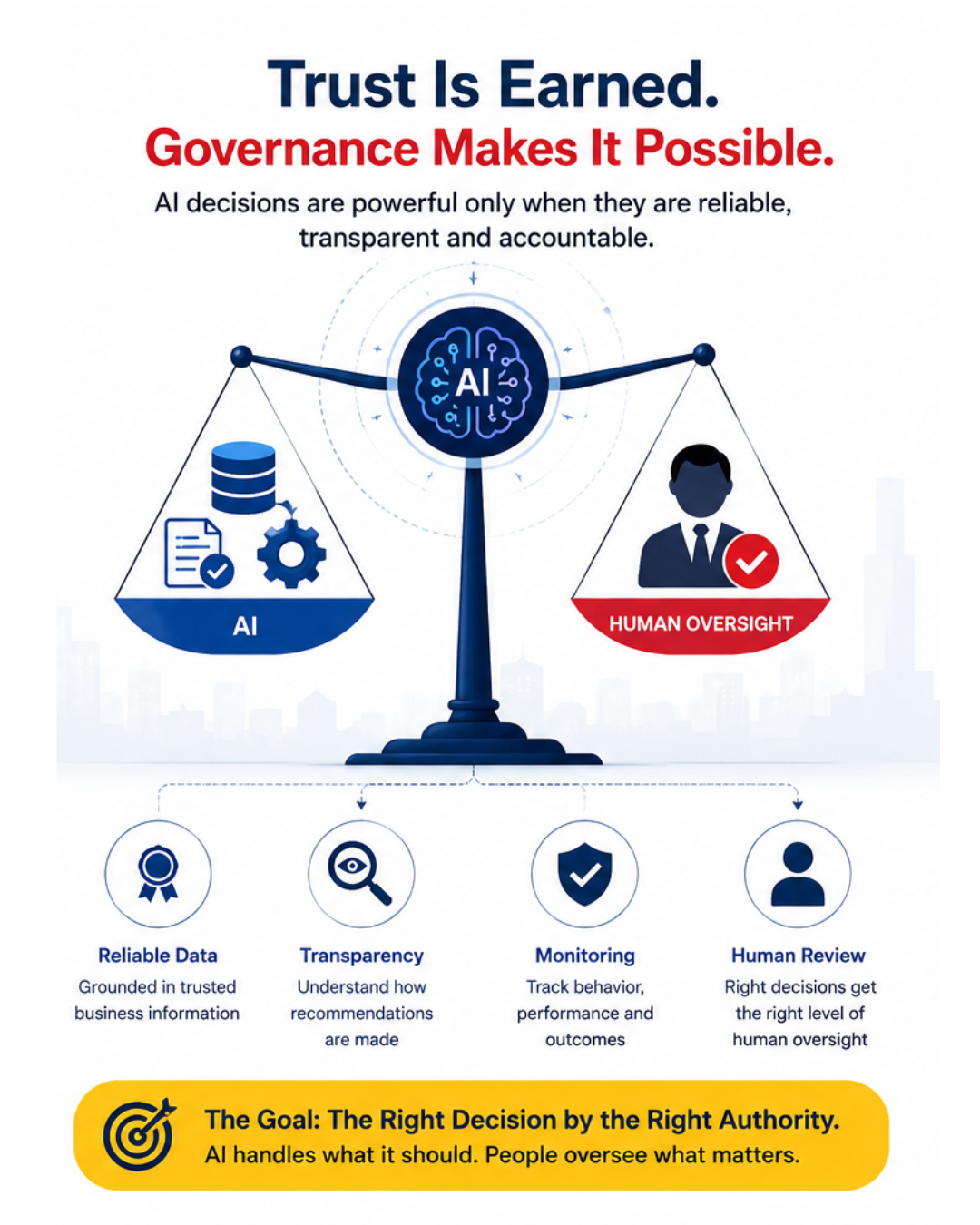
Trust is one of the biggest questions surrounding enterprise AI.
Generative AI can sometimes produce incorrect information with a convincing tone. Enterprise AI can also encounter incomplete data, conflicting records or changing business rules.
For that reason, organizations should not evaluate AI only by asking whether it produces impressive responses.
They should ask whether the AI is grounded in reliable business information, whether its behavior can be monitored, whether users can understand the basis of important recommendations and whether appropriate human review exists.
This is where governance becomes part of the technology rather than an administrative activity added later.
A low-risk recommendation may require limited human intervention. A decision involving sensitive employee information, financial commitments or regulatory consequences may require significantly stronger controls.
The objective should not be to create an enterprise where AI makes every decision.
The objective should be to create an enterprise where AI can be trusted to perform the tasks that are appropriate for its level of authority.
That is a much more realistic vision of intelligent automation.
Why Will Data Quality Become Even More Important?
There is a common misconception that AI can solve poor data.
It cannot.
If customer information is duplicated, supplier records are outdated, business definitions are inconsistent and important information is trapped in disconnected systems, AI will face the same underlying problems that humans face.
In some cases, AI may make those problems harder to see because it can produce a confident-looking answer from incomplete information.
This makes the data foundation critical to Business AI.
The AI may be sophisticated, but the quality of its output still depends heavily on the quality and relevance of the information available to it.
That is why enterprise AI projects should not begin with the question, "Which AI model should we use?"
A better starting point is:
"Which business problem are we solving, and does the organization have the data and process foundation required to solve it?"
For professionals working with SAP landscapes, this is also where understanding enterprise data, SAP BTP, integration and business processes becomes increasingly valuable.
As organizations explore SAP Business AI Platform Training, the most useful learning approach should therefore go beyond understanding AI terminology. Professionals should understand how AI connects with enterprise data, business processes, security, applications and business outcomes.
Will SAP Business AI Replace People?
This question will continue to attract attention, but it is probably the wrong way to frame the transformation.
Most businesses do not need AI to replace every person involved in a process. They need to remove unnecessary manual work.
Think about an employee who spends hours every week searching for information, copying data between systems, preparing routine summaries and checking exceptions.
If AI can handle some of that work, the employee has more time for analysis, communication, problem-solving and decisions that require judgment.
The future is therefore more likely to be about human-AI collaboration than simple human replacement.
A finance professional can remain accountable for financial decisions while AI handles repetitive analysis. A procurement professional can remain responsible for supplier strategy while AI helps investigate operational issues. A consultant can continue designing business solutions while AI accelerates research and development activities.
The role changes because the nature of the work changes.
The most valuable professionals may increasingly be those who know how to combine business expertise with AI capabilities.
What Skills Will SAP Professionals Need in the Business AI Era?
The growth of SAP Business AI is creating a different kind of skills demand.
Professionals do not necessarily need to become data scientists or machine-learning researchers. What matters more is the ability to understand where AI fits into an enterprise environment.
An SAP consultant who understands business processes and AI can identify automation opportunities more effectively. An SAP developer who understands AI-enabled application patterns can build more intelligent solutions. A security professional who understands AI authorization and governance can help organizations deploy AI more safely. A data professional who understands business context can help ensure AI receives the information it needs.
This creates an interesting shift from specialization toward combination.
The valuable profile is increasingly:
SAP knowledge + business-process knowledge + AI understanding + data awareness + governance
That combination can be useful across consulting, development, architecture, security, data and business analysis roles.
For professionals planning their next SAP career move, Business AI is therefore not just another technology to memorize. It is becoming part of the broader enterprise technology skill set.
What Could the SAP Business AI Future Look Like?
Imagine starting a workday without immediately opening ten different dashboards.
Instead, your business environment already understands what requires attention.
A supply-chain issue appears. AI explains that a supplier delay could affect a particular production schedule. It connects the issue to inventory and customer commitments. It suggests possible alternatives.
Meanwhile, finance receives an explanation of an unusual financial pattern. Procurement receives a recommendation related to supplier performance. Employees get answers to routine questions without navigating several applications.
None of this requires humans to disappear.
People remain responsible for priorities, judgment, strategy and accountability.
The difference is that AI increasingly handles the work of connecting information and coordinating routine activities.
This is the direction in which the idea of the autonomous enterprise becomes meaningful.
Autonomy does not necessarily mean that machines run everything without people.
It can mean that technology handles more of the operational complexity while humans concentrate on decisions that genuinely require human judgment.
That is a much more practical and compelling vision.
What Should Businesses Do Before Adopting Business AI?
Organizations should resist the temptation to start with technology alone.
The first step should be identifying business problems where AI can create measurable value. A process that consumes significant employee time, involves repetitive investigation or requires employees to gather information from multiple systems may be a stronger candidate than a process chosen simply because AI sounds impressive.
The next step is understanding the data behind that process. Organizations need to know where the information comes from, whether it is reliable and whether the AI can access it appropriately.
Security should then be considered as part of the design. AI access needs to follow business authorization, data protection and governance requirements.
Finally, organizations should decide where human involvement remains necessary.
This creates a more responsible path toward Business AI:
Business problem first. Data second. AI third. Automation only where it makes sense.
That approach can prevent organizations from deploying AI simply for the sake of saying they use AI.
The Bigger Picture: AI Is Becoming Part of the Business Process
The most important change may not be the AI model itself.
It may be the location of intelligence.
For years, intelligence largely sat with people. Software stored information and executed predefined processes. People interpreted the information and decided what to do.
Then analytics became more powerful. Systems could identify patterns and provide insights.
Generative AI added another layer by making interaction with information more natural.
Now AI agents are beginning to move toward multi-step work.
The result is a gradual shift:
Software records work. Analytics explains patterns. AI understands context. Agents coordinate actions. People provide direction and accountability.
That is why the Business AI conversation is bigger than chatbots.
It is about changing the relationship between employees, data and enterprise software.
When intelligence becomes part of the process itself, employees may no longer experience AI as a separate tool.
They may simply experience a smarter way of working.
Conclusion: The Real Shift Is From Information to Intelligence
Enterprise software has always been about helping businesses manage complexity.
It records transactions. It manages processes. It stores information. It produces reports. It helps organizations operate at scale.
But the next stage is different.
Businesses do not simply want systems that tell them what happened. They want systems that can help them understand what is happening, why it matters and what could happen next.
That is where SAP Business AI Platform becomes significant.
The opportunity is not simply to add AI to an existing application. The bigger opportunity is to connect AI with business data, business context, enterprise processes and governance.
When those pieces come together, AI can become much more relevant to the way organizations actually work.
The future will not necessarily belong to companies that automate everything. It will belong to companies that understand where intelligence can create value and where human judgment must remain in control.
The most interesting part of this transformation is that AI is moving closer to the business itself.
It is learning to work with the language of customers, suppliers, employees, finance, operations and processes.
And perhaps that is the real meaning behind the title.
The future of enterprise AI is not simply AI that thinks more. It is AI that understands what the business is trying to achieve.
Frequently Asked Questions
1. What is SAP Business AI Platform?
SAP Business AI Platform is SAP's approach to bringing AI capabilities together with enterprise data, business processes, applications and governance. It is designed to help organizations use AI in business situations where context, security and process understanding matter.
2. What is SAP Business AI used for?
SAP Business AI can support areas such as finance, procurement, supply chain, human resources and other enterprise processes. Its value comes from helping users understand business information, receive intelligent assistance and, where appropriate, automate parts of business workflows.
3. What is the role of Joule in SAP Business AI?
Joule provides an AI-driven interaction experience within the SAP ecosystem. It is designed to help users interact with business information and processes more naturally, while SAP continues expanding its capabilities through agents and assistants.
4. How are AI agents different from AI assistants?
An AI assistant generally responds to user requests and helps provide information or recommendations. An AI agent can be designed to perform multiple steps toward a particular business objective, potentially coordinating tasks and actions while operating within defined permissions and governance controls.
5. Is SAP Business AI secure for enterprise use?
Security needs to be designed into every enterprise AI implementation. Organizations need appropriate identity, authorization, data protection, monitoring and governance controls. AI should not automatically receive additional business authority simply because it can understand or process information.
6. What skills are useful for SAP Business AI?
Professionals can benefit from combining SAP knowledge with AI fundamentals, business-process understanding, enterprise data, SAP BTP, integration, automation and governance. The ability to connect AI capabilities with real business requirements can become especially valuable as enterprise AI adoption grows.
About the Author
TechBrainz Consulting
Helping professionals build practical SAP skills for modern enterprise technology and business transformation.