
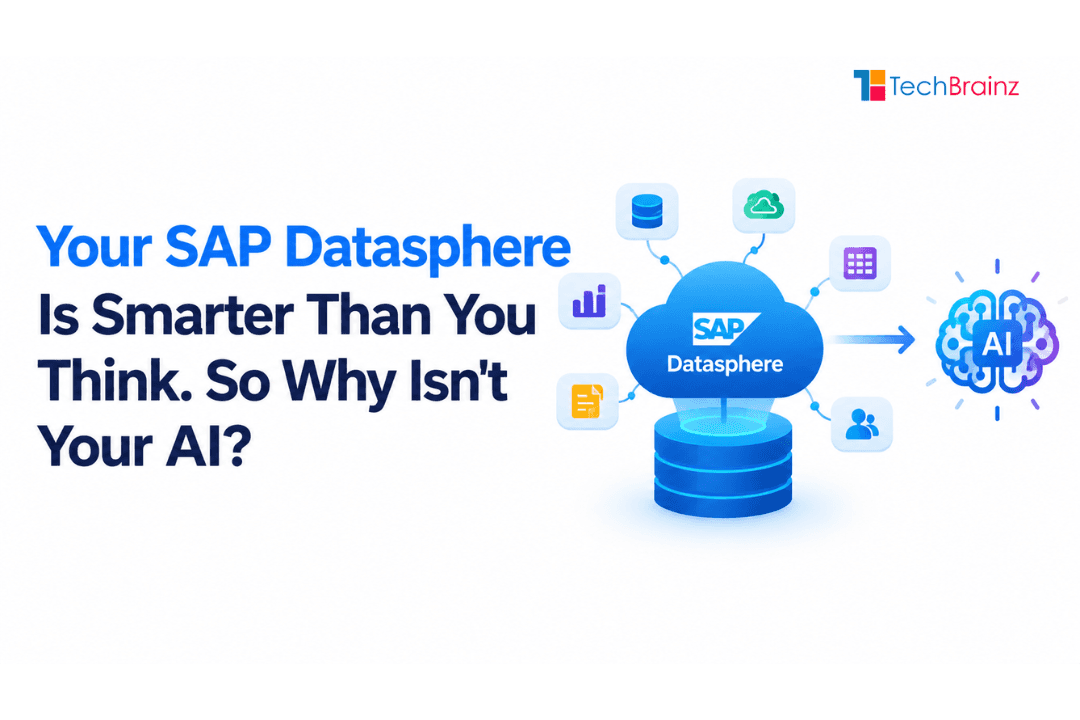
Your SAP Datasphere Is Smarter Than You Think. So Why Isn't Your AI?
Introduction: Your AI Has Data. But Does It Understand Your Business?
Your company probably has more data than it knows what to do with.
Sales orders. Customer records. Products. Suppliers. Inventory. Finance data. Procurement data. Workforce information. Forecasts. Service transactions.
And somewhere inside that enormous landscape, there is probably a question your leadership team wants answered:
"Why did profitability decline last quarter?"
At first glance, this sounds like a simple AI question.
Give the AI access to the data, ask the question, and wait for the answer.
But enterprise data doesn't work that way.
An AI model might find that revenue decreased. It might identify a region with declining sales. It might even detect that certain products contributed to the decline.
But does it understand what "profitability" means in your organization?
Does it know which revenue definition is approved by finance?
Does it understand the relationship between customers, products, regions, orders, costs, inventory, and supply constraints?
Does it know which data source is authoritative?
And perhaps most importantly:
Can it distinguish a technically correct answer from a business-correct answer?
This is where SAP Datasphere becomes much more interesting than a conventional data platform.
SAP currently describes SAP Datasphere as a key component of SAP Business Data Cloud that unifies semantics, data products, and modeling to preserve business context across hybrid and multi-cloud environments. SAP also positions its context-rich data foundation as an enabler for analytics and AI.
That changes the conversation.
The challenge isn't always getting more data into AI.
Sometimes the bigger challenge is giving AI the meaning behind the data it already has.
And that leads to a much more interesting question:
Your SAP Datasphere may already understand your business better than your AI does. So why aren't you using that context?
Business Context Layer: What Makes SAP Datasphere Valuable for AI?
SAP Datasphere is a cloud data service within the SAP Business Data Cloud ecosystem that helps organizations integrate, model, harmonize, govern, and consume business data from SAP and non-SAP environments while preserving business meaning and context.
Its value is not simply about storing information.
It brings together capabilities such as:
- Data integration
- Semantic modeling
- Data warehousing
- Data cataloging
- Data products
- Data governance
- Data virtualization
- Business semantics
SAP describes Datasphere as a "knowledge core" for SAP Business Data Cloud, with capabilities designed to preserve business context and deliver trusted, AI-ready data.
That distinction matters because AI doesn't just need data.
It needs to understand what the data represents.
Data Is Not the Same as Business Knowledge
Consider a simple dataset:
CUSTOMER_10452 | 458000 | 12 | IN
A machine can read those values.
But a business professional might see:
Customer 10452 generated €458,000 in revenue, placed 12 orders, and belongs to the India market.
Now add another layer:
The customer is strategically important, has declining order frequency, and has experienced increasing delivery delays.
That is no longer just data.
It is business context.
And this is the central idea behind this entire article:
Raw data tells AI what exists. Context helps AI understand what it means.
SAP's Business Data Cloud architecture emphasizes bringing data together with semantics, business processes, and governance so AI can work with richer enterprise context.
Why Your AI May Be Smarter With Less Data
This sounds counterintuitive.
Shouldn't more data always make AI better?
Not necessarily.
Imagine giving an AI assistant 10,000 database tables without explaining:
- What each table represents
- Which table is authoritative
- How tables relate
- What business terms mean
- Which KPIs are approved
- Which fields should be trusted
- Which data the user is allowed to access
You've given the AI more information.
But you've also given it more opportunities to misunderstand the business.
Now imagine giving it a smaller, governed collection of business-ready data with clearly defined relationships, measures, hierarchies, metadata, and ownership.
The dataset may be smaller.
But the AI has a much better chance of producing a useful answer.
This is why AI-ready data is becoming a more important concept than simply "big data."
The 5 Layers of Context Your AI Needs
A useful way to think about enterprise AI is through five layers.
1. Data
This is the foundation. Orders, invoices, products, customers, suppliers, inventory, employees, and transactions. Without data, there is nothing to analyze. But data alone isn't enough.
2. Metadata
Metadata explains what the data is. Where did it come from? Who owns it? When was it updated? What does a particular field represent? Metadata begins turning a collection of values into something understandable.
3. Semantics
Semantics answer: "What does this actually mean to the business?" For example, "Revenue" may have a very specific definition within an organization. A finance team, sales team, and analytics team shouldn't unknowingly use three different versions of the same KPI. SAP Datasphere provides semantic modeling capabilities that allow modelers to define and enrich entities with business-relevant semantic information.
4. Relationships
Business information rarely exists in isolation. A customer has orders. An order contains products. Products belong to categories. Categories belong to business units. Business units operate across regions. Regions affect profitability. Those relationships create a much richer picture.
5. Business Context
Finally, AI needs to understand the surrounding business situation. Policies. Processes. Responsibilities. Definitions. Rules. Business objectives. This is where enterprise AI begins moving from simple information retrieval toward meaningful business assistance.
SAP Datasphere's Hidden Advantage: Semantic Modeling
One of the most important capabilities to understand is semantic modeling.
A traditional database might tell you that a field contains a number.
A semantic model can tell you that the number represents a particular business measure and how that measure relates to other business entities.
SAP Datasphere supports concepts such as facts, dimensions, measures, attributes, texts, and hierarchies as part of its modeling capabilities. SAP documentation explains that semantic information can be added to entities to make data ready for analysis and consumption.
Consider this difference.
Raw structure
PRODUCT_ID | REGION_ID | SALES | COST
Business-aware structure
Product: Industrial Pump A
Region: South India
Net Sales: ₹12.4 million
Cost: ₹9.1 million
Gross Margin: 26.6%
Now imagine adding relationships to:
- Customer segment
- Product hierarchy
- Sales organization
- Distribution channel
- Fiscal period
Suddenly, AI isn't looking at isolated numbers. It has a model of the business.
From "What Happened?" to "Why Did It Happen?"
Traditional analytics often focuses on descriptive questions:
What happened? Sales increased 8%. Revenue declined 4%. Inventory increased 12%.
AI can go further.
Why did it happen?
And then:
What should we investigate next?
And potentially:
What action should we take?
That progression can be represented as:
Data → Information → Context → Insight → Decision → Action
The further an organization moves along that chain, the more valuable its data architecture becomes.
SAP's current Business Data Cloud positioning specifically emphasizes semantically rich, governed data as a foundation for reliable AI and context-aware applications.
SAP Datasphere + Business Data Cloud: Where the Bigger Picture Appears
SAP Datasphere doesn't exist in isolation.
It is now positioned as a key component of SAP Business Data Cloud, alongside capabilities such as SAP Analytics Cloud, SAP Business Warehouse, SAP Databricks, and SAP HANA Cloud.
The broader concept is important.
Instead of thinking: "Where can we store our SAP data?" organizations can begin thinking: "How can we create a governed business data foundation that analytics, applications, and AI can all understand?"
SAP describes its business data fabric approach as connecting data, semantics, and business processes into a unified layer while preserving business context.
That is a significant shift in how enterprise data architecture can be viewed.
Figure 1: The AI Context Architecture
Recommended diagram
SAP + Non-SAP Data Sources
↓
SAP Datasphere
↓
Integration + Harmonization
↓
Semantic Models + Metadata
↓
Governed Data Products
↓
Business Data Cloud / Business Data Fabric
↓
Connected Business Context
↓
AI Applications / Joule / AI Agents
↓
Business Decision or Action
Figure 1 Alt Text
SAP Datasphere AI architecture showing SAP and non-SAP data flowing into SAP Datasphere, where data is harmonized, semantically modeled, governed, and packaged into business-ready data products before being consumed by AI applications and agents through a business data fabric.
The important point is that the architecture is not simply: Data → AI
It becomes: Data → Meaning → Context → AI
That middle layer is where much of the enterprise value lives.
SAP Knowledge Graph: When Relationships Become Intelligence
There is another important piece of the story: SAP Knowledge Graph.
SAP describes Knowledge Graph as a solution that connects the company's data fabric to AI and provides the context required for more accurate, contextual responses. SAP also highlights its ability to connect data and business relationships for AI applications and agents.
Why does that matter?
Because businesses are built around relationships.
Consider a simple question:
"Which customers are at risk?"
A basic system might look at declining sales.
A context-rich system could potentially connect:
Customer → Orders → Products → Service Issues → Deliveries → Revenue → Region
That creates a much richer picture.
The AI isn't simply looking for a number. It's looking at the relationship between business events.
That is where knowledge graphs become particularly interesting for enterprise AI.
Data Products: Turning Data Into Reusable Business Assets
Another important capability is the concept of data products.
Instead of forcing every analytics or AI team to repeatedly extract, clean, transform, and interpret the same datasets, organizations can create governed, reusable business-ready datasets.
Examples could include:
- Customer 360 data
- Sales performance
- Supplier performance
- Inventory health
- Workforce analytics
- Profitability
- Procurement performance
SAP documentation describes data products as self-contained datasets exposed for consumption outside their producing application or service, with SAP Business Data Cloud supporting standardized data products from SAP applications.
This creates an important principle:
Build the business data foundation once. Reuse it across multiple use cases.
That can reduce repeated data preparation and help organizations establish more consistent definitions.
Use Case 1: AI-Powered Sales Intelligence
Imagine a sales director asking:
"Which high-value customers are showing early signs of revenue decline?"
A basic AI implementation might only examine revenue trends.
But a context-rich environment can potentially bring together:
- Customer
- Revenue
- Order frequency
- Product mix
- Region
- Service history
- Delivery performance
- Sales pipeline
Now the AI can investigate a broader business story.
For example:
Customer A
Revenue is down 7%. Orders are down 12%. Service incidents are up 18%. Two major deliveries were delayed. A major product line is approaching renewal.
The answer is no longer simply: "Revenue declined."
It becomes: "Customer A shows several indicators that may warrant account-team attention."
That is a much more useful business conversation.
Use Case 2: Finance AI That Understands Profitability
Finance is another area where context matters enormously.
Ask an AI:
"Which business unit is most profitable?"
The answer depends on definitions.
What counts as revenue? Which costs are included? Which currency conversion is used? Which fiscal period? Are intercompany transactions eliminated? How are allocations handled?
A raw database cannot explain these questions by itself.
Business semantics can.
This is why AI-ready finance data needs more than technically accessible tables.
It needs trusted definitions and relationships.
The objective is not to make AI sound intelligent. The objective is to make its answers business-relevant and explainable.
Use Case 3: Supply Chain Intelligence
Now consider a supply chain question:
"Which suppliers are creating the greatest production risk?"
That question potentially involves:
Supplier → Purchase Order → Material → Inventory → Delivery → Production Order
A supplier with one late shipment may not be a major risk. But a supplier with repeated delays involving a critical material and limited inventory coverage could be very different.
The value comes from connecting the dots.
This is exactly why relationships and business context matter when organizations move from traditional reporting toward AI-assisted decision-making.
Why "Just Connect an LLM to the Database" Isn't Enough
This is one of the biggest misconceptions in enterprise AI.
The argument sounds simple:
"We already have a database. Let's connect an LLM to it."
The problem is that the database may not contain the business explanation around the data.
An LLM may not automatically know:
- Which KPI definition is authoritative
- Which table should be trusted
- How two business objects relate
- What a particular SAP field means
- Which business hierarchy matters
- Which user should access specific information
- Which business rule applies
So the architecture needs more than: LLM + Database
A stronger model is: AI + Trusted Data + Semantics + Relationships + Governance + Business Context
This is why the data foundation matters so much.
Data Quality: Context Doesn't Fix Bad Data
There is an important warning here.
SAP Datasphere does not magically turn poor data into perfect data.
If customer master data contains duplicates, semantic modeling won't automatically eliminate every problem.
If two systems use conflicting definitions, AI still needs a governed resolution.
If historical data is incomplete, AI must account for that limitation.
In other words: Better context makes data more useful. It does not make inaccurate data accurate.
An AI-ready data foundation should therefore consider:
- Accuracy
- Completeness
- Consistency
- Timeliness
- Lineage
- Ownership
- Governance
This distinction is essential for credible enterprise AI.
Governance: Can AI Access Everything?
Here's another question organizations sometimes overlook.
If AI can understand more of the business, should it automatically access more of the business?
No.
Context and access are separate concerns.
An employee may be allowed to ask about regional sales performance but not confidential employee compensation. A procurement user may need supplier information but not sensitive financial records outside their responsibility.
Therefore, an AI architecture needs both: Context and Governance
SAP's Business Data Cloud positioning emphasizes governed data alongside context-rich data for AI.
The objective is not to expose everything to AI. It is to provide the appropriate information to the appropriate user or agent under the appropriate controls.
The 6 Biggest Mistakes Organizations Make
1. Treating Datasphere Only as a Reporting Platform
If Datasphere is viewed only as a place to create dashboards, organizations may miss its broader data modeling, data product, and business-context capabilities.
2. Feeding AI Raw Tables
Tables contain data, but they don't necessarily communicate business meaning.
3. Ignoring Semantic Definitions
If "profit," "customer," or "revenue" means different things to different teams, AI can reproduce those inconsistencies.
4. Building AI Before Governance
AI can accelerate the use of data, but organizations still need ownership, access controls, quality processes, and policies.
5. Ignoring Relationships
Enterprise questions often require relationships across multiple business domains.
6. Measuring AI Only by Answer Quality
A technically impressive answer isn't enough. Measure whether AI actually improves: decision speed, analyst productivity, data preparation time, user adoption, business outcomes.
A Practical SAP Datasphere AI-Readiness Blueprint
If your organization wants to move toward context-rich AI, don't start by asking: "Which AI model should we buy?"
Start with the data foundation.
Phase 1: Identify the business questions
Choose high-value questions instead of starting with technology. Examples: Why are margins declining? Which customers are at risk? Which suppliers threaten production? Where is working capital trapped?
Phase 2: Identify the required data
Map the business objects and systems required to answer each question.
Phase 3: Harmonize the data
Connect relevant SAP and non-SAP sources and resolve major inconsistencies. SAP Datasphere supports multiple data integration patterns and is designed to work across SAP and third-party environments.
Phase 4: Build semantic models
Define: measures, dimensions, hierarchies, associations, business definitions. SAP documentation specifically describes modeling facts, dimensions, texts, and hierarchies to enrich data with semantic information.
Phase 5: Create governed data products
Package trusted datasets for reuse.
Phase 6: Connect business context
Where appropriate, incorporate relationships and contextual structures that help AI understand how business entities interact.
Phase 7: Introduce AI
Only now should organizations connect appropriate AI applications, assistants, or agents to the governed context.
Phase 8: Measure outcomes
Track whether the implementation actually improves the business.
Figure 2: From Raw Data to AI Decision
Recommended visual
Raw Data
↓
Sales + Finance + Supply Chain + Customer Data
Harmonized Data
↓
Consistent structures and definitions
Semantic Layer
↓
Measures + Dimensions + Hierarchies + Relationships
Governed Data Products
↓
Trusted, reusable business datasets
Business Context
↓
Processes + Policies + Relationships
AI
↓
Question → Reasoning → Insight
Business Action
Figure 2 Alt Text
Enterprise AI data flow showing raw SAP and third-party data transformed through harmonization, semantic modeling, governed data products, and business context before reaching AI systems that generate insights and support business decisions.
How to Measure the Business Value
AI projects often become difficult to justify when organizations measure only model performance.
Instead, measure the business process.
For example, if an analyst previously spent 10 hours every week manually combining data for a management report, and a governed data foundation reduces that work substantially, that time saving has measurable value.
Useful KPIs include:
- Analyst hours saved
- Data preparation hours reduced
- Report creation time
- Decision cycle time
- Manual reconciliation effort
- User adoption
- Query resolution time
- Forecasting performance
- Business process efficiency
A simple ROI framework can be: Annual Value = Time Saved + Process Improvement + Business Impact - Technology and Operating Cost
Avoid publishing generic ROI percentages unless they are backed by a credible customer study. For TechBrainz content, using the organization's own measured baseline will be more credible than promising a universal percentage.
Where SAP Datasphere Skills Fit Into the AI Era
This shift is also changing the skills required from SAP data professionals.
The traditional data specialist may have focused heavily on:
- Data extraction
- Transformation
- Reporting
- SQL
- Data warehousing
The modern SAP data professional increasingly needs to understand:
- SAP Datasphere
- Semantic modeling
- Data products
- SAP Business Data Cloud
- Data integration
- SAP HANA Cloud
- SAP Analytics Cloud
- Business data fabric
- AI fundamentals
- Data governance
- Business process context
For professionals who want to build practical expertise in semantic modeling, data integration, data products, SAP Business Data Cloud, and AI-ready enterprise data, SAP Datasphere Training can provide a structured path from platform fundamentals to real-world business scenarios. Hands-on learning can also help professionals understand how data models, business semantics, governance, and AI requirements come together in modern SAP data architectures.
It is learning how to connect enterprise data architecture with AI-driven business outcomes.
Why SAP BTP Skills Still Matter
The data foundation is only one part of modern SAP architecture.
AI applications, integrations, APIs, extensions, workflows, and cloud-native applications can also depend on SAP BTP capabilities.
Professionals working across these areas can benefit from broader SAP BTP Full Stack Training, particularly when their role involves building applications and services that consume or expose enterprise data.
This creates an interesting career intersection: SAP Data + SAP BTP + AI + Business Context
That combination can be significantly more valuable than understanding any one layer in isolation.
The Future: AI Will Compete on Context, Not Just Models
Enterprise AI is moving toward assistants and agents that do more than answer questions.
They may increasingly help users:
- Investigate problems
- Compare business scenarios
- Recommend actions
- Automate workflows
- Retrieve enterprise information
- Support operational decisions
SAP currently describes its Business Data Cloud AI strategy around context-aware agents and applications connected to enterprise data and business context.
That makes the underlying data architecture increasingly important.
Two organizations could use similar AI technology. But if one organization has: better semantics + better data quality + better governance + better relationships + better business context its AI has a stronger foundation.
The future AI advantage may therefore not come from simply having the biggest model. It may come from having the best business context around the model.
FAQs
1. What is SAP Datasphere used for?
SAP Datasphere helps organizations integrate, model, harmonize, govern, and consume business data from SAP and third-party sources. It supports capabilities such as semantic modeling, data warehousing, cataloging, data products, and governed data access, making it useful for analytics and AI-ready data foundations.
2. How does SAP Datasphere support AI?
SAP Datasphere can support AI by providing trusted, context-rich business data through semantic models, reusable data products, metadata, relationships, and governance. SAP positions Datasphere within Business Data Cloud as a knowledge core that helps preserve business context for analytics, applications, and AI.
3. Why does AI need business context?
Raw data does not automatically explain business definitions, relationships, processes, or policies. Business context helps AI understand what data represents and how different business entities relate to one another, which can make enterprise responses more relevant and useful.
4. What is the SAP Datasphere semantic layer?
The semantic layer gives business meaning to enterprise data by defining concepts such as measures, dimensions, attributes, hierarchies, and relationships. SAP Datasphere provides modeling capabilities that allow data professionals to enrich entities with semantic information for analysis and consumption.
5. What is SAP Knowledge Graph?
SAP Knowledge Graph connects business data and relationships with AI to provide richer business context. SAP describes it as a solution that connects the company's data fabric to AI and helps AI applications and agents access contextual enterprise information.
6. Is SAP Datasphere important for AI-ready enterprises?
SAP Datasphere can be an important part of an AI-ready enterprise data foundation because it combines integration, semantic modeling, data products, and governed data access. However, successful AI also depends on data quality, governance, security, appropriate AI design, and clearly defined business use cases.
Conclusion: Your Data May Already Know More Than Your AI
The next major AI breakthrough inside your organization may not require another enormous dataset.
You may already have much of what you need.
Your SAP systems contain years of business transactions. Your data warehouse contains historical information. Your operational systems contain process knowledge. Your teams have established business definitions.
And SAP Datasphere can help bring that information together with modeling, semantics, data products, governance, and business context. SAP's current positioning places Datasphere within Business Data Cloud as a knowledge core designed to preserve business context across SAP and third-party data.
The real opportunity is to stop thinking about enterprise AI as: "Give the model more data."
Start thinking: "Give the model better understanding."
Because an AI that knows your numbers is useful. An AI that understands why those numbers matter, how they relate to your business, and what decisions they support is far more powerful.
Your SAP Datasphere may already be smarter than you think.
The question is whether your AI knows how to use that intelligence.
About the Author
TechBrainz Consulting
Helping professionals build practical SAP data, cloud, and AI skills for modern enterprise technology environments.