
SAP DRC: E-Invoicing & Digital Tax Compliance Guide
Tax compliance is no longer something that happens only at the end of an accounting period. Governments are increasingly moving toward digital compliance models where transaction information can be validated, exchanged, and reported much closer to the moment a business transaction occurs. For organizations running SAP, this shift makes digital compliance an operational requirement rather than a separate reporting activity.
This is where SAP Document and Reporting Compliance (SAP DRC) becomes important. It connects business transactions with electronic documents, government submissions, statutory reporting, monitoring, exception handling, and audit evidence. What may look like a simple e-invoicing requirement is often part of a much larger compliance journey.
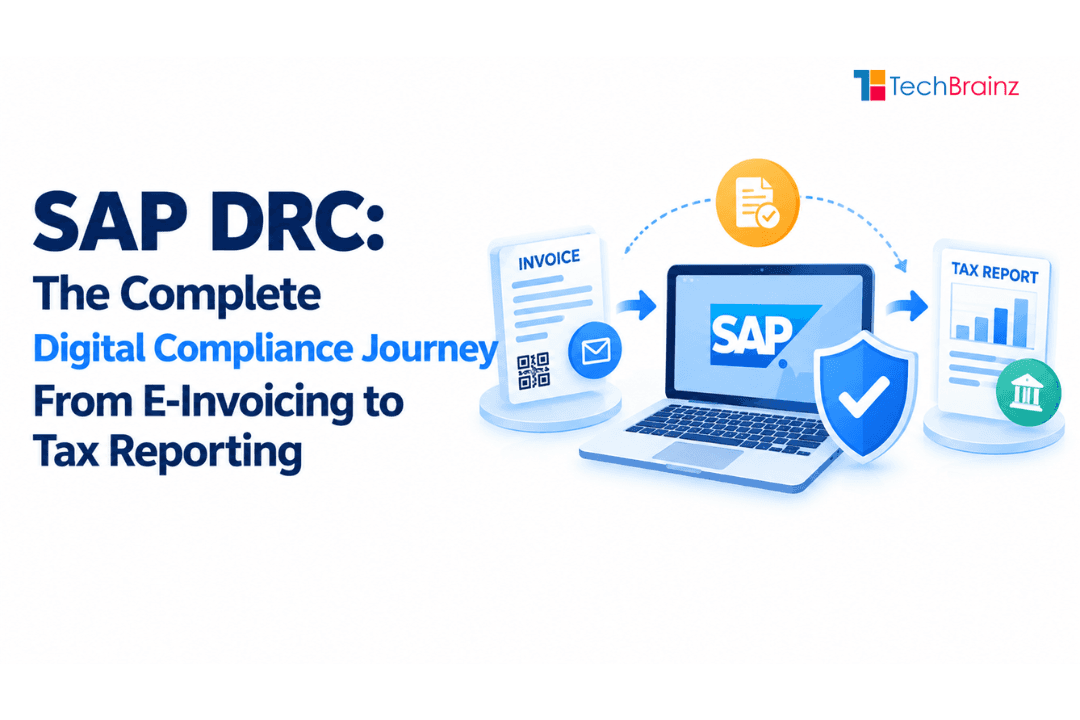
A customer invoice, for example, may begin as a normal business transaction in SAP. However, that transaction may need to become a structured electronic document, pass validation rules, reach a government platform or authorized network, receive a response, and eventually become part of a tax reporting or reconciliation process. SAP DRC helps organizations manage this journey in a more connected way.
What Is SAP DRC?
SAP Document and Reporting Compliance is an SAP solution for managing electronic documents and statutory reporting processes according to applicable country and regional compliance requirements. Its capabilities can include electronic invoicing, electronic document exchange, tax reporting, and localized compliance processes.
The important point is that SAP DRC should not be viewed only as an e-invoicing tool. Its broader value comes from connecting business data with the compliance process surrounding that data. Instead of treating invoice submission, tax reporting, monitoring, corrections, and audit evidence as disconnected activities, organizations can manage them as parts of one digital compliance lifecycle.
Why SAP DRC Matters in Modern Tax Compliance
The relationship between businesses and tax authorities is becoming increasingly digital. Traditional models often relied on periodic reports where organizations summarized transactions and submitted information after the business activity had already occurred. Modern compliance models increasingly move toward structured electronic documents, digital reporting, validation, and transaction-level visibility.
This change creates a new expectation for enterprise systems: compliance information must be accurate at the source. If an invoice contains an incorrect tax identifier, missing reference, invalid customer information, or incorrect tax treatment, the problem may appear immediately during electronic validation rather than months later during an audit.
SAP DRC therefore brings compliance closer to the transaction itself. The quality of the original SAP business data becomes directly connected to the quality of the compliance output. This is especially important as more countries adopt Continuous Transaction Controls, commonly known as CTC, where tax authorities receive or validate transaction information closer to the time of the actual business event.
The Complete SAP DRC Compliance Journey
The SAP DRC journey can be understood as a continuous flow: business transaction → compliance data → electronic document or report → validation → submission → response → correction → reconciliation → audit evidence.
This journey begins with the original business transaction. A sales invoice, purchase transaction, credit memo, or other relevant financial event creates data inside the SAP environment. That data contains the commercial and financial information that may eventually be required for compliance.
The next stage is identifying the information required for the applicable compliance scenario. Customer details, supplier information, tax numbers, tax codes, document references, amounts, dates, and other regulatory fields may become important. At this point, compliance depends heavily on the quality of business and master data.
The relevant information is then transformed into the required electronic format or reporting structure. Depending on the country and compliance model, the document may need specific fields, codes, references, classifications, and structures before it can be accepted.
Validation comes next. SAP DRC can help organizations identify whether required information is available and whether the electronic document or report meets the applicable requirements. A business transaction can be financially successful while its electronic compliance document still fails validation. This distinction is one of the most important concepts in digital compliance.
After validation, the document or report can move toward the required external destination. This may involve a government platform, tax authority, clearance mechanism, or other authorized electronic network depending on the country's model. The external system may return an acceptance, rejection, warning, or other status.
A rejection does not necessarily mean the entire business transaction is wrong. It may indicate a missing field, incorrect master data, invalid tax information, formatting issue, or another compliance-specific problem. The organization must identify the root cause, correct the relevant information, resubmit where required, and maintain an appropriate history of the event.
The final part of the journey involves reporting, reconciliation, and evidence. Organizations need confidence that the information submitted electronically matches the underlying accounting and business transactions. The resulting records can also become important evidence during internal reviews, statutory audits, or tax authority inquiries.
SAP DRC and E-Invoicing: More Than File Generation

E-invoicing is one of the most visible SAP DRC use cases, but electronic invoicing is not simply about converting an invoice into a digital file.
A traditional invoice may contain information that is perfectly understandable to a human reader. A government-compliant electronic invoice, however, usually requires structured information that can be processed automatically. Specific identifiers, tax information, references, codes, and formats may be mandatory.
This means the organization needs more than document generation. It needs accurate source data, appropriate mapping, validation, transmission, response monitoring, and exception handling. A successful e-invoicing process therefore depends on the entire chain rather than one technical step.
When an invoice is created in SAP, the relevant compliance information must be identified and transformed into the required electronic representation. The resulting document is then validated and transmitted according to the applicable compliance scenario. The response received from the external system becomes part of the document's lifecycle.
This is why organizations should avoid treating e-invoicing as a standalone technical interface. It is a business compliance process that crosses finance, tax, master data, integration, SAP configuration, and operational ownership.
From SAP Transaction to Government-Ready Document
The quality of a government-ready document starts before the document is generated. If customer master data contains the wrong tax registration number, or a transaction uses an incorrect tax code, the resulting electronic document may fail even when the underlying invoice was posted successfully.
This creates an important principle: automation does not replace data quality. It amplifies it. Good data can move through an automated compliance process efficiently, while poor data can create repeated exceptions at scale.
Organizations therefore need to consider compliance requirements while designing master data governance and business processes. Finance teams, tax teams, SAP consultants, integration teams, and compliance owners may all have responsibilities within the same journey.
SAP's official documentation provides further information about Document and Reporting Compliance and its supported compliance processes.
Validation and Exception Handling
Validation is where the difference between a normal business transaction and a compliance-ready transaction becomes particularly visible.
A document may fail because a mandatory value is missing, a tax identifier is incorrect, a reference is invalid, a required classification is absent, or a country-specific rule has not been satisfied. The technical error message is only the beginning. The real business requirement is understanding why the error occurred and who should resolve it.
Effective exception handling therefore requires visibility into document status and clear ownership. Teams need to know which documents are waiting, which have been accepted, which have failed, and which require correction. They also need enough information to distinguish between data problems, configuration problems, integration failures, and external authority responses.
This is also where professional SAP DRC Training can be valuable for SAP professionals who need to understand how electronic documents, statutory reporting, compliance scenarios, monitoring, and exception handling work together rather than treating each process as isolated configuration work.
SAP DRC and Tax Reporting
E-invoicing is only one side of the digital compliance landscape. Tax authorities may also require periodic or event-based statutory reports containing financial and tax information.
Tax reporting and e-invoicing have different purposes, but they are connected by the same underlying business data. If the information in invoices, accounting records, and statutory reports does not align, organizations can face reconciliation problems and additional compliance risk.
SAP DRC can help organizations manage relevant reporting processes while maintaining greater consistency between operational transactions and regulatory information. The objective is not simply to produce a report but to establish confidence that the report represents the underlying business activity accurately.
This becomes particularly important for organizations operating across multiple countries. Each jurisdiction can introduce different tax requirements, document structures, reporting formats, submission mechanisms, and validation rules.
Country-Specific Compliance and Global SAP Environments
Global organizations face a difficult balance. They need consistent enterprise processes while also complying with local regulatory requirements.
A single global SAP template cannot always be applied identically in every country. Local requirements may determine which electronic documents are required, what information must be reported, how documents are validated, and where they must be submitted.
A successful SAP DRC implementation therefore combines global governance with local compliance requirements. The organization can establish common principles for data quality, monitoring, ownership, and controls while allowing country-specific compliance scenarios to operate according to local regulations.
This approach becomes increasingly important as governments continue modernizing tax administration. Regulatory changes can affect document formats, reporting deadlines, validation rules, and submission processes, making compliance monitoring an ongoing activity rather than a one-time implementation project.
Master Data: The Hidden Foundation of Digital Compliance
Master data is often underestimated in compliance projects. Yet electronic compliance depends heavily on information such as customer and supplier details, tax registration numbers, addresses, classifications, company information, and tax attributes.
When this information is incomplete or inaccurate, the problem may not become visible until a compliance document is generated or submitted. That creates delays that could have been prevented upstream.
Organizations should therefore treat master data governance as part of the compliance architecture. Data ownership, validation, maintenance processes, and change controls all contribute to the reliability of electronic documents and tax reports.
The strongest SAP DRC implementations do not simply ask, "How do we submit this document?" They also ask, "Where did this information come from, who owns it, and how do we know it is correct?"
SAP DRC with SAP S/4HANA
SAP DRC fits naturally into the broader SAP S/4HANA business environment because compliance information originates from business transactions.
A typical journey can begin with a sales, purchasing, or financial transaction in SAP S/4HANA. Relevant tax and business information is then used to create the required electronic document or reporting output. Validation and submission processes follow, after which responses and exceptions must be monitored.
The value comes from maintaining a connected flow between the original transaction and the compliance result. When that connection is clear, organizations can investigate an exception by tracing it back toward the source transaction and the data that produced the document.
This traceability can significantly improve operational support and audit readiness because teams are not forced to investigate compliance events as isolated records.
Implementing SAP DRC Successfully
A strong SAP DRC implementation begins with requirements rather than configuration. Organizations should first understand which countries, legal entities, document types, tax processes, and statutory reports are in scope.
The next consideration is data. Teams should identify the master and transactional information required for each compliance scenario and determine whether that information is consistently available. Integration requirements should then be evaluated across SAP systems and relevant external platforms.
Ownership is equally important. Someone must be responsible for monitoring compliance documents, investigating failures, correcting data, coordinating resubmissions, and maintaining evidence. Without clear ownership, even a technically successful implementation can become difficult to operate.
Organizations should also design for regulatory change. Digital compliance requirements evolve continuously, so the operating model should support updates rather than assuming that the original implementation will remain unchanged for years.
Common SAP DRC Challenges
One common challenge is treating compliance as an IT-only responsibility. SAP configuration and integration are important, but tax and business teams understand the regulatory meaning behind the data. Successful implementations require collaboration between technical and business stakeholders.
Another challenge is relying on a global template without properly considering local requirements. Standardization is useful, but compliance cannot ignore country-specific rules.
Data quality is another major challenge. If incorrect information enters the process, automated compliance can generate repeated failures. Organizations should therefore address data governance alongside technical implementation.
Finally, exception management should not be treated as an afterthought. A compliance process is not complete when the document is submitted. Teams must be prepared to monitor responses, investigate failures, correct issues, resubmit documents, and maintain evidence.
Continuous Transaction Controls and the Future of SAP DRC
One of the most important developments in digital tax compliance is the growth of Continuous Transaction Controls (CTC).
CTC models generally move tax administration closer to the underlying business transaction. Instead of relying entirely on periodic reporting after transactions have occurred, authorities may require electronic invoices, transaction-level information, clearance, validation, or near-real-time reporting.
The exact model differs by jurisdiction, but the direction is clear: tax compliance is becoming increasingly connected to digital business transactions.
For SAP customers, this increases the importance of having accurate source data, reliable electronic document processes, strong monitoring, and clear exception handling. SAP DRC becomes more relevant because compliance is increasingly embedded within the transaction lifecycle rather than being treated as a separate end-of-period activity.
The Complete Compliance Journey at a Glance
The most useful way to understand SAP DRC is to look at the entire journey rather than one individual feature. A business transaction creates data. That data becomes the foundation for an electronic document or statutory report. The output is validated, submitted, and monitored. External responses determine whether further action is required. Exceptions are investigated and corrected. Finally, the organization reconciles the compliance information with the underlying business transaction and retains appropriate evidence.
This creates a connected chain from transaction to data, data to document, document to submission, submission to response, response to correction, and correction to evidence.
That chain is the real meaning of digital compliance.
Frequently Asked Questions
What is SAP DRC?
SAP Document and Reporting Compliance is an SAP solution that supports electronic documents and statutory reporting processes according to applicable compliance requirements. It can support scenarios such as e-invoicing, electronic document exchange, and tax reporting.
What is SAP DRC used for?
SAP DRC is used to manage digital compliance processes connected to business transactions. It can help organizations generate, validate, submit, monitor, and manage electronic documents and reporting requirements.
How does SAP DRC support e-invoicing?
SAP DRC helps connect an SAP business transaction with the required electronic invoice process. The journey can include document creation, validation, submission, external responses, exception handling, and monitoring.
Is SAP DRC only for e-invoicing?
No. E-invoicing is an important use case, but SAP DRC can also support statutory reporting and other electronic compliance processes. Its broader purpose is to connect business data with digital compliance requirements.
Why is master data important for SAP DRC?
Electronic compliance depends on accurate information such as tax identifiers, customer and supplier details, addresses, classifications, and tax attributes. Incorrect master data can cause validation failures, rejected documents, and reporting inconsistencies.
What skills are needed for SAP DRC?
SAP DRC professionals benefit from knowledge of SAP finance processes, taxation, e-invoicing, statutory reporting, integration, compliance requirements, and exception handling. Understanding both the technical configuration and business purpose of compliance processes is especially valuable.
Conclusion
SAP DRC represents a shift from viewing compliance as a final reporting task to treating it as a connected digital journey. The process begins with a business transaction and continues through data preparation, electronic document generation, validation, submission, response handling, correction, reporting, reconciliation, and evidence.
As e-invoicing and Continuous Transaction Controls continue to reshape tax compliance, organizations need stronger connections between business transactions and regulatory requirements. The real strength of SAP DRC lies in creating that connection while giving organizations greater visibility into compliance processes and exceptions.
For SAP customers, the goal should not simply be to submit an electronic invoice successfully. The larger objective is to build a reliable compliance lifecycle where accurate data creates trusted documents, validated documents reach the right authority, exceptions are resolved efficiently, and the final compliance result can be traced back to the original business transaction.
That is what turns SAP DRC from an e-invoicing solution into a broader digital compliance framework for modern enterprises.
About the Author
TechBrainz Consulting
TechBrainz Consulting provides practical SAP insights covering business transformation, process optimization, governance, security, and enterprise technology. Its content focuses on human-centered explanations that connect SAP technology with real business challenges and practical implementation scenarios.