
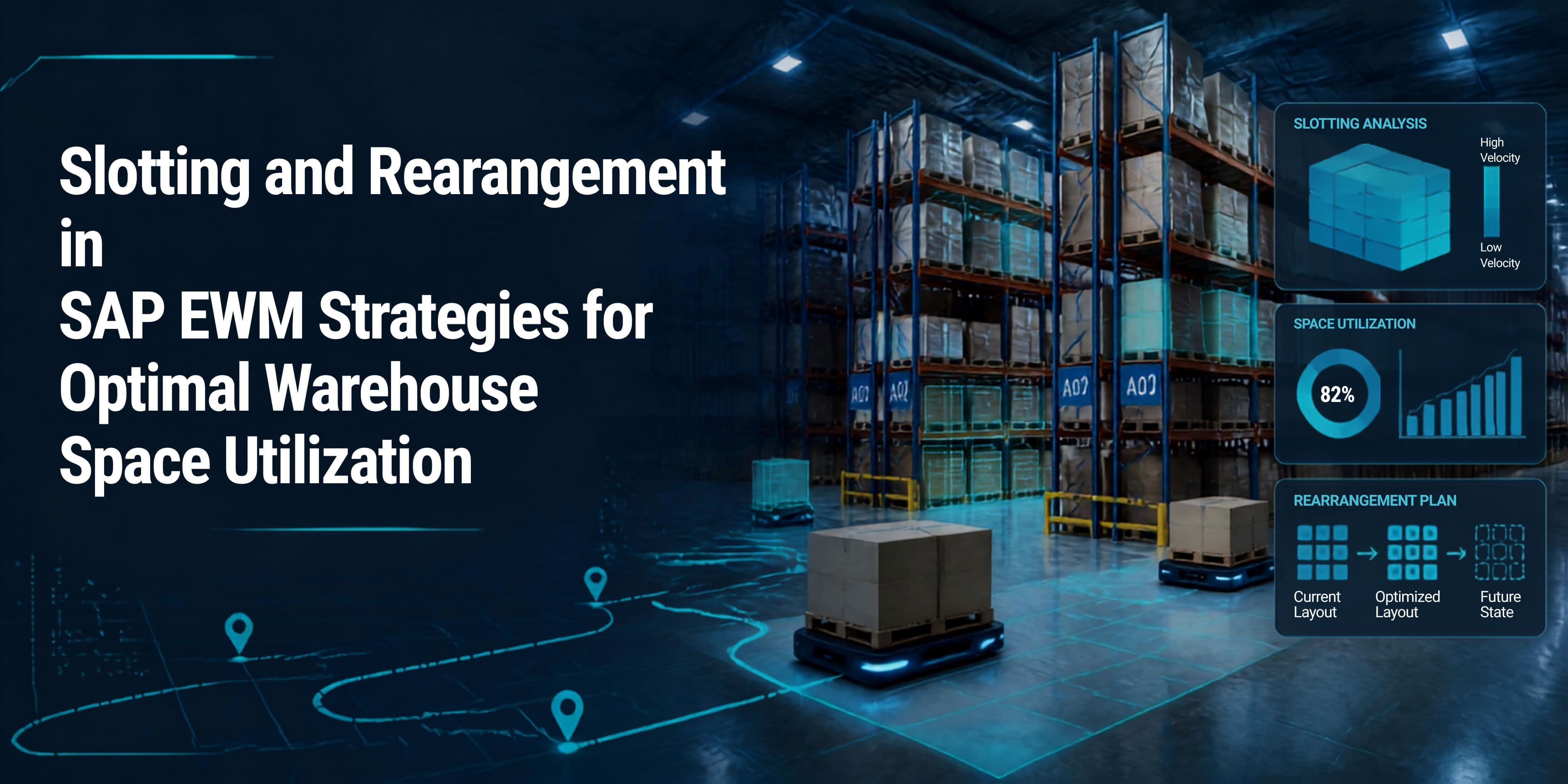
Slotting and Rearrangement in SAP EWM Strategies for Optimal Warehouse Space Utilization
Modern warehouses are no longer just storage facilities. They are complex, high-speed operational environments where every square foot of space and every second of picker movement directly impacts the bottom line. As supply chains become increasingly dynamic, businesses need smarter tools to manage storage intelligently. This is where SAP Extended Warehouse Management (SAP EWM) steps in — and two of its most powerful capabilities are Slotting and Rearrangement.
Whether you are a warehouse manager looking to cut operational costs, a logistics professional aiming to reduce picker travel time, or an IT consultant implementing SAP EWM in your organization, understanding slotting and rearrangement strategies is essential. This article walks you through everything you need to know — from core definitions to implementation strategies — in a practical, business-focused way.
What Is SAP EWM? A Quick Definition
SAP EWM (SAP Extended Warehouse Management) is a comprehensive warehouse management solution that is part of the SAP supply chain suite. It provides granular control over all warehouse processes, including goods receipt, putaway, storage, picking, packing, shipping, and returns. Unlike basic WMS tools, SAP EWM integrates tightly with SAP S/4HANA and offers real-time inventory visibility, advanced labor management, slotting optimization, and yard management — all within a single platform.
SAP EWM is used by global enterprises across manufacturing, retail, e-commerce, pharmaceuticals, and third-party logistics (3PL) industries. Its slotting and rearrangement capabilities are particularly valuable for businesses dealing with high SKU counts, seasonal demand shifts, and continuous throughput pressure.
Quick Facts: SAP EWM Slotting & Rearrangement
| Metric | Industry Benchmark / SAP EWM Impact |
|---|---|
| Warehouse travel time reduction | Up to 30% with optimized slotting |
| Storage space utilization improvement | 15–25% gain with dynamic rearrangement |
| Picking accuracy improvement | Up to 99.9% with EWM-directed storage |
| Rearrangement strategy types | Manual, Semi-automatic, Fully automated |
| Slotting criteria supported | Weight, velocity, volume, hazard class, expiry |
| Integration touchpoints | SAP S/4HANA, SAP TM, SAP GTS, RF/RFID devices |
| Typical ROI timeline | 6–18 months post-implementation |
What Is Slotting in SAP EWM?
Slotting in SAP EWM refers to the strategic assignment of specific storage locations (bins) to products (SKUs) based on a set of predefined criteria. Rather than placing products randomly or based on first-available logic, slotting ensures that each product is stored in the most efficient location possible — considering factors like picking frequency, product weight, product dimensions, expiration sensitivity, and hazardous material classification.
In practical terms, slotting answers a critical question: Where should each product live in the warehouse so that operations run as smoothly and cost-effectively as possible?
Core Slotting Criteria in SAP EWM
SAP EWM supports a rich set of slotting criteria that warehouse planners can configure based on their specific operational needs:
- Velocity / Movement Class: Fast-moving items (A-class) are placed closest to packing or dispatch areas to minimize picker travel time. Slow-moving items (C-class) are stored in deeper or harder-to-reach locations.
- Product Dimensions and Weight: Heavy or bulky items are stored at lower shelf heights (ergonomic slotting) to reduce injury risk and improve handling efficiency.
- Batch and Expiry Date Management: Goods with FEFO (First Expired, First Out) requirements are slotted to ensure the oldest inventory is always picked first.
- Hazardous Material Classification: Chemicals, flammable goods, or regulated items are automatically assigned to compliant, segregated storage zones.
- Product Compatibility: Items that should not be stored near each other (e.g., food and chemicals) are automatically separated through slotting rules.
- Storage Type Constraints: Products requiring specific temperature zones, racking types, or bin sizes are assigned accordingly.
Types of Slotting in SAP EWM
SAP EWM supports multiple slotting approaches depending on the level of automation and operational requirements:
- Static Slotting: Each product is assigned a fixed, permanent storage location. This works well for environments with predictable product ranges and stable demand patterns.
- Dynamic Slotting: Storage locations are assigned and reassigned based on real-time or periodic data analysis, ideal for e-commerce warehouses with seasonal fluctuations.
- Slotting Proposals: SAP EWM generates system-suggested slotting proposals based on historical order data, sales trends, and warehouse configuration.
- Rule-Based Slotting: Slotting is driven by a hierarchy of rules defined in the system, allowing businesses to encode complex business logic into the slotting engine automatically.
Benefits of Optimized Slotting in SAP EWM
- Reduced Picker Travel Time: By positioning high-velocity items nearest to shipping areas, pickers walk fewer steps per order. In large warehouses, this alone can cut picking time by 20-30%.
- Improved Ergonomics and Safety: Proper weight-based and dimension-based slotting ensures heavy items are stored at waist height and hazardous items are segregated, reducing workplace injuries.
- Better Space Utilization: Matching product dimensions to bin sizes minimizes wasted vertical and horizontal space, effectively increasing the warehouse's usable capacity without physical expansion.
- Higher Order Accuracy: When products are always in the correct, expected location, pick errors drop significantly.
- Compliance and Shelf Life Management: FEFO slotting and hazardous material assignments ensure regulatory compliance and reduce product waste due to expiry.
- Scalability: As SKU counts grow, SAP EWM slotting scales with automated proposals and batch re-slotting capabilities.
What Is Rearrangement in SAP EWM?
While slotting defines where products should ideally live, rearrangement is the process of physically moving products to achieve or maintain that optimal layout. Over time, warehouse operations naturally drift from the ideal slotting plan — bins become overstocked, new products arrive, demand patterns shift, and products end up in suboptimal locations. Rearrangement in SAP EWM is the mechanism to correct this drift proactively and systematically.
SAP EWM automates rearrangement by generating warehouse tasks that instruct workers (or automated equipment) to move products from their current locations to their target locations. These tasks can be triggered manually by a planner, automatically by the system on a scheduled basis, or dynamically in response to real-time events.
Rearrangement Strategies in SAP EWM
- Replenishment-Based Rearrangement: When pick bins reach a minimum stock threshold, the system triggers replenishment from bulk storage.
- Slotting-Based Rearrangement: After a new slotting plan is generated or approved, SAP EWM creates rearrangement tasks to physically relocate products to their newly assigned bins.
- Consolidation Rearrangement: Partially filled bins containing the same product are consolidated into single bins to free up storage locations.
- Demand-Driven Rearrangement: The system analyzes upcoming order demand and proactively moves products closer to dispatch areas before the rush begins.
- Putaway-Directed Rearrangement: During goods receipt, the system directs products to the most appropriate storage location based on current warehouse load and slotting rules.
- Automated Rearrangement with Robotics: In highly automated warehouses, SAP EWM orchestrates rearrangement tasks automatically without manual worker intervention.
How Slotting and Rearrangement Work Together in SAP EWM
Slotting and rearrangement are two sides of the same coin. Think of slotting as the strategic blueprint and rearrangement as the operational execution. Here is how the cycle typically works in SAP EWM:
- Data Collection: SAP EWM collects historical order data, product movement statistics, and storage usage metrics.
- Slotting Analysis: The slotting engine analyzes the data and generates a revised optimal slot assignment for products across warehouse zones.
- Slotting Proposal Review: Warehouse planners review the system-generated proposal, make adjustments, and approve the plan.
- Rearrangement Task Generation: SAP EWM automatically generates warehouse transfer orders for all products that need to be moved to their new slots.
- Task Execution: Workers using RF devices, voice-directed picking, or automated equipment execute the rearrangement tasks during low-activity periods.
- Verification and Go-Live: After rearrangement is complete, the new slotting layout goes live and subsequent operations follow the updated plan.
- Continuous Monitoring: The system tracks KPIs like travel time, pick rates, and bin utilization, feeding back into the next slotting cycle.
Industry Applications of SAP EWM Slotting & Rearrangement
Retail and E-Commerce
For retailers, seasonal demand swings are a major challenge. SAP EWM slotting allows retailers to proactively re-slot their inventory ahead of peak seasons, ensuring that high-demand products are positioned for fast fulfillment. E-commerce warehouses benefit enormously from zone-based slotting that places complementary products in adjacent bins, reducing multi-zone pick trips.
Pharmaceuticals and Life Sciences
Pharma warehouses deal with strict regulatory requirements around temperature, expiry, serialization, and controlled substances. SAP EWM slotting integrates with batch management and FEFO logic to ensure that expiring products are always picked first, controlled substances are stored in locked zones, and cold-chain products never leave their temperature-controlled bins.
Automotive and Manufacturing
Automotive parts warehouses often handle thousands of SKUs with widely varying sizes. SAP EWM slotting ensures that heavy, oversized parts are stored in floor-level pallet locations, while small parts are in shelving bins close to the production line. Rearrangement keeps the line-side buffers stocked with just-in-time inventory.
3PL (Third-Party Logistics)
3PL providers serve multiple clients from shared warehouse space. SAP EWM allows client-specific slotting rules so that each client's inventory is managed according to their individual SLA requirements, product characteristics, and seasonal patterns. Rearrangement tasks can be run per client, giving 3PLs the flexibility to optimize space across multiple accounts simultaneously.
Best Practices for SAP EWM Slotting & Rearrangement Implementation
- Start With Data Quality: Ensure product dimensions, weights, velocity classifications, and storage constraints are accurately maintained in the SAP material master.
- Run Slotting Analysis Regularly: A quarterly or monthly slotting review ensures your warehouse layout stays aligned with current business realities.
- Involve Warehouse Staff: Include team leads in the slotting proposal review process to catch practical issues before execution.
- Phase Rearrangement During Off-Peak Hours: Schedule bulk rearrangement tasks during night shifts, weekends, or planned maintenance windows.
- Use SAP EWM KPI Dashboards: Monitor travel distance per pick, bin utilization rates, and slotting compliance rates using SAP EWM analytics.
- Integrate With Demand Forecasting: Connecting SAP EWM with SAP IBP or SAP S/4HANA demand forecasting allows slotting to be driven by future expected demand.
- Consider Automation for High-Volume Sites: For warehouses with very high throughput, invest in automated rearrangement capabilities using conveyors, AS/RS, or AMRs integrated with SAP EWM.
Why SAP EWM Training Is Essential for Slotting Success
Implementing slotting and rearrangement in SAP EWM is not just a technology project — it is a people and process transformation. The most sophisticated slotting configuration will fail to deliver results if warehouse planners, supervisors, and IT teams do not understand how to use the tools effectively.
Investing in SAP EWM training equips your team with the practical skills to configure slotting rules, run slotting analyses, interpret system proposals, approve rearrangement plans, and monitor performance KPIs. Organizations that invest in structured SAP EWM training consistently report faster implementation timelines, fewer post-go-live issues, and stronger long-term adoption of optimization features.
Frequently Asked Questions (FAQs)
1. What is the difference between slotting and put away in SAP EWM?
Slotting is the strategic planning process that defines where each product should be stored. Put away is the operational execution of placing received goods into a storage bin, guided by the slotting rules.
2. How often should a company run slotting analysis in SAP EWM?
For most businesses, a quarterly slotting review is a good starting point. High-velocity operations with seasonal swings may benefit from monthly reviews.
3. Can SAP EWM handle slotting for hazardous materials?
Yes. SAP EWM supports hazardous material (HazMat) slotting through its dangerous goods management integration.
4. What is a slotting proposal in SAP EWM and how is it used?
A slotting proposal is a system-generated recommendation that specifies which storage bins products should be assigned to. Once approved, SAP EWM generates the rearrangement tasks needed to physically move products.
5. Does SAP EWM support automated rearrangement with warehouse robots?
Yes. SAP EWM integrates with automated material handling equipment, including AS/RS, conveyors, and Autonomous Mobile Robots (AMRs).
6. How does slotting in SAP EWM reduce operational costs?
Optimized slotting reduces picker travel time (the single largest component of warehouse labor cost), minimizes product handling and damage, improves ergonomics, and increases storage density.
7. Is SAP EWM slotting suitable for small and mid-sized warehouses?
Absolutely. Even smaller warehouses with a few thousand SKUs benefit significantly from basic velocity-based slotting and periodic rearrangement.
8. What prerequisites are needed before implementing slotting in SAP EWM?
Successful slotting implementation requires clean, accurate product master data, a well-configured warehouse structure, historical order data, and trained warehouse planners.
Conclusion
Slotting and rearrangement in SAP EWM are not optional add-ons — they are core strategies that determine whether a warehouse runs at peak efficiency or struggles under the weight of suboptimal layouts. When implemented thoughtfully, these capabilities deliver measurable reductions in travel time, improvements in space utilization, enhanced compliance, and ultimately, better customer service.
The key to success lies in combining the right technology configuration with high-quality data, regular review cycles, and empowered warehouse teams. If you are planning to implement or optimize slotting and rearrangement in your warehouse, start by evaluating your current data quality, analyzing your product velocity classifications, and engaging your operations team. And to truly unlock the full potential of SAP EWM, consider enrolling in a comprehensive SAP EWM training program.
Author Bio: The TechBrainz SAP EWM Team is a group of experienced supply chain and warehouse management professionals specializing in SAP Extended Warehouse Management (SAP EWM). The team shares practical insights, implementation strategies, industry trends, and real-time warehouse optimization techniques to help businesses improve operational efficiency.