
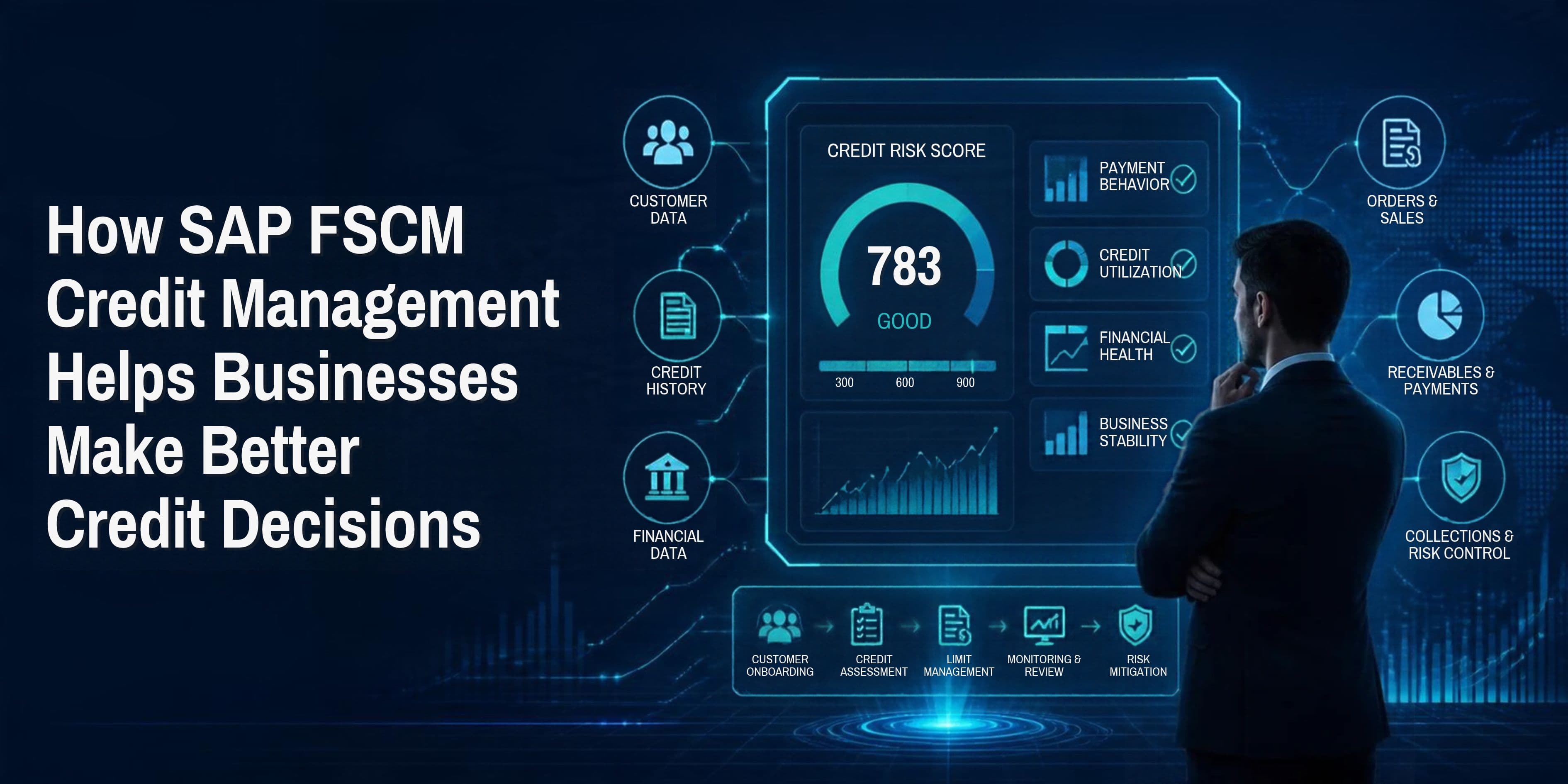
How SAP FSCM Credit Management Helps Businesses Make Better Credit Decisions
Definition: What Is SAP FSCM Credit Management?
SAP FSCM Credit Management is a module within SAP Financial Supply Chain Management (FSCM) that enables organizations to automate, centralize, and govern the entire process of evaluating customer creditworthiness, assigning credit limits, and controlling credit exposure across the enterprise. It replaces fragmented, manual credit-checking processes spreadsheets, siloed ERP credit blocks, and reactive escalation chains with a single, rules-driven credit management workflow that integrates directly with SAP Sales and Distribution (SD), SAP Accounts Receivable (FI-AR), and external credit information providers.
In practical terms, SAP FSCM Credit Management answers three questions that every credit team faces daily: How much credit should we extend to this customer? What is our current exposure across all open receivables and sales orders for this customer? And what action should we take when a customer exceeds their limit or shows signs of becoming a payment risk? The module provides the data, workflow, and automated controls to answer all three consistently, at scale, and in real time transforming credit management from a reactive, manually intensive discipline into a proactive, data-driven one.
Quick Facts: SAP FSCM Credit Management at a Glance
Introduction: The Hidden Cost of Getting Credit Decisions Wrong
Every business that sells on credit is making a calculated bet with its cash flow. Extend too little credit and you lose revenue to competitors willing to take the risk. Extend too much without proper controls and you expose the business to bad debt, strained working capital, and collection costs that erode the margin on every sale. According to the Credit Research Foundation's 2024 Benchmarking Survey, companies without automated SAP credit management systems reported an average bad debt write-off rate of 0.62% of annual revenue nearly three times higher than the 0.22% average for companies using integrated credit management platforms. For an organization with USD 500 million in annual revenue, that difference represents USD 2 million in avoidable losses every single year.
The problem is not that credit teams lack judgment. The problem is that manual SAP credit management does not scale. A credit analyst reviewing customer files one by one, checking payment histories in one system and outstanding balances in another, routing exception approvals through email chains, and re-evaluating risk profiles on an ad hoc basis cannot keep pace with a modern sales organization processing hundreds of orders per day. SAP FSCM Credit Management was designed to solve exactly this problem not by removing the credit team's judgment, but by giving that judgment a system-level foundation that makes consistent, fast, and auditable credit decisions possible at enterprise scale.
How SAP FSCM Credit Management Works: Core Architecture and Components
Centralized Credit Master Data and Credit Segments
The foundation of SAP FSCM Credit Management is the credit master record a centralized data object that stores all credit-relevant information for a customer in one place. This includes the credit limit, the credit segment assignment, the credit score, the credit risk class, the payment history summary, and the current credit exposure calculated across all open sales orders, deliveries, and receivables. Unlike SAP's classic credit management in SD, which stores credit data at the company code level only, FSCM Credit Management supports credit segments logical groupings that allow a global business to manage credit exposure by region, business unit, or product line separately, while still enforcing an overall limit across the entire customer relationship.
This centralized architecture is what makes enterprise-scale SAP credit management possible. When a sales order arrives for a customer in one region, the credit check does not just look at that customer's balance in a single company code it aggregates exposure across every credit segment assigned to that customer, applies the configured limit rules, and returns a real-time decision reflecting the customer's total financial relationship with the organization.
Automated Credit Scoring Engine
SAP FSCM Credit Management includes a configurable credit scoring engine that assigns a numeric score to each customer based on weighted criteria defined by the credit team. The formula can incorporate payment behavior data from SAP FI-AR days sales outstanding, payment history, dispute frequency alongside external credit ratings from agencies such as Dun & Bradstreet or Creditreform, financial statement data, and any custom criteria the business defines. The score is then mapped to a credit risk class typically a scale such as low, medium, high, and blocked which drives credit limit assignments and the workflow routing for limit reviews.
The scoring engine runs automatically on a defined schedule daily, weekly, or triggered by specific events such as a payment default or a new external credit report which means every customer's risk class is updated continuously rather than only when an analyst has bandwidth to review. For a credit team managing thousands of accounts, this continuous automated scoring is the operational difference between proactive risk management and reactive fire-fighting.
Credit Limit Workflow and Approval
When a credit analyst proposes a new credit limit or a limit increase, SAP FSCM Credit Management routes the request through a configurable approval workflow. Thresholds, reviewer assignments, and escalation rules are all defined in the system so a limit below a defined threshold might require only a credit analyst sign-off, while a larger limit routes to the credit manager and CFO. Every approval step creates an auditable record: the credit score at the time of decision, the supporting documents reviewed, and the names and timestamps of every approver in the chain.
This audit trail matters beyond compliance. When a customer defaults, the credit manager can trace the limit decision back to the original approval, review what information was available, and update the scoring model or approval thresholds to prevent recurrence. Over time, this feedback loop drives continuous improvement in credit decision quality.
Real-Time Credit Checks in the Order-to-Cash Process
SAP FSCM Credit Management integrates with the SAP SD order-to-cash process to perform automated credit checks at configurable points: sales order creation, delivery creation, goods issue, and billing. When a sales order arrives for a customer whose total credit exposure open receivables plus open deliveries plus the new order value exceeds their assigned limit, the system responds according to the configured credit check rule: warning message only, delivery block, billing block, or full order block. The response rules are configured by risk class, so low-risk customers may trigger only a warning while high-risk customers receive an automatic delivery block requiring credit team release. This risk-proportionate model prevents the credit team from being overwhelmed with low-value exceptions while ensuring genuinely risky situations receive attention before goods leave the warehouse.
Five Business Benefits of SAP FSCM Credit Management
The business case for SAP FSCM Credit Management rests on five measurable outcomes that directly affect revenue, cash flow, and operational cost.
SAP FSCM Credit Management vs. Classic SAP Credit Management
Organizations currently running SAP ECC are familiar with the classic credit management functionality in SAP SD. SAP FSCM Credit Management is a fundamentally more capable approach and in SAP S/4HANA, it is the only supported option. Classic SD credit management is deprecated in S/4HANA, making this comparison essential for any organization planning an S/4HANA migration.
How SAP FSCM Credit Management Integrates Across the SAP Landscape
SAP FSCM Credit Management functions as an integration hub for credit-relevant data flowing across the SAP ecosystem. The value it delivers is proportional to the completeness of data feeding the scoring engine which makes understanding these integration points essential for any implementation project.
Which Organizations Benefit Most from SAP Credit Management?
SAP FSCM Credit Management delivers measurable value across industries, but the return on implementation is highest in specific business contexts. Organizations should evaluate whether their environment matches one or more of these profiles before beginning implementation planning.
- High-volume B2B sales organizations: Companies processing hundreds or thousands of sales orders daily cannot manage credit risk through manual review of each transaction. Automated credit checks, risk-class-based release rules, and exception-only routing to human reviewers are built for this scale.
- Multi-entity or global enterprises: Organizations with multiple company codes, business units, or geographic entities need to see and control credit exposure at the total customer level across all of them simultaneously. Credit segments make this possible in a way classic SD cannot support.
- Industries with significant bad debt history: Manufacturing, wholesale distribution, construction, and professional services where customer payment behavior is variable and credit exposure is large relative to order value gain disproportionate benefit from continuous automated scoring and early risk detection.
- Companies migrating to SAP S/4HANA: Because classic SD credit management is deprecated in S/4HANA, any organization on the migration path must implement SAP FSCM Credit Management. The migration is the right moment to redesign credit processes alongside the system change.
- Finance teams under DSO and working capital pressure: Credit management is one of the most direct operational levers on days sales outstanding. Organizations with board-level pressure on DSO metrics benefit from structured limit-setting, automated collection triggers, and portfolio visibility that FSCM provides.
Real-World Outcome: What SAP FSCM Credit Management Delivers
A mid-size European manufacturing company with operations across six countries and approximately 3,200 active customer accounts implemented SAP FSCM Credit Management as part of a broader SAP S/4HANA migration in 2023. Before implementation, the credit team of eight analysts managed exposure through a combination of SAP ECC classic credit management, Excel-based scoring models, and email approval routing for limit changes. The average time from a credit limit request to approved limit was eleven business days. The bad debt write-off rate for the prior fiscal year was 0.54% of revenue.
Eighteen months after go-live, the results were clear. The average credit limit approval cycle dropped from eleven days to three days, because automated workflow routing eliminated the manual email chain and reduced routine limit reviews to a single approver screen interaction. The bad debt write-off rate fell from 0.54% to 0.31% of revenue a 43% reduction driven by earlier detection of payment risk through continuous automated scoring updates and systematic blocking of new orders for customers whose risk class had deteriorated. The credit team's time allocation shifted from approximately 60% data gathering and 40% decision-making to the reverse, because the scoring engine and real-time exposure calculations eliminated most manual data work. The company reported full ROI within fourteen months, primarily through the reduction in bad debt write-offs and the elimination of manual credit analyst data tasks.
Frequently Asked Questions: SAP FSCM Credit Management
1. What is SAP FSCM Credit Management and how does it differ from classic SAP credit management?
SAP FSCM Credit Management is the advanced credit management module within SAP Financial Supply Chain Management, available in both SAP ECC and SAP S/4HANA. It differs from classic SAP SD credit management in four important ways: it supports credit segments for exposure aggregation across multiple company codes and regions; it includes an automated, rules-driven credit scoring engine with scheduled updates; it provides a fully integrated SAP Business Workflow for limit approvals with complete audit trails; and it integrates with external credit agencies for enriched scoring data. In SAP S/4HANA, classic SD credit management is deprecated FSCM Credit Management is the only supported approach for new implementations.
2. How does SAP FSCM Credit Management calculate a customer's credit exposure?
SAP FSCM Credit Management calculates total credit exposure by aggregating all credit-relevant open items across the customer's assigned credit segments. This includes posted invoices not yet paid (open AR items), accepted sales orders not yet invoiced, open deliveries shipped but not yet billed, and any other commitments configured for inclusion. The exposure figure is calculated and updated in real time as new orders arrive, payments post, and invoices are created so the credit check at any point in the order-to-cash cycle reflects the customer's current actual financial position with the organization.
3. What is a credit segment in SAP FSCM Credit Management?
A credit segment is the core organizational unit in SAP FSCM Credit Management that groups a customer's credit exposure for monitoring and limit enforcement. Unlike classic SAP credit management, which controls credit at the company code level only, credit segments allow a business to manage exposure across multiple company codes, geographies, or business units simultaneously. A customer can be assigned to one or more credit segments, each with its own sub-limit, while the system also enforces an overall limit across all segments. Credit segments are the architectural feature that makes enterprise-wide credit risk aggregation and multi-entity credit governance possible in SAP FSCM.
4. Which SAP modules does FSCM Credit Management integrate with?
SAP FSCM Credit Management integrates with SAP SD for real-time credit checks at sales order, delivery, and billing stages; with SAP FI-AR for payment history, aging data, and open item balances feeding the scoring engine; with SAP Collections Management (FSCM-COL) for automatic escalation of overdue accounts to collection workflows; with SAP Dispute Management (FSCM-DM) so disputed items reduce effective credit exposure in real time; with external credit agencies via SAP BAPI for enriched scoring data; and with SAP BW and SAP Analytics Cloud for portfolio-level credit risk reporting.
5. Can SAP FSCM Credit Management connect to external credit rating agencies?
Yes. SAP FSCM Credit Management provides standard BAPI-based integration with external credit information providers including Dun & Bradstreet, Creditreform, and others. External credit scores, recommended limits, and financial statement data from these providers can be imported into the credit master record and incorporated into the automated scoring formula as weighted criteria alongside internal payment history data. This is particularly valuable for new customers with limited internal AR history, where external agency data provides risk signals that the internal system cannot yet generate.
6. Is SAP FSCM Credit Management available in SAP S/4HANA?
Yes, and it is the only supported credit management approach in SAP S/4HANA. Classic SAP SD credit management, which was standard in SAP ECC, is deprecated in S/4HANA and unavailable for new implementations. Organizations migrating from ECC to S/4HANA must implement SAP FSCM Credit Management as the replacement. The S/4HANA implementation adds enhancements including SAP Fiori apps for simplified credit master maintenance, improved real-time exposure calculation performance, and stronger integration with SAP Analytics Cloud for portfolio reporting.
7. What are the most common implementation challenges for SAP FSCM Credit Management?
The three most consistent implementation challenges are credit scoring model design, credit segment structure, and change management. Scoring model design requires defining and weighting the criteria that determine each customer's risk class a decision requiring both business judgment and historical payment data analysis. Credit segment structure must balance risk visibility against administrative overhead, and over-segmentation is a frequent mistake. Change management is often underestimated: the shift from manual credit checking to automated scoring and exception-based workflows fundamentally changes the daily work of credit analysts, sales teams, and AR staff, and organizations that do not redesign surrounding processes alongside the system consistently underperform on benefit realization.
8. How long does a typical SAP FSCM Credit Management implementation take?
For a mid-size organization implementing SAP FSCM Credit Management either as part of an SAP S/4HANA migration or as a standalone project within SAP ECC a typical timeline runs four to seven months from kickoff to go-live. This covers the scoring model design workshop (four to six weeks), system configuration and integration testing (eight to ten weeks), user acceptance testing with parallel run against current credit decisions (four to six weeks), and go-live preparation including training and data cutover. Larger organizations with multiple credit segments, complex external agency integrations, or global multi-language deployments typically require eight to twelve months.
Conclusion: Better Credit Decisions Start with the Right System and the Right Skills
SAP FSCM Credit Management transforms credit management from a reactive, manually intensive process into a proactive, data-driven discipline. The combination of automated credit scoring, centralized credit segment management, real-time exposure calculation, configurable order-to-cash credit checks, and fully auditable approval workflows addresses every major weakness of traditional SAP credit management approaches inconsistent decisions, version-controlled data gaps, and governance that does not scale with business volume. SAP FSCM training builds the understanding of credit master configuration, scoring model design, workflow setup, credit segment architecture, and integration design that credit analysts, finance professionals, and SAP consultants need to implement and operate this module effectively. If you are ready to build that capability for yourself or your team, structured SAP FSCM training programs designed around real-world implementation scenarios are the fastest path from theory to confident, productive practice.
Author Note: This article has been written by the TechBrainz SAP FSCM team, drawing on in depth research and practical knowledge of SAP FSCM Credit Management. Our team has analyzed key industry practices and real-world business challenges across different sectors. The article shares valuable insights to help readers understand SAP FSCM concepts and their practical applications.