
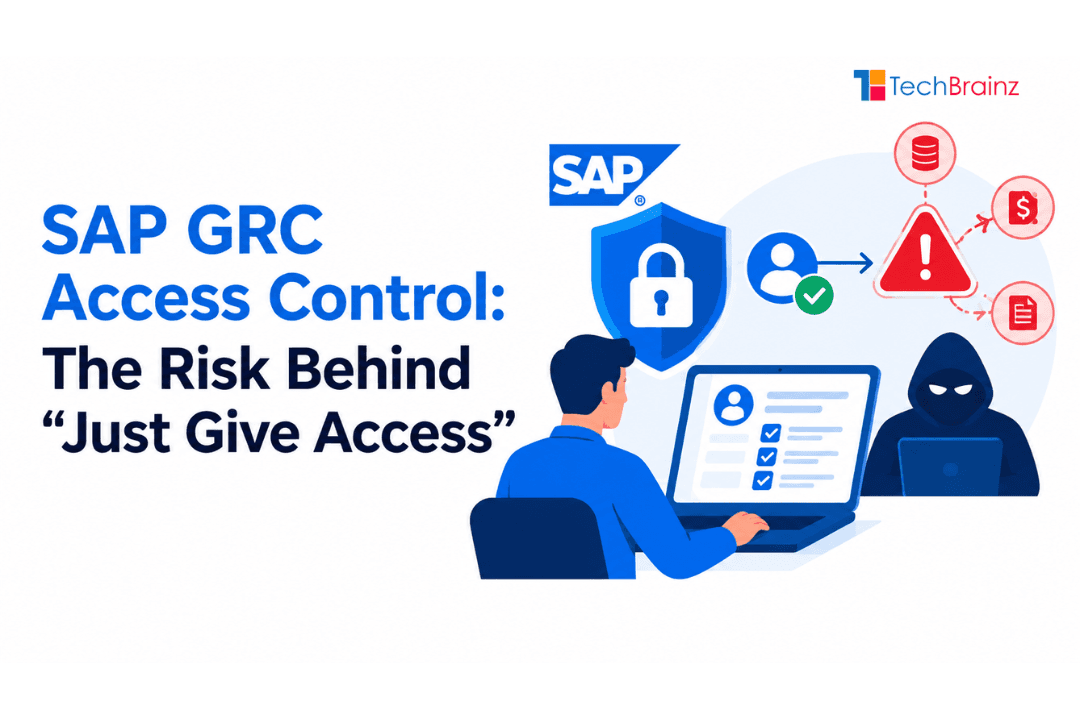
SAP GRC Access Control: Access Risk & SoD Guide
Introduction: "Just Give Access" Is Not Always a Simple Request
"Can you just give me access?"
It sounds like one of the easiest requests an SAP team can receive. An employee joins a project, moves to a new department, or needs to complete an urgent task. Someone checks the required role, assigns it, and the user gets back to work.
But there is a question that can easily get missed: What exactly can that access allow the user to do?
An SAP user may need access to create invoices, maintain vendors, process payments, manage purchase orders, or approve transactions. Each permission can look reasonable when viewed separately. The real risk can appear when several permissions come together.
Imagine a user who can create a vendor, modify vendor information, process invoices, and execute payments. The problem is not necessarily any single permission. It is the combination.
This is where SAP GRC Access Control becomes important. Instead of treating access as a simple technical task, organizations can use access governance to understand risk, control requests, manage approvals, and review potentially conflicting responsibilities.
In other words, the question changes from "Should we give this person access?" to "What does this access enable, what risks does it create, and has it been properly approved?"
Definition: SAP GRC Access Control
SAP GRC Access Control is an SAP governance solution used to manage user access, analyze access risks, control access requests, support role management, and help organizations identify and address segregation-of-duties conflicts.
Why SAP Access Is More Than a Username and Password
A username and password only determine whether someone can enter a system. What matters after login is what that person is actually allowed to do.
Consider an accounts payable employee. They may legitimately need access to process invoices. But if the same user can independently create vendors, change sensitive vendor information, and execute payments, the overall access profile deserves closer attention.
This is why SAP access management cannot be reduced to simply asking whether a user needs a particular transaction or application.
The business process matters.
The user's existing roles matter.
The combination of permissions matters.
And the approval process matters.
In a large organization, users can also change responsibilities over time. Someone may move from procurement to finance but continue carrying access from their previous role. Another employee may receive temporary project access that remains active long after the project finishes.
Access can quietly accumulate.
That is why effective access governance needs to look beyond the original access request.
The Real Risk Is Often Hidden in the Combination of Access
One of the most important concepts in SAP access governance is Segregation of Duties, commonly called SoD.
The basic idea is straightforward: certain sensitive responsibilities should not be concentrated in the hands of one person when that combination could create an unacceptable business risk.
For example, imagine a fictional company where one user has the ability to create a vendor and independently process a payment to that vendor.
The individual permissions might each have a legitimate business purpose. But together, they could create a significant control concern.
This is why simply asking, "Does this employee need access?" may not be enough.
A better question is:
"Does the complete combination of this employee's access create a risk?"
SAP GRC Access Control can help organizations analyze these combinations and identify potential conflicts.
The goal isn't necessarily to remove every risk from every user. Businesses sometimes have genuine operational requirements that make certain access combinations necessary. Instead, the objective is to identify the risk, understand it, apply appropriate controls, and make the decision visible and traceable.
A Simple Example of How Access Risk Can Grow
Imagine an employee named Ravi working in a finance department.
Initially, Ravi receives access to process invoices.
A few weeks later, he needs to update vendor information, so another role is added.
Later, his manager asks for payment-related access because Ravi is supporting an additional process.
Nobody looks at the complete access picture.
Individually, every request appeared reasonable.
But now Ravi's combined access may allow him to perform several activities that should ideally be separated.
This is the problem with access accumulation.
It rarely starts with someone saying, "Let's create a risky access profile."
It can happen through a series of perfectly ordinary requests.
That is why access risk analysis is important.
What Does SAP GRC Access Control Actually Do?

SAP GRC Access Control brings several access governance activities into a structured framework.
Instead of relying entirely on manual checks, emails, spreadsheets, and individual knowledge, organizations can establish controlled processes for requesting, analyzing, approving, provisioning, and reviewing access.
One important capability is Access Risk Analysis.
It can be used to identify potential access risks, including SoD conflicts and critical access, based on configured rules and the organization's governance requirements.
Another major area is Access Request Management. Rather than simply assigning access because someone asked for it, organizations can establish a defined request and approval process.
There is also Business Role Management, which helps organizations manage roles and their associated access from a governance perspective.
For situations requiring elevated or temporary privileges, Emergency Access Management provides controls around emergency access and the review of activities performed using that access.
Together, these capabilities support a more structured approach to SAP access governance.
Access Risk Analysis: Finding the Problems Before They Become Bigger
Access Risk Analysis is one of the areas that makes SAP GRC Access Control particularly relevant to access governance.
Think of it as looking at the access picture from a risk perspective.
Instead of reviewing one permission at a time, organizations can analyze whether particular combinations of access create defined risks.
For example:
Create Vendor + Change Vendor Details + Execute Payment
That combination may represent a risk that would be difficult to identify if every permission were reviewed independently.
The analysis can help security and compliance teams identify potential conflicts and investigate them.
The important word here is potential.
A flagged risk does not automatically mean that someone has committed wrongdoing. It means the configured rules have identified an access combination that deserves review.
The organization can then determine whether the access should be removed, redesigned, mitigated, or retained with appropriate controls.
This distinction is important because good access governance is not about creating unnecessary restrictions. It is about making access decisions based on visibility and risk.
Access Requests Should Have a Story Behind Them
A user request should not end with:
"Give me this role."
A stronger access process asks:
Why does the user need it? What business activity requires it? Who should approve it? Does the requested access create a risk? Does the user already have conflicting access? Should the access be permanent or temporary?
This is where Access Request Management becomes useful.
A structured workflow can connect the request with risk analysis and approval.
For example:
User requests access → Risk is analyzed → Appropriate approver reviews → Decision is made → Access is provisioned
This creates more visibility around the access lifecycle.
It also makes the process easier to understand later when an internal control review or audit asks how a particular user received sensitive access.
Role Management: The Access Problem Can Start Before the User Gets the Role
Access risk isn't always caused by the person requesting access.
Sometimes the problem begins with the role itself.
If a role contains unnecessary or conflicting permissions, assigning that role repeatedly can spread the same problem to multiple users.
This is why SAP GRC role management deserves attention.
A role should represent a meaningful business requirement rather than becoming a convenient container for every permission someone might need.
Poorly controlled role design can result in excessive access, unnecessary privileges, and difficult-to-manage user profiles.
A better approach is to think about roles from the perspective of the business process:
What does this role need to accomplish?
Then ask:
What permissions are genuinely required to accomplish it?
And finally:
Does the role introduce any known access risks?
That sequence can help organizations move away from the habit of simply copying existing roles whenever someone needs access.
Emergency Access: When "Temporary" Access Needs Control
Sometimes normal access isn't enough.
A production issue may occur outside business hours. A critical configuration problem may need immediate attention. A technical specialist may need elevated access to resolve an urgent problem.
This is where emergency access becomes relevant.
The challenge is obvious: emergency situations require speed, but privileged access requires control.
If temporary elevated access is granted without proper monitoring or review, it can become difficult to understand what happened afterward.
Emergency Access Management helps organizations establish controls around this type of privileged access.
The principle is simple:
Urgent access should still be accountable access.
The organization should be able to understand who used the emergency access, why it was required, and what activities were performed, according to its configured governance process.
What Happens When Access Is Never Reviewed?
Imagine an employee who changes departments.
Their new job requires finance access, but their old procurement access remains active.
Six months later, they still have both.
Nothing dramatic happened.
No alarm went off.
Nobody necessarily noticed.
But the user's access profile has gradually moved away from what their current job requires.
This is one reason periodic access reviews matter.
Organizations need processes for reviewing whether users still require the access they have.
The same principle applies to temporary project access, privileged access, and roles that evolve over time.
Access governance should not be treated as a one-time activity that ends when a user receives a role.
Access changes because businesses change.
SAP GRC Access Control in a Real Business Scenario

Consider a fictional manufacturing organization.
The accounts payable team needs access to process supplier invoices. A new employee joins the team and requests the required finance roles.
During the request process, the organization identifies that the employee already has access associated with vendor creation from a previous assignment.
Now there is a question.
Should the new access simply be approved?
The organization can instead review the complete access combination.
If a conflict exists, the relevant team can decide how to handle it. The role can potentially be adjusted, conflicting access can be removed, or an appropriate mitigation control can be established depending on the organization's policies and business requirements.
The important part is that the decision is made with visibility into the risk.
That is the value of access governance.
SAP GRC Access Control and Compliance
Access governance also connects closely with internal controls and audit activities.
Organizations often need to demonstrate that sensitive access is controlled, approvals are documented, risks are addressed, and access is periodically reviewed.
SAP GRC Access Control can support these governance processes by providing structured workflows and risk-analysis capabilities.
However, it should not be viewed as a magic compliance button.
Technology supports a governance framework. It does not replace business policies, responsible approvals, role ownership, periodic reviews, or appropriate risk decisions.
A successful access-control process therefore combines:
Technology + Business Rules + Ownership + Review + Accountability
Common SAP GRC Access Control Mistakes
Even with a dedicated access governance solution, organizations can run into problems if the underlying process is weak.
Copying roles without checking risk
A role that worked for one employee may contain unnecessary permissions for another. Copying it without analysis can reproduce existing access issues.
Treating every access request as urgent
Not every request needs the same level of urgency or access. A controlled process should distinguish legitimate business requirements from unnecessary privilege.
Forgetting old access
When employees change positions, their previous access should not automatically remain forever.
Using emergency access as normal access
Emergency privileges are intended for exceptional situations. Using them as a replacement for properly designed regular access can undermine governance.
Focusing only on technical permissions
The business process behind the access is just as important as the technical role.
How Organizations Can Build a Stronger Access Governance Process
A practical approach starts with understanding the current environment.
First, organizations need visibility into their SAP landscape, users, roles, business processes, and existing access.
Next comes risk definition. The organization needs to determine which combinations of access represent meaningful risks for its business.
Then comes role design and cleanup. Existing roles should be reviewed rather than assuming that every historical role is still appropriate.
After that, access-request workflows can be structured around business ownership and appropriate approvals.
Finally, access should be reviewed continuously.
The process should look less like:
and more like:
Analyze → Design → Control → Review → Improve
That mindset makes access governance an ongoing business process rather than a one-time SAP project.
What Skills Do You Need to Work With SAP GRC Access Control?
Learning SAP GRC Access Control involves more than memorizing transaction codes or configuration screens.
A strong foundation starts with understanding SAP users, roles, authorizations, and business processes.
From there, learners can build knowledge of:
Access Risk Analysis
Understanding how access combinations can create risks is fundamental.
Segregation of Duties
Knowing why certain responsibilities should be separated helps connect technical access with business controls.
Access Request Management
Understanding request and approval workflows is important for managing access throughout its lifecycle.
Role Management
Professionals need to understand how roles are structured, maintained, reviewed, and governed.
Emergency Access Management
Knowledge of privileged and emergency access adds another important layer to SAP access governance.
For professionals who want to develop these capabilities through structured learning and practical exposure, SAP GRC AC Training can provide a focused learning path around SAP GRC Access Control concepts and practical skills.
Why SAP GRC Access Control Skills Matter
SAP environments are rarely static.
Organizations add applications, employees change responsibilities, projects begin and end, and business processes evolve. With every change, access requirements can change as well.
This creates an ongoing need for professionals who understand the connection between SAP security, access management, risk analysis, and business controls.
For SAP security professionals, GRC specialists, SAP administrators, auditors, and consultants, understanding access governance can therefore complement core SAP authorization knowledge.
The most useful skill is not simply knowing how to assign access.
It is understanding why the access is needed, what it enables, what risk it creates, and how that risk should be governed.
SAP GRC Access Control: Frequently Asked Questions
1. What is SAP GRC Access Control?
SAP GRC Access Control is used to manage and govern user access in SAP environments. It supports activities such as access risk analysis, access requests, role management, and emergency access management. It can help organizations identify potential access conflicts and establish controlled processes for granting and reviewing access.
2. What is SoD in SAP GRC?
SoD stands for Segregation of Duties. It is a control principle that certain sensitive business responsibilities should not be performed by the same user, because combining them could create an unacceptable risk. SAP GRC Access Control helps organizations identify and manage potential SoD conflicts.
3. What is Access Risk Analysis in SAP GRC?
Access Risk Analysis evaluates user and role access against configured risk rules. It can identify potential SoD conflicts and other critical access risks. The results give security, risk, and compliance teams visibility into access combinations that may require remediation, approval, or mitigating controls.
4. What is Emergency Access Management in SAP GRC?
Emergency Access Management provides governance around temporary or elevated access required for urgent situations. It can help organizations control and monitor emergency access according to their configured processes. This provides greater visibility into privileged activity while allowing authorized users to respond to critical issues.
5. Is SAP GRC Access Control only for SAP security professionals?
No. SAP security professionals commonly work with it, but access governance can also involve SAP administrators, GRC consultants, auditors, risk teams, and functional professionals. Understanding business processes is particularly useful because access risks often depend on how different responsibilities interact.
6. How can I learn SAP GRC Access Control?
A good learning path starts with SAP authorization and role fundamentals before moving into SoD, Access Risk Analysis, Access Request Management, role governance, and Emergency Access Management. Practical exercises using realistic business scenarios can make these concepts easier to understand and apply.
Conclusion: Access Should Be More Than "Approved"
The next time someone says, "Just give me access," there is a better question to ask.
What will this access allow the user to do?
That question changes the entire conversation.
SAP access isn't simply about getting users into the system. It is about giving them the access they genuinely need while understanding the risks created by their complete access profile.
SAP GRC Access Control helps organizations bring structure to that process through access risk analysis, controlled requests, role governance, emergency access controls, and ongoing review.
The goal isn't to make access difficult.
The goal is to make access visible, justified, controlled, and accountable.
Because in an SAP environment, the most important access question isn't always "Can this user have access?"
It is:
"What happens when we give it to them?"
About the Author
TechBrainz Consulting
Helping professionals build practical SAP skills for modern enterprise technology and business transformation.