
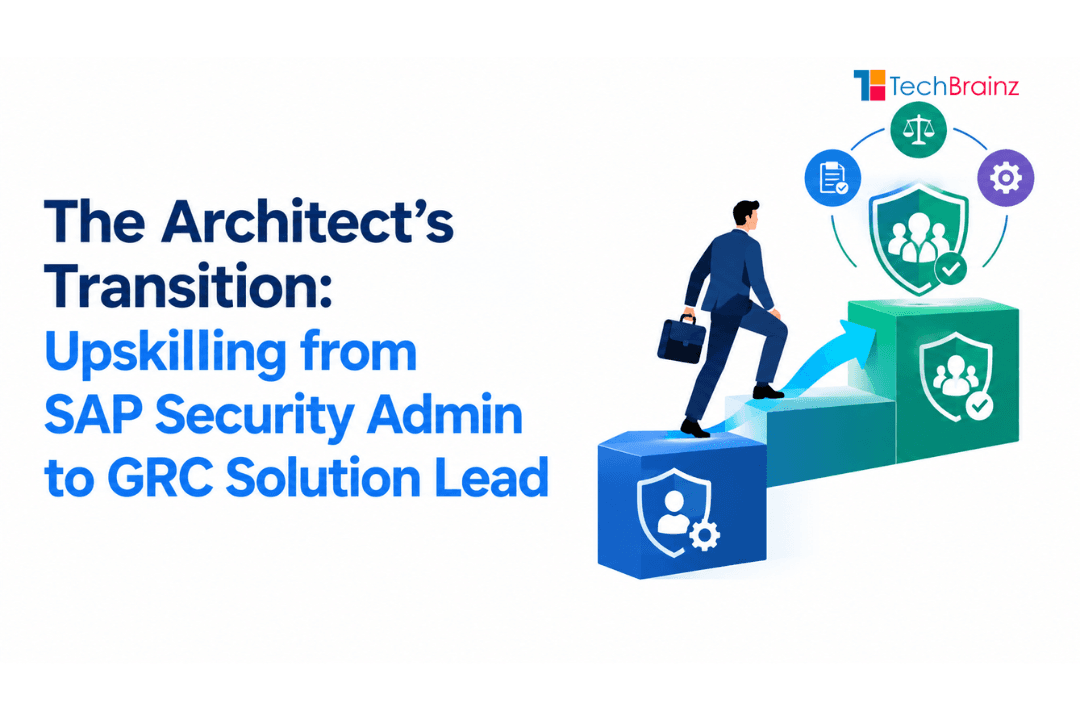
The Architect’s Transition: Upskilling from SAP Security Admin to GRC Solution Lead
The SAP GRC Career Path: Transitioning from SAP Security Admin to GRC Solution Lead
SAP Security Administrators are among the most technically capable professionals within SAP landscapes. They manage user access, build authorization roles, resolve security issues, and ensure employees receive the right permissions to perform their jobs.
However, today's organizations expect security professionals to contribute beyond user administration. As regulatory requirements become stricter and cyber risks continue to increase, companies need professionals who understand governance, risk, compliance, and business processes—not just authorizations.
This shift has created one of the fastest-growing career opportunities within the SAP ecosystem: becoming an SAP GRC Solution Lead.
For professionals looking to build a long-term SAP career, moving into SAP Governance, Risk, and Compliance (GRC) offers greater strategic responsibility, stronger career progression, and increased earning potential.
This guide explains how to make that transition successfully, the skills required, industry demand, expected salary growth, and a practical six-month roadmap for becoming a GRC Solution Lead.
Definition Box
What is a GRC Solution Lead?
A GRC Solution Lead is a senior SAP professional responsible for designing and managing Governance, Risk, and Compliance (GRC) solutions across an organization.
Unlike an SAP Security Administrator, who primarily manages users, roles, and authorizations, a GRC Solution Lead focuses on reducing business risk, ensuring regulatory compliance, improving audit readiness, and aligning SAP security with organizational objectives.

Typical Responsibilities
- Designing SAP GRC Access Control solutions
- Managing Segregation of Duties (SoD) risks
- Leading compliance and audit initiatives
- Working with Internal Audit and Risk teams
- Advising business leaders on access governance
- Driving SAP security strategy across projects
Quick Facts: SAP GRC Career Path
| Starting Role | SAP Security Administrator |
| Target Role | SAP GRC Solution Lead |
| Average Transition Time | 4–8 Months |
| Core SAP Modules | ARA, ARM, EAM, BRM |
| Key Business Knowledge | Procure-to-Pay, Order-to-Cash, Record-to-Report |
| Recommended Certifications | SAP GRC Access Control, SAP Security, SAP S/4HANA Security |
| Typical Salary Growth | 20–40% (depending on experience and region) |
| Long-Term Career Options | GRC Architect, SAP Security Manager, IAM Consultant, Cyber Risk Consultant |
Why More SAP Security Professionals Are Choosing the GRC Career Path
The SAP job market has changed significantly over the last few years.
Organizations no longer view SAP security as an isolated technical function. Security teams are increasingly expected to collaborate with audit, compliance, finance, cybersecurity, and business process owners.
As a result, professionals who understand both SAP Security and SAP GRC are becoming highly valuable.
Industry research supports this trend.
- LinkedIn Jobs continues to show strong global demand for SAP GRC consultants and access governance specialists across manufacturing, healthcare, banking, retail, and consulting sectors.
- Glassdoor salary data consistently indicates that SAP GRC professionals typically earn higher compensation than purely operational SAP Security roles, particularly at consultant and solution lead levels.
- Gartner has highlighted identity governance and continuous controls monitoring as strategic priorities for organizations strengthening enterprise risk management and regulatory compliance.
These trends indicate that SAP GRC expertise is becoming a long-term career advantage rather than a niche specialization.
From SAP Security Administrator to Solution Lead: Understanding the Shift
Most SAP Security Administrators begin their careers by mastering the technical side of SAP authorization management.
Their daily responsibilities often include:
- Creating users
- Maintaining roles
- Troubleshooting authorization issues
- Supporting transport activities
- Processing access requests
- Resolving SU53 authorization errors
These responsibilities are essential for maintaining secure SAP environments.
A GRC Solution Lead, however, operates at a broader organizational level.
Instead of asking, "Does this user have the required access?" they ask, "Should this access exist, what risks does it create, and how should those risks be governed?"
This broader perspective requires professionals to combine technical expertise with governance, business process knowledge, compliance frameworks, and strategic thinking.
Comparing the Two Roles
| SAP Security Administrator | SAP GRC Solution Lead |
|---|---|
| Creates and maintains roles | Designs governance strategies |
| Resolves authorization issues | Identifies business risks |
| Processes access requests | Builds compliance frameworks |
| Supports end users | Advises business leaders |
| Focuses on technical execution | Focuses on risk management and business alignment |
| Works mainly within IT | Collaborates across IT, Audit, Finance, Compliance, and Leadership |
The transition is less about leaving security behind and more about expanding your expertise to include governance and business decision-making.

Why This Career Move Matters
Organizations across every major industry are facing increasing pressure from regulators, auditors, and customers to demonstrate stronger governance over user access.
Regulations such as:
- Sarbanes-Oxley (SOX)
- GDPR
- ISO 27001
- NIST Cybersecurity Framework
- Industry-specific compliance requirements
have made access governance a business priority rather than simply an IT responsibility.
Consequently, professionals capable of connecting SAP security with governance and compliance are increasingly being considered for leadership positions.
In addition to broader responsibilities, this career path often provides:
- Higher earning potential
- Greater job stability
- Leadership opportunities
- Exposure to enterprise-wide transformation projects
- Increased interaction with executive stakeholders
For many SAP professionals, moving into GRC represents a natural progression from operational execution to strategic contribution.
Bridging the Skills Gap
Although SAP Security provides an excellent technical foundation, becoming a successful GRC Solution Lead requires developing capabilities in three additional areas. >
1. Advanced SAP GRC Knowledge
Professionals should build expertise in core SAP GRC Access Control modules, including:
- Access Risk Analysis (ARA)
- Access Request Management (ARM)
- Emergency Access Management (EAM)
- Business Role Management (BRM)
Understanding how these modules work together is essential for designing secure and compliant access governance processes.
2. Business Process Understanding
Technical knowledge alone is not enough.
A Solution Lead must understand how user access affects business operations such as:
- Procure-to-Pay (P2P)
- Order-to-Cash (O2C)
- Record-to-Report (R2R)
- Hire-to-Retire (H2R)
This enables security decisions to be aligned with operational objectives while minimizing compliance risks.
3. Governance and Compliance Expertise
Successful GRC professionals also develop skills in:
- Segregation of Duties (SoD)
- Risk assessment
- Audit preparation
- Internal controls
- Compliance documentation
- Policy development
- Stakeholder communication
These competencies distinguish strategic advisors from technical administrators.
Developing Practical GRC Expertise
Learning SAP GRC concepts is an important first step, but employers increasingly look for professionals who can apply those concepts in real business environments.
Developing practical expertise means learning how to:
- Analyze complex access risks
- Interpret audit findings
- Recommend mitigation controls
- Communicate technical issues to business stakeholders
- Design governance processes that support compliance objectives
Professionals who combine technical knowledge with business understanding are often better positioned for Solution Lead roles because they can contribute to both project delivery and long-term governance initiatives.
Turning Knowledge into Leadership: Building Real GRC Expertise
Making the transition from SAP Security Administrator to GRC Solution Lead requires more than learning new terminology. Employers expect professionals who can apply governance principles in practical situations and contribute to business decisions.
Technical expertise remains valuable, but leadership roles require a broader perspective. Instead of focusing only on configuring roles or resolving authorization issues, Solution Leads evaluate how access decisions affect compliance, operational efficiency, and business risk.
Developing this perspective involves strengthening four key capabilities:
- Risk analysis and control design
- Business process understanding
- Audit readiness and documentation
- Stakeholder communication
Professionals who combine these skills become trusted advisors rather than technical specialists.
Think Beyond System Configuration
Many SAP Security professionals already understand transactions, authorization objects, and role design. The next step is learning to evaluate access from a governance perspective.
For example, instead of asking: "Can this user access transaction FB60?" ask:
- Does this access create a Segregation of Duties (SoD) conflict?
- Is there an approved business justification?
- Should compensating controls be implemented?
- How will this decision be explained during an audit?
Approaching security decisions this way develops the analytical thinking expected from GRC Solution Leads.
Build Practical Experience Before Your First GRC Project
One challenge many professionals face is gaining experience before securing a dedicated SAP GRC role.
Fortunately, practical exposure can be developed independently.
Useful exercises include:
- Reviewing sample SoD conflict reports
- Mapping business risks to SAP roles
- Creating mitigation control documentation
- Practicing audit evidence preparation
- Studying approval workflows
- Reviewing SAP GRC Access Control demonstrations
If you're planning to move into a GRC-focused role, structured learning through an SAP GRC Access Control Training program can accelerate your transition by providing hands-on exposure to Access Risk Analysis (ARA), Access Request Management (ARM), Emergency Access Management (EAM), Business Role Management (BRM), and real-world project scenarios.
Learn to Communicate Like a Solution Lead
Technical expertise alone rarely leads to leadership positions.
GRC Solution Leads regularly communicate with:
- Internal Audit teams
- Compliance managers
- Business process owners
- Finance leaders
- External auditors
- Senior management
This requires translating technical findings into business language.
For example:
Instead of saying: "The user has conflicting authorization objects."
A Solution Lead might explain: "This access combination allows the same employee to create vendors and approve payments, increasing the risk of fraudulent transactions. Implementing a compensating review control will reduce this exposure."
Clear communication helps stakeholders understand both the technical issue and its business impact.
Focus on Business Outcomes
Organizations increasingly measure success through outcomes rather than activities.
Consider the difference:
Activity-Based Statement — Managed user access requests.
Outcome-Based Statement — Reduced Segregation of Duties conflicts by 35% through proactive access reviews and standardized role redesign.
Or:
Activity — Worked with SAP GRC.
Outcome — Improved audit readiness by implementing automated access reviews and reducing evidence collection time by 60%.
Employers consistently value measurable achievements over lists of routine responsibilities.
Your 6-Month SAP GRC Career Roadmap
One of the biggest advantages of transitioning into SAP GRC is that you don't need to start from scratch. Your SAP Security experience already provides a strong technical foundation.
The following roadmap builds on that knowledge progressively.
Months 1–2: Build the Foundation
Focus on understanding governance principles and SAP GRC fundamentals.
Learn:
- Governance, Risk, and Compliance concepts
- Segregation of Duties (SoD)
- Audit terminology
- Internal controls
- Compliance frameworks
- SAP GRC Access Control architecture
Recommended outcome: You should understand why access governance matters—not just how SAP authorizations work.
Months 3–4: Gain Hands-On Experience
Begin working with practical scenarios.
Practice:
- Access Risk Analysis (ARA)
- Access Request Management (ARM)
- Emergency Access Management (EAM)
- Business Role Management (BRM)
- Risk analysis reports
- Mitigation controls
- Audit evidence preparation
If possible, work in a sandbox environment or complete project-based exercises.
Months 5–6: Prepare for Career Growth
Now focus on positioning yourself for Solution Lead opportunities.
Activities include:
- Updating your resume with governance-focused achievements
- Building a portfolio of GRC projects
- Earning an SAP GRC certification
- Participating in compliance initiatives
- Applying for SAP GRC Consultant or GRC Solution Lead roles
- Expanding your professional network through SAP communities and LinkedIn
At this stage, an SAP GRC Access Control Training program with real project simulations can help bridge the gap between theory and practical implementation, particularly if you're targeting consulting or leadership roles.
Real Career Transition: From SAP Security Administrator to GRC Solution Lead
Consider the experience of a professional working for a global automotive manufacturing company with approximately 8,000 employees operating across North America and Europe.
Starting Position
- SAP Security Administrator
- Six years of experience
- Primary responsibilities included user provisioning, role maintenance, and authorization troubleshooting
- Limited exposure to compliance or audit activities
Although technically proficient, career progression had slowed because the role remained largely operational.
The Transition
Over a six-month period, the professional focused on expanding into governance by:
- Learning SAP GRC Access Control
- Studying Segregation of Duties risks
- Participating in internal audit meetings
- Supporting quarterly access reviews
- Completing an SAP GRC certification
- Leading a small access governance improvement initiative
Results After Nine Months
The transition produced measurable outcomes.
| Before Transition | After Transition |
|---|---|
| SAP Security Administrator | SAP GRC Consultant / Solution Lead |
| Primarily technical responsibilities | Governance and compliance leadership |
| Limited stakeholder interaction | Regular collaboration with Audit, Finance, and Risk teams |
| Annual salary: approximately ₹12 LPA | Annual salary: approximately ₹17 LPA (about 40% increase) |
| Reactive issue resolution | Proactive risk management and audit readiness |
In addition to higher compensation, the professional gained responsibility for designing access governance strategies, advising business leaders, and supporting enterprise-wide compliance initiatives.
While individual career outcomes vary by organization, experience, and region, this example reflects a common progression seen among professionals who successfully combine SAP Security expertise with GRC capabilities.
Common Mistakes That Delay Career Growth
Many professionals remain in operational roles longer than necessary because they overlook skills that hiring managers increasingly value.
Common mistakes include:
Focusing Only on Technical Skills — Strong technical knowledge is essential, but leadership roles also require business understanding and governance expertise.
Ignoring Business Processes — Understanding Procure-to-Pay, Order-to-Cash, and Record-to-Report processes helps explain why access risks matter.
Avoiding Compliance Knowledge — A basic understanding of SOX, ISO 27001, audit processes, and internal controls significantly strengthens your profile.
Delaying Certification — Recognized SAP GRC certifications demonstrate commitment and improve credibility during interviews.
Waiting for the "Perfect" Opportunity — Many professionals postpone learning until they receive a GRC project. Starting early through self-study, training, or internal initiatives often shortens the transition considerably.
Certifications That Strengthen Your SAP GRC Career
While experience remains the most valuable qualification, certifications can help validate your knowledge and improve visibility with recruiters.
Recommended learning areas include:
- SAP GRC Access Control
- SAP Security Administration
- SAP S/4HANA Security
- Identity and Access Management (IAM)
- Internal Controls and Compliance
- Risk Management Fundamentals
The strongest certification programs combine conceptual learning with practical exercises, case studies, and real-world implementation scenarios rather than focusing solely on theoretical content.
Future Trends Shaping the SAP GRC Career Path
The demand for SAP GRC professionals continues to grow as organizations strengthen governance, cybersecurity, and regulatory compliance programs. Modern enterprises are no longer relying solely on periodic access reviews—they are investing in continuous monitoring, intelligent automation, and integrated risk management.
Several trends are shaping the future of SAP GRC careers:
AI-Assisted Risk Analysis — Artificial Intelligence is helping organizations identify unusual access patterns, prioritize high-risk conflicts, and recommend remediation actions. Rather than replacing GRC professionals, AI enables them to focus on strategic risk management and decision-making.
Cloud-Based Governance — As businesses migrate to SAP S/4HANA Cloud and other cloud applications, access governance becomes more complex. Organizations increasingly require professionals who understand hybrid security models and cloud-native compliance practices.
Integrated Identity Governance — SAP GRC is becoming more closely integrated with Identity and Access Management (IAM), cybersecurity platforms, and enterprise risk management solutions. Professionals with expertise across these areas are well positioned for leadership roles.
Continuous Compliance — Instead of preparing for annual audits, organizations are moving toward continuous compliance models where access risks, approvals, and controls are monitored throughout the year. This shift increases the importance of SAP GRC specialists who can design sustainable governance frameworks.
Salary and Job Market Outlook
Career growth is one of the strongest reasons many SAP Security professionals pursue SAP GRC roles.
Current market trends indicate:
- LinkedIn Jobs consistently lists thousands of SAP GRC-related openings worldwide, particularly in consulting, manufacturing, banking, healthcare, retail, and technology sectors.
- Glassdoor salary insights show that SAP GRC Consultants and Solution Leads generally earn more than traditional SAP Security Administrators due to their broader responsibilities in governance, compliance, and audit readiness.
- Gartner continues to identify Identity Governance and Administration (IGA) and Continuous Controls Monitoring (CCM) as strategic priorities for organizations seeking stronger compliance and risk management.
While salaries vary by country, experience, and employer, professionals transitioning from SAP Security to SAP GRC leadership roles often experience salary growth in the range of 20–40%, particularly after gaining project experience and relevant certifications.
Frequently Asked Questions
1. What is the difference between SAP Security and SAP GRC?
SAP Security focuses on user administration, authorizations, roles, and access management within SAP systems. SAP GRC expands this scope by incorporating governance, risk analysis, compliance management, audit readiness, and access control policies. It helps organizations ensure that security controls align with business and regulatory requirements.
2. How long does it take to transition from SAP Security Admin to GRC Solution Lead?
For professionals with a solid SAP Security background, a structured learning plan combined with practical exposure can make the transition achievable within 4 to 8 months. The exact timeline depends on prior experience, project opportunities, and consistency in learning.
3. Is SAP GRC a good long-term career?
Yes. As organizations place greater emphasis on compliance, cybersecurity, and risk management, SAP GRC continues to be one of the most stable and rewarding career paths within the SAP ecosystem. It also opens opportunities in consulting, enterprise architecture, governance leadership, and cybersecurity.
4. Do I need programming skills for SAP GRC?
No. Coding is generally not required for most SAP GRC roles. A stronger understanding of SAP authorization concepts, business processes, governance frameworks, and audit requirements is far more valuable.
5. Which SAP GRC module should I learn first?
Most professionals begin with Access Risk Analysis (ARA) because it introduces core concepts such as Segregation of Duties (SoD), critical access risks, and compliance reporting. From there, learning Access Request Management (ARM), Emergency Access Management (EAM), and Business Role Management (BRM) provides a well-rounded understanding of SAP GRC Access Control.
6. Which certifications help advance an SAP GRC career?
Valuable certifications include: SAP GRC Access Control, SAP Security Administration, SAP S/4HANA Security, Identity and Access Management (IAM), and Information Security and Risk Management certifications. Practical training that includes real-world projects, case studies, and implementation scenarios is often more valuable than theoretical study alone.
Conclusion
Transitioning from an SAP Security Administrator to an SAP GRC Solution Lead is more than a job change—it is an opportunity to expand your influence within an organization.
The technical skills developed through SAP Security provide a strong foundation, but long-term career growth increasingly depends on understanding governance, compliance, business processes, and enterprise risk management. Organizations value professionals who can connect technical controls with business objectives, improve audit readiness, and help reduce operational risk.
By building expertise in SAP GRC Access Control, strengthening communication skills, gaining practical project experience, and following a structured learning roadmap, SAP Security professionals can confidently move into leadership roles that offer greater responsibility, broader business exposure, and stronger earning potential.
As digital transformation and regulatory expectations continue to evolve, professionals who invest in governance and compliance capabilities will be well positioned for future opportunities across consulting firms, global enterprises, and technology-driven organizations.
Whether your goal is to become an SAP GRC Consultant, Solution Lead, Security Architect, or Governance Manager, the journey begins by taking deliberate steps toward expanding your knowledge and applying it in real-world scenarios.
About the Author
TechBrainz Consulting
TechBrainz Consulting specializes in SAP Security, SAP GRC, Identity and Access Management (IAM), and enterprise compliance solutions. Through practical training, implementation expertise, and industry-focused consulting, TechBrainz helps professionals and organizations strengthen governance, improve audit readiness, and build future-ready SAP security capabilities.
© 2026 TechBrainz. All rights reserved. | www.techbrainz.com