
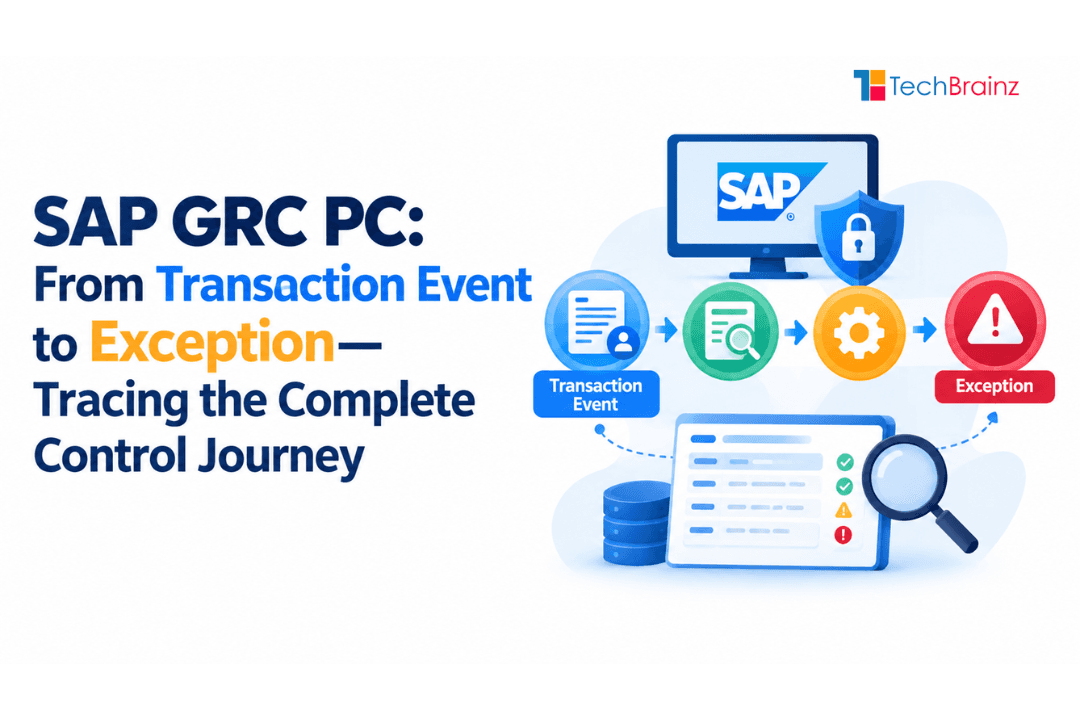
SAP GRC PC: From Transaction Event to Exception—Tracing the Complete Control Journey
A business transaction can take only a few seconds to complete in SAP, but the control journey behind that transaction can be much longer. A finance user posts a journal entry, a procurement employee creates a purchase order, or a master-data specialist changes a vendor record. To the business, these may look like routine activities. From a controls perspective, however, each event can become part of a larger story about authorization, compliance, risk, and accountability.
This is where SAP GRC Process Control (SAP GRC PC) becomes particularly important. Instead of depending entirely on periodic manual reviews, organizations can use continuous monitoring to examine relevant business data against predefined control conditions. When the monitored information matches the criteria established in a business rule, SAP GRC PC can identify an exception and move the result into an issue-management process. SAP describes Continuous Monitoring around data sources, business rules, control assignments, monitoring execution, exception identification, and subsequent issue handling.
The interesting part is not simply that SAP GRC PC can identify an exception. The real story is everything that happens between the original transaction and that exception. Understanding this complete journey makes it easier to understand how SAP GRC PC works in a real enterprise environment and why Continuous Control Monitoring is more than another compliance dashboard.
Definition: What Is SAP GRC PC Continuous Control Monitoring?
SAP GRC PC Continuous Control Monitoring (CCM) is a monitoring approach within SAP Process Control that uses defined data sources and business rules to evaluate relevant business, master-data, or configuration information against control requirements. When monitored information meets defined deficiency criteria, the system can identify an exception and support the subsequent issue-review and remediation process.
In simple terms, the journey can be understood as transaction event → data → business rule → control evaluation → exception → review → remediation → evidence. Each stage has a different purpose, and the strength of the overall control process depends on how effectively those stages work together.
The Control Journey Begins With a Transaction
Every control story starts somewhere, and in many SAP environments it starts with an ordinary transaction. A user posts a journal entry, creates a purchasing document, changes a customer record, or performs another business activity. At the moment the transaction is created, it is not automatically a control exception. It is simply an event recorded by the business system.
Consider a finance user posting a manual journal entry during month-end closing. The posting may contain a company code, account, amount, posting date, document type, user information, and other attributes. Nothing about the transaction alone necessarily proves that there is a problem. However, those attributes create the information that a monitoring process can later evaluate.
This distinction is important because a mature control environment should not treat every unusual transaction as evidence of wrongdoing. Instead, monitoring should identify activity that meets predefined criteria and therefore deserves further attention. SAP GRC PC provides the mechanism for making that distinction at scale.
The transaction is therefore the beginning of the journey, not the final answer.
From Transaction Data to a Monitoring Data Source
Once a transaction exists, the next question becomes: how does the monitoring process obtain the information required to evaluate it? This is where the data-source layer becomes important.
SAP Process Control supports data sources that can use SAP tables, queries and reports, BI queries, third-party connectors, and custom programs depending on the monitoring scenario. The purpose is to make relevant information available to the monitoring logic in a form that can be evaluated against the organization's control requirements.
This part of the architecture is sometimes underestimated. A business rule can be perfectly designed from a logical perspective, but if the underlying data source does not provide the right information, the rule cannot produce a meaningful result. Monitoring quality is therefore closely connected to data quality.
Imagine that an organization wants to identify unusual journal postings. If the monitoring process needs the posting amount, user, account, document type, and posting date to make its decision, those fields must be available and reliable. Missing or poorly structured information can weaken the entire monitoring chain before the business rule even runs.
That is why data-source design should be viewed as part of control design rather than as a purely technical configuration exercise.
The Business Rule Gives Meaning to the Data

Raw transaction data is not automatically meaningful from a control perspective. An organization may have thousands or millions of records, but the control owner does not want to manually inspect every record. The business rule provides the logic that separates potentially relevant activity from the larger population.
For example, an organization might define monitoring logic around manual journal postings above a certain threshold. Another control could focus on transactions outside an approved tolerance or particular changes to sensitive master data. SAP documentation describes business rules as using data sources together with filter and deficiency criteria to identify exceptions.
The business rule essentially asks a question: does this particular piece of data meet the conditions that the organization considers significant for this control?
This is where a normal transaction begins to become a control event.
However, the quality of the rule matters enormously. A rule that is too broad can produce a large number of irrelevant exceptions and create unnecessary work for control owners. A rule that is too narrow can miss activity that the organization actually needs to monitor. The objective is not to create the most complicated rule. The objective is to create a rule that reflects the business risk the control is designed to address.
Connecting the Business Rule to the Control
A business rule is only one part of the control story. It provides the detection logic, while the control provides the governance context.
SAP Process Control allows business rules to be assigned to applicable controls within the compliance structure. This relationship is what connects a technical monitoring condition with a defined control objective.
Suppose an organization wants to monitor high-value manual journal postings. The control may be designed around the expectation that certain financial postings receive appropriate authorization or review. The business rule then becomes a mechanism for identifying transactions that match the conditions established for that control.
This distinction is useful when explaining SAP GRC PC to new professionals. The rule answers the question, "What should the system look for?" The control answers the broader question, "Why does this matter to the organization?"
When those two elements are correctly connected, monitoring becomes much more meaningful.
Scheduling Turns a Rule Into Continuous Monitoring
A business rule cannot provide continuous monitoring if it is never executed. Scheduling is therefore another important stage in the control journey.
SAP Process Control provides Automated Monitoring capabilities that can support recurring jobs for automatically testing controls for deficiencies. Monitoring can be scheduled according to the requirements of the organization and the nature of the control.
This changes the traditional control model. Instead of relying exclusively on someone to remember to perform a review at a particular point in time, the monitoring process can execute according to a defined schedule.
The appropriate frequency depends on the business scenario. A high-volume process with significant financial exposure may require more frequent monitoring than a relatively stable process. The important consideration is whether the monitoring frequency provides an appropriate level of visibility for the control objective.
This is one of the reasons continuous monitoring can change the daily work of control teams. Rather than spending significant time searching through large populations of transactions, reviewers can focus their attention on results that meet predefined conditions.
The Moment an Exception Appears
Now the journey reaches its most important moment.
The monitoring job executes. The relevant data is retrieved. The business rule evaluates the data. One or more records satisfy the defined deficiency criteria.
An exception is identified.
This is the point at which the original transaction becomes visible from a control perspective. SAP documentation describes automated monitoring as identifying exceptions and supporting the creation and handling of resulting issues.
But there is an important principle here: an exception is not automatically proof of a control failure, fraud, or misconduct.
It is a signal that the defined monitoring condition has been met.
For example, a high-value manual journal may trigger a rule because its amount exceeds a defined threshold. That does not automatically mean the posting was unauthorized. There could be a legitimate business reason, appropriate approval, or supporting documentation.
The role of the monitoring process is to bring the transaction into focus. The next stage determines what the organization should do with that signal.
From Exception to Issue
Once an exception has been identified, the process can move from automated detection into issue management. The relevant business owner can be brought into the process so that the exception can be investigated and understood.
This is where SAP GRC PC moves beyond pure automation.
The system can identify the condition, but someone with appropriate business responsibility must determine what the result actually means. The reviewer may examine the transaction, supporting documentation, authorization information, or other relevant evidence before deciding how the issue should be handled.
SAP's Process Control documentation describes the use of issues and business-owner review as part of the automated monitoring process.
This creates an important division of responsibility. Technology performs the repetitive evaluation. The business provides the context.
That combination is particularly valuable when monitoring large transaction populations where manual inspection of every record would be impractical.
Remediation Moves the Process Beyond Detection
Finding an exception is useful, but the ultimate purpose of control monitoring is not to create a larger exception list. It is to help organizations identify and address control weaknesses.
When an exception is confirmed as requiring action, remediation may involve correcting a transaction, changing master data, reviewing a process, adjusting configuration, improving an approval mechanism, or taking another corrective action appropriate to the situation.
This is where issue management becomes more valuable than simple alerting.
An alert says something deserves attention.
A remediation process asks what should actually be done about it.
SAP's documented Process Control workflow includes remediation activities and subsequent review as part of the issue lifecycle.
A mature organization should therefore look beyond the question of whether an issue was closed. It should also consider why the issue occurred and whether the underlying condition could happen again.
Closing the Issue Does Not End the Control Story
An issue can eventually be closed, but closure should not necessarily be viewed as the end of the learning process.
Suppose the same business rule produces hundreds of exceptions over several monitoring cycles. One possible explanation is that the business process has a genuine weakness. Another possibility is that the monitoring threshold is too broad. The rule might be identifying legitimate business activity that was never intended to represent a control deficiency.
This is why exception trends can be useful.
Control teams can ask whether the same type of exception is recurring, whether remediation is effective, whether the rule continues to reflect the business risk, and whether the control design should be adjusted.
Continuous monitoring therefore has two purposes. It can identify individual exceptions, but it can also reveal patterns that may not be visible when transactions are reviewed individually.
What Happens When No Exception Is Found?
The control journey does not disappear simply because no exception is identified.
A monitoring job can execute, evaluate the relevant data, and produce no exception. SAP documentation describes monitoring results being recorded even when no exception is identified, depending on the monitoring configuration.
This creates two sides of the monitoring story.
When an exception is identified, the process may move toward issue review and remediation. When no exception is identified, the monitoring activity still provides a record of the test result.
That distinction is important for control evidence.
A control environment should not only show the issues that were found. It should also provide visibility into the monitoring activities that were performed and the results those activities produced.
SAP GRC PC Can Look Beyond Transactions
Although transaction monitoring is an important use case, SAP GRC PC monitoring is not limited to transaction records.

SAP documentation describes automated monitoring scenarios involving transaction data, master data, and configuration data.
This broader approach allows organizations to think about control monitoring across different layers of the SAP environment.
Transaction monitoring can examine what users actually posted or changed. Master-data monitoring can help identify unexpected changes to important business information. Configuration monitoring can help identify settings that fall outside defined expectations.
The result is a broader control perspective.
Instead of asking only, "What transactions occurred?" organizations can also ask, "What important data changed?" and "Did the system configuration remain within the expected control boundaries?"
Automated and Semi-Automated Control Monitoring
Not every control should be treated as a completely automated decision.
Some control activities are well suited to automated monitoring because the conditions can be clearly defined and measured. Other scenarios require human interpretation after the system produces a result.
SAP Process Control supports automated and semi-automated approaches. In automated monitoring, the system can execute defined monitoring logic and identify results. In semi-automated scenarios, users can review the resulting information and perform the required control evaluation.
This distinction becomes especially important for complex business processes.
A system may be able to identify that a transaction meets certain conditions, but a business owner may still need to determine whether the activity was appropriate under the circumstances.
The strongest control environments therefore do not necessarily attempt to automate every decision. They automate the repetitive parts and preserve human judgment where business context matters.
A Real-World Example: Following a Month-End Journal
Consider a finance team working through month-end closing. A user posts a manual journal entry that exceeds the threshold defined for a particular monitoring scenario.
At the transaction level, it is simply a journal entry.
The relevant information becomes available through the configured data source. The business rule evaluates the transaction and determines that it satisfies the defined criteria. During the scheduled monitoring cycle, the system identifies the record as an exception.
The exception enters the issue process, where the responsible business owner reviews the transaction and supporting information. The reviewer determines whether the transaction was legitimate and appropriately supported.
If no corrective action is required, the issue can proceed according to the organization's defined closure process. If action is required, remediation can be assigned and reviewed before the issue is closed.
The important point is that SAP GRC PC did not simply "find a bad journal."
It created a traceable journey from the original transaction to the eventual control decision.
That is the real value of continuous control monitoring.
Where the Control Journey Can Break Down
A control journey is only as strong as its weakest stage.
If the data source does not provide reliable information, the monitoring result can be affected before the business rule even executes. If the rule is too broad, control owners may face large numbers of irrelevant exceptions. If the rule is too narrow, important activity may remain outside the monitoring population.
Control mapping can create another weakness. A rule may technically execute successfully but still fail to support the right control objective if its relationship to the control has not been clearly designed.
Ownership also matters. An exception without a clearly responsible reviewer can quickly become another unresolved item in the compliance process.
Finally, remediation should not become a simple administrative exercise. If an organization repeatedly closes similar issues without understanding why they keep occurring, the monitoring system may continue to report the same problem cycle after cycle.
Designing a Better SAP GRC PC Control Journey
A strong control journey begins by understanding the business process rather than starting with technical configuration.
First, the organization needs to identify what activity actually matters to the control objective. It then needs to determine which characteristics would indicate that the activity deserves attention.
The next step is translating that requirement into business-rule logic that can be applied consistently to the available data. The rule should then be connected to the appropriate control so that the monitoring result has clear governance meaning.
But the design should not stop there. The organization also needs to decide who reviews an exception, how the issue is handled, what evidence is required, when remediation is considered complete, and how the result is ultimately reported.
In other words, a strong control is not simply a strong business rule.
It is a complete journey.
Understanding the Complete SAP GRC PC Journey
The easiest way to understand SAP GRC PC is to follow one event from beginning to end.
A transaction occurs in the SAP environment. Relevant information becomes available through a configured data source. A business rule evaluates that information against predefined conditions. The rule is connected to a control objective. Scheduled monitoring executes the test. If the deficiency criteria are met, an exception is identified.
The exception can then move into issue management. A responsible owner reviews the result and determines whether the activity is legitimate or requires corrective action. If remediation is necessary, the organization addresses the issue and reviews the outcome before closure.
The result becomes part of the organization's broader control evidence and reporting story.
This is why the phrase "from transaction event to exception" is so useful. It describes not just what SAP GRC PC detects, but the complete path that connects business activity with control governance.
Understanding this complete control journey is also important for professionals working with SAP governance and compliance environments. SAP GRC PC Training can help learners connect concepts such as control monitoring, business rules, exception handling, issue management, and evidence generation with practical SAP GRC Process Control scenarios. This makes it easier to understand not only how a control works, but also how each stage contributes to continuous compliance monitoring.
Frequently Asked Questions
What is SAP GRC Process Control?
SAP GRC Process Control is designed to help organizations document, evaluate, monitor, report, and certify internal controls. Its Continuous Monitoring capabilities can use data sources and business rules to evaluate control conditions and identify exceptions that may require further review.
What is Continuous Control Monitoring in SAP GRC PC?
Continuous Control Monitoring uses defined data sources and business rules to evaluate relevant business, master-data, or configuration information against predefined control criteria. Monitoring can be scheduled so that potential exceptions are identified systematically instead of relying only on periodic manual checks.
What happens when SAP GRC PC detects an exception?
When monitoring identifies information that meets the configured deficiency criteria, the result can become an exception and may generate an issue for business-owner review. The responsible owner evaluates the situation and determines whether remediation or another appropriate action is required.
What is the difference between a business rule and a control in SAP GRC PC?
A business rule provides the logic used to evaluate data and identify conditions that require attention. A control represents the broader governance requirement or control objective that the rule supports. SAP Process Control allows business rules to be associated with applicable controls.
Does every SAP GRC PC exception mean a control failure?
No. An exception means that the monitored information met the criteria defined by the monitoring logic. The business owner still needs to review the situation and determine whether the activity was legitimate, whether remediation is required, or whether the monitoring logic needs refinement.
Can SAP GRC PC automate control monitoring?
Yes. SAP Process Control supports Automated Monitoring capabilities that can execute recurring monitoring jobs and test controls against configured conditions. It also supports scenarios in which monitoring results are subsequently reviewed by users as part of semi-automated control activities.
Conclusion
A transaction may begin as an ordinary business event, but SAP GRC PC can turn that event into a traceable control story.
The journey starts with the transaction and moves through the data source, business rule, control assignment, monitoring execution, exception detection, issue review, remediation, and closure. Each stage contributes something different, and the strength of the final control result depends on how well those stages connect.
The most important idea is that SAP GRC PC is not simply about finding exceptions. It is about connecting what happened in the business with what the organization expected to happen, identifying where those two things differ, bringing the right people into the review process, and creating evidence of what happened next.
That is what makes Continuous Control Monitoring valuable.
The transaction is the event.
The rule is the filter.
The control provides the context.
The exception creates the signal.
The human review provides the judgment.
And the remediation creates the response.
Together, they form the complete SAP GRC PC control journey.
About the Author
TechBrainz Consulting
TechBrainz Consulting provides practical SAP insights across governance, security, compliance, business transformation, and enterprise technology. Our content simplifies complex SAP concepts through practical, human-centered explanations that connect technology with real-world business challenges.