
SAP GRC Process Control 12.0 End of Maintenance: Migration Action Plan Before December 2027
The clock is ticking for organizations relying on SAP Governance, Risk, and Compliance (GRC) Process Control 12.0. With the SAP GRC PC end of maintenance deadline looming in December 2027, businesses face a stark choice: migrate to the next-generation platform, pay a premium for extended support, or risk falling out of compliance. While December 2027 may feel distant, the complexity of migrating from legacy GRC architectures to the new GRC Process Control 2027 (SAP GRC for HANA 2026) requires a minimum of 12–18 months of dedicated planning. This article serves as your technical action plan, outlining exactly what "end of maintenance" means, why the GRC Process Control 2027 deadline is non-negotiable for auditors, and a quarterly roadmap to ensure a seamless transition before support ceases. For organizations that have invested heavily in custom rule sets, automated control monitors, and integration with SAP Business Warehouse, this migration represents not just a technical lift but a fundamental re-architecture. The good news? Those who start now will find that the new HANA-based platform offers performance gains that directly reduce the cost of compliance testing by 30-50%. Delaying only increases technical debt and consultant costs as the deadline approaches. Every quarter you wait, the risk profile of your GRC system degrades, and the pool of available consultants with deep GRC 12.0 expertise begins to shrink as they retrain on the new platform. A critical point often overlooked: your external auditors are already asking about your migration plans. In 2025 and 2026 audit cycles, they will begin documenting your "end-of-maintenance remediation plan" as a standard inquiry. If you cannot show a project charter with defined timelines and budget by Q2 2026, expect a formal audit finding even before the deadline hits. Leading organizations are already building this into their 2026 internal audit plans. Do not be caught unprepared when your auditor asks for your SAP Note 3326989 response strategy. Another factor to consider: SAP's support infrastructure for GRC 12.0 is already winding down. While the official end-of-maintenance date is December 2027, SAP has already reduced the number of support engineers trained on the legacy stack. By late 2026, response times for GRC 12.0 tickets will lengthen significantly as SAP shifts resources to the HANA platform. Do not wait until you have a critical production issue to discover that the available support has degraded. Additionally, third-party tool integrations (like GRC connectors to HR systems or identity management platforms) may stop releasing updates for GRC 12.0 before the official deadline, creating unexpected integration failures. Verify with all your software vendors that they will support GRC 12.0 through December 2027—many will drop support earlier.
The Critical December 2027 Deadline
SAP operates on a predictable lifecycle strategy. Unlike consumer software that updates silently, enterprise GRC systems require rigid adherence to SAP's maintenance timelines to remain legally compliant for financial auditing (e.g., SOX, GDPR). Missing a maintenance deadline is not merely an IT inconvenience; it is a reportable event for publicly traded companies under Section 404 of the Sarbanes-Oxley Act.
SAP's official EOL announcement
According to official SAP notes, the end of mainstream maintenance for SAP GRC 12.0 is scheduled for December 31, 2027. The successor, SAP GRC for HANA 2026 (GRC Process Control 2027), is in Early Adopter Care and will be generally available by Q3 2026. SAP Note 3326989 is the authoritative source auditors will request. Without a signed extended maintenance contract or completed migration before December 2027, your IT General Controls (ITGC) audit will contain a finding. SAP releases these notes approximately 24 months before end-of-maintenance, giving customers a clear runway. Your failure to act on this notice is not a valid defense during an audit. The note explicitly states the deadlines and recommends migration paths, leaving no room for ambiguity. Download and retain this note in your audit evidence repository immediately.
What 'end of maintenance' really means
Your GRC 12.0 system will continue to run technically after December 2027. However, "end of maintenance" means:
- No more security patches: New vulnerabilities remain unpatched. SAP releases 200-300 security notes annually. After December 2027, none apply to GRC 12.0.
- No regulatory updates: Tax or compliance rule changes will not be updated.
- No technical support: SAP rejects tickets for system errors.
- No legal warranty: Your organization assumes full liability.
Consider this scenario: In 2028, a new NetWeaver vulnerability is discovered. SAP releases a patch that explicitly excludes GRC 12.0. Your system remains exposed. An audit discovers this. Your CFO must disclose a material weakness. Share price drops. This has happened to SAP customers who ignored previous deadlines for other products like SAP CRM or SAP SRM. The pattern is consistent: organizations that wait beyond the deadline always pay more—either in extended maintenance fees, emergency consulting rates, or audit penalties.
Extended maintenance options until 2030
For enterprises unable to migrate by 2027, SAP offers Extended Maintenance until 2030. This costs a 20-40% premium on standard maintenance fees. For a $250k annual contract, that adds $50k–$100k per year from 2028-2030—$150k–$300k with zero functional improvement. What extended maintenance includes: Critical security patches only, reduced-scope tax updates, and system-down support. What it excludes: New features, performance improvements, non-critical bug fixes, new browser support, or BTP integration. Extended maintenance is a bridge, not a destination. Use it for 12 months maximum while running a parallel migration project. The worst strategy is purchasing extended maintenance and then doing nothing—you simply burn cash while falling further behind on technical debt. A smarter approach: sign for one year of extended maintenance in early 2028 only if your migration is 80% complete but needs a few more weeks. Never sign for three years upfront. Remember that extended maintenance pricing increases each year, so delaying the decision only makes it more expensive.
Why You Can't Ignore This Deadline
Ignoring the GRC migration deadline creates three distinct risk categories that every GRC steering committee must evaluate.
Compliance risks
Process Control is the bedrock of your Internal Controls framework. External auditors require that systems managing financial controls be on a supported version. Running GRC 12.0 after December 2027 violates ITGC domain "system software maintenance." The audit perspective: Auditors evaluate five ITGC domains. "System software maintenance" requires vendor-supported applications. Violation results in a deficiency. If uncorrected, it becomes a material weakness under SOX 404. Once a material weakness is declared, your organization faces increased scrutiny from the audit committee, potential SEC inquiries, and higher external audit fees for at least two years. Some organizations have seen their external audit fees double following a material weakness declaration. The reputational damage with investors can be even more costly. Regulatory fines: GDPR requires "appropriate technical measures" to secure personal data. An unsupported system with unpatched vulnerabilities fails this. Fines reach €20 million or 4% of global revenue. HIPAA, GLBA, and NERC CIP have similar requirements. In some jurisdictions, IT leadership can face personal liability for knowingly running unsupported software that leads to a breach. This is not theoretical—several IT directors in Europe have faced personal fines under GDPR Article 32 for security negligence. Remediation costs: Your internal audit team must document a "compensating control" for every control in GRC 12.0. Manual testing of 500 controls each quarter at 30 minutes each equals 250 hours quarterly—$25k–$50k annually in internal labor alone. These costs recur every year until migration. Over three years, that is $75k–$150k of wasted internal audit capacity that could have been spent on strategic risk projects. Additionally, external auditors will charge a premium for reviewing manual compensating controls, adding another $20k–$40k annually.
Security risks
SAP systems are prime cyberattack targets. GRC systems hold the "keys to the kingdom"—user access rules, sensitive financial data, and audit logs. When SAP stops releasing security notes, any zero-day exploit after the deadline will never be fixed. The GRC PC HANA migration moves you to a modern security architecture that SAP actively monitors. Attack vectors:
- Unauthorized access changes: Attacker modifies SoD rules, approves their own access, deletes audit logs.
- Control disablement: Attacker disables fraud monitoring controls, executes undetected transactions.
- Data exfiltration: GRC contains financial data, org structures, user lists—perfect reconnaissance for larger SAP attacks.
Real-world precedent: In 2020, a European manufacturer suffered a ransomware attack starting with an exploit of an unsupported SAP component. Cost: $50 million remediation, six weeks downtime, permanent customer trust damage. Your GRC system may not seem critical, but to an attacker, it is the map to every financial control in your enterprise. Once attackers understand your controls, they can craft transactions that bypass detection entirely. This is why security experts rank GRC systems as high-value targets—they provide the blueprint for fraud.
Innovation gap
SAP embeds AI and advanced analytics into HANA-based GRC. The 2026 release offers continuous controls monitoring and machine-learning risk detection that cannot be retrofitted to 12.0. What you miss:
- Real-time monitoring: GRC 12.0 runs controls overnight in batch. HANA 2026 runs continuously, alerting within seconds.
- Embedded GRC: In S/4HANA, GRC embeds directly into transactions. Users never leave Fiori.
- AI prediction: Machine learning models predict SoD violations before users attempt transactions.
- BTP integration: Route control assessments to Microsoft Teams or Slack.
The S/4HANA dependency: If you plan to migrate to S/4HANA, you must migrate GRC first. S/4HANA's authorization model differs fundamentally from ECC. GRC 12.0 cannot manage S/4HANA authorizations. Delaying GRC migration blocks your S/4HANA roadmap indefinitely. Many organizations have learned this the hard way—they planned an S/4HANA migration only to discover that their GRC system was the critical path bottleneck. Some have had to delay their S/4HANA go-live by 6-12 months solely because GRC was not ready. Do not let this be you.
Your Options for GRC PC After 2027
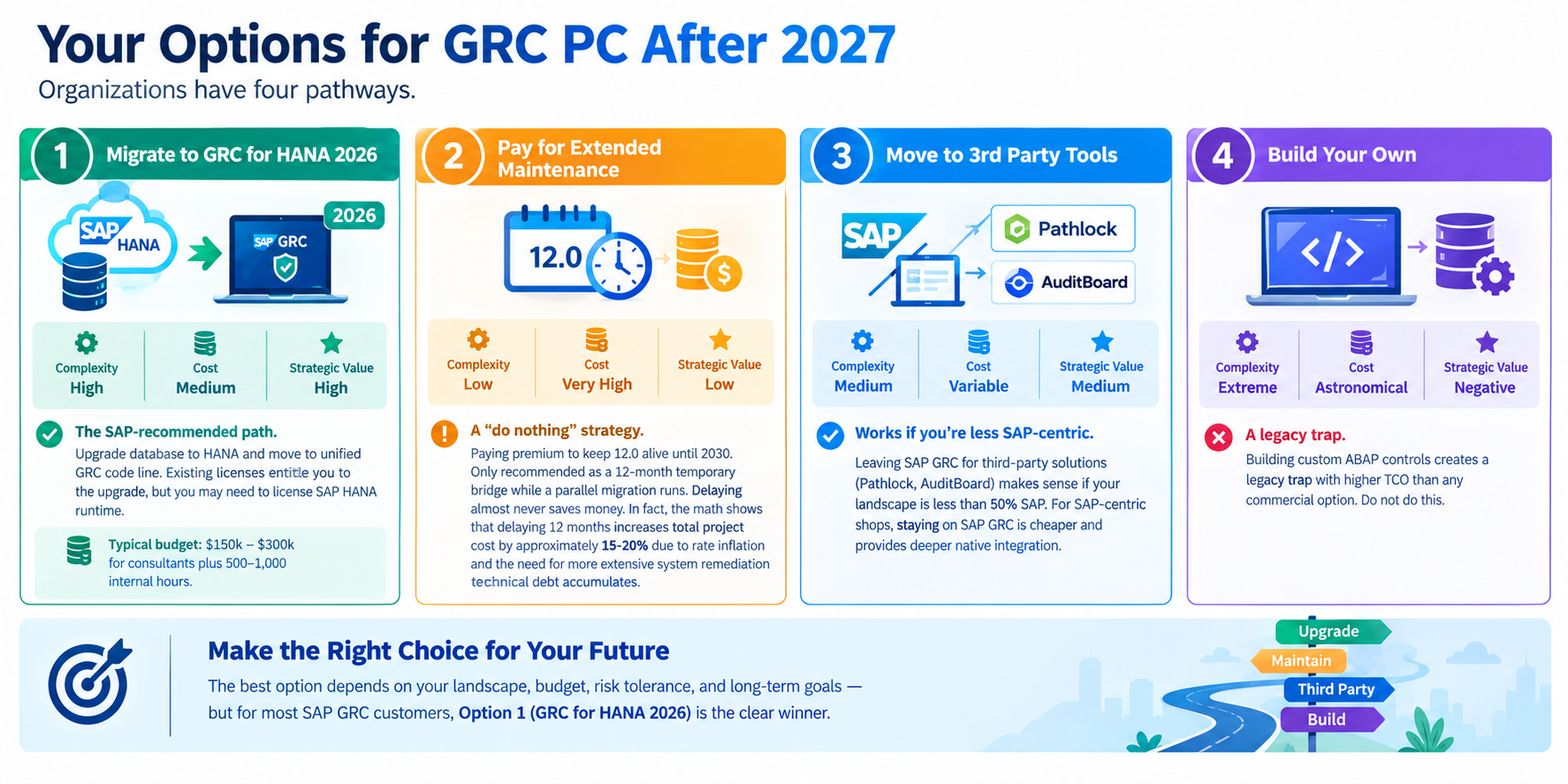
Organizations have four pathways.
- Option 1: Migrate to GRC for HANA 2026 — Complexity: High, Cost: Medium, Strategic Value: High
- Option 2: Pay for Extended Maintenance — Complexity: Low, Cost: Very High, Strategic Value: Low
- Option 3: Move to 3rd Party Tools — Complexity: Medium, Cost: Variable, Strategic Value: Medium
- Option 4: Build Your Own — Complexity: Extreme, Cost: Astronomical, Strategic Value: Negative
Option 1: Migrate to GRC for HANA 2026 The SAP-recommended path. Upgrade database to HANA and move to unified GRC code line. Existing licenses entitle you to the upgrade, but you may need to license SAP HANA runtime. Typical budget: $150k–$300k for consultants plus 500-1,000 internal hours.
Option 2: Pay for extended maintenance
A "do nothing" strategy paying premium to keep 12.0 alive until 2030. Only recommended as a 12-month temporary bridge while a parallel migration runs. Delaying almost never saves money. In fact, the math shows that delaying 12 months increases total project cost by approximately 15-20% due to rate inflation and the need for more extensive system remediation as technical debt accumulates.
Option 3: Move to alternative GRC tools
Leaving SAP GRC for third-party solutions (Pathlock, AuditBoard) makes sense if your landscape is less than 50% SAP. For SAP-centric shops, staying on SAP GRC is cheaper and provides deeper native integration.
Option 4: Build your own
Building custom ABAP controls creates a legacy trap with higher TCO than any commercial option. Do not do this.
The Recommended Path: GRC for HANA 2026 Migration
For 90% of existing SAP shops, the best answer is moving to SAP GRC for HANA 2026.
Why this is the best choice
The primary driver is architecture. The new version unifies Access Control, Process Control, and Risk Management on a single platform, eliminating old "hub" complexities. SAP confirms support until approximately 2040. Architectural benefit: In GRC 12.0, Process Control and Access Control are separate applications on the same ABAP stack. Integration requires RFC connections. In GRC 2026, they are truly unified. A single rule defines both access and control testing. This reduces configuration effort by 30% and eliminates a class of integration bugs that plagued dual-system environments.
What you get with the upgrade
- Fiori 2.0 UI: Modern, role-based experience. Control owners complete assessments on mobile devices.
- Performance: HANA columnar storage enables real-time analysis. A control test taking 45 minutes on GRC 12.0 takes 8 seconds on GRC 2026.
- Embedded options: Run GRC inside S/4HANA, eliminating network latency and simplifying security.
- Unified audit trail: One log for all GRC activities through a single Fiori app.
Migration Prerequisites
Before installing GRC Process Control 2026, your landscape must meet strict technical criteria.
HANA database migration
SAP GRC for HANA 2026 only runs on SAP HANA. If your GRC 12.0 runs on AnyDB (Oracle, SQL Server, DB2), you must perform a "Database Migration Option" (DMO). The DMO process takes 48-72 hours for a medium-sized system. If your system is non-Unicode, expect an additional 12-24 hours for automatic conversion.
SAP S/4HANA Foundation upgrade
The new GRC requires the SAP S/4HANA Foundation stack. Your current NetWeaver 7.4 or 7.5 must be upgraded to NetWeaver 7.5 SP or higher. Custom ABAP code must be rechecked for compatibility.
Fiori 2.0 prerequisite
The new UI is Fiori 2.0. You must install SAP Gateway, activate OData services for GRC, configure SAP Web Dispatcher, and set up SAML 2.0 SSO. This is typically a 2-4 week project.
Step-by-Step Migration Plan (Q2 2026 – Q4 2027)
Here is the GRC migration action plan with quarterly deliverables.
Q2 2026: Assessment (April – June 2026)
- Action: Run SAP Readiness Check for GRC.
- Deliverable: Inventory of custom controls, SoD rules, existing plugins.
- Goal: Confirm OS/DB supports HANA. Cite SAP Note 3326989.
- Team: Basis lead (owner), GRC functional lead, security architect.
- Success criteria: Documented gap list with estimated remediation hours.
Q3-Q4 2026: Planning and design (July – December 2026)
- Action: Order HANA hardware, install sandbox environment.
- Decision point: Choose "Hub vs. Embedded" architecture.
- Deliverable: Technical design document with network diagrams and cutover runbook.
- Success criteria: Signed-off design document. Sandbox running GRC 2026.
Q1-Q2 2027: Implementation (January – June 2027)
- Action: Run SUM with DMO to migrate database to HANA and upgrade code to GRC 2026 in development.
- Deliverable: Fully functional GRC 2026 Dev environment.
- Risk Mitigation: Assign dedicated ABAP developer for two months for code repairs.
- Success criteria: All critical controls (Priority 1 and 2) pass functional testing.
Q3-Q4 2027: Testing and cutover (July – December 2027)
- Action: User Acceptance Testing (UAT) on Fiori 2.0. Train control owners.
- Deliverable: Production cutover. Signed UAT completion certificate.
- Deadline: Go-live before December 31, 2027 (schedule for November buffer).
- Success criteria: Zero critical defects after 30 days. All users logged into Fiori GRC apps.
Cost of Inaction
What does missing the deadline cost a mid-sized enterprise? Direct costs:
- Extended Maintenance Fees (2028-2030): $40k/year premium × 3 years = $120,000
- Emergency migration penalty: Waiting until 2027 to start means 2x consultant rates. A $200k migration becomes $400,000
- Audit failure remediation: Material weakness finding requires special audit: $50,000–$150,000
- Security incident response: Average SAP breach remediation: $500,000–$2,000,000
Total potential cost of inaction: $670,000 – $2.67 million Compare to proactive migration: Planned migration costs $200,000–$350,000. Proactive migration saves at least $320,000 and eliminates audit risk.
How to Build the Business Case
Present this to your CFO, CIO, and Audit Committee. Executive Summary: "Our GRC 12.0 loses support December 2027. If we do nothing, we pay $120k in extended fees and risk a $500k+ audit finding. For $250k, we upgrade, eliminate risk, and reduce control testing time by 40%. Payback in 18 months." ROI Calculation (Three-Year View):
- Category: Do Nothing — Extended maintenance fees: $120,000, Migration cost: $0, Audit remediation (expected): $75,000, Efficiency gain (40% reduction): $0, Net Three-Year Cost: $195,000
- Category: Proactive Migration — Extended maintenance fees: $0, Migration cost: $250,000, Audit remediation (expected): $0, Efficiency gain (40% reduction): ($60,000), Net Three-Year Cost: $190,000
- Difference: +$5,000 in favor of migration
Recommended Approval: Fund migration with $250,000 budget + 800 internal hours. Approve by May 31, 2026.
FAQ: GRC PC End of Maintenance
Q: Is SAP discontinuing GRC Process Control?
A: No. SAP discontinues maintenance for the 12.0 version. The product continues as SAP GRC for HANA 2026.
Q: Can I skip migration if moving to S/4HANA?
A: No. GRC 12.0 cannot manage S/4HANA authorizations. Migrate GRC first.
Q: What is SAP Note 3326989?
A: Official SAP Note announcing end-of-maintenance dates. Auditors will request it.
Q: How long does migration take?
A: Technical DMO takes 72 hours downtime. Full project: 12-14 months.
Q: Will existing reports work?
A: Standard reports work. Custom ABAP reports need 2-4 weeks adjustment.
Q: What happens if I miss the deadline?
A: System becomes unsupported January 1, 2028. Auditors issue a finding. Extended maintenance available with penalty.
Q: Does migration require OS upgrade?
A: HANA requires Linux. If on Windows or AIX, you must migrate to Linux.
Q: Can I migrate directly from GRC 10.0 or 11.0?
A: No. Upgrade to 12.0 first, then to 2026.
Conclusion
The SAP GRC Process Control 12.0 End of Maintenance on December 31, 2027, is a governance mandate. By following the quarterly migration plan—starting with assessment in Q2 2026—you turn a forced upgrade into a strategic advantage. The GRC for HANA 2026 platform offers faster analytics, a modern Fiori interface, and support through 2040. Review SAP Note 3326989 with your team today. Set your baseline for HANA migration before the holiday season of 2027 hits. To ensure your team is fully prepared for this transition, consider enrolling in SAP GRC Process Control training at TechBrainz, which helps professionals build hands-on expertise in next-generation compliance and control automation.
With the December 2026 maintenance deadline rapidly approaching, migrating your legacy risk controls is critical to preventing immediate compliance gaps. To help you navigate this high-stakes migration path and secure your corporate governance landscape, the TechBrainz team is providing advanced SAP GRC PC training. Learn how to transition complex automated rulesets and manage multi-system compliance setups directly from active enterprise consultants. Join our course today to lead this critical transition.