
SAP GRC Process Control: The Exception That Slipped Through Every Check—Until the Audit Exposed It
Introduction: Every Control Passed. So Why Did the Audit Find a Failure?
The compliance dashboard was green. Control assessments were completed, monitoring reports showed no major concerns, and the finance team believed everything was under control. Then an internal auditor discovered a transaction that should have triggered an investigation months earlier.
It was not a sophisticated cyberattack or an obvious attempt to bypass security. It was an ordinary-looking financial transaction that moved through the business without attracting attention. The payment was processed, the accounting entry was recorded, and the reporting cycle continued as usual.
The problem was that the transaction had crossed a critical risk threshold. It should have been reviewed, but the expected control response never happened.
This is one of the most uncomfortable situations for organizations using SAP GRC Process Control. A control framework may appear healthy while important business risks remain undetected. Successful control assessments do not necessarily mean every relevant transaction has been examined or every exception has been investigated.
The real challenge is understanding where the monitoring process failed. Was the source data incomplete? Was the business rule configured incorrectly? Did an exception reach the wrong person? Or did the organization simply trust a green dashboard without verifying what it represented?
To understand how these failures happen, consider a realistic audit scenario and follow the overlooked exception from its original transaction to the evidence that finally exposed it.
What Is an Exception in SAP GRC Process Control?
An exception is a condition identified during a control evaluation that requires review because it may indicate a violation of a defined business rule, policy, or control requirement. SAP GRC Process Control supports control assessments, automated monitoring, issue management, and remediation activities. However, an undetected risky transaction is not necessarily a recorded exception. It may indicate a gap in monitoring coverage, data selection, or rule configuration.
The Audit Discovery That Changed Everything
Imagine a multinational manufacturing company that processes thousands of supplier payments every month. Its finance department uses SAP systems to manage purchasing, invoices, payments, and financial reporting. The organization has also implemented SAP GRC Process Control to support its internal control framework and compliance activities.
During a routine audit, an auditor notices a supplier payment worth $185,000. The amount itself is not necessarily suspicious. Large payments are common in manufacturing businesses, particularly when suppliers provide expensive materials or specialized equipment.
What attracts the auditor's attention is the approval history.
According to the company's internal policy, payments exceeding $100,000 require an additional independent review. Yet the payment record does not contain the expected evidence of that approval.
The auditor investigates further and discovers that the transaction was processed during a period when the organization had changed its approval procedures. The business process had been updated, but the relevant monitoring logic had not been reviewed against the new requirements.
The transaction was included in financial reporting, and the payment itself had been completed. Nothing in the routine management reporting had raised an obvious concern.
The auditor's finding was not simply that one payment lacked approval. It was that the organization's control framework had failed to identify the missing approval when it mattered.
This illustrative scenario reveals a broader problem: a transaction can be financially valid while still violating an internal control requirement.
SAP GRC Process Control can help organizations monitor such risks, but its effectiveness depends on whether the relevant data, rules, responsibilities, and review procedures are properly designed and maintained.
How Did the Exception Slip Through SAP GRC Process Control?
When organizations investigate missed control violations, the first reaction is often to question the technology. Why did the system not identify the transaction? Why was no alert generated? Why did the control dashboard continue to show satisfactory results?
These questions are important, but they do not always lead directly to the root cause.
An effective investigation must examine the complete control design, including the business requirement, source data, monitoring rule, evaluation conditions, and exception-handling process.
The Data That Never Entered the Control Check
Automated monitoring can only evaluate the information available within its configured scope. If a relevant transaction is excluded from the selected data source or extraction criteria, the monitoring rule may never examine it.
Consider an organization that monitors payment approvals for several company codes. A newly created company code begins processing transactions, but the monitoring configuration is not updated to include it.
The control may continue to execute successfully against its existing scope. Reports may show no exceptions, even though important transactions are outside the evaluation.
This creates a dangerous distinction between a successful monitoring execution and complete monitoring coverage.
The monitoring process may be functioning exactly as configured while failing to address the full business risk.
The Rule That Evaluated the Wrong Condition
Business rules translate control requirements into evaluation logic. They determine which records should be examined and which conditions represent potential violations.
Suppose an organization changes its approval threshold from $150,000 to $100,000. If the automated monitoring rule continues using the old threshold, payments between those values may escape the intended review.
The issue is not necessarily a software malfunction. It is a mismatch between the current business policy and the configured control logic.
Similar problems can occur when rule conditions exclude particular transaction types, incorrectly interpret approval statuses, or use data fields that no longer reflect the actual business process.
The Exception That Had No Clear Owner
Not every control failure begins with missing detection. Sometimes an exception is identified correctly, but the organization fails to investigate it.
An exception may remain unresolved because responsibility is unclear, the assigned reviewer has changed roles, or escalation procedures are ineffective.
This is why exception ownership matters as much as detection accuracy.
A monitoring result has limited value if nobody is accountable for determining whether it represents a genuine violation, a justified business exception, or a configuration issue.
Following the Digital Footprint: From Transaction to Audit Evidence
The most useful way to investigate an overlooked exception is to reconstruct the complete control journey.
Instead of beginning with the dashboard, the investigation should begin with the original business transaction.
In the manufacturing example, the auditor first examines the supplier payment and its supporting documents. The payment amount, supplier information, posting details, approval records, and transaction history establish what happened within the business process.
The next step is understanding which information was available to the monitoring process.
SAP GRC Process Control can use configured data sources and automated monitoring rules to evaluate defined control conditions. Depending on the organization's architecture and implementation, those data sources may originate from SAP applications or other supported systems.
The investigation must confirm whether the payment record was included in the monitoring population. If it was excluded, the auditor needs to determine whether the exclusion was intentional, outdated, or incorrect.
If the transaction was included, attention moves to the rule evaluation.
Did the monitoring logic compare the payment amount against the correct threshold? Did it evaluate the appropriate approval information? Were relevant organizational units and transaction categories included?
These questions reveal whether the control was capable of recognizing the policy violation.
The next stage concerns exception handling.
If the configured monitoring process identified a violation, the auditor should examine the resulting records and any associated review or issue-management activities. The organization needs to establish who received the result, what action was taken, and whether the outcome was documented.
Finally, the investigation reaches audit evidence.
A reliable control history should make it possible to explain the original transaction, the applicable control requirement, the evaluation performed, the resulting finding, and the actions taken to resolve it.
Not every piece of evidence is automatically created by SAP GRC Process Control. Some information may come from connected business systems, supporting documents, workflow histories, or other audit records.
The objective is to establish a defensible chain of evidence rather than assume that a completed monitoring run proves every relevant transaction was compliant.
Why a Green Control Dashboard Can Hide a Red Business Risk
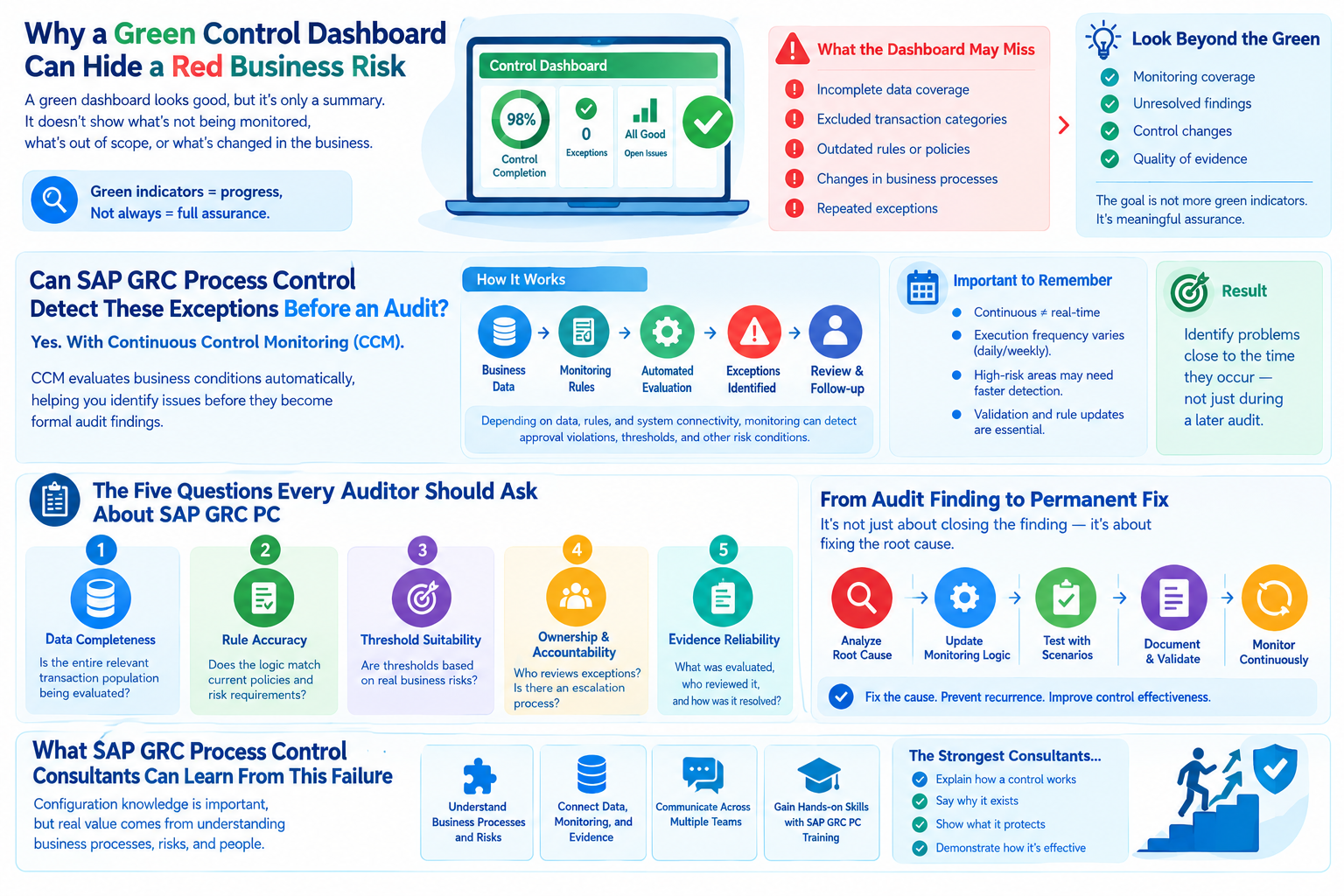
A green dashboard is reassuring. It gives managers a quick indication that expected control activities have been completed or that reported results are within acceptable conditions.
However, dashboard indicators are summaries. Their meaning depends on the underlying data, assessment scope, evaluation logic, and reporting configuration.
This creates a problem when organizations treat reported control status as absolute proof of control effectiveness.
Imagine that a monitoring rule evaluates 10,000 transactions and finds no violations. At first glance, this appears to be a positive result.
But what if the business processed 12,000 transactions during the same period?
The missing 2,000 records could represent transactions outside the selected organizational scope, excluded transaction categories, incomplete source-data extraction, or another coverage problem.
The control may have performed correctly against the records it received. Nevertheless, the organization cannot confidently conclude that the entire transaction population was evaluated.
Another challenge involves the timing of control assessments.
A control may have been tested successfully earlier in the year, but the business process could have changed afterward. New approval structures, additional company codes, updated financial thresholds, or changes in system integration may introduce risks that the original control design did not anticipate.
A completed assessment therefore represents evidence about a particular control and evaluation period, not a permanent guarantee of effectiveness.
Organizations should interpret dashboard results alongside monitoring coverage, unresolved findings, control changes, and the quality of supporting evidence.
The goal is not to eliminate green indicators. It is to make sure those indicators represent meaningful assurance.
Can SAP GRC Process Control Detect These Exceptions Before an Audit?
SAP GRC Process Control supports organizations in identifying and managing control weaknesses through structured assessments, automated monitoring, and issue-management processes.
One important capability is Continuous Control Monitoring, commonly called CCM.
CCM allows organizations to evaluate defined business conditions through automated monitoring activities rather than relying exclusively on periodic manual testing.
For example, an organization may configure monitoring to identify transactions that violate approval requirements, exceed defined thresholds, or meet other risk-related conditions.
The exact monitoring possibilities depend on available data, configured rules, system connectivity, and the organization's control design.
When monitoring identifies a potential violation, the resulting information can support review and follow-up through the configured exception or issue-handling process.
This creates an opportunity to investigate problems closer to the time they occur, rather than discovering them during a later audit.
However, continuous monitoring does not automatically mean real-time monitoring.
Execution frequency, data availability, and processing arrangements vary by implementation. A control scheduled to run daily or weekly may identify an issue after the underlying transaction has already been completed.
That distinction is important for high-risk financial activities.
Organizations should determine how quickly particular risks need to be detected and design their monitoring schedules accordingly.
Effective monitoring also requires periodic validation. Teams should verify that business rules still reflect current policies, that source-data coverage remains complete, and that responsible reviewers are actively handling the results.
SAP GRC Process Control provides capabilities that can support this approach, but successful implementation depends on strong business ownership and ongoing control governance.
The Five Questions Every Auditor Should Ask About SAP GRC PC
An effective audit should examine more than whether a control exists or whether its latest reported status is satisfactory.
The first question concerns data completeness. Does the monitoring process evaluate the entire relevant transaction population, including newly introduced company codes, transaction categories, and business units?
Without confidence in the source data, even well-designed monitoring rules can produce misleading results.
The second question focuses on rule accuracy. Does the configured logic reflect the organization's current policies and risk requirements? A rule based on an outdated approval threshold may continue operating successfully while missing violations of the revised policy.
The third question concerns threshold suitability. Are monitoring conditions designed around meaningful business risks, or have thresholds been selected mainly to reduce the number of exceptions requiring investigation?
The fourth question addresses ownership and accountability. When a potential violation is identified, who is responsible for reviewing it? Is there a defined escalation process when investigations remain incomplete?
The final question concerns evidence reliability. Can the organization demonstrate what was evaluated, what result was produced, who reviewed the finding, and how the issue was resolved?
These questions help auditors distinguish between the existence of a control framework and its actual operational effectiveness.
They also encourage organizations to identify weaknesses before those weaknesses become formal audit findings.
From Audit Finding to Permanent Fix: Closing the Control Gap
Discovering an overlooked exception is only the beginning of the remediation process.
The organization must understand why the failure occurred and determine whether similar problems exist elsewhere.
In the manufacturing example, the missing approval initially appears to be an isolated payment-processing issue. Further investigation reveals that the monitoring threshold was not updated after the company's approval policy changed.
Correcting the individual transaction record would not solve the underlying problem.
The organization needs to update the monitoring logic, validate the revised conditions, and determine whether other transactions were affected during the period when the outdated rule was active.
This is where root-cause analysis becomes essential.
A useful remediation process addresses both the immediate finding and the control weakness that allowed it to occur.
The control owner and relevant technical specialists should review the monitoring configuration against the current business requirement. Changes should follow appropriate approval and testing procedures before being introduced into the productive environment.
The revised control should then be tested using representative scenarios, including transactions that should pass and transactions that should generate a violation.
Testing only successful transactions is insufficient because it does not demonstrate that the control can recognize the risk it was designed to detect.
Historical analysis may also be necessary. Depending on data availability and the nature of the issue, organizations may need to examine earlier transactions to determine whether additional violations occurred.
The remediation record should document the identified root cause, corrective actions, responsible individuals, supporting evidence, and validation results.
Once the control has been corrected, ongoing monitoring should confirm that the updated design continues to operate as intended.
The objective is not simply to close an audit finding. It is to reduce the likelihood of the same weakness recurring.
What SAP GRC Process Control Consultants Can Learn From This Failure
The overlooked exception highlights an important reality about SAP GRC Process Control consulting: technical configuration knowledge alone is not enough.
A consultant may understand how to configure monitoring rules and control activities, yet still struggle to design an effective solution without understanding the underlying business process.
For example, identifying a missing payment approval requires knowledge of payment processing, approval responsibilities, financial risk, and the organization's internal policies.
Consultants must also understand how data sources, monitoring logic, exception review, control assessments, and evidence requirements work together.
Communication is equally important.
SAP GRC Process Control projects frequently involve finance teams, process owners, internal auditors, compliance professionals, security specialists, and technical teams. Each group approaches control effectiveness from a different perspective.
Professionals seeking to build these capabilities can benefit from practical, scenario-based learning. A structured SAP GRC PC Training program can help learners connect configuration concepts with real business risks, monitoring scenarios, audit requirements, and remediation processes.
The strongest consultants are those who can explain not only how a control works, but also why it exists, what it protects, and how its effectiveness can be demonstrated.
Frequently Asked Questions
1. What is an exception in SAP GRC Process Control?
An exception is a condition identified during control evaluation that may indicate a violation of a defined business rule or control requirement. It requires appropriate review to determine whether a genuine issue exists. Exceptions can help organizations identify control weaknesses, investigate risks, and document corrective actions.
2. How does SAP GRC Process Control identify control failures?
SAP GRC Process Control supports control assessments and automated monitoring activities that evaluate defined business conditions. Configured rules can identify potential violations using relevant source data. Detection effectiveness depends on data completeness, rule design, monitoring schedules, and the organization's implementation.
3. Why can control exceptions remain undetected until an audit?
Control violations may remain undetected when transactions fall outside monitoring coverage, business rules contain outdated conditions, or relevant data is unavailable. In other situations, findings may be generated but not investigated properly. Audits can expose these weaknesses by examining transaction records and supporting control evidence.
4. What is the role of Continuous Control Monitoring in SAP GRC PC?
Continuous Control Monitoring helps organizations perform recurring automated evaluations of defined control conditions. It can support earlier identification of potential violations and reduce reliance on periodic manual checks. However, its effectiveness depends on correct configuration, suitable execution frequency, and timely review of results.
5. How does SAP GRC Process Control support audit evidence?
SAP GRC Process Control supports documentation of control assessments, monitoring activities, findings, and related remediation processes. These records can contribute to audit evidence when combined with relevant source-system information and supporting documentation. Auditors must still verify that the evidence is complete, accurate, and appropriate for the control being examined.
6. How can organizations prevent recurring control exceptions?
Organizations should investigate the root causes of identified issues, update outdated monitoring rules, validate source-data coverage, and assign clear control ownership. Remediation should include appropriate testing and documented evidence. Regular reviews of business-process changes and monitoring effectiveness can help reduce repeated failures.
Conclusion: The Most Dangerous Exception Is the One Nobody Investigates
The most serious control failures are not always the ones that immediately trigger alarms. Sometimes they are ordinary transactions that pass through established processes without receiving the scrutiny they require.
SAP GRC Process Control can help organizations strengthen monitoring, manage control activities, and support audit readiness. But its value depends on the quality of the underlying control design, the completeness of the data, and the accountability of the people responsible for reviewing results.
The overlooked payment in our illustrative scenario was not simply an audit surprise. It exposed a gap between the organization's documented control requirements and the monitoring actually performed.
That is the lesson organizations should carry forward: a control is not effective merely because it runs successfully. It must evaluate the right risks, identify meaningful violations, and support timely corrective action.
When those elements work together, audit findings become less surprising, control evidence becomes more reliable, and compliance moves beyond the appearance of assurance.
About the Author
TechBrainz Consulting
TechBrainz Consulting shares practical SAP insights covering governance, risk management, compliance, security, and enterprise technology. Our content connects SAP concepts with real-world business scenarios to help professionals understand complex processes and build practical skills.