
What Are the Most Asked SAP GRC Process Control Interview Questions and How Do You Answer Them with Examples?
Introduction: Why SAP GRC Process Control Interviews Require More Than Definitions
Preparing for an SAP GRC Process Control interview is not just about memorizing technical terms. Interviewers want to understand how well you can connect internal controls, business risks, compliance requirements, and real-world SAP processes. They may ask you to explain a control framework in one minute, investigate a failed control, or describe how you would respond when an auditor discovers a weakness that the business team overlooked.
For freshers, the challenge is explaining fundamental concepts confidently without claiming implementation experience they do not have. For experienced consultants, interviewers often look beyond definitions and expect practical knowledge of control assessments, Continuous Control Monitoring (CCM), exception management, remediation, and audit evidence.
The best answers combine a clear explanation with a relevant business example. Instead of simply defining a control, explain what it protects, how it operates, what happens when it fails, and how the organization verifies the outcome.
This guide covers essential SAP GRC Process Control interview questions, technical concepts, and realistic scenarios to help you prepare answers that sound natural, demonstrate practical understanding, and reflect how compliance works in an enterprise environment.
Definition box: What is SAP GRC Process Control?
SAP GRC Process Control is an SAP governance, risk, and compliance solution designed to help organizations document internal controls, assess control effectiveness, monitor compliance, manage control deficiencies, and support audit activities. Depending on the solution version and configuration, it can support automated monitoring, manual control assessments, and exception management to help businesses identify and address potential control weaknesses.
1. What Do Interviewers Expect from an SAP GRC PC Candidate?
Interviewers generally want to know whether you understand how an organization identifies risks, establishes controls, tests whether those controls work, and responds when something goes wrong. Knowing product terminology is useful, but being able to explain the business purpose behind a control makes your answer stronger.
For example, if an interviewer asks how you would investigate an invoice approval issue, they may expect you to explain how you would identify the relevant transaction, review the approval history, check the applicable policy, determine whether an exception occurred, and document the investigation. A good answer demonstrates a logical approach rather than jumping straight to a technical conclusion.
Freshers should focus on understanding control objectives, risk and control relationships, preventive and detective controls, and the basics of compliance monitoring. Experienced consultants should be prepared to discuss implementation decisions, control ownership, assessment processes, monitoring logic, issue remediation, and coordination with auditors and business stakeholders.
A useful approach is to answer each question in four steps: define the concept, explain how it works, give a business example, and describe the expected result. This structure keeps answers concise while showing that you understand both the technology and the business process.
2. Basic SAP GRC Process Control Interview Questions and Answers
Question 1: What is SAP GRC Process Control, and why is it used?
SAP GRC Process Control helps organizations manage internal controls and assess whether business processes operate according to defined policies and compliance requirements. It supports control documentation, assessments, monitoring, and the management of identified deficiencies.
For example, a company may require every supplier payment above a defined amount to receive approval from an authorized manager. A control can be established to support this requirement, and the organization can assess whether the approval process operates as intended. If an issue is identified, the responsible team investigates it and documents the corrective action.
Interview tip: Explain that Process Control helps provide visibility into control effectiveness; it does not automatically guarantee compliance or eliminate business risk.
Question 2: What is the difference between SAP GRC Process Control and SAP GRC Access Control?
SAP GRC Process Control focuses on internal business controls and compliance monitoring, whereas SAP GRC Access Control focuses on access governance, authorization risks, and access-related compliance.
For example, Process Control may help an organization monitor whether required approvals are being followed during financial transactions. Access Control may help identify whether a user has conflicting permissions that could allow them to create a supplier and process payments without appropriate oversight.
The two solutions address different risk areas and can complement each other. Their specific capabilities depend on the implemented products, versions, and integrations.
Question 3: What is the difference between a risk, a control, and a control deficiency?
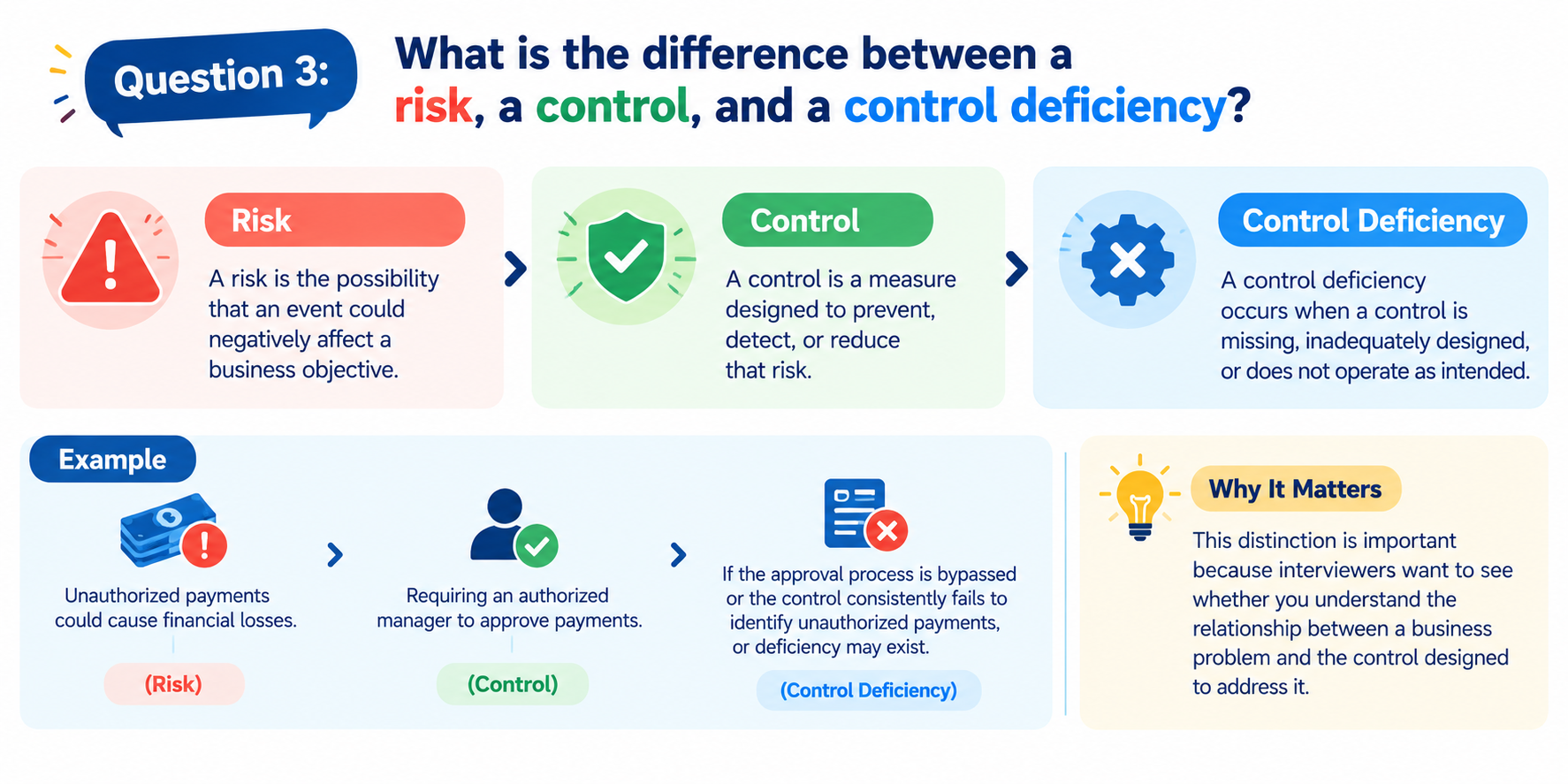
A risk is the possibility that an event could negatively affect a business objective. A control is a measure designed to prevent, detect, or reduce that risk. A control deficiency occurs when a control is missing, inadequately designed, or does not operate as intended.
Consider a company where unauthorized payments could cause financial losses. That is the risk. Requiring an authorized manager to approve payments is the control. If the approval process is bypassed or the control consistently fails to identify unauthorized payments, a deficiency may exist.
This distinction is important because interviewers want to see whether you understand the relationship between a business problem and the control designed to address it.
Question 4: What is the difference between preventive and detective controls?
Preventive controls aim to stop an unwanted activity before it occurs. Detective controls aim to identify an unwanted activity after it has occurred or while it is taking place.
For instance, requiring approval before a payment is released is a preventive control. Reviewing payment records to identify transactions that lack the required approval is a detective control. Organizations often use both because prevention alone may not catch every issue, while detection alone may identify problems only after exposure has occurred.
Question 5: What is the role of a control owner?
A control owner is the person responsible for ensuring that an assigned control is properly maintained and performed according to its requirements. Depending on the organization's governance model, the owner may provide evidence, complete assessments, explain exceptions, and coordinate corrective actions.
Imagine that a finance manager owns a monthly reconciliation control. If a reconciliation is incomplete, the control owner may need to explain the reason, provide supporting documents, and coordinate remediation. A GRC consultant helps ensure the control process is configured and documented appropriately, but responsibility for operating the business control generally remains with the designated business owner.
3. Technical and Configuration-Based Interview Questions
Question 6: What is a control framework in SAP GRC Process Control?
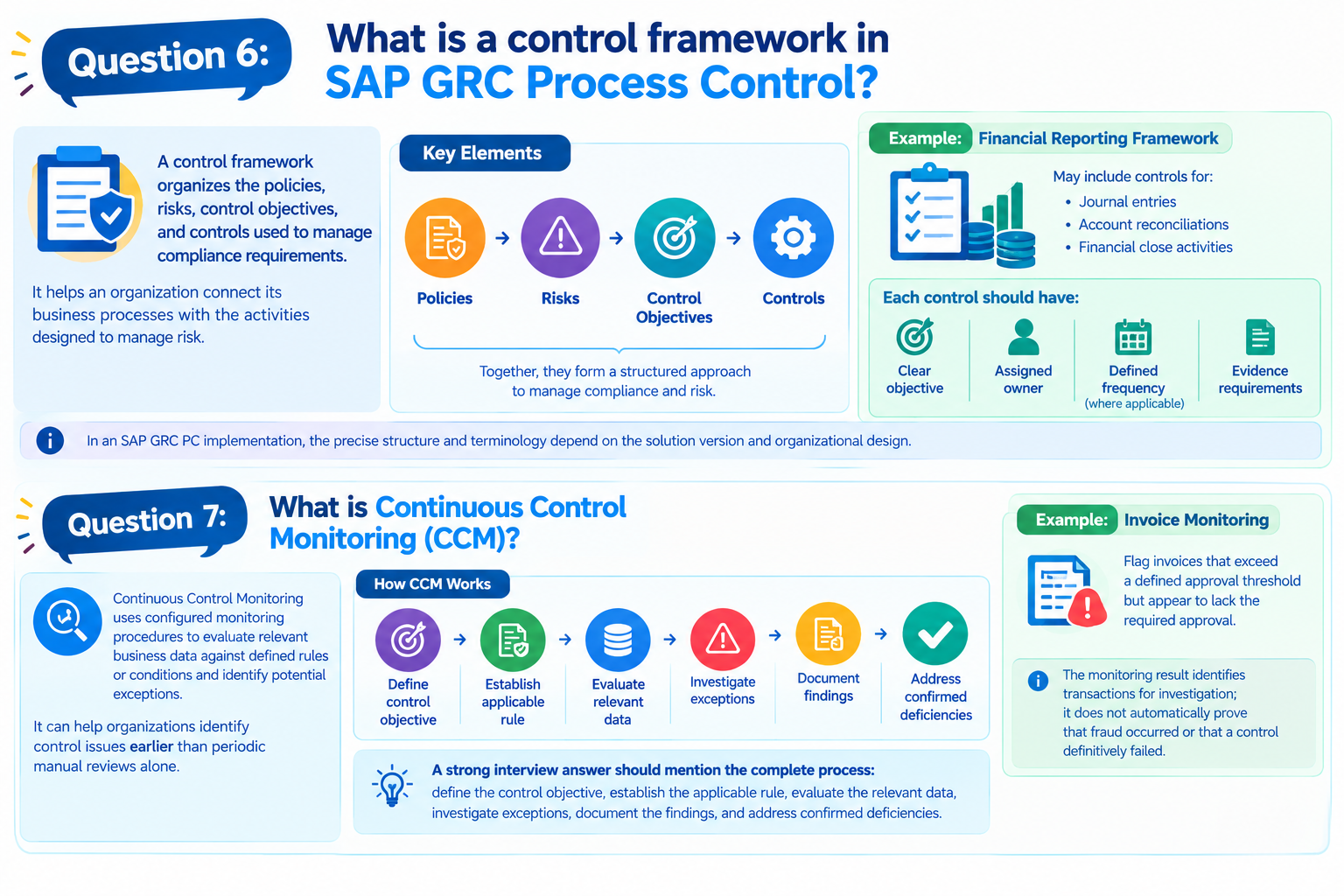
A control framework organizes the policies, risks, control objectives, and controls used to manage compliance requirements. It helps an organization connect its business processes with the activities designed to manage risk.
For example, a financial reporting framework might include controls for journal entries, account reconciliations, and financial close activities. Each control should have a clear objective, an assigned owner, a defined frequency where applicable, and evidence requirements that support assessment. In an SAP GRC PC implementation, the precise structure and terminology depend on the solution version and organizational design.
Question 7: What is Continuous Control Monitoring (CCM)?
Continuous Control Monitoring uses configured monitoring procedures to evaluate relevant business data against defined rules or conditions and identify potential exceptions. It can help organizations identify control issues earlier than periodic manual reviews alone.
For example, a company might configure monitoring to flag invoices that exceed a defined approval threshold but appear to lack the required approval. The monitoring result identifies transactions for investigation; it does not automatically prove that fraud occurred or that a control definitively failed.
A strong interview answer should mention the complete process: define the control objective, establish the applicable rule, evaluate the relevant data, investigate exceptions, document the findings, and address confirmed deficiencies.
Question 8: How do automated controls differ from manual controls?
Automated controls rely on system-enforced rules or configured procedures to perform or monitor defined activities. Manual controls rely on people performing and documenting activities such as reviews, approvals, and reconciliations.
For example, a system rule that prevents a transaction from proceeding without a required field can act as an automated preventive control. A finance employee reviewing a monthly reconciliation and signing off on discrepancies is performing a manual control.
Automation can improve consistency and reduce repetitive work, but it still depends on accurate data, appropriate configuration, and effective oversight. Manual controls also remain important when business judgment or investigation is necessary.
Question 9: How are control assessments and testing activities managed?
Control assessments and testing help determine whether a control is appropriately designed and operates effectively. The process generally involves defining the assessment criteria, collecting relevant evidence, performing the review, recording the results, and addressing any identified deficiencies.
For example, an auditor may examine a sample of payments to determine whether each payment received the required approval. If some transactions lack evidence, the reviewer investigates whether approvals were missing, records were incomplete, or the evidence was stored elsewhere. The conclusion should be supported by the available facts rather than assumptions.
The exact assessment workflow, testing functionality, and terminology depend on the SAP GRC PC release and implementation.
Question 10: What evidence is required to demonstrate control effectiveness?
Control evidence demonstrates that a control was performed and provides support for the assessment conclusion. Depending on the control, evidence may include approval records, system logs, reconciliation reports, transaction extracts, review documentation, or records of corrective actions.
Suppose a company claims that every high-value payment receives approval. A policy document alone does not prove that the control operated. Approval records and appropriate transaction evidence are needed to demonstrate whether the requirement was followed during the period under review.
Interview tip: Distinguish between evidence that a control exists and evidence that it operated effectively. These are related, but they are not the same.
4. Scenario-Based SAP GRC PC Interview Questions
Scenario-based questions are where interviewers can distinguish candidates who understand compliance concepts from those who can apply them. The key is to explain your investigation step by step and avoid assuming that every system alert represents a confirmed failure.
Question 11: How would you investigate a duplicate vendor invoice exception?
First, I would identify the flagged invoices and compare relevant details such as vendor account, invoice reference, amount, company code, and posting date. I would then review the available transaction records and supporting documents to determine whether the invoices represent a genuine duplicate, a legitimate repeat transaction, or a data-quality issue.
For example, a monitoring procedure flags two invoices with the same vendor reference and amount. After investigation, the team discovers that one invoice was posted twice. The responsible finance team assesses the impact, follows the organization's correction and approval procedures, and documents the resolution.
As the GRC consultant, I would ensure that the exception is handled through the appropriate process, supporting evidence is retained, and any underlying control weakness is considered. I would not conclude that fraud occurred based on the alert alone.
Question 12: What would you do if a control test failed?
I would first verify the test result and review the control objective, testing criteria, evidence, and transactions involved. Next, I would determine whether the failure resulted from a genuine control breakdown, incorrect configuration, incomplete evidence, or an error in the testing procedure.
For example, a monthly reconciliation control fails because the review was completed after the required deadline. I would document the deviation, discuss the cause with the control owner, assess the potential impact, and support the appropriate remediation process. The control should then be reassessed using suitable evidence.
The important point is that remediation should address the underlying cause rather than merely changing the status of the finding.
Question 13: How would you handle repeated exceptions from the same control?
Repeated exceptions may indicate that the underlying process has not been corrected, the control is poorly designed, or the monitoring rule needs adjustment. I would review previous findings, identify recurring patterns, and work with the control owner to establish the root cause.
For example, if multiple purchase orders repeatedly lack the required approval, the investigation might reveal unclear approval responsibilities or a process that allows users to bypass the intended review. The corrective action could involve clarifying responsibilities, strengthening the approval process, or reviewing the relevant system configuration.
I would also ensure that the remediation is documented and that subsequent testing or monitoring provides evidence of improvement.
Question 14: What would you do if an automated control generated too many false positives?
I would validate the monitoring logic against the control objective and examine examples of both valid exceptions and incorrectly flagged transactions. I would then review relevant thresholds, data sources, business conditions, and rule criteria with the appropriate technical and business stakeholders.
For instance, a monitoring rule may flag all invoices above a particular amount even when some belong to an approved exception category. If the rule does not account for that category, legitimate transactions may be flagged unnecessarily.
Any change should be tested and approved through the organization's change-management process. The goal is to improve accuracy without creating gaps that allow genuine control failures to go undetected.
5. Continuous Control Monitoring and Exception Management
Question 15: How does exception management work in SAP GRC Process Control?
Exception management begins when a monitoring procedure or assessment identifies a potential deviation from a defined control requirement. The responsible team validates the result, investigates the cause, determines whether a deficiency exists, and records the appropriate outcome.
Consider a monitoring rule that identifies journal entries posted outside the expected review process. The finance team checks the entry, examines supporting documentation, and determines whether the posting was authorized. If a genuine issue is confirmed, the organization follows its defined escalation and remediation procedures.
Depending on the configured solution and workflow, responsibilities may be assigned to control owners, compliance teams, or other stakeholders. The objective is to ensure that findings are investigated, decisions are supported by evidence, and corrective actions are tracked to completion.
Question 16: How would you explain the difference between an exception and a control failure?
An exception is a result that requires investigation because it appears to violate a defined rule or condition. A control failure is a conclusion that the control did not operate as required or did not adequately address the relevant risk.
For example, a monitoring rule flags a payment without an approval record. Investigation reveals that the approval was completed in a separate authorized system, but the evidence was not included in the monitoring data. The exception may be explained by an evidence gap rather than a failure to approve the payment.
However, if the payment genuinely bypassed the required approval, a control deficiency may exist. This distinction is essential because incorrect conclusions can lead to unnecessary escalations or unresolved risks.
6. Real-World Implementation and Audit Questions
Question 17: What are the common challenges in an SAP GRC Process Control implementation?
Common challenges include unclear control ownership, inconsistent control documentation, poor-quality source data, complicated business processes, insufficient stakeholder engagement, and monitoring rules that do not reflect actual business requirements.
For example, a company may attempt to automate a control before agreeing on the approval policy that the control is supposed to enforce. Even technically correct configuration may produce confusing results if the underlying business requirement is unclear.
A practical implementation approach begins with understanding the business process and control objective. The team then defines responsibilities, validates data availability, configures and tests the relevant functionality, and confirms that business users understand how to investigate and resolve findings.
Question 18: How do you explain a control deficiency to a business stakeholder?
I would explain the issue in terms of business impact rather than relying entirely on technical terminology. I would describe the control requirement, what happened, why it matters, what evidence supports the finding, and what corrective action is needed.
For example, instead of saying that a monitoring rule detected a transaction exception, I would explain that a payment was processed without the approval required by company policy. I would then clarify the potential financial or compliance exposure and discuss the steps needed to prevent recurrence.
This approach helps business stakeholders understand the reason for remediation and encourages collaboration between finance, compliance, IT, and audit teams.
Question 19: How do you verify that a corrective action has resolved a control issue?
I would first confirm that the corrective action addresses the identified root cause. Next, I would review the available implementation evidence and perform appropriate follow-up testing or monitoring to determine whether the control now operates as intended.
For example, if missing payment approvals resulted from a process configuration issue, I would verify the approved change and examine relevant transactions after implementation. Evidence that the configuration was changed is useful, but it does not by itself prove that the control is consistently effective.
The finding should be closed only when the organization's defined criteria for remediation and validation have been met and the supporting evidence has been documented.
7. How to Answer SAP GRC PC Interview Questions Confidently
A strong interview answer does not need to be long. It needs to be clear, technically accurate, and supported by an example. When asked about a control, start with its purpose, explain how it works, and connect it to a business risk. When asked about a problem, explain how you would investigate it, identify the cause, document the evidence, and support remediation.
If you are a fresher, use realistic examples to demonstrate your understanding, but distinguish hypothetical scenarios from actual project experience. If you are experienced, describe your responsibilities and decisions precisely, including how you worked with control owners, auditors, and technical teams.
Before the interview, practise explaining key concepts aloud. Review control types, assessments, monitoring rules, exception handling, and evidence requirements. You should also be prepared to explain why a control matters to the business, not simply how it is configured.
8. How SAP GRC PC Training Can Help You Prepare
Reading interview questions is a useful starting point, but practical understanding comes from connecting the concepts to business processes and realistic control scenarios. Candidates should practise explaining control objectives, evaluating exceptions, interpreting evidence, and identifying appropriate remediation steps.
If you want to strengthen your preparation, explore SAP GRC PC Training from TechBrainz Consulting. Structured learning can help you build a clearer understanding of SAP GRC Process Control concepts and prepare for technical discussions with greater confidence. Focus on the topics most relevant to your target role and the SAP solution version used by the employer.
Conclusion: Turn Your SAP GRC PC Knowledge into Interview-Ready Answers
Success in an SAP GRC Process Control interview depends on more than remembering definitions. Interviewers want to see that you understand how controls protect business processes, how monitoring identifies potential issues, and how evidence supports decisions about control effectiveness.
Build your preparation around practical examples involving approvals, reconciliations, transaction exceptions, audit findings, and remediation. Learn to distinguish a monitoring alert from a confirmed control deficiency, explain your investigation logically, and communicate findings in business terms.
Whether you are a fresher entering the SAP GRC field or an experienced consultant preparing for your next opportunity, a structured approach will help you deliver clearer and more credible answers. Understand the control, explain the risk, demonstrate the investigation, and show how the issue is resolved. That is what makes an interview answer stand out.
Frequently Asked Questions (FAQs)
1. What are the most important SAP GRC Process Control interview questions?
Focus on questions about control frameworks, risk and control relationships, Continuous Control Monitoring, manual and automated controls, assessments, and exception management. Prepare scenario-based answers involving failed controls, audit evidence, and corrective actions.
2. Is SAP GRC Process Control difficult to learn?
The fundamentals become easier when you understand how business risks connect to internal controls and compliance requirements. Practical examples and structured exercises can help you understand assessments, monitoring, and issue resolution.
3. What is the difference between SAP GRC PC and SAP GRC AC?
SAP GRC Process Control focuses on internal controls and compliance monitoring across business processes. SAP GRC Access Control focuses on user access governance, authorization risks, and segregation of duties. Both address different aspects of enterprise risk management.
4. What is Continuous Control Monitoring in SAP GRC PC?
Continuous Control Monitoring evaluates relevant business data against configured rules to identify potential control exceptions. These exceptions require investigation to determine whether a genuine control deficiency exists and what action is appropriate.
5. How should freshers prepare for SAP GRC Process Control interviews?
Freshers should understand core GRC concepts, preventive and detective controls, control ownership, assessments, and audit evidence. Practising realistic scenarios and explaining answers in their own words can help demonstrate knowledge without overstating project experience.
6. What skills are required for an SAP GRC Process Control consultant?
Important skills include understanding internal controls, business processes, compliance requirements, control testing, exception investigation, and documentation. Consultants also benefit from analytical thinking, communication skills, and familiarity with the relevant SAP GRC solution and its configuration.
About the Author
TechBrainz Consulting
TechBrainz Consulting provides SAP-focused training and learning resources designed to help professionals strengthen their technical knowledge and develop practical skills for enterprise technology roles.