
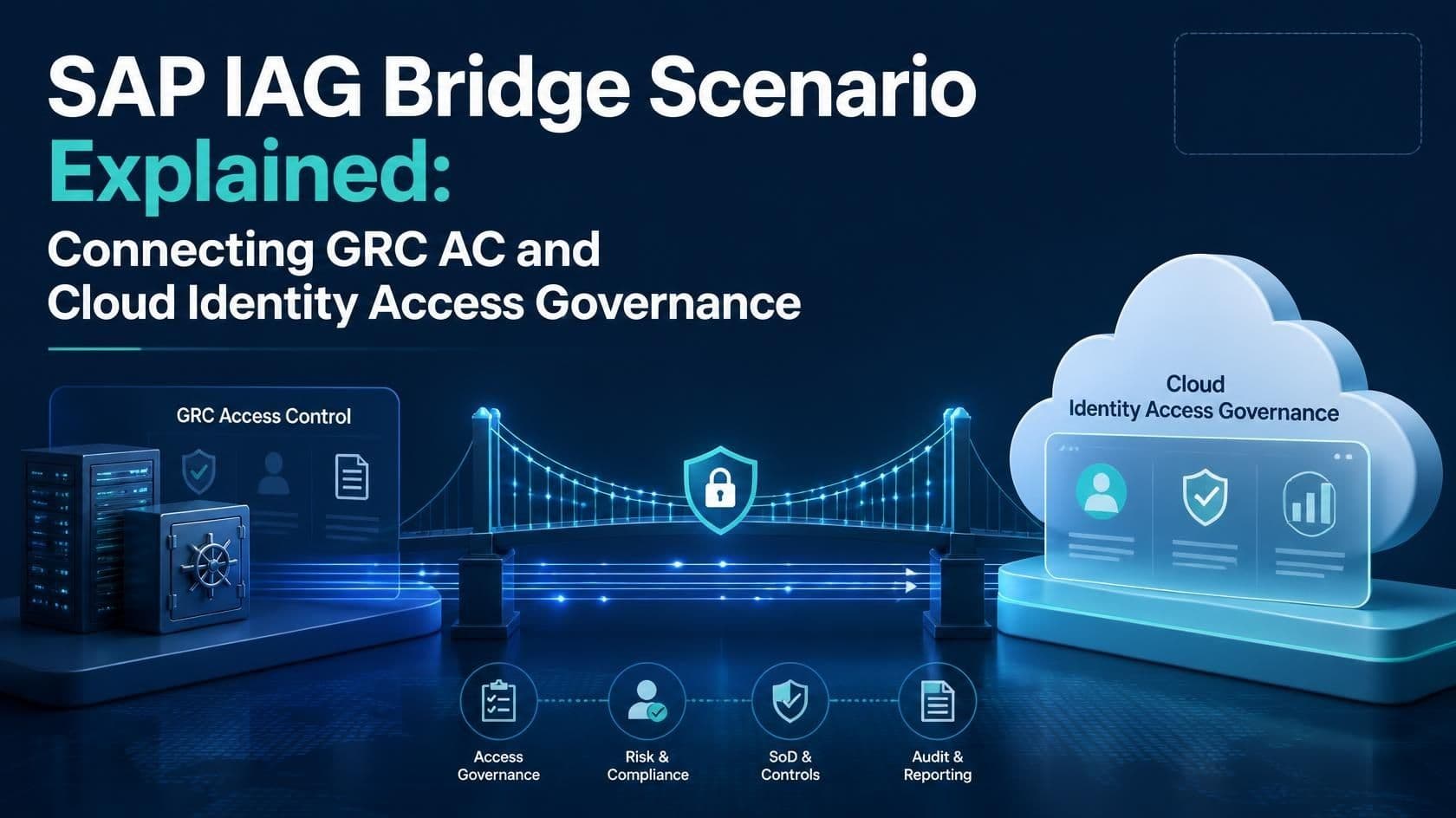
SAP IAG Bridge Scenario Explained: Connecting GRC AC and Cloud Identity Access Governance
The SAP IAG Bridge Scenario is one of the most practical governance models for organizations moving to the cloud while still relying on SAP GRC Access Control for core access governance. In many enterprises, the existing GRC setup continues to serve as the trusted control layer for risk analysis, approvals, and compliance, while cloud applications require a modern execution layer for provisioning and access requests. The bridge scenario connects these two environments in a structured and efficient way.
This article explains what the SAP IAG Bridge Scenario is, why it exists, how it works, when organizations should use it, how it compares with standalone IAG, and the common implementation challenges businesses may face. It is written for professionals, consultants, and teams looking for a practical understanding of hybrid access governance, and it is especially useful for learners pursuing SAP IAG training to understand real-world governance scenarios.
SAP GRC Access Control is an on-premise governance solution used to manage access risks, segregation of duties, approvals, and emergency access. It includes Access Risk Analysis, Access Request Management, Business Role Management, and Emergency Access Management. Many enterprises use it to keep strong control over compliance in traditional SAP landscapes.
SAP Identity Access Governance is a cloud-based governance solution built for modern SAP landscapes. It supports cloud access provisioning, cloud risk analysis, and integration with SAP SaaS applications. In hybrid setups, it can extend governance into cloud systems where older on-premise models are not enough.
Quick Facts
- The bridge scenario is designed for hybrid SAP landscapes, not cloud-only environments.
- SAP GRC Access Control remains the central governance engine in the bridge model.
- SAP IAG acts as the cloud execution layer for provisioning and de-provisioning.
- The bridge helps organizations protect existing GRC investments while extending governance to cloud applications.
- It is most useful when a company already uses GRC AC and is adopting SAP cloud applications such as SuccessFactors, Ariba, or SAP Analytics Cloud.
- The main value is centralized compliance with cloud-ready access execution.
- It is not the simplest model, but it is often the best fit for mature hybrid environments.
Why People Confuse SAP IAG and GRC AC
SAP GRC Access Control and SAP IAG solve related problems, but they do not do the same job in the same way. GRC AC was built for on-premise control, while IAG was built for cloud-first governance. That is why teams often compare them, even though the better question is usually whether an organization needs replacement, extension, or integration.
The confusion grows when companies operate in a hybrid model. A business may still depend on GRC AC for core workflows, but at the same time it may need to manage access for cloud applications that use APIs and modern provisioning methods. In such cases, the bridge scenario becomes the practical answer. It does not force a full replacement of GRC AC, and it avoids leaving cloud systems outside governance.
SAP GRC Access Control: What It Is
SAP GRC Access Control is the classic enterprise governance platform for SAP access control and compliance. It is widely used in organizations that want structured approval flows, risk checks, role maintenance, and emergency access monitoring. Its strength lies in its maturity and depth of control. Many organizations have customized workflows, detailed Segregation of Duties rules, and strong audit processes built around it.
The main modules of GRC AC are Access Risk Analysis, Access Request Management, Business Role Management, and Emergency Access Management. These modules support compliance teams by helping them identify risky access combinations, route requests through proper approvals, define business roles, and manage temporary emergency access in a controlled way.
In traditional SAP environments, GRC AC works very well because it was designed for on-premise systems. However, the same strength can also become a limitation in cloud transformation projects. Cloud applications often depend on APIs, modern identity services, and faster provisioning models. That is where GRC alone may not be enough.
SAP Cloud IAG: What It Is
SAP IAG is SAP's cloud governance layer for modern access control. It is built to support cloud applications, cloud provisioning, and cloud-related governance processes. It is especially useful when organizations are not fully on-premise and need a flexible governance approach that can work across cloud systems.
Unlike traditional systems, IAG is designed around cloud communication and modern integration patterns. It can connect to SAP cloud applications and support access execution in a way that aligns better with current enterprise architectures. In a cloud-first or cloud-only landscape, that makes it the more natural fit.
IAG is also important because many companies do not want to rebuild everything from scratch. Some still need parts of their existing governance model, while others are ready to move away from on-premise control. IAG gives organizations a path forward, either as a standalone governance solution or as part of a bridge architecture with GRC AC.
Architecture Comparison
The SAP IAG Bridge Scenario uses a hub-and-spoke style architecture. In this model, SAP GRC Access Control acts as the central hub for decision-making, while SAP IAG acts as the extension layer that executes provisioning in cloud applications. This structure allows organizations to preserve control logic in GRC while still supporting cloud access workflows.
In the bridge architecture, a request starts in GRC AC. GRC performs the risk analysis, evaluates segregation-of-duties rules, and routes the request through approval workflows. Once the request is approved, it is passed to IAG, which provisions access in the cloud system. Status updates then flow back to GRC so the organization can retain visibility and control.
This design is useful because it separates governance from execution. GRC remains the policy and compliance engine, while IAG handles cloud delivery. That separation reduces the need to redesign the entire governance model while still making cloud enablement possible.
Setting Up the Bridge
Implementing the SAP IAG Bridge Scenario is not just a conceptual integration—it requires careful technical configuration, governance alignment, and data consistency between SAP GRC Access Control and SAP IAG. A structured setup ensures that risk analysis, approvals, and cloud provisioning work seamlessly across both systems.
Prerequisites
Before configuring the bridge, organizations must ensure the following foundations are in place:
- A stable SAP GRC Access Control system with active modules (ARA, ARM, BRM)
- Defined and validated SoD ruleset in GRC AC
- Active SAP IAG tenant with proper licensing
- Integration readiness with SAP Identity Authentication Service (IAS) and Identity Provisioning Service (IPS)
- Identified target cloud applications (e.g., SuccessFactors, Ariba, SAC)
- Clean and standardized role design and naming conventions
- Network connectivity and API readiness between systems
Without these prerequisites, the bridge setup can lead to inconsistent risk analysis and provisioning failures.
Feature Comparison: 15+ Side-by-Side Differences
Here is a detailed comparison table designed to help decision-makers.
| Feature | SAP GRC Access Control | SAP IAG |
|---|---|---|
| Deployment | On-premise | Cloud |
| Access Risk Analysis | Advanced, mature | Moderate, improving |
| Emergency Access (Firefighter) | Full support | Limited |
| Role Management | Advanced BRM | Basic role handling |
| Access Requests | Complex workflows | Simplified workflows |
| User Access Reviews | Available | Strong and modern |
| Reporting | Deep audit reports | Dashboard-based |
| Integration | SAP-heavy | API-based |
| Cloud Support | Limited | Strong |
| Non-SAP Integration | Limited | Better |
| Implementation Time | Long | Short |
| Customization | High | Moderate |
| Maintenance | High | Low |
| Scalability | Limited | High |
| Compliance Depth | Very strong | Moderate |
| User Experience | Traditional | Modern UI |
| Real-time Processing | Limited | Better |
| Cost | High upfront | Subscription-based |
Feature Comparison: 15+ Side-by-Side Differences
Below is a practical comparison of SAP GRC Access Control and SAP IAG in the context of bridge and hybrid use cases.
- Deployment model — GRC AC is on-premise, while IAG is cloud-based.
- Primary purpose — GRC AC focuses on risk and compliance control; IAG focuses on modern access governance for cloud environments.
- Best-fit landscape — GRC AC fits traditional SAP environments; IAG fits cloud-first or hybrid environments.
- Provisioning method — GRC AC does not directly provision cloud systems, while IAG can provision access through cloud integration.
- Workflow ownership — In the bridge model, GRC owns the request and approval logic, while IAG executes the cloud action.
- Risk analysis role — GRC AC is the stronger engine for SoD and access risk control in classic SAP environments.
- Cloud support — IAG is built to support cloud applications and APIs more naturally than GRC AC.
- Compliance reporting — GRC AC provides mature compliance workflows and audit support, especially where historical controls already exist.
- Implementation approach — GRC AC often requires heavier legacy setup, while IAG can be simpler in a clean cloud setup.
- Integration complexity — The bridge model introduces more integration points because two systems must work together.
- Maintenance effort — GRC AC on its own may be stable but rigid; a bridge setup requires ongoing coordination between platforms.
- Role of approvals — GRC AC typically remains the approval authority in the bridge scenario.
- Cloud app onboarding — IAG simplifies onboarding of cloud applications compared with a pure GRC model.
- Investment protection — The bridge scenario is valuable because it lets companies preserve existing GRC investments.
- Transformation fit — GRC AC alone works best for steady on-premise control, while the bridge is better for transformation programs.
- User experience — In a bridge setup, end users continue to follow centralized governance processes while cloud execution happens behind the scenes.
- Audit readiness — The bridge can strengthen audit readiness because it keeps approvals, risk checks, and execution traceability connected.
This comparison shows that the real choice is not simply "GRC versus IAG." The smarter question is whether the organization needs a bridge, a standalone IAG setup, or a full legacy governance model.
Bridge vs IAG Standard Edition vs Integration Edition
Understanding how the bridge scenario compares with SAP IAG editions is critical for decision-making.
| Criteria | Bridge Scenario | IAG Standard Edition | IAG Integration Edition |
|---|---|---|---|
| Core Concept | GRC + IAG hybrid model | Standalone cloud governance | Hybrid with GRC integration |
| Risk Analysis | Powered by GRC AC | Native IAG rules | GRC + IAG combined |
| Landscape Fit | Hybrid (on-prem + cloud) | Cloud-only | Hybrid |
| Dependency on GRC | Mandatory | Not required | Required |
| Provisioning | IAG executes | IAG executes | IAG executes |
| Complexity | High | Low | Medium–High |
| Implementation Speed | Moderate | Fast | Moderate |
| Best For | Existing GRC customers | New cloud-first orgs | Transitional enterprises |
The key takeaway:
- Bridge Scenario = Best for protecting GRC investment
- Standard Edition = Best for clean cloud setups
- Integration Edition = Best for structured hybrid governance
Integration Differences
The biggest difference between GRC AC and IAG is not just the features, but the integration style. GRC AC was built for traditional SAP connectors and established on-premise processes. IAG is designed to work with cloud systems, where communication often happens through APIs and cloud services.
In the bridge scenario, this difference becomes important. GRC continues to manage the governance decision, but IAG performs the technical execution in the cloud. That means organizations need proper role mapping, user synchronization, connector setup, and status reconciliation. The integration is powerful, but it is not lightweight.
A practical way to think about it is this: GRC AC answers the question, "Should the user get access?" IAG helps answer the question, "How is that access delivered to the cloud system?" The bridge combines both answers into a single workflow.
Cost Comparison
Cost is one of the most important considerations in any governance decision. Replacing GRC AC entirely may sound simple, but in practice it can be expensive and disruptive because many organizations have already invested heavily in workflows, risk rules, role design, and compliance processes. The bridge scenario exists partly to protect that investment.
A standalone IAG model may have a lower implementation burden when a company is starting fresh in the cloud. However, for organizations with a mature GRC system, abandoning that investment can create higher long-term migration and redesign costs. The bridge can be more expensive than a simple cloud-only setup, but it may still be the most cost-effective path when legacy controls are already in place.
The real cost question is therefore not only license cost. It also includes transformation effort, process redesign, audit impact, testing, training, and change management. In a hybrid environment, the bridge can often reduce business risk even if it increases technical complexity.
Use Case Decision Framework
The bridge scenario is not the right answer for every organization. It is best suited to companies that already use GRC AC and are now extending governance to cloud applications. If the company has mature SoD rules, approved workflows, and a strong GRC foundation, the bridge is usually the most logical step.
Choose the bridge scenario when:
- You already have GRC AC implemented.
- Your environment is hybrid, not cloud-only.
- You need centralized compliance reporting.
- You want to extend governance to cloud applications without replacing your current model.
Choose standalone IAG when:
- You are starting fresh.
- You are mostly or fully cloud-based.
- Your governance model is relatively simple.
- You want a faster cloud-first deployment.
The simple rule is still useful: if GRC AC exists and is deeply embedded in the organization, the bridge is usually the right path. If not, IAG may be enough on its own.
Real-World Bridge Implementation Stories
Case Study 1: Global Manufacturing Enterprise
Scenario: A large manufacturing company using SAP ECC and GRC AC implemented multiple cloud solutions including SuccessFactors and Ariba.
Challenge: GRC AC could not directly provision access to cloud systems, creating governance gaps.
Solution: They implemented the SAP IAG Bridge Scenario, keeping GRC as the approval and risk engine while using IAG for cloud provisioning.
Outcome:
- Centralized governance across all systems
- Reduced manual provisioning effort by 40%
- Improved audit compliance with unified reporting
Case Study 2: Financial Services Organization
Scenario: A financial institution with strict SOX compliance requirements expanded into SAP Analytics Cloud and SAP BTP.
Challenge: They needed real-time access control in cloud systems without compromising existing compliance frameworks.
Solution: The bridge scenario allowed them to retain GRC-based SoD rules while enabling automated cloud access provisioning through IAG.
Outcome:
- Maintained full SOX compliance
- Achieved faster access turnaround times
- Enabled secure cloud adoption without redesigning governance
Migration Path: GRC AC to IAG — Key Considerations
Organizations often ask whether they should move from GRC AC to IAG completely. The answer depends on the landscape. A full migration makes sense only when the company is ready to leave the on-premise model behind and move toward cloud-native governance. Otherwise, the bridge scenario is the safer transition path.
A sensible migration path usually starts with assessment. First, review existing GRC content such as workflows, SoD rules, roles, and approval patterns. Then identify which parts are still needed in the future and which parts can be simplified. After that, decide whether the bridge will serve as a temporary transition model or as a long-term hybrid design.
A migration also needs technical planning. Role mapping, user synchronization, cloud connector setup, API readiness, and end-to-end testing all matter. If the business has multiple SAP cloud applications, the migration should be staged carefully rather than rushed. A pilot project is usually the safest way to validate the target design before wider rollout.
SAP IAG Bridge Scenario: How It Works in Practice
The bridge scenario was created because many organizations could not simply replace GRC AC overnight. They had existing governance investments, custom workflows, and compliance models that were already working well. At the same time, they needed a way to govern cloud applications that GRC AC could not handle directly in the same way. The bridge is the practical answer to that hybrid challenge.
In day-to-day operation, the bridge scenario works like this. A user raises an access request through GRC AC. GRC evaluates the request against rules and risks, including segregation-of-duties checks. The request is approved through the normal governance workflow. Once approved, IAG takes the request and provisions access in the cloud application. The final status is then sent back to GRC for tracking and audit visibility.
This model is especially useful for companies using systems such as SAP SuccessFactors, SAP Ariba, SAP Business Technology Platform, and SAP Analytics Cloud, where the governance problem is not just approval but execution across modern cloud services.
Bridge Capabilities
The SAP IAG Bridge Scenario offers several important capabilities for hybrid governance:
Cloud system access requests
Users can submit access requests in a centralized way, while the request is still governed through the existing GRC process.
Risk analysis on cloud applications
The bridge preserves the strength of GRC-based risk analysis while extending the outcome to cloud systems.
Cloud provisioning
IAG supports automated provisioning and de-provisioning for cloud applications, reducing manual effort and lowering the chance of human error.
End-to-end visibility
Because request status flows back into GRC, teams maintain a single view of governance and execution.
These capabilities make the bridge particularly valuable for organizations that want centralized governance without losing the flexibility of cloud execution.
Bridge Limitations
The bridge scenario is strong, but it is not perfect. It does not replace GRC AC. It does not reduce complexity to zero. It also requires managing two systems rather than one, which means more integration work, more monitoring, and more coordination between teams.
Another limitation is that not every cloud application behaves the same way. Some cloud apps may have limited real-time risk analysis or different provisioning constraints. That means organizations still need good role design, strong mapping discipline, and careful testing.
The best way to handle these limitations is to keep the design simple where possible, pilot the setup first, and use monitoring to catch integration issues early. The bridge is best when it is implemented with realistic expectations, not as a shortcut.
When the Bridge Is the Wrong Choice
The bridge is not ideal for every business. It may be too much if the company is newly cloud-based and has no major GRC investment to protect. In that case, a standalone IAG model can be faster, simpler, and cheaper to run.
It may also be unnecessary if the organization has very simple governance requirements or only one or two cloud applications to manage. The bridge is most useful when the governance landscape is already mature and the business needs a controlled transition rather than a clean break.
FAQ: SAP IAG Bridge Scenario
Q1: Is the SAP IAG Bridge Scenario mandatory?
No. It is mainly used when an organization operates in a hybrid SAP landscape and wants to extend existing GRC governance into cloud applications.
Q2: Can SAP GRC Access Control be replaced by SAP IAG?
Yes, but only when the business is ready to move fully to the cloud and no longer depends on GRC AC as the central governance layer.
Q3: What is the main benefit of the bridge scenario?
The biggest benefit is centralized governance across on-premise and cloud systems without losing the value of existing GRC investments.
Q4: Is the bridge scenario difficult to implement?
It requires planning, technical setup, role mapping, and testing. It is manageable, but it is not a simple plug-and-play setup.
Q5: Which SAP cloud applications fit the bridge model?
The bridge is especially relevant for cloud systems such as SAP SuccessFactors, SAP Ariba, SAP Business Technology Platform, and SAP Analytics Cloud.
Q6: Should a company use the bridge or standalone IAG?
If the company already has GRC AC and a hybrid landscape, the bridge is usually better. If the company is starting fresh and is cloud-only, standalone IAG is often the simpler choice.
Q7: What is the biggest challenge in the bridge model?
The biggest challenge is integration complexity, because governance and execution are split across two systems.
Conclusion
The SAP IAG Bridge Scenario is a strategic governance model for organizations that are moving to the cloud but still rely on SAP GRC Access Control. It allows businesses to keep their mature approval, risk, and compliance processes while extending access provisioning into cloud applications. For hybrid enterprises, that combination is often the most practical and least disruptive path forward.
At the same time, the bridge is not the right solution for every company. If an organization is cloud-only or starting from scratch, standalone SAP IAG may be easier to adopt. The right choice depends on the current architecture, the maturity of the governance model, and the long-term cloud strategy.
Author Bio: The TechBrainz Content Team delivers expert insights on SAP, digital transformation, and enterprise technology to help professionals stay industry-ready.
Deploying the IAG Bridge scenario allows you to extend your robust, on-premise Access Control rulesets directly into a modern, cloud-based application landscape. To help you synchronize cross-system risks, map hybrid user provisioning, and manage dual-landscape compliance setups flawlessly, the TechBrainz team is providing advanced SAP IAG training. Learn how to configure active bridge connections directly from active enterprise governance consultants. Join our course today to secure your career upgrade.