
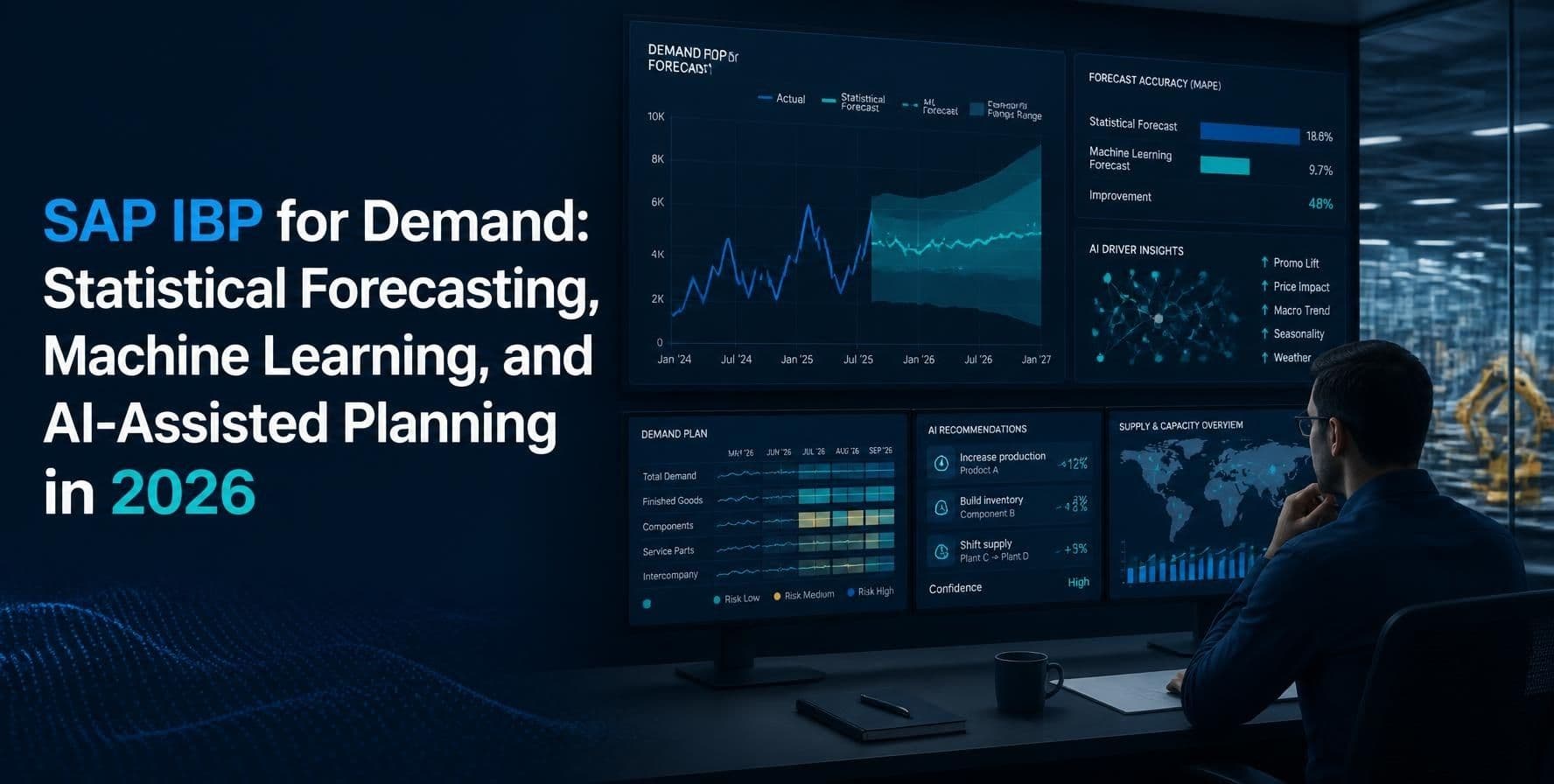
SAP IBP for Demand: Statistical Forecasting, Machine Learning, and AI-Assisted Planning in 2026
Here is an uncomfortable truth that most planning teams already know but rarely say out loud: the forecast is wrong before it is even finished. The question is not whether demand planning will produce errors — it will — but whether the process is disciplined enough to catch those errors quickly, explain them honestly, and correct them before they cascade into inventory overstock, missed service levels, or a supply plan that the business no longer trusts. That is the problem SAP IBP for Demand is designed to solve.
The stakes are significant. According to Gartner (2024), organizations with mature demand-driven planning processes achieve inventory reductions of 15–20% and service-level improvements of 5–10 percentage points compared to peers running manual or spreadsheet-based forecasting. SAP's own customer evidence is equally compelling: SLB reported that some business lines improved forecast accuracy from below 50% to nearly 90% within six to nine months of disciplined IBP demand planning, while BRF reduced the time required to access and analyze forecast data by 33% after implementation. These results demonstrate why businesses are increasingly investing in intelligent planning platforms and skilled professionals with hands-on SAP IBP training experience.
SAP IBP for Demand combines statistical forecasting, machine learning, demand sensing, and AI-assisted forecast analysis into a single governed platform. Instead of relying on disconnected spreadsheets and reactive planning decisions, organizations can use IBP to create a collaborative, data-driven demand planning environment that improves forecast visibility and business alignment across sales, operations, procurement, and supply chain teams.
This guide explains how each forecasting layer works, when to use different forecasting models, how to configure SAP IBP for better forecast accuracy, and the most common implementation mistakes that reduce planning effectiveness. It also explores practical concepts such as forecast consumption, exception-based planning, consensus demand planning, key figure configuration, and real-time analytics that are critical for successful IBP deployments.
Whether you are evaluating SAP IBP, preparing for implementation, or already managing a live planning environment, the objective here is to provide practical insights that generic product overviews often miss. For professionals pursuing SAP IBP training, this guide also serves as a valuable learning resource by connecting theoretical forecasting concepts with real-world business scenarios used across manufacturing, retail, consumer goods, and distribution industries.
What Is SAP IBP for Demand and Where It Fits
SAP IBP for Demand is the demand planning capability inside SAP Integrated Business Planning. SAP's Help Portal describes it as the set of tools used to generate forecasts for different scenarios or parts of the business, with forecast models defining how statistical forecasting and demand sensing are executed. That definition is accurate but understates what the module actually does in a mature implementation.
In practice, SAP IBP for Demand is the analytical core of the entire IBP planning cycle. Everything downstream — supply planning, inventory optimization, S&OP alignment, and executive decision-making — inherits whatever the demand plan gets right or wrong. SAP's best-practice analytics content for demand planning is built around forecast error, forecast bias, forecast stability, forecast value add, outlier analysis, and segmentation precisely because these are the levers that determine whether the forecast is genuinely useful or just a number that everyone ignores.
How IBP for Demand Fits Within the IBP Suite
SAP IBP is an integrated suite, not a collection of standalone modules. Demand planning feeds supply planning and the S&OP process, and SAP's preconfigured planning stories give demand planners, process experts, and global planners connected views across forecast volume, error, bias, revenue, and impact analysis. That integration is what makes IBP different from a standalone forecasting tool: when the demand plan changes, the downstream impact is visible immediately rather than discovered a week later in a supply review meeting.
Statistical Forecasting in SAP IBP: Algorithms, Best-Fit, and When to Use Each
Statistical forecasting in SAP IBP is built on time-series algorithms that predict future demand from historical demand patterns. SAP's Help Portal defines forecasting algorithms as mathematical methods used to predict future demand for a product or product group based on time-series values. The platform includes a wide range of algorithms, and knowing which one to deploy in which situation is one of the most consequential decisions a demand planning team makes.
The Full Algorithm Stack
SAP IBP's documented forecasting algorithms include Automated Exponential Smoothing, Croston Method, Croston TSB Method, Curve-Based Method, Daily Disaggregation Optimization, Double Exponential Smoothing, Extreme Gradient Boosting, Forecast Consumption, and Gradient Boosting of Decision Trees. For seasonal and trend-based forecasting, SAP also supports Holt-style linear methods for trend and Holt-Winters-style seasonal trend exponential smoothing for products with both seasonality and trend. That breadth is intentional: no single algorithm fits every demand pattern, and forcing the wrong model onto a product family will produce systematically biased forecasts regardless of how well the system is configured.
Best-Fit Algorithm Selection
SAP supports multi-algorithm forecast models and an automatic best-fit selection mechanism. When more than one forecasting algorithm is added to a forecast model, the system evaluates historical patterns — including trend properties — and selects the most suitable method. Automated Exponential Smoothing, for example, is documented by SAP as a method that selects the most suitable exponential smoothing algorithm and its coefficients before forecasting, removing the need for manual parameter tuning on every item.
Best-fit saves significant planning effort across large product portfolios, but it does not eliminate the need for judgment. Planners still need to verify whether the selected algorithm makes sense for a new product launch, a promotion-heavy item entering a lifecycle transition, or a slow-moving spare part with lumpy demand. The algorithm is a starting point; the demand review process is what keeps it honest.
Algorithm Selection Guide by Demand Pattern
| Demand Pattern | Best Algorithm | Why It Fits | SAP Basis |
|---|---|---|---|
| Stable, low-noise | Automated Exponential Smoothing | Fast, reliable, self-tuning | SAP documents auto-selection of the most suitable exponential smoothing method |
| Trend-driven, no strong seasonality | Double Exponential Smoothing / Holt | Captures upward or downward trends | SAP links double exponential smoothing to Holt's linear method |
| Seasonal with trend | Holt-Winters seasonal trend smoothing | Handles both seasonality and trend together | SAP documents Winter/Holt multiplicative methods for seasonal-trend patterns |
| Intermittent / lumpy demand | Croston or Croston TSB | Built specifically for zero-heavy time series | SAP defines Croston as designed for intermittent demand |
| Complex with external drivers | Gradient Boosting or Extreme Gradient Boosting | Learns nonlinear patterns and driver interactions | SAP documents both as ensemble ML algorithms in the forecasting stack |
Machine Learning Forecasting in SAP IBP: When the Classical Models Are Not Enough
Machine learning forecasting in SAP IBP addresses a genuine limitation of classical time-series methods: they extrapolate historical patterns but cannot learn from the drivers that cause those patterns to change. Promotions, product launches, competitor actions, and channel shifts all affect demand in ways that an exponential smoothing model has no mechanism to detect. That is where gradient boosting and extreme gradient boosting enter the picture.
Gradient Boosting in IBP for Demand
SAP defines Gradient Boosting of Decision Trees as an ensemble machine learning algorithm used for regression and classification. In demand planning terms, that means the model can learn how multiple inputs — historical shipments, promotional calendars, lifecycle stage, external market signals — combine to produce a demand outcome, and it can do so even when those relationships are nonlinear or change over time. SAP also documents Extreme Gradient Boosting (XGBoost) as part of the forecasting algorithm stack, which offers similar capability with a different optimization approach that often performs better on larger datasets.
One implementation detail that matters significantly: SAP specifies that demand sensing with gradient boosting is available only for new forecast models and only for full runs, not incremental updates. That means teams need to plan their forecast model architecture around this constraint before go-live, not retrofit it after a production problem surfaces.
Combining Statistical and ML Methods
The strongest IBP demand programs do not choose between statistical forecasting and machine learning as if one must permanently win. They segment the product portfolio by demand complexity and match the method to the pattern. Statistical algorithms handle the majority of items — the stable, seasonal, and intermittent demand patterns where clean time-series methods are both fast and accurate. Machine learning handles the high-value or high-complexity segments where external drivers, lifecycle effects, and promotional behavior make classical models systematically underperform.
SAP's forecast model design supports this hybrid approach because a single model can include multiple algorithms and the system can apply selection logic to determine how results are combined. In practice, a well-designed IBP demand program runs statistical forecasting across the full portfolio and deploys gradient boosting on a specific, governed subset where the additional complexity is justified by measurable accuracy improvement.
Outlier Handling and Noise Reduction
Machine learning models are only as good as the history they are trained on. Outliers — one-time demand spikes from a discontinued promotion, a customer stocking event that will not repeat, a weather-driven anomaly — will teach the model the wrong lesson if they are not identified and treated before forecasting runs. SAP's demand-planning analytics stories explicitly include outlier analysis as a core review step, and SAP's demand sensing release content shows that change point detection can be incorporated into the gradient boosting model to improve near-term forecast accuracy. The practical discipline is to clean history before forecasting, not after the output looks strange.
SAP IBP Demand Sensing: Short-Term Forecasting That Responds to Real Signals
Demand sensing is the short-term forecasting layer in SAP IBP that complements the monthly statistical and ML forecast. SAP defines demand sensing as a mechanism that creates optimized daily forecasts for multiple products using consensus demand and recent demand signals. Where statistical forecasting builds a view of the next three to twelve months, demand sensing adjusts the near-term horizon — typically one to four weeks — based on the most recent available data.
What Demand Sensing Actually Does
Demand sensing takes the agreed consensus demand plan and recalibrates daily buckets using the latest shipment data, point-of-sale signals, or other near-term inputs. SAP's documentation confirms that demand sensing with gradient boosting can improve near-future demand forecasting based on short-term data, and that change points and product lifecycle information can be factored into the sensing calculation. For high-velocity businesses — FMCG, retail replenishment, distribution — that daily adjustment capability can meaningfully reduce short-term safety stock requirements and improve customer service levels simultaneously.
Demand Signal Integration
Demand sensing works best when it has access to signals beyond historical shipments. SAP's documentation and release notes show that promotions planned in a trade promotion planning system can be integrated into demand forecasting, and that external forecasting systems can be connected through SAP IBP's external preprocessing and forecasting interface. That means demand sensing is not limited to internal data; it can ingest POS data, customer order signals, and promotion calendars as part of its daily recalibration logic.
Short-Term vs. Mid-Term Forecasting Responsibilities
A common implementation mistake is treating demand sensing as a replacement for statistical forecasting rather than as a complement to it. Demand sensing operates best in the one-to-four-week horizon where recent signals carry more predictive weight than historical patterns. Mid-term and long-term forecasting — the three-to-eighteen-month horizon that drives supply planning, capacity decisions, and S&OP — is better served by statistical and ML models that have the breadth of history and planning horizon needed for meaningful supply response. SAP's planning analytics stories reflect this split: local demand planners use short-term and mid-term views, while process experts focus on forecast quality, stability, and value add across the full horizon.
AI-Assisted Forecast Analysis: Making the Forecast Explainable
One of the persistent frustrations in demand planning is the black-box problem: the system produces a number, the business asks why it changed, and the planner cannot give a clear answer. SAP's 2026 UX update addresses this directly. SAP now says IBP users can display detailed explanations for the values of main forecast key figures, and that AI-assisted forecast analysis can be opened directly from the IBP panel in planning UIs. That is a meaningful change in how demand review conversations can be structured.
Forecast Explainability with Joule
Joule in SAP IBP provides access to AI-assisted explanations of planning results. In the demand planning context, a planner can open the statistical forecast details for a specific product or product family, then use the SAP IBP panel to interrogate what drove the forecast change — whether it was a trend shift, a seasonality adjustment, an outlier correction, or a model-selection change. In a demand review meeting where the commercial team challenges a downward revision, the ability to point to a specific driver rather than saying 'the algorithm changed it' is the difference between a credible planning function and one that loses its seat at the executive table.
How to Use AI Explanations in the Demand Review
The most productive way to use AI forecast explanations in the monthly demand review is to treat them as a triage tool, not a confirmation tool. Look for the two or three biggest drivers of forecast movement — the ones that explain the most variance — and focus the discussion on whether those drivers represent real business signals or planning noise. SAP's demand expert analytics stories are already organized around forecast error, outlier analysis, stability, and forecast value add, so AI explanations fit naturally into that review structure. The planner still owns the judgment call; the AI explanation tells them where to look first.
Statistical vs. Machine Learning Forecasting: A Direct Comparison
The debate between statistical and machine learning forecasting is often framed as a choice between the old way and the new way. That framing is misleading. The better question is which method fits the demand pattern, and whether the organization has the data discipline to support the method it chooses.
| Dimension | Statistical Forecasting | Machine Learning Forecasting |
|---|---|---|
| Core strength | Clear, explainable, computationally light | Learns nonlinear patterns and complex driver interactions |
| Best demand patterns | Stable, seasonal, trend-based, intermittent | Promotion-driven, lifecycle-affected, external-signal-rich |
| SAP examples | Automated Exponential Smoothing, Croston, Holt-Winters | Gradient Boosting of Decision Trees, Extreme Gradient Boosting |
| Explainability | High — model mechanics are transparent | Medium to high, depending on AI explanation configuration |
| Setup effort | Lower — faster to configure and tune | Higher — requires clean driver data and model governance |
| Change sensitivity | Lower — stable response to noise | Higher — reacts faster to real signals but also to noise |
| Primary risk | Underfitting complex, driver-rich demand | Overfitting or noise amplification without good data discipline |
| Recommended use | Baseline coverage across the full portfolio | High-value or high-complexity segments with measurable complexity |
The practical conclusion from this comparison is not that machine learning is superior — it is that the right tool depends on the product, the data available, and the organization's capacity to govern a more complex model. A well-run IBP demand program uses statistical forecasting for the broad portfolio and machine learning for the segments where the incremental accuracy improvement justifies the additional configuration and review overhead.
Configuring SAP IBP for Demand: What Gets Planners Into Trouble
Configuration in SAP IBP for Demand is where model quality is either protected or quietly destroyed. SAP says forecast models are the parameter sets that define how statistical forecasting and demand sensing are run, and that forecast automation profiles are rule sets for making forecasting more effective. Both of those definitions sound straightforward. In practice, the configuration decisions planners make in the first three months of an IBP implementation determine how accurate — and how trustworthy — the demand plan will be two years later.
Master Data: The Foundation Everything Else Depends On
If master data is inconsistent, the forecast will inherit that inconsistency no matter how well the algorithm is configured. Products with wrong time profiles produce forecasts in the wrong planning buckets. Locations with incorrect hierarchies aggregate demand in ways that hide exceptions. Customers with duplicate records split demand signals that should be combined. SAP's demand-planning analytics stories include outlier analysis, segmentation, and time-series review precisely because master-data problems show up as forecast anomalies — and the fastest way to fix the anomaly is to trace it back to the master data, not to adjust the algorithm.
Forecast Model Architecture
A forecast model in SAP IBP defines the algorithms, forecasting steps, and parameters the system uses to build the demand plan. SAP says users define overall parameters and choose algorithms on the Forecasting Steps tab, and the system can be configured to evaluate time-series properties and produce multiple forecasts for comparison. The most common configuration mistake TechBrainz consultants see is building one model that is expected to cover every demand pattern in the portfolio — stable products, seasonal products, intermittent spare parts, and new launches all assigned to the same algorithm and the same parameters. That approach produces average results across all segments and excellent results for none.
Best-Fit Configuration That Actually Reflects Reality
Best-fit algorithm selection only works well when the planning area and forecast model are configured to reflect genuine demand behavior rather than theoretical behavior. SAP's guidance on time-series properties shows the system evaluates trend before selecting the best-fit algorithm. If the history loaded into the planning area is too short, too dirty, or inconsistently structured, the trend evaluation will reach the wrong conclusion and best-fit will select the wrong model. The configuration should be reviewed after the first full planning cycle with real data — not left static after go-live on the assumption that the system will self-correct.
Automation Profiles and Exception Management
SAP's forecast automation profiles allow teams to automate forecasting for stable, well-understood product families while routing exceptions to manual review. That design is correct: the goal of automation is not to remove planners from the process but to focus planner attention where it adds value. A planner who spends four hours a week reviewing 300 stable products that could be auto-approved is a planner who does not have time to investigate the 15 high-value exceptions that genuinely need analysis. Automation profiles, when configured well, shift the planning function from number-checking to decision-making.
How to Improve Forecast Accuracy: A Practical Framework
Forecast accuracy is not a metric to report — it is a capability to build. SAP IBP's demand analytics stories are organized around forecast error, forecast bias, forecast stability, and forecast value add precisely because accuracy improvement is an iterative process, not a one-time configuration exercise. The framework below reflects both SAP's documented approach and the implementation patterns TechBrainz has seen produce measurable results.
Step 1 — Diagnose Before You Fix
The most common accuracy improvement mistake is changing the algorithm before understanding the source of the error. SAP's demand planning analytics stories give planners the tools to distinguish between forecast error caused by model selection, forecast error caused by dirty history, forecast error caused by unmodeled promotions, and forecast error caused by genuine demand volatility that no model could have predicted. Diagnosing the source first saves months of configuration changes that solve the wrong problem.
Step 2 — Clean History Before Forecasting
Outliers in historical demand — one-time spikes from customer stocking events, promotional lifts that will not repeat, weather-driven anomalies — teach the forecasting model the wrong lesson. SAP's demand-planning analytics stories include outlier analysis as a primary review step. The discipline of cleaning history before forecasting runs is not glamorous, but it consistently produces larger accuracy improvements than algorithm upgrades applied to dirty data.
Step 3 — Segment Products and Match Method to Pattern
SAP's best-practice demand analytics content uses ABC/XYZ segmentation and time-series analysis to distinguish demand patterns before improvement actions are taken. High-volume, low-variability products (AX segment) are strong candidates for automated statistical forecasting with tight exception thresholds. Low-volume, high-variability products (CZ segment) benefit more from planner judgment and exception-based review than from statistical model refinement. Applying one approach across all segments is the most reliable way to produce mediocre accuracy across all segments.
Step 4 — Review Forecast Value Add, Not Just Forecast Error
Forecast Value Add (FVA) measures whether the manual adjustment step in the demand review process is improving the statistical forecast or making it worse. SAP's demand expert analytics stories explicitly include FVA as a KPI. In many organizations, FVA analysis reveals that planners are systematically adjusting forecasts in ways that add noise rather than signal — often because the review process rewards adjustment activity rather than accuracy outcomes. FVA data gives planning managers the evidence to have that conversation with the team.
Step 5 — Use Demand Sensing for Short-Term Correction
Statistical and ML models operate at monthly or weekly planning frequencies. For businesses where near-term demand moves faster than the planning cycle, demand sensing provides the daily correction mechanism that keeps the short-term plan aligned with actual market signals. SAP says demand sensing creates optimized daily forecasts using consensus demand and recent demand signals, which is exactly where fast-moving businesses lose the most accuracy without a sensing capability.
When SAP IBP for Demand Is Not the Right Solution
SAP IBP for Demand is a powerful platform, but it is not the right answer for every organization. Being clear about the limitations is part of making a good implementation decision — and it is the kind of honesty that separates credible planning consultants from software advocates.
Small organizations with fewer than five demand planners and straightforward product portfolios — a few hundred SKUs with stable demand patterns — often find that SAP IBP's configuration and governance overhead exceeds the accuracy benefit it delivers over a well-managed statistical forecasting tool or even a structured Excel-based process. The platform is designed for complexity; if the planning problem is not complex, the investment in IBP for Demand should be evaluated carefully against simpler alternatives.
SAP IBP for Demand also requires a minimum level of data maturity to produce meaningful results. Organizations with inconsistent historical demand data — missing months, duplicate transactions, poor master data governance — will find that IBP surfaces those problems very clearly through poor forecast accuracy, but it cannot fix them automatically. The prerequisite is a data remediation program, not a software implementation. Implementing IBP on top of bad data produces expensive bad forecasts rather than cheap bad forecasts.
Finally, organizations that are not running SAP ERP or are not planning to move toward the SAP ecosystem should evaluate IBP integration costs carefully. SAP IBP can connect to non-SAP systems, but its deepest and most reliable integration is with S/4HANA. For organizations with Oracle, Microsoft, or other ERP environments as their long-term system of record, a best-of-breed demand planning tool may deliver better outcomes at lower total cost than a full SAP IBP deployment.
Frequently Asked Questions: SAP IBP for Demand
What forecasting algorithms does SAP IBP for Demand include?
SAP IBP's documented algorithm stack includes Automated Exponential Smoothing, Double Exponential Smoothing, Croston Method, Croston TSB Method, Gradient Boosting of Decision Trees, Extreme Gradient Boosting, Curve-Based Method, Daily Disaggregation Optimization, and Forecast Consumption. For trend and seasonal patterns, SAP also supports Holt-style linear methods and Holt-Winters seasonal trend smoothing. Best-fit selection allows the system to choose among multiple configured algorithms based on the historical pattern of each planning object.
When should I use machine learning forecasting instead of statistical methods?
Use machine learning — specifically gradient boosting or extreme gradient boosting in SAP IBP — when the demand pattern is driven by external factors, promotions, lifecycle effects, or nonlinear interactions that classical time-series models cannot capture. For stable, seasonal, and intermittent demand patterns, statistical methods are faster to configure, easier to explain, and usually produce comparable or better accuracy. The right answer for most organizations is a hybrid: statistical methods for the broad portfolio and ML for high-complexity or high-value segments.
What is demand sensing and how is it different from demand forecasting?
Demand sensing in SAP IBP creates optimized daily forecasts using consensus demand and the most recent available demand signals. It operates in the short-term horizon — typically one to four weeks — where recent signals carry more predictive weight than historical patterns. Standard demand forecasting operates across monthly or weekly planning buckets over a three-to-eighteen-month horizon. Demand sensing does not replace demand forecasting; it refines the near-term portion of the agreed plan using data that was not available when the monthly forecast was created.
How does AI-assisted forecast analysis work in SAP IBP in 2026?
SAP's 2026 UX update introduced the ability to display detailed explanations for main forecast key figure values directly in IBP planning UIs. Users can open AI-assisted forecast analysis from the IBP panel to understand why a forecast changed — whether due to a trend shift, seasonality adjustment, outlier treatment, or algorithm selection change. Joule, SAP's AI assistant, supports this explanation capability within the planning environment. The feature is designed to make forecast movements transparent to planners and to the business stakeholders they present to in demand review meetings.
What KPIs should I track to measure SAP IBP demand planning performance?
The core KPIs for IBP demand planning performance are forecast error (MAPE or WMAPE), forecast bias, forecast stability, and Forecast Value Add. SAP's demand-planning analytics stories are built around exactly these metrics. Forecast error tells you how far off the plan is. Bias tells you whether the errors are systematic. Stability tells you whether the forecast is reliable enough to be trusted by supply planning. FVA tells you whether the human review process is adding accuracy or adding noise. Tracking all four gives a complete picture of demand planning health.
How long does it take to see forecast accuracy improvement after implementing SAP IBP for Demand?
Based on publicly available SAP customer evidence, meaningful accuracy improvement typically emerges within three to six months of a disciplined IBP demand implementation — assuming clean master data, a structured demand review process, and appropriate algorithm selection. SLB reported improvements from under 50% to around 90% accuracy in six to nine months. Organizations with data quality issues, governance gaps, or weak demand review processes typically take longer. The technology is not the constraint; process discipline is.
Conclusion
SAP IBP for Demand in 2026 is best understood as a layered forecasting system with a clear hierarchy of purpose. Statistical forecasting provides a reliable and explainable baseline across the entire product portfolio, helping organizations maintain consistency in demand planning. Machine learning addresses high-complexity demand patterns where external factors, promotions, seasonality, and product lifecycle changes make traditional forecasting models less effective. Demand sensing strengthens short-term planning by using real-time signals and operational data that standard monthly planning cycles often miss. At the same time, AI-assisted forecast analysis makes forecasting outputs more transparent, understandable, and easier to defend during demand review and executive planning meetings.
Organizations that gain the highest value from SAP IBP for Demand are not necessarily the ones using the most advanced algorithms. The real differentiator is operational discipline. Businesses with clean master data, structured demand review cycles, cross-functional collaboration, and a strong focus on forecast quality consistently achieve better planning accuracy and supply chain performance. SAP IBP provides the technology foundation to support these capabilities, but successful outcomes still depend on process maturity and planning governance. This is one of the most important lessons emphasized in practical SAP IBP training programs and real-world implementation workshops.
In our experience working on SAP IBP demand planning implementations at TechBrainz, the planning teams that improve forecast performance the fastest are those that begin with a clear understanding of where forecast accuracy is failing. Instead of applying the same forecasting model to every product, successful teams identify demand patterns, classify products correctly, and match the right algorithm to the right business scenario. They also use structured demand review meetings to continuously compare forecast outputs with actual business results and refine planning assumptions over time.
SAP IBP for Demand is not simply a forecasting application—it is a strategic planning platform that combines analytics, automation, machine learning, and collaborative workflows into a unified demand planning process. As businesses continue investing in AI-driven supply chain transformation, professionals with hands-on SAP IBP training and implementation knowledge will play a critical role in helping organizations improve forecast reliability, reduce inventory costs, and build more agile supply chains. The technology accelerates planning discipline and decision-making, but long-term success still depends on skilled planners who understand both the system and the business processes behind it.
Ready to build real SAP IBP demand planning skills? TechBrainZ's SAP IBP Training Program is built around actual implementation scenarios — not just certification theory. Our instructors have led IBP demand planning projects across manufacturing, FMCG, and distribution industries, and the curriculum reflects the configuration decisions, accuracy improvement frameworks, and process design patterns that determine whether an IBP demand program delivers results. Explore the program at book a free consultation to find the learning path that fits your career goals.
Author bio
Written by the TechBrainz SAP Practice Team | SAP Certified Consultants with 10+ years of IBP implementation experience