
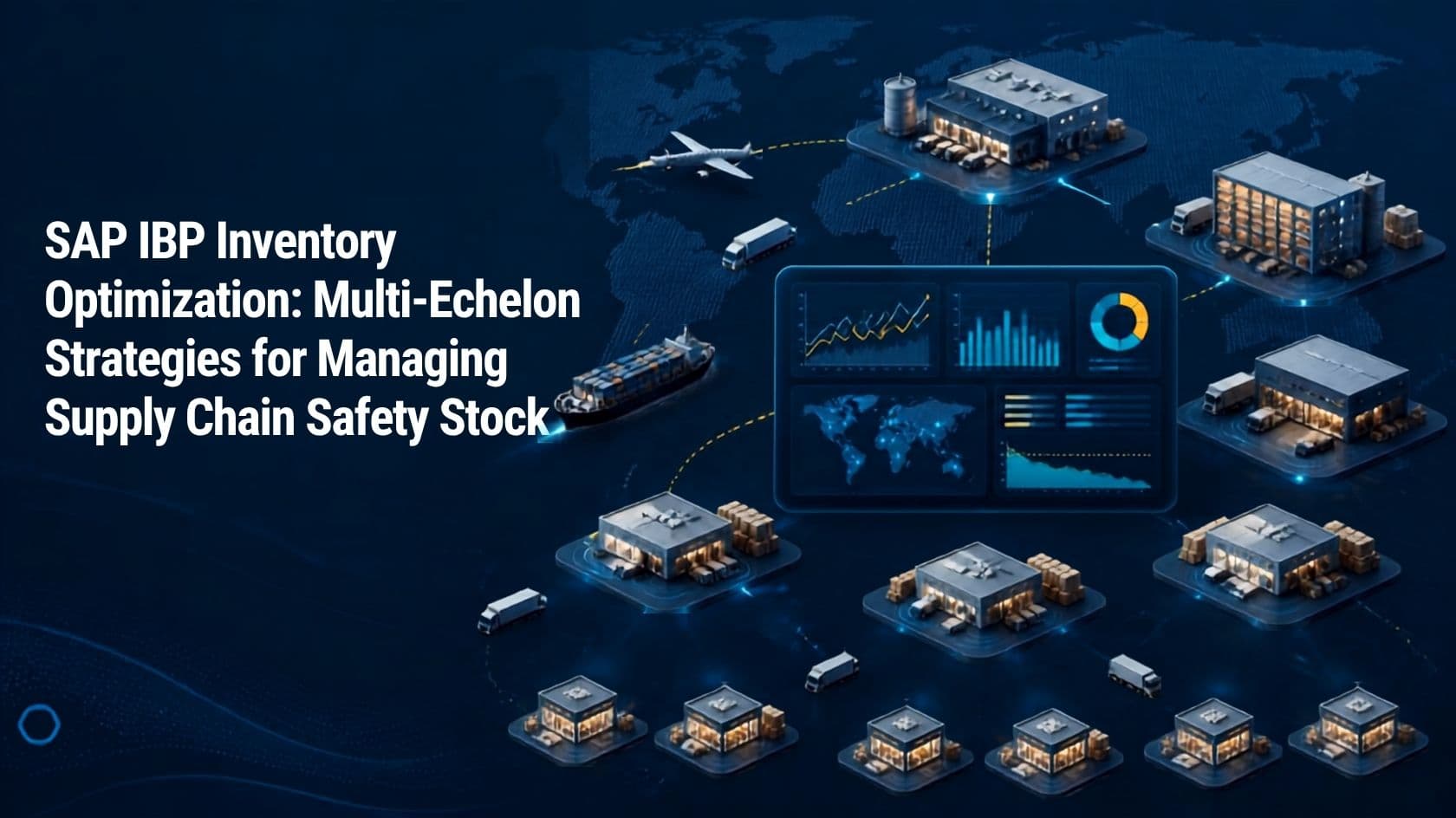
SAP IBP Inventory Optimization: Multi-Echelon Strategies for Managing Supply Chain Safety Stock
Modern supply chains rarely consist of a single warehouse serving a single customer. A typical network includes multiple tiers of suppliers, manufacturing plants, regional distribution centers, and retail or customer-facing locations, each holding some level of inventory to buffer against uncertainty. Traditional inventory planning methods calculate safety stock at each location in isolation, which frequently leads to redundant buffers, inflated working capital, and inconsistent service levels. SAP IBP's multi-echelon inventory optimization capability was built to solve exactly this problem, treating the supply chain as a connected system rather than a collection of independent nodes.
This article explains what multi-echelon inventory optimization means inside SAP IBP, how it differs from single-echelon safety stock planning, the mechanics behind the calculation, practical implementation strategies, common challenges, and real-world style case scenarios that illustrate the business impact.
The stakes of getting this right have grown considerably. Global disruptions, longer and less predictable lead times, and rising customer expectations for availability have made it increasingly costly to rely on static, rule-of-thumb safety stock buffers. At the same time, finance leaders are under pressure to release working capital tied up in inventory. Multi-echelon inventory optimization gives supply chain teams a defensible, data-driven way to satisfy both goals at once protecting service levels while systematically removing redundant inventory from the network.
Definition
SAP IBP Inventory Optimization (IO) is a module within SAP Integrated Business Planning that uses multi-echelon inventory optimization (MEIO) algorithms to calculate statistically optimal safety stock and target inventory levels across every node and stage of a supply chain from raw material suppliers to distribution centers to end customers. Rather than setting safety stock independently at each location, MEIO models how demand variability, supply lead-time variability, and service-level requirements propagate across the network, producing inventory targets that meet customer service goals with the lowest possible total inventory investment.
Quick Facts
| Module | SAP Integrated Business Planning for Inventory (SAP IBP for Inventory) |
| Core Method | Multi-Echelon Inventory Optimization (MEIO), based on the Guaranteed Service Model (GSM) approach |
| Primary Output | Time-phased safety stock and target stock levels by location, product, and echelon |
| Key Inputs | Demand forecast error, supply/lead-time variability, service-level targets, review periods, bill of materials |
| Deployment | Cloud-based, part of the SAP IBP suite alongside Demand, Supply, S&OP, and Response modules |
| Typical Users | Supply chain planners, inventory analysts, S&OP managers, demand planners |
| Common Benefit Range | 10–30% reduction in inventory holding costs with equal or improved service levels (varies by industry and baseline maturity) |
| Integration | Connects with SAP S/4HANA, SAP ECC, and non-SAP ERP systems via SAP IBP's integration layer |
What Is Multi-Echelon Inventory Optimization?
Multi-echelon inventory optimization is a planning technique that determines safety stock and inventory targets by simultaneously considering every stage (echelon) of a supply chain network suppliers, plants, distribution centers, and downstream locations instead of optimizing each location separately. SAP IBP for Inventory implements MEIO using a Guaranteed Service Model, which assumes that each node commits to a guaranteed replenishment time to its downstream customer, and calculates the safety stock needed at each stage to protect against forecast error and supply variability within that guaranteed time window.
The result is a network-aware safety stock policy: some variability is absorbed upstream near the source of supply, some is absorbed downstream close to the customer, and the total inventory held across the entire network is minimized while still meeting the target service level at the point of customer demand.
How Multi-Echelon Differs from Single-Echelon Planning
| Aspect | Single-Echelon Planning | Multi-Echelon Planning (SAP IBP) |
|---|---|---|
| Scope | Each location plans safety stock independently | Entire network is optimized as one connected system |
| Variability Handling | Full variability buffered at every node | Variability absorbed at the most cost-effective echelon |
| Inventory Investment | Higher, due to duplicated buffers | Lower, because redundant buffers are eliminated |
| Service Level Consistency | Prone to gaps between locations | Aligned end-to-end with defined target service levels |
| Visibility | Limited to a single node or tier | Full network visibility across BOM, lead times, and demand |
Key Multi-Echelon Strategies in SAP IBP
1. Network-Wide Safety Stock Positioning
SAP IBP evaluates the entire bill of materials and distribution network to decide where safety stock should be strategically placed. Instead of holding buffer stock at every tier, the system identifies decoupling points — locations where holding inventory yields the greatest service-level benefit for the lowest cost and concentrates safety stock there.
2. Demand and Supply Variability Modeling
The engine calculates forecast error (demand variability) and lead-time variability (supply variability) at each node, then propagates these values through the network using statistical formulas rooted in the Guaranteed Service Model. This produces safety stock recommendations that reflect real, measured uncertainty rather than static rule-of-thumb buffers.
3. Service-Level Differentiation
Not every product or customer segment warrants the same service level. SAP IBP allows planners to set differentiated target service levels by product, location, or customer segment, so that high-priority SKUs receive tighter service commitments while slower-moving or lower-margin items are planned more leanly.
4. Dynamic Recalculation and What-If Simulation
Because supply chains are dynamic, SAP IBP supports scenario planning simulating the impact of lead-time changes, demand shifts, network redesign, or new supplier relationships on required safety stock before changes are implemented. This what-if capability lets planners quantify trade-offs between service level, inventory cost, and network structure.
5. Integration with S&OP and Demand Planning
Inventory optimization in SAP IBP does not operate in a silo. It draws statistical forecast error directly from the Demand module and feeds optimized targets into Supply Planning and Sales & Operations Planning, ensuring that inventory targets remain aligned with the latest consensus forecast and supply constraints.
Business Benefits of Multi-Echelon Inventory Optimization
- Lower total inventory investment while maintaining or improving service levels
- Reduced working capital tied up in redundant safety stock across the network
- Improved on-shelf and on-time delivery performance for priority products
- Greater resilience to demand and supply variability through data-driven buffer placement
- Faster, scenario-based decision-making for network design and supplier changes
- Better alignment between finance, sales, and supply chain teams through shared, transparent targets
Implementing Multi-Echelon Inventory Optimization in SAP IBP
Step 1: Define the Supply Chain Network Model
Map every relevant node supplier, plants, distribution centers, and customer locations along with the lead times and replenishment relationships that connect them. Accuracy here is critical, since the network model is the foundation for every downstream calculation.
Step 2: Cleanse and Load Master Data
Lead times, minimum order quantities, review periods, and historical demand data must be accurate and current. Poor master data quality is the single most common cause of unreliable safety stock recommendations in any MEIO implementation.
Step 3: Set Service-Level Targets
Work with commercial and finance stakeholders to define target service levels by product segment, using tools such as ABC/XYZ segmentation to prioritize where higher service levels are commercially justified.
Step 4: Run and Validate the Optimization
Execute the MEIO run, then validate outputs against historical performance and business judgment. Planners should sanity-check extreme results and adjust input parameters such as forecast error calculation windows or lead-time assumptions — rather than accepting outputs blindly.
Step 5: Operationalize and Monitor
Push approved safety stock targets into replenishment and supply planning processes, then monitor actual service levels and inventory turns against the plan. SAP IBP supports periodic re-optimization so targets stay current as demand and supply conditions evolve.
Common Challenges and How to Address Them
| Challenge | Recommended Approach |
|---|---|
| Poor or incomplete master data | Run a data quality audit on lead times, BOMs, and demand history before go live |
| Resistance to centralized buffer placement | Involve regional planners early and demonstrate service-level impact with pilot scenarios |
| Overly volatile demand signals | Use statistical forecast error smoothing and segment SKUs by demand pattern |
| Organizational silos between planning teams | Establish a shared governance process linking demand, supply, and inventory planning |
| Difficulty trusting system outputs | Start with a phased rollout, validating results against a subset of the network |
Illustrative Case Studies
The following scenarios reflect the types of outcomes commonly reported by manufacturing and distribution organizations after adopting multi-echelon inventory optimization. Company names are illustrative composites representative of real-world implementation patterns rather than disclosures of specific client engagements.
Case Study 1: Global Consumer Packaged Goods Manufacturer
Situation: A multinational consumer goods company operated a three-echelon network of plants, regional distribution centers, and national warehouses. Safety stock was set independently at each tier, resulting in high inventory levels and inconsistent service to retail customers.
Approach: The company implemented SAP IBP for Inventory, mapping its full network and applying differentiated service-level targets across roughly 20,000 SKU-location combinations.
Outcome: By repositioning safety stock closer to the optimal decoupling points, the company reduced total network inventory while improving fill rates for its top-priority product lines, and gained a repeatable process for evaluating distribution network changes through scenario simulation.
Case Study 2: Industrial Equipment Manufacturer with Long Lead-Time Components
Situation: An industrial equipment manufacturer sourced critical components from overseas suppliers with long and variable lead times, causing frequent stockouts on the assembly line despite carrying large volumes of finished-goods inventory.
Approach: Using SAP IBP's multi-echelon model, planners shifted a portion of safety stock upstream to key component and sub-assembly stages, where variability could be absorbed more cheaply than at the finished-goods level.
Outcome: The company reduced finished-goods inventory, decreased production line stockouts, and created better visibility into which suppliers were driving the greatest amount of network-wide variability, supporting more targeted supplier negotiations.
Case Study 3: Regional Retail Distribution Network
Situation: A regional retailer with a central distribution center and multiple store clusters struggled with excess inventory in slow-moving categories alongside stockouts in fast-moving, high-demand items.
Approach: The retailer applied ABC/XYZ segmentation within SAP IBP, assigning higher service-level targets to fast-moving, high-variability items and leaner targets to stable, low-priority items, then ran MEIO across the distribution center and store echelons.
Outcome: The retailer achieved a more balanced inventory profile, with improved availability on priority items and freed-up working capital previously tied up in overstocked slow movers, while maintaining a single consistent planning process across the network.
Measuring Success: Key Performance Indicators
Organizations should track a consistent set of KPIs before and after adopting multi-echelon inventory optimization to confirm that the expected benefits are being realized in practice rather than only on paper. Financial, service, and operational metrics should be reviewed together, since improving one in isolation can sometimes mask a decline in another.
| KPI | What It Measures | Why It Matters |
|---|---|---|
| Inventory Turns | How many times inventory is sold and replaced over a period | Higher turns generally indicate leaner, more efficient inventory investment |
| Fill Rate / Service Level | Percentage of demand met from available stock | Confirms that inventory reductions are not eroding customer service |
| Days of Supply | Average number of days current inventory will last | Highlights whether buffers are appropriately sized relative to demand |
| Safety Stock Value | Monetary value of safety stock held network-wide | Directly reflects the working-capital impact of optimization |
| Forecast Accuracy / Error | Deviation between forecast and actual demand | A key input to safety stock calculations; monitoring it explains changes in targets |
Best Practices for Sustained Success
- Treat master data governance as an ongoing discipline, not a one-time cleanup
- Review service-level targets at least annually as product and customer priorities shift
- Use scenario simulation before committing to major network or sourcing changes
- Maintain cross-functional governance linking demand planning, supply planning, and finance
- Track inventory KPIs (turns, fill rate, days of supply) alongside service-level attainment to validate the optimization's real-world impact
Conclusion
Multi-echelon inventory optimization within SAP IBP shifts inventory planning from a set of disconnected, node-by-node decisions to a coordinated, network-wide strategy. By modeling demand and supply variability across every echelon and placing safety stock where it delivers the greatest service-level benefit at the lowest cost, organizations can reduce working capital, improve customer service consistency, and build a more resilient, data-driven approach to inventory management. Realizing these benefits in practice depends heavily on capability building which is why structured SAP IBP training for planners and analysts is often the difference between a technically sound configuration and one that planning teams actually trust and use day to day. As supply chains grow more complex and volatile, the ability to see and optimize the network as a whole, rather than in isolated pieces, is increasingly a competitive necessity rather than an optional refinement.
Frequently Asked Questions (FAQs)
1. What is multi-echelon inventory optimization in SAP IBP?
It is a planning method within SAP IBP for Inventory that calculates safety stock across all connected stages of a supply chain — suppliers, plants, distribution centers, and customer locations — simultaneously, rather than at each location in isolation, to minimize total inventory while meeting service-level targets.
2. How is SAP IBP's approach different from traditional safety stock formulas?
Traditional formulas typically calculate safety stock for a single location based on that location's own demand and lead-time variability. SAP IBP's multi-echelon approach accounts for how variability is shared and absorbed across connected nodes, often resulting in lower total inventory for the same service level.
3. What is the Guaranteed Service Model, and why does SAP IBP use it?
The Guaranteed Service Model is a mathematical framework in which each supply chain node commits to a guaranteed replenishment time to its downstream partner. SAP IBP uses this model because it scales efficiently to large, complex networks and produces stable, explainable safety stock recommendations.
4. What data is required to run inventory optimization in SAP IBP?
Key inputs include historical demand and forecast error, lead times and their variability, bills of materials, review periods, minimum order quantities, and target service levels by product or location. Accurate, well-maintained master data is essential for reliable results.
5. Can service levels be different for different products or customers?
Yes. SAP IBP allows planners to set differentiated service-level targets by product, location, or customer segment, so that high-priority or high-margin items can be planned with tighter service commitments than lower-priority items.
6. How long does a typical SAP IBP inventory optimization implementation take?
Timelines vary with network complexity and data readiness, but implementations commonly range from a few months for a focused pilot to longer, phased rollouts for large, multi-tier global networks. Data quality and organizational alignment are usually the biggest drivers of timeline.
7. Does multi-echelon optimization replace demand and supply planning?
No. It works alongside SAP IBP's Demand and Supply Planning modules, consuming forecast error and supply variability data from them and feeding optimized safety stock targets back into supply and replenishment planning.
8. What results can organizations realistically expect?
Outcomes vary by industry and starting point, but organizations frequently report meaningful reductions in inventory holding costs alongside equal or improved service levels, along with better visibility into where and why inventory is held across the network.
About the Author
TechBrainz SAP IBP Team
Written by the SAP IBP team at TechBrainz, specialists in SAP Integrated Business Planning implementation, training, and supply chain optimization. Our consultants bring hands-on, real-world project experience to every guide we publish.
© 2025 TechBrainz. All rights reserved. | www.techbrainz.in