
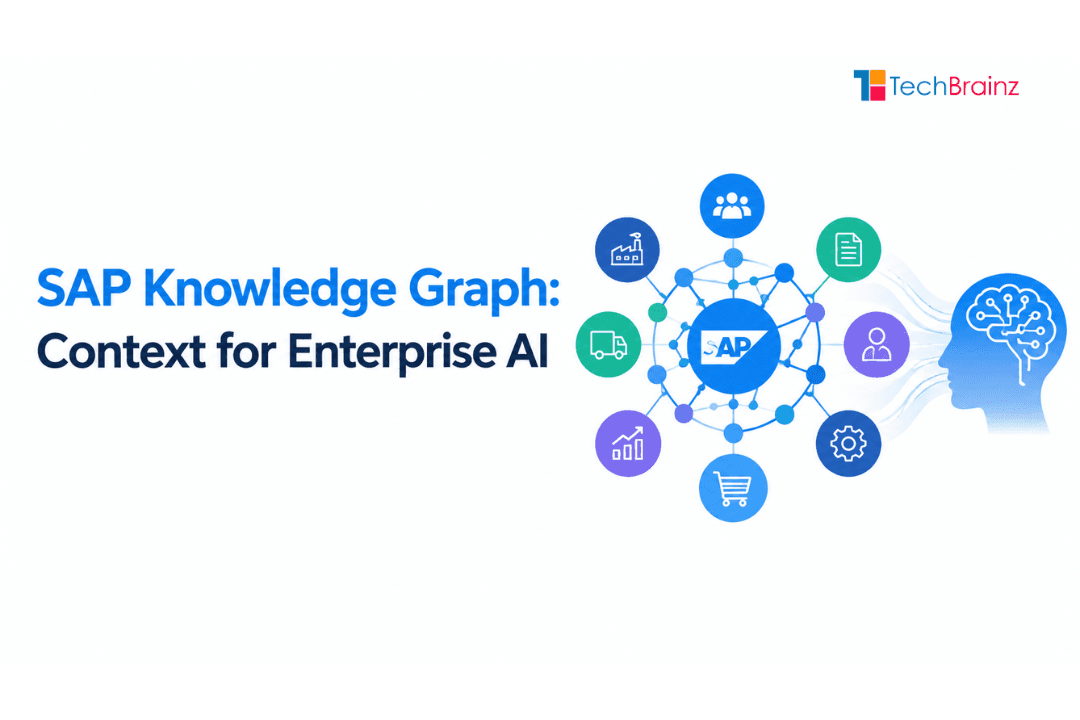
SAP Knowledge Graph: Context for Enterprise AI
Introduction: Your AI Has the Data. Does It Understand the Business?
Imagine asking an AI assistant a very simple business question: "Why are sales falling for this product in Germany?"
The company already has the information. Sales transactions are stored in SAP systems. Product information exists. Customer records are available. Inventory data is somewhere in the landscape. Pricing, suppliers, orders and regional information all exist as well.
So why can answering that question still be difficult?
Because having access to information is not the same as understanding the relationships between that information.
A product is connected to customers. Customers are connected to orders. Orders are connected to revenue. Products are connected to suppliers and inventory. Suppliers are connected to materials. Materials are connected to manufacturing and procurement processes. One business question can therefore cross several applications, datasets and business domains before reaching a meaningful answer.
This is where SAP Knowledge Graph becomes interesting. SAP describes it as a solution that connects an organization's data fabric to AI so that AI services such as Joule can work with richer business context. SAP positions it as a semantic backbone for connecting business meaning, structured metadata, data and relationships across the enterprise.
The bigger idea is simple: enterprise AI does not only need more data. It needs to understand what that data means and how everything is connected.

Definition: What Is SAP Knowledge Graph?
SAP Knowledge Graph is an SAP solution that represents business entities, relationships, metadata and semantics so AI applications can work with enterprise information in its business context. It helps connect data and business meaning so AI can retrieve and reason over more relevant enterprise information.
Think of it as a contextual map of the enterprise.
A customer is not just a customer number. A customer places orders, buys products, belongs to a region, has contracts and may interact with service teams. A product is not simply a product ID. It can belong to a category, have inventory, come from suppliers and appear in sales transactions.
A knowledge graph helps represent these connections so that machines can work with the relationships rather than treating every piece of information as an isolated fact.
Why Does Enterprise AI Have a Context Problem?
The biggest challenge with enterprise AI is not necessarily access to information. Modern companies have an extraordinary amount of it. The challenge is that the information is often distributed across applications, databases, data platforms and business processes.
Consider the word "customer." A sales application may use it one way. A finance system may associate it with billing information. A service application may connect it to support cases. A marketing system may use it in segmentation. All of these systems are talking about the same business concept, but they may represent it through different data structures and relationships.
A human who has worked inside the organization may understand this naturally. They know that a customer can place an order, receive an invoice, open a service case and belong to a particular sales region. An AI system needs those relationships to be represented and accessible if it is expected to provide reliable enterprise answers.
This is why business context matters so much.
Data tells you what exists. Context helps explain what it means.
SAP's current architecture guidance describes SAP Knowledge Graph as the semantic backbone of its AI-native architecture, connecting natural-language inputs with structured metadata, business semantics, APIs, data models and business entities.
Why Isn't a Traditional Database Enough?
A database is extremely good at storing structured information. Relational databases have powered enterprise applications for decades, and they remain fundamental to business computing.
But storing information and representing knowledge are not exactly the same problem.
Suppose a database contains a customer record, an order record and a product record. Those records may be connected through keys and tables, but an AI system may still need to understand the business meaning behind those connections.
A knowledge graph approaches the problem from the relationship itself.
Instead of thinking only about rows and columns, you can think about entities and relationships. A customer purchases a product. A product is supplied by a vendor. A vendor supplies material to a manufacturing location. An order belongs to a customer.
The relationships become part of the knowledge representation.
This does not mean knowledge graphs replace databases. In modern enterprise architectures, the two can work together. SAP HANA Cloud, for example, provides multi-model capabilities including relational and graph processing, while its knowledge graph engine supports RDF data and SPARQL queries.
The important difference is the perspective.
A database primarily stores data. A knowledge graph emphasizes the meaning and relationships connecting that data.
What Exactly Is a Knowledge Graph?

The easiest way to understand a knowledge graph is to imagine a map.
A normal map does not simply list cities. It shows how cities are connected by roads, railways and other routes.
A knowledge graph does something conceptually similar with information.
The entities become the points on the map. The relationships become the connections.
A customer can be connected to an order. An order can be connected to a product. A product can be connected to a supplier. A supplier can be connected to a location. Additional properties can describe those entities and relationships.
SAP explains knowledge graphs in terms of entities, relationships and properties, describing them as a way to transform raw data into a network of meaning.
That network can become particularly useful when AI needs to answer questions that cross multiple business concepts.
Instead of asking only, "What is this record?", the system can work toward a more useful question: "What is this record connected to, and why does that relationship matter?"
How Does SAP Knowledge Graph Support Enterprise AI?
The value of SAP Knowledge Graph becomes clearer when you look at how an AI interaction might work.
A business user asks a question in natural language. The AI first needs to understand the intent. Then it needs to identify which business entities and information are relevant. It needs to find the correct data, understand the relationships between those entities and return an answer that reflects the organization's actual business context.
SAP says its Knowledge Graph can connect natural-language inputs to SAP structured metadata and help identify relevant APIs, data models and business entities.
That is a significant difference from simply asking a general-purpose model to answer a question from its pretrained knowledge.
The goal is to ground the interaction in enterprise information.
The conceptual journey becomes:
User Question → Business Context → Relevant Enterprise Data → AI Response
The context layer is what makes the journey particularly interesting.
Why Does Business Context Matter So Much for Generative AI?
Generative AI is extremely good at working with language. It can summarize documents, generate content, answer questions and communicate in natural language.
But an enterprise question often requires more than language understanding.
Imagine a manager asks, "Show me the overdue orders from our most important customers."
The AI needs to understand what "overdue" means in the relevant business context. It needs to identify orders. It needs to understand the relationship between orders and customers. It may need to determine what qualifies as an important customer. It then needs access to the appropriate current business information.
A language model alone may understand the words in the question but still lack the organization's specific business context.
This is where SAP Knowledge Graph can play a role. SAP describes it as a mechanism for grounding AI in enterprise data and business context so services such as Joule can deliver more contextual answers.
The distinction is important.
Understanding language is not the same as understanding the business.
Can SAP Knowledge Graph Reduce AI Hallucinations?
This is one of the most important reasons knowledge graphs are being discussed alongside enterprise AI.
An AI model can sometimes produce an answer that sounds convincing but is not adequately supported by the available facts. In a business environment, that can be a serious problem.
Imagine an AI assistant giving the wrong supplier, incorrect order status or inaccurate financial interpretation. A response that sounds confident is not enough. Enterprise AI needs to be grounded in trustworthy information.
SAP explicitly positions its Knowledge Graph around grounding AI with business context and reducing hallucination risk.
However, it is important not to interpret this as a guarantee that hallucinations disappear.
A knowledge graph does not magically make every AI response correct. Data can still be incomplete. Business definitions can still be wrong. Access rules still matter. Models can still make mistakes.
The better way to think about it is that providing structured, trusted business context can give AI a stronger foundation for producing relevant answers.
Where Could SAP Knowledge Graph Be Used in Business?
The potential applications become easier to understand when you stop thinking about the graph as a standalone technology and start thinking about the business questions it can help contextualize.
In customer operations, relationships between customers, products, orders, contracts and service interactions can provide a much richer view of customer activity. An AI assistant could potentially use these connections when answering questions about purchasing behavior, service history or customer relationships.
In supply chain operations, the relationships can become even more complicated. A product can depend on materials, suppliers, warehouses, transportation and production processes. If one supplier experiences a disruption, the impact may spread across several connected business objects. A contextual graph can help represent those dependencies.
In procurement, relationships between suppliers, materials, purchase orders, contracts and delivery information can help users explore information from a connected perspective.
In finance, relationships between transactions, customers, suppliers, organizational units and financial structures can provide context for analytical questions.
The common thread is not the department.
It is the relationship between business entities.
SAP Knowledge Graph and Supply Chain: Seeing the Connections
Imagine that a company discovers that a popular product is repeatedly arriving late.
A conventional report might show the delayed orders.
But the business wants to know something more useful:
Why are these orders delayed?
The answer might involve a specific supplier. That supplier may be connected to a particular material. The material may be required at one manufacturing location. That location may be experiencing inventory constraints. Transportation could then add another delay.
Suddenly, the problem is no longer a single late order.
It is a chain of connected events.
This is exactly the type of situation where relationship-based context can become valuable. Instead of examining every piece of information separately, the organization can explore how the entities are connected.
For AI agents, that context can potentially make business questions more precise because the system has a richer representation of the relationships involved.
SAP Knowledge Graph and Customer Experience
Customer experience provides another strong example.
A customer record alone doesn't tell the complete story.
The customer may have purchased several products, opened support cases, changed an order, interacted with a sales representative and recently renewed a contract.
Each activity creates another relationship.
Now imagine asking an AI assistant:
"Why has this customer's purchasing behavior changed?"
The answer may require more than looking at sales history. The AI could need to consider products, orders, service interactions and other connected business information.
This is where contextual AI becomes more interesting than generic AI.
The objective isn't simply to produce a fluent answer.
It is to produce an answer that reflects the actual relationships inside the enterprise.
SAP Knowledge Graph and SAP Business AI
SAP Knowledge Graph sits within a broader SAP strategy around Business AI and AI-native enterprise architecture.
SAP describes its AI services and models as being built around business data and emphasizes grounding AI responses in SAP solution metadata and data. Its current AI platform materials describe SAP Knowledge Graph as an SAP-managed semantic layer that encodes business meaning and connects data, processes and relationships so AI can reason with greater context.
That distinction is worth understanding.
SAP Knowledge Graph is not simply another generative AI model.
It is part of the context and knowledge layer that can help AI systems work with enterprise information.
Think of the architecture as a combination of capabilities.
Business applications generate and use data. Data platforms organize and govern that information. Semantic technologies represent business meaning and relationships. AI models interpret questions and generate responses. AI agents can then use that contextual information to support or execute business tasks.
The value emerges when these pieces work together.
How Does SAP Knowledge Graph Relate to SAP Datasphere?
SAP Datasphere is highly relevant to this conversation because enterprise AI depends on a strong data foundation.
SAP describes SAP Datasphere as a key component of SAP Business Data Cloud and emphasizes its ability to preserve business context through shared semantics and metadata. Its current capabilities also include knowledge-graph functionality for mapping relationships across data and business processes to provide context for AI agents.
This makes the relationship between data platforms and knowledge graphs particularly interesting.
SAP Datasphere can help organizations integrate, model and manage business data while preserving its semantics. Knowledge-graph capabilities can then help represent relationships and connected context.
The important point is that these technologies solve related but distinct problems.
Data needs to be available and trustworthy. Business meaning needs to be preserved. Relationships need to be represented. AI needs access to the right context.
That creates a much stronger foundation for enterprise intelligence than simply placing an AI model on top of disconnected datasets.
SAP Knowledge Graph vs. Generative AI: What Is the Difference?
Generative AI and knowledge graphs are often mentioned together, but they are not the same thing.
Generative AI is primarily concerned with understanding and generating content. A large language model can take a question and produce a natural-language response.
A knowledge graph is concerned with representing structured knowledge, entities and relationships.
That difference can actually make them complementary.
A knowledge graph can provide contextual information about the enterprise, while generative AI can use that context to communicate with people in natural language.
Imagine a business user asks:
"Which customers are affected by this supply-chain disruption?"
The knowledge layer can help identify relationships among products, customers, orders and supply-chain information.
The generative AI layer can then explain the result in a way a business user can understand.
One provides context.
The other provides communication.
Together, they can create a much more useful enterprise AI experience.
Why Business Context Could Become the Real AI Advantage
AI models are becoming increasingly accessible.
That creates an interesting strategic question.
If many companies can access similar AI capabilities, what makes one organization's AI more useful than another's?
One answer is business context.
Every enterprise has its own customers, products, processes, suppliers, organizational structures, business rules and historical information.
That information is difficult to copy because it represents how the organization actually operates.
A generic AI model may be widely available.
Your enterprise knowledge is not.
This is why connecting AI to proprietary, governed business context could become a major differentiator. SAP's AI-native architecture similarly emphasizes the combination of governed data, semantic grounding and AI capabilities to provide context for enterprise intelligence.
The competitive advantage may therefore shift from simply asking, "Which AI model are you using?" to asking, "How well does your AI understand your business?"
What Does SAP Knowledge Graph Mean for SAP Professionals?
The rise of contextual AI is changing the skills that matter in the SAP ecosystem.
Traditional SAP expertise remains important, but professionals increasingly need to understand the relationship between applications, processes, data and AI.
An SAP consultant who understands only where a transaction occurs may miss the larger picture. An AI specialist who understands models but not enterprise processes may struggle to interpret the data correctly. A data architect who understands databases but not business semantics may have difficulty defining meaningful relationships.
The strongest combination is becoming increasingly clear.
SAP knowledge + business-process knowledge + data knowledge + AI awareness.
This is especially relevant for professionals working with SAP Business Data Cloud, SAP Datasphere, SAP BTP, SAP Business AI and enterprise transformation initiatives.
What Skills Should You Learn Alongside SAP Knowledge Graph?
Learning SAP Knowledge Graph should not be treated as memorizing another SAP product name. The more valuable approach is to understand the concepts surrounding it.
Enterprise data modeling is an important foundation because professionals need to understand how business information is structured. Knowledge graph concepts are also valuable because they introduce ideas such as entities, relationships, semantics and ontologies.
AI fundamentals matter as well. You should understand how generative AI, retrieval, grounding and AI agents work at a conceptual level. This makes it easier to understand why context is important.
Business-process knowledge is equally important because enterprise data does not appear from nowhere. It is created by business activities. Understanding those processes makes it easier to understand why relationships exist and what they mean.
For professionals who want to build this broader understanding, SAP Knowledge Graph Training can be a useful learning direction when combined with enterprise data, SAP Business AI and business-process concepts.
The goal should be to move beyond knowing what a knowledge graph is and toward understanding where it creates practical business value.
How Can SAP Signavio Connect With Knowledge Graph Thinking?
Business processes generate relationships.
A customer process may connect a customer, order, product, employee and financial transaction. A procurement process may connect a supplier, purchase order, material, warehouse and invoice.
This makes process intelligence and knowledge representation naturally connected.
SAP Signavio focuses on understanding, analyzing and improving business processes, while knowledge graphs focus on representing connected business entities and relationships.
That creates an interesting combination.
Process knowledge can explain how work happens.
Knowledge graphs can help represent how business information is connected.
AI can then potentially use both forms of context to provide more meaningful insights.
This is why understanding business processes can be valuable for professionals moving into enterprise AI. The future isn't only about understanding data or models. It is about understanding how processes, data and decisions fit together.
What About Security and Governance in SAP Knowledge Graph?
Security becomes critical as soon as AI receives access to enterprise information.
A knowledge graph may connect information across business domains, but that does not mean every user should automatically have access to everything connected to the graph.
A finance employee, procurement manager and sales representative may need different levels of access. The context provided to an AI system therefore needs to respect the same security and authorization principles that apply to enterprise applications and data.
This is particularly important for AI agents. If an agent can retrieve information or execute actions, organizations need to ensure that identity, authorization, data access and governance are properly enforced.
SAP's AI architecture emphasizes guardrails for security, compliance and governance, while SAP Business Data Cloud emphasizes governed access to enterprise data.
The lesson is simple: more context is useful only when the right users and AI systems receive the right context.
A secure knowledge graph should therefore not be thought of as a giant open information pool. It should be part of a governed enterprise architecture where access, ownership and policies remain important.
What Are the Challenges of Implementing SAP Knowledge Graph?
Building useful enterprise knowledge is not simply a matter of connecting every available dataset.
The first challenge is data quality. If the underlying information is inaccurate or incomplete, the relationships built around it may also be unreliable.
The second challenge is semantics. Different departments can use the same word to mean different things. Even something as simple as "customer," "revenue" or "product" can have different interpretations across organizations.
The third challenge is governance. Someone needs to define who owns important business concepts, who can access the information and how changes are managed.
Integration can also become complicated. Large enterprises rarely operate on one system. They have SAP applications, third-party platforms, legacy systems, external data and multiple cloud environments.
This means a successful knowledge-graph strategy requires more than technology.
It requires data governance, business ownership, architecture and continuous maintenance.
Is SAP Knowledge Graph the Missing Piece for Enterprise AI?
The title of this article calls SAP Knowledge Graph "the missing context" behind enterprise AI, but the reality is more nuanced.
A knowledge graph is not the only thing enterprise AI needs.
Organizations still need high-quality data, secure infrastructure, appropriate AI models, governance, business processes and people who understand how to use the technology.
But context is certainly one of the important pieces.
An AI model