
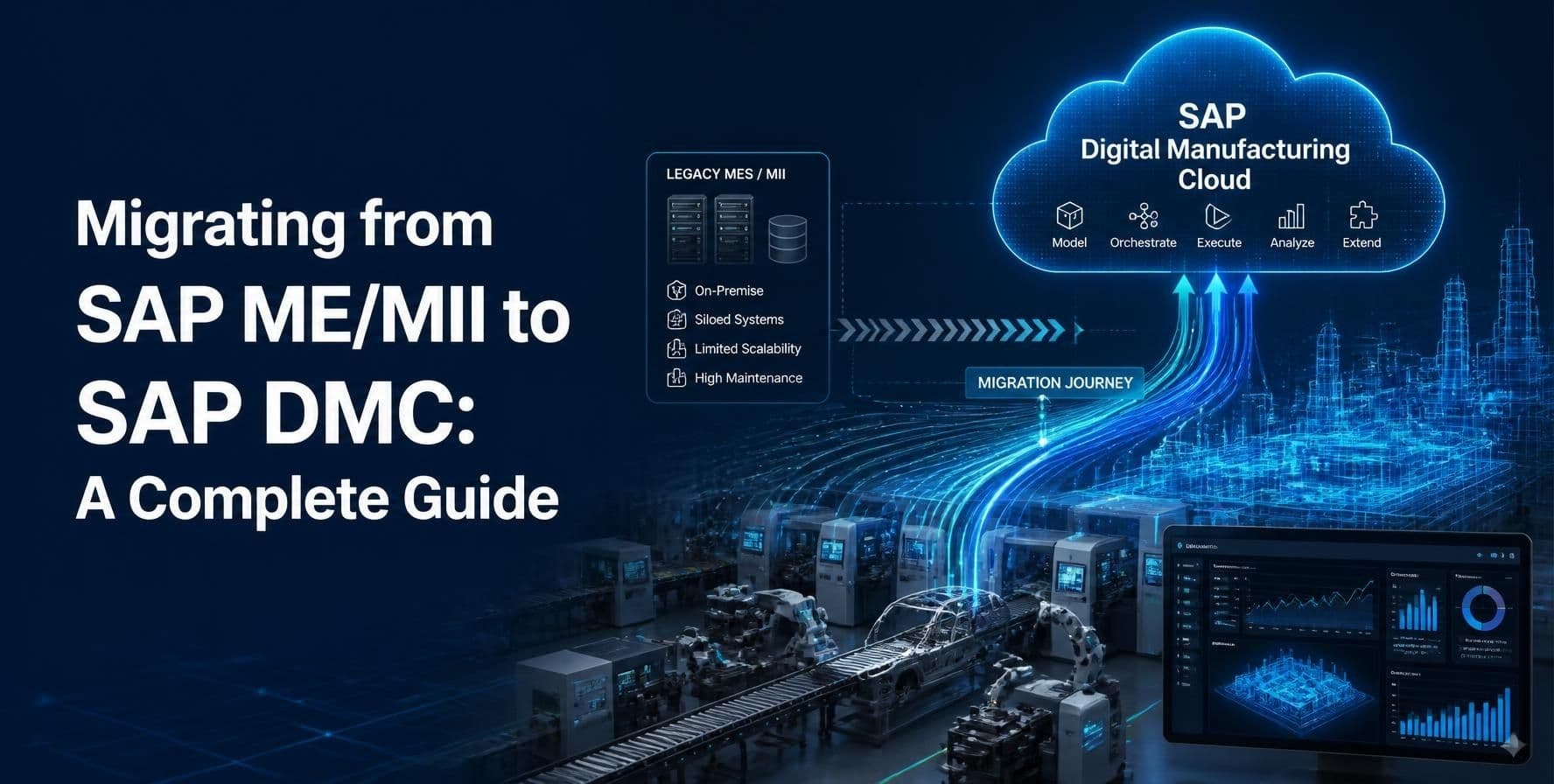
Migrating from Legacy ME and MII to SAP Digital Manufacturing Cloud
Manufacturing plants that have relied on SAP Manufacturing Execution (SAP ME) and SAP Manufacturing Integration and Intelligence (SAP MII) for well over a decade are now standing at a fork in the road. These on-premise systems, once considered the gold standard for shop floor execution, are reaching the end of their innovation runway, and SAP has been fairly direct that its long-term manufacturing roadmap is built around SAP Digital Manufacturing Cloud. For plant managers, IT leaders, and the
people actually running production lines, this is not simply a software upgrade tucked away in an IT project plan. It changes how production data gets captured, how quality is managed in real time, and how decisions get made on the floor itself.
This article walks through what moving away from SAP ME and MII actually involves in practice, why so many manufacturers have pushed this migration to the top of their digital transformation agenda, and what a realistic, phased migration path looks like once you get past the sales slides. Whether your organization is still evaluating a SAP Digital Manufacturing Cloud implementation or you are already a few months into a rollout, the intent here is to give a grounded, practitioner-level view
rather than a polished marketing pitch.
Understanding the Legacy Landscape: SAP ME and SAP MII
SAP ME has been the backbone of shop floor execution for many discrete and process manufacturers, handling work order management, production tracking, genealogy, and in-process quality checks directly at the line. SAP MII sat one layer above it, acting as the integration and intelligence bridge, pulling data out of PLCs, historians, and other plant systems and pushing it up into SAP ERP and business intelligence tools
Together, ME and MII formed a combination that was powerful but, in almost every real deployment, heavily customized. Over ten or fifteen years, most implementations accumulated plant-specific configuration, custom Java code, and a web of point-to-point integrations. That customization made the systems dependable for the plant that built them, but it also made them expensive to maintain, slow to scale to new sites, and genuinely painful to upgrade. Every new plant essentially meant starting over with manual setup. Every version upgrade meant regression-testing years of accumulated custom code. That accumulated complexity is exactly the problem SAP Digital Manufacturing Cloud was designed to address.
What Makes SAP Digital Manufacturing Cloud Different
SAP Digital Manufacturing Cloud, usually shortened to SAP DMC, is a cloud-native, software-as-a-service manufacturing execution and analytics platform. Rather than being installed and maintained plant by plant on local servers, it runs on a multi-tenant cloud architecture, with a common core template that can be extended to multiple sites using standardized configuration and, only where genuinely needed, site-specific extensions built on top
Where the old world split responsibilities between ME for shop floor execution and MII for integration and analytics, DMC brings production execution, machine connectivity, and manufacturing analytics together on one platform, built on SAP Business Technology Platform. It ships with standard connectivity options for shop floor equipment, tighter integration with SAP S/4HANA, and built-in dashboards, so plants no longer need a bolted-on BI layer just to track OEE, scrap rates, or unplanned downtime.
Because it is cloud-based, SAP handles updates on a regular release cycle rather than leaving the customer to plan, budget for, and execute a full on-premise upgrade project every few years. That single change alone removes a recurring cost and risk that most ME/MII customers know all too well.
Why Manufacturers Are Moving Now
A few forces are converging at once. SAP has been clear that ME and MII will not see the same level of ongoing innovation investment as DMC, and the maintenance and support timelines for the older stack keep getting revisited. Beyond the vendor roadmap itself, plants that have already moved to SAP S/4HANA want a manufacturing execution layer that connects natively instead of through custom middleware that someone has to keep patching. Leadership teams several years into broader Industry 4.0 programs also want a standardized template they can replicate across new plants in weeks, not months.
There is a practical staffing angle too. Deep SAP MII development expertise is getting harder to find and more expensive to retain, while DMC's configuration-first approach lowers the skill barrier for day-to-day support and gives internal teams a real shot at owning the platform themselves rather than depending permanently on a small group of specialists.
Comparing the Two Platforms
The table below summarizes how the two approaches differ across the areas that matter most during a migration decision.
| Aspect | SAP ME / MII | SAP Digital Manufacturing Cloud |
|---|---|---|
| Deployment | On-premise or hosted, plant by plant | Cloud-native SaaS, multi-site template |
| Architecture | Java-based ME with a separate MII integration layer | Unified platform built on SAP BTP |
| Customization | Heavy custom coding, done per plant | Configuration-driven, with BTP extensions |
| Upgrades | Customer-managed, periodic large projects | SAP-managed, continuous updates |
| Analytics | Requires MII add-ons or a separate BI layer | Built-in manufacturing analytics and dashboards |
| New plant rollout | Weeks to months, largely manual setup | Faster, using standardized templates |
| S/4HANA integration | Typically middleware-dependent | Native, pre-built integration |
Common Challenges During Migration
Migrating away from a platform that has been customized for ten or fifteen years is rarely a clean, linear project, and it helps to go in with realistic expectations rather than a vendor-supplied timeline.
- Data and process mapping: ME work centers, routings, and quality plans do not map one-to-one onto DMC's data model, so someone has to genuinely rethink the structure rather than just copy it across.
- Custom logic: A large share of ME/MII implementations have business rules buried inside custom Java exits or MII business logic transactions with no direct DMC equivalent, requiring re-architecture as BTP extensions.
- Shop-floor connectivity: Equipment integrations built through MII need to be re-established using DMC's connectivity tooling, sometimes requiring new edge components.
- Change management: Operators and supervisors who have used ME screens for years need proper retraining, and quiet resistance on the floor can slow adoption more than any technical issue.
- Parallel operations: Most plants cannot do a single big-bang cutover, so running ME/MII and DMC in parallel for a defined period is usually necessary.
A Practical Migration Roadmap
A realistic manufacturing execution system migration does not start with the technology. It starts with an honest, plant-by-plant assessment of what is actually being used versus what has simply accumulated over the years.
| Phase | What Happens |
|---|---|
| 1. Discovery & Assessment | Document existing ME/MII customizations, integrations, and shop-floor equipment connections; separate what is standard from what is custom. |
| 2. Fit-Gap Analysis | Compare current processes against DMC's standard capabilities and decide what to standardize versus what genuinely needs an extension. |
| 3. Template Design | Build a reusable core DMC template with clearly defined extension points for site-specific needs. |
| 4. Pilot Plant | Select one representative, ideally simpler, plant to migrate first and validate the template under real production conditions. |
| 5. Connectivity & Integration | Re-establish machine, PLC, and S/4HANA integrations using DMC's connectivity tools and edge components. |
| 6. Data Migration & Validation | Migrate master data, routings, and relevant historical records, then validate outputs against legacy reports. |
| 7. Testing & Parallel Run | Run DMC alongside ME/MII for a defined period to compare results before committing to full cutover. |
| 8. Rollout & Stabilization | Extend the validated template to remaining plants, with dedicated hypercare support after each go-live. |
Each of these phases deserves its own governance, its own sign-off criteria, and enough time built into the schedule to absorb the inevitable surprises that show up once the team starts looking under the hood of a system that has been running quietly for over a decade.
A Real-World Scenario
To make this less abstract, it helps to walk through a representative scenario built from patterns commonly seen across similar projects. Consider a mid-sized automotive components manufacturer operating six plants across two continents, running SAP ME and MII for close to twelve years. This example is illustrative rather than a specific named company, but the pattern it describes shows up repeatedly in real migrations.
The flagship plant, the oldest of the six, had the heaviest customization: years of bolted-on quality checks, custom genealogy logic, and a handful of MII business logic transactions that nobody fully documented anymore. The newer plants, by contrast, were running much closer to standard ME configuration. Rather than starting with the most complex site, the project team deliberately chose one of the simpler, newer plants as the pilot for the SAP ME to DMC migration. That decision turned out to matter more than almost anything else in the project. It let the team validate the core template, work out integration issues with a smaller blast radius, and build internal confidence before tackling the flagship plant's decade of accumulated customization.
Over roughly fourteen months, the organization rolled the validated template out across all six sites. New plant onboarding time, which historically took around four months under the old ME/MII model, dropped to under six weeks once the DMC template was mature. For the first time, leadership had a single, unified view of OEE and downtime across all six plants instead of stitching together separate MII reports site by site. A meaningful share of the old custom MII scripts were retired entirely because the equivalent functionality existed natively in DMC.
The lessons that came out of that project are fairly consistent with what shows up elsewhere: pilot at a simpler site first rather than the most complex one, invest in change management from day one rather than treating it as a training afterthought, and never underestimate how much time equipment connectivity rework will actually take once you get into the detail.
What This Means for Different Roles in the Organization
The impact of this shift lands differently depending on where you sit. For IT leaders, it means moving from owning and patching on-premise infrastructure to managing a SaaS relationship, vendor-managed updates, and integration governance instead. For plant managers and production supervisors, it means new screens, new workflows, and a real opportunity to clean up years of workarounds that existed only because the old system made certain things awkward. For quality and compliance teams, it means re-validating genealogy and traceability processes against a new data model, which is often more work than expected but also a chance to tighten up processes that had drifted over the years. And for finance and procurement, moving from capital-heavy on-premise licensing to a subscription-based SaaS model changes how the investment gets budgeted and justified internally, which is worth involving them in early rather than late.
Best Practices for a Smooth Transition
A few practices tend to separate the migrations that go smoothly from the ones that drag on for years.
- Start with a template mindset rather than a plant mindset, measuring every site against one core design.
- Involve shop-floor operators and supervisors early, not just IT and the project office.
- Resist the urge to replicate every legacy customization; question whether old workarounds are still needed.
- Build a dedicated cutover and hypercare plan for every site rather than assuming one plan fits all.
- Treat integration and connectivity testing as its own workstream with its own timeline.
- Track KPIs before and after migration to demonstrate the actual value of the move.
Building Internal Capability
Even with a well-run project plan and a strong implementation partner, the organizations that get the most lasting value out of SAP Digital Manufacturing Cloud implementation are the ones that build internal capability early instead of relying entirely on outside consultants who eventually roll off the project. Getting configuration teams, shop-floor supervisors, and production planners through structured SAP DMC Training well before go-live tends to pay off directly in a smoother cutover and noticeably less firefighting in the weeks that follow. Training should not be squeezed in the week before cutover as an afterthought; it works far better when it is woven into the project timeline starting around the pilot plant phase, so people are building confidence with the system while the template itself is still being validated.
Frequently Asked Questions
Q1: Is SAP ME and MII actually being retired, or can we keep using it?
SAP has not announced an immediate end-of-life date for every version, but investment and innovation are clearly focused on DMC now. Existing ME/MII customers should expect maintenance windows to get progressively tighter, which is exactly why most organizations are planning their move now rather than waiting for a forced deadline.
Q2: How long does a typical SAP ME to DMC migration actually take?
It depends heavily on the number of plants and the degree of customization, but a single pilot plant migration commonly runs three to six months, with a full multi-site rollout stretching anywhere from twelve to twenty-four months once template replication kicks in.
Q3: Can DMC really handle the custom business logic we built in MII over the years?
Most custom logic can be rebuilt as extensions on SAP Business Technology Platform, though it rarely transfers as a direct copy-paste. This is usually the right moment to question whether every piece of old logic is still genuinely needed.
Q4: Do all our plants need to move to DMC at the same time?
No, and most successful projects do the opposite. A phased, plant-by-plant rollout starting with a pilot site is generally lower risk compared to a single big-bang cutover across every location at once.
Q5: What happens to years of historical production and quality data sitting in the old system?
Historical data can be migrated, archived, or kept accessible in a read-only legacy environment depending on retention and compliance requirements. Most teams migrate a defined window of active data and archive the rest.
Q6: Is SAP DMC only built for discrete manufacturing, or does it work for process industries too?
DMC supports both discrete and process manufacturing scenarios, though the depth of out-of-the-box functionality can vary by industry, so it is worth validating specific process requirements during the fit-gap phase.
Q7: How does DMC actually connect to machines and equipment on the shop floor?
DMC supports standard connectivity through SAP's manufacturing integration tooling and edge components, along with common industrial protocols. In most cases this still requires a dedicated connectivity workstream.
Q8: What is the single biggest mistake companies make during this kind of migration?
Underestimating change management. Teams often plan the technical migration in detail but treat operator training and shop floor buy-in as a formality, and that is usually where timelines and adoption both suffer the most.
Conclusion
Moving off SAP ME and MII is not a decision most manufacturers take lightly, and it shouldn't be. These systems have run production for years, and in many plants, they still work, at least on the surface. But the direction SAP has set is clear, the skills gap for maintaining deeply customized MII environments keeps widening, and the operational upside of a standardized, cloud-native platform is hard to ignore once you have seen it working across even two or three plants. The organizations that get this right treat it as a genuine transformation project rather than a lift-and-shift: they assess honestly, pilot at a manageable site, rebuild only the customizations that truly earn their place, and invest in people through proper SAP DMC Training alongside the technical rollout, not after it. Approached that way, the migration stops being a risk to manage and starts becoming the foundation for how the next decade of manufacturing operations actually runs.