
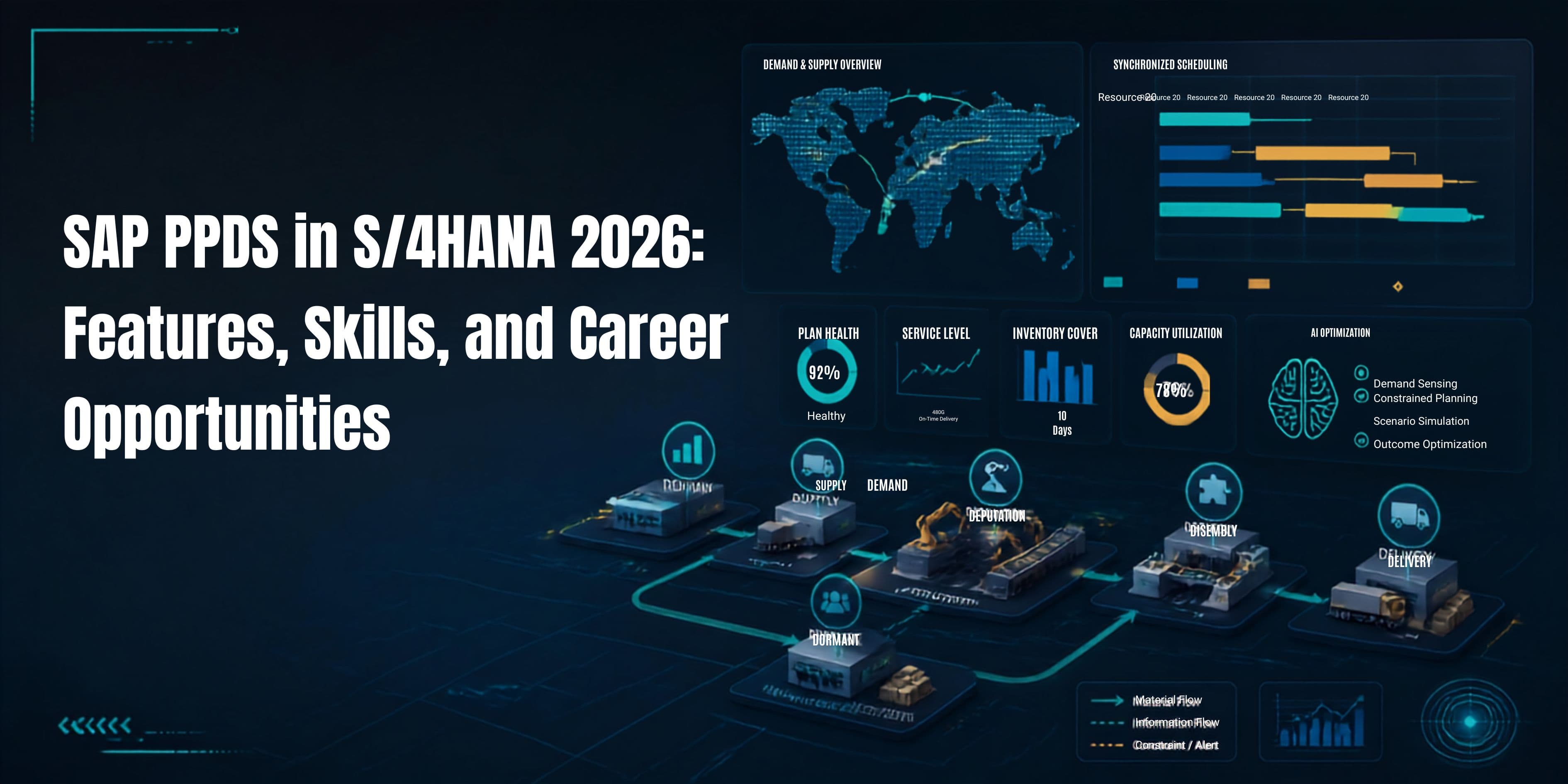
SAP PPDS in S/4HANA 2026: Features, Skills, and Career Opportunities
Manufacturers running SAP S/4HANA are under more pressure than ever to plan production down to the hour, absorb supply disruptions in real time, and do it all with fewer planners than a decade ago. That pressure is exactly why SAP PPDS (Production Planning and Detailed Scheduling) has moved from a specialist APO add-on to one of the most searched-for, most hired-for modules inside the S/4HANA ecosystem. With the 2026 release wave now generally available, PPDS has picked up meaningful AI, scheduling, and integration upgrades that change both how manufacturers plan and what skills consultants need to stay relevant.
This article breaks down what's actually new in SAP PPDS for S/4HANA 2026, the skills employers are paying for, realistic salary benchmarks, and a practical roadmap if you're planning a career around this module.
What Is SAP PPDS and Why It Still Matters in 2026
SAP PPDS (Production Planning and Detailed Scheduling) is the finite-capacity planning engine inside SAP that answers two questions standard MRP cannot answer well on its own: exactly when should an order run, and on exactly which resource. Where classic MRP in SAP PP works with infinite capacity and day-level buckets, PPDS works with finite capacity, sequence-dependent setup times, and scheduling precision down to the minute.
Originally built inside SAP APO (Advanced Planning and Optimizer) and connected to ECC through CIF (Core Interface), PPDS has now been fully embedded into S/4HANA. That means no separate APO server, no CIF replication lag, and no dual maintenance of master data. For process manufacturers, discrete manufacturers with complex changeovers, and companies running make-to-order alongside make-to-stock, embedded PPDS is quickly becoming the default rather than the exception.
Evolution of PPDS: From SAP APO to Embedded PPDS in S/4HANA
SAP officially ended mainstream maintenance for standalone APO, and with the SAP ECC end-of-support deadline of December 2027 approaching, thousands of manufacturers are migrating their APO PP/DS footprint into embedded PPDS as part of their S/4HANA transition. This isn't a lift-and-shift: master data structures, the optimizer, and several planning apps have been redesigned around HANA's in-memory architecture and Fiori.
| Aspect | SAP APO PP/DS (legacy) | Embedded PPDS in S/4HANA 2026 |
|---|---|---|
| System landscape | Separate APO server + CIF integration | Native, embedded in S/4HANA core |
| Data consistency | Batch/near-real-time via CIF queues | Real-time, single source of truth |
| User interface | SAP GUI, Planning Board (dynamic) | Fiori apps + upgraded Gantt-style Planning Board |
| Optimizer | Standalone optimizer engine | HANA-accelerated optimizer, faster runtimes |
| AI/ML capability | None (rule-based heuristics only) | Embedded AI scheduling assist, Joule copilot support |
| IBP integration | Manual/CIF-based key figure exchange | Direct key-figure integration with SAP IBP |
| Maintenance status | End of mainstream maintenance | Actively enhanced every release wave |
Table 1: How embedded PPDS in S/4HANA 2026 differs from legacy SAP APO PP/DS
Key Features of SAP PPDS in S/4HANA 2026
The S/4HANA 2026 release continues a pattern SAP has followed since 2023: incremental but meaningful upgrades to interactive planning, tighter IBP synchronization, and a growing layer of AI assistance rather than a single dramatic rewrite.
1. Real-Time Integration with MRP Live
MRP Live, the in-memory requirements planning engine, now hands off exceptions to PPDS almost instantly. Planners see finite-capacity conflicts the moment a sales order or forecast change hits the system, instead of waiting for the next planning run.
2. AI-Assisted Scheduling and Joule Copilot Support
SAP has extended its Joule generative AI assistant into planning workflows, allowing planners to ask natural-language questions about capacity bottlenecks, late orders, or alternative resource assignments directly inside the Fiori planning apps, rather than digging through the Planning Board manually. This is the single biggest shift in the 2025-2026 release wave: PPDS is no longer purely rule-based.
3. Enhanced Optimizer and Heuristics
The cost-based optimizer now runs faster on HANA and supports more granular setup-time matrices, which matters most for process industries (chemicals, food and beverage, pharma) where changeover sequencing drives most of the cost.
4. Key Figure Integration with SAP IBP
Tactical plans built in SAP Integrated Business Planning can now flow into PPDS as executable key figures with far less manual mapping, closing the loop between demand planning and shop-floor execution.
5. Specialized Planning: Tank, Shelf-Life, and Block Planning
Process manufacturers get continued investment in tank planning (multi-batch, multi-product tank scheduling), shelf-life-constrained planning, and block planning for repetitive, campaign-style production.
6. Modernized Fiori Planning Apps
The interactive Gantt-style Planning Board, alert monitor, and detailed scheduling apps have been refreshed for faster load times and better exception visualization, reducing the number of screens a planner has to switch between during a shift.
Figure 1: Illustrative growth in embedded PPDS adoption and PPDS-related job postings, indexed to 2026 (Source: Techbrainz analysis of public SAP community and job-market data)
Architecture: How Embedded PPDS Works Inside S/4HANA
Embedded PPDS runs in the same database as your S/4HANA system, using liveCache-equivalent, in-memory structures on HANA instead of a separate live Cache server. Planning-relevant master data (products, resources, PPMs/production versions) is activated for Advanced Planning at the plant level, after which orders for that material are picked up by the PPDS engine instead of standard MRP. This single-system design is what eliminates the CIF layer and the data-consistency issues that plagued classic APO landscapes.
Typical implementation prerequisites include: activating the PP/DS switch per plant, sizing live cache memory using the HANA Quick Sizer, defining planning procedures and heuristics, and setting up integration models for relevant master data objects.
Business Benefits and ROI
The numbers below are representative ranges compiled from SAP customer case studies, implementation partner benchmarks, and industry surveys on advanced planning system deployments — treat them as directional, since actual results depend heavily on manufacturing complexity and baseline planning maturity.
| Business Metric | Typical Improvement Range | Primary Driver |
|---|---|---|
| Planning cycle time | 30% — 50% faster | Real-time MRP Live + PPDS handoff |
| On-time delivery performance | 8 — 15 percentage points | Finite-capacity, sequence-aware scheduling |
| Manual scheduling effort | 20% — 40% reduction | AI-assisted / Joule-supported exception handling |
| Changeover / setup cost | 10% — 18% reduction | Optimizer-driven sequencing |
| Inventory carrying cost | 5% — 12% reduction | Tighter IBP-to-PPDS synchronization |
| Expedite / rush-order incidents | 15% — 25% fewer | Earlier visibility into capacity conflicts |
Table 2: Representative business impact ranges reported by manufacturers after embedded PPDS adoption
Skills Required to Master SAP PPDS in 2026
PPDS talent is scarce because the module sits at the intersection of manufacturing domain knowledge, SAP configuration skill, and increasingly data and AI literacy. Employers are no longer hiring pure heuristics-and-configuration specialists; they want consultants who can also interpret planning data and work alongside AI-assisted tools.
Functional Skills
- Production planning fundamentals: MRP logic, heuristics, planning procedures, order types
- Master data modeling: PPMs/production versions, resources, setup matrices, quota arrangements
- Detailed scheduling: Planning Board configuration, alert monitor, capacity leveling
- Industry-specific planning: tank planning, shelf-life planning, block/campaign planning
- Integration knowledge: SAP IBP key figure exchange, MRP Live, PP/QM/MM handoffs
Technical Skills
- Embedded PPDS configuration in SPRO and activation of Advanced Planning objects
- Working knowledge of the optimizer profiles and cost-function tuning
- Fiori app configuration and role-based launchpad setup for planners
- Basic ABAP/CDS view reading ability for troubleshooting and reporting
- Data migration experience from classic APO PP/DS to embedded PPDS
Emerging AI and Data Skills
- Prompting and validating outputs from Joule and other embedded AI copilots
- Understanding of how AI-based demand signals feed into IBP and then PPDS
- Comfort interpreting exception dashboards driven by predictive analytics
- Basic understanding of SAP Business AI / SAP AI Core concepts and governance
| Career Level | Core Focus | Typical Experience |
|---|---|---|
| Associate Consultant | Master data setup, basic heuristics, support tickets | 0 — 2 years |
| Consultant | End-to-end PPDS configuration, Planning Board setup | 3 — 6 years |
| Senior Consultant | Optimizer tuning, IBP integration, complex industries | 7 — 12 years |
| Solution Architect / Lead | Landscape design, APO-to-embedded migration strategy, AI roadmap | 12+ years |
Table 3: How SAP PPDS skill focus shifts across career levels
Career Opportunities and Salary Trends for SAP PPDS Professionals
Demand for PPDS specialists is climbing for two structural reasons: the SAP ECC end-of-support deadline is forcing manufacturers to migrate off classic APO PP/DS now, and SAP's growing AI layer (Joule, SAP AI Core) is creating a hybrid skill category that commands a pay premium over traditional functional-only roles.
Figure 2: Approximate US base salary ranges for SAP PPDS/PP consultants by experience level, 2026 (compiled from Glassdoor, Salary.com, and industry salary guides)
| Region | Entry-Level | Mid-Level | Senior/Architect |
|---|---|---|---|
| United States | $58K — $72K | $85K — $110K | $130K — $175K |
| Western Europe | €40K — €50K | €55K — €75K | €85K — €110K |
| India | ₹4L — ₹6L | ₹9L — ₹16L | ₹20L — ₹35L |
| Eastern Europe | $22K — $30K | $36K — $48K | $50K — $65K |
Table 4: Indicative annual base salary ranges for SAP PPDS professionals by region (2026, base pay only — excludes bonus and contract-rate premiums)
Independent contract rates for PPDS specialists in the US and Western Europe typically run well above the full-time equivalents above, often in the $90–$160 per hour range for senior migration leads, reflecting how thin the specialist talent pool remains relative to the wave of APO-to-embedded-PPDS migration projects underway before the 2027 deadline.
Certification and Learning Path
There isn't a single 'correct' path into PPDS, but most successful consultants follow a similar arc: build core production planning fundamentals, get hands-on in a sandbox system, pursue an SAP certification tied to S/4HANA Manufacturing, then specialize into an industry (process, discrete, or a specific planning capability like tank or shelf-life planning).
- Start with SAP S/4HANA Manufacturing for Production Planning fundamentals
- Move into an S/4HANA-specific PP/DS certification track
- Get practical exposure to a sandbox or demo system for heuristics and Planning Board configuration
- Layer in SAP IBP fundamentals, since most PPDS roles now expect IBP awareness
- Add SAP Business AI / Joule familiarity to stand out in 2026's hybrid job postings
Challenges in Implementing PPDS and How to Overcome Them
Even with a cleaner embedded architecture, PPDS projects still run into predictable friction points.
- Master data quality: inconsistent setup times or missing quota arrangements undermine optimizer results — invest in data cleansing before go-live, not after
- Change management: planners used to Excel-based scheduling often resist Planning Board adoption without hands-on coaching
- Sizing live cache memory: undersized environments cause slow planning runs — use the HANA Quick Sizer early in the project
- APO-to-embedded migration complexity: heuristics and PPM structures don't always map 1:1, so plan for a redesign, not a straight technical conversion
- Over-reliance on AI outputs: Joule-assisted suggestions still need experienced planners validating exceptions, especially in the first year post-go-live
Future of SAP PPDS: AI, Joule, and Beyond
SAP has been explicit that future PP/DS investment centers on tighter cross-horizon synchronization with IBP, deeper generative AI support inside planning apps, and continued UI modernization rather than a wholesale re-architecture. Expect each future release wave to add more natural-language exception handling, more predictive alerting, and gradually reduced manual heuristics configuration as AI recommendations mature. For consultants, that means the functional core of PPDS will stay relevant, but the ability to work alongside AI copilots will increasingly separate senior consultants from the rest of the market.
Frequently Asked Questions
1. Is SAP APO PP/DS still supported in 2026?
Standalone SAP APO is past mainstream maintenance, and SAP has been actively pushing customers toward embedded PPDS in S/4HANA ahead of the ECC end-of-support deadline. Extended maintenance options exist but are considered a bridge, not a long-term strategy.
2. What is the difference between SAP PP and SAP PPDS?
SAP PP (Production Planning) handles high-level, infinite-capacity MRP planning at the day level. SAP PPDS adds finite-capacity, sequence-dependent, hour-and-minute-level detailed scheduling on top of that for constrained resources.
3. Do I need SAP APO experience to learn embedded PPDS?
It helps but isn't mandatory. The core planning logic — heuristics, optimizer, Planning Board — is conceptually similar; what changes most is the underlying architecture, integration approach, and the Fiori-based UI.
4. How long does an embedded PPDS implementation typically take?
For a single-plant, moderately complex environment, 4–7 months is typical; multi-plant or APO-migration projects with process-industry requirements (tank or shelf-life planning) often run 9–14 months.
5. Is SAP PPDS a good career choice in 2026?
Yes — demand is rising due to the ECC 2027 deadline pushing migrations, and the module's growing AI layer is creating new, better-paid hybrid roles for consultants who combine functional PPDS knowledge with AI/data fluency.
6. What industries rely most heavily on SAP PPDS?
Process manufacturing (chemicals, food and beverage, pharmaceuticals), automotive and discrete manufacturing with complex changeovers, and high-mix, make-to-order manufacturers see the strongest PPDS ROI.
7. Does SAP PPDS work with SAP IBP?
Yes. S/4HANA 2026 continues to strengthen direct key-figure integration between SAP IBP's tactical planning and PPDS's operational scheduling, reducing manual data mapping between the two.
8. What certification should I pursue first for a PPDS career?
Most professionals start with an S/4HANA Manufacturing for Production Planning certification before specializing into a PP/DS-focused or IBP-integration track, then add AI/Joule familiarity as a differentiator.
Conclusion
SAP PPDS in S/4HANA 2026 is no longer just a scheduling engine bolted onto ERP — it's becoming an AI-assisted planning hub that sits at the center of manufacturing execution. For businesses, that means faster, more resilient production plans; for professionals, it means a genuine window to build a high-value, AI-adjacent SAP career while the specialist talent pool is still thin. If you're serious about future-proofing your SAP career, now is the right time to pair your PPDS or manufacturing planning skills with formal SAP Generative AI training — understanding how Joule, SAP AI Core, and embedded AI planning assistants actually work will be the difference between a functional consultant and consultant clients specifically ask for by name.
Ready to go deeper? TechBrainz's SAP PPDS training program is built exactly for this moment — covering Joule, SAP AI Core, and how generative AI is reshaping modules like PPDS, IBP, and beyond. Explore the program and take the next step in your SAP AI career.
About the Author
TechBrainz SAP PPDS Team
This article has been written by the TechBrainz SAP PPDS team — a group of SAP functional consultants, technical architects, and AI practitioners at Techbrainz who specialize in S/4HANA Manufacturing, advanced planning modules like EWM and IBP, and the emerging generative AI capabilities being embedded across the SAP ecosystem. The team regularly publishes deep-dive, research-backed guides to help SAP professionals and businesses stay ahead of each release wave.