
SAP RAR Trending: Why Revenue Accounting Skills Are in High Demand
A complete guide to SAP RAR — definition, process flow, quick facts, and real-time compliance use cases
Revenue recognition has become one of the most scrutinized areas of financial reporting since the introduction of global accounting standards IFRS 15 and ASC 606. Companies that sell subscriptions, bundled products, long-term service contracts, or multi-element arrangements can no longer rely on simple invoice-based revenue postings. This regulatory shift has pushed SAP Revenue Accounting and Reporting, widely known as SAP RAR, into the spotlight as one of the fastest-growing trending topics in the SAP finance ecosystem.
Search interest, job postings, and corporate training requests around SAP RAR have all climbed sharply over the past few quarters. Finance transformation teams at software companies, telecom providers, and manufacturers are actively hiring consultants who understand how to configure performance obligations, automate price allocation, and generate audit-ready disclosure reports directly from SAP. As a result, SAP RAR has moved from a niche compliance topic to a mainstream, high-value SAP finance skill that is actively driving traffic to training platforms, forums, and consulting blogs.
This article provides a complete, traffic-worthy breakdown of SAP RAR: what it is, why it is trending, the process flow behind it, quick facts every finance and SAP professional should know, and real-time industry use cases. We will also walk through visual flowcharts that make the revenue recognition process easier to understand, and close with a clear roadmap for anyone looking to build expertise in this increasingly important SAP finance module.
What Is SAP RAR? (Definition)
SAP Revenue Accounting and Reporting (SAP RAR) is a specialized SAP finance solution designed to automate and standardize revenue recognition in compliance with IFRS 15 and ASC 606. It decouples revenue recognition from billing and delivery documents, allowing companies to recognize revenue based on the transfer of control of goods or services to the customer, rather than simply when an invoice is issued.
At its core, SAP RAR works by receiving data from source systems such as Sales and Distribution (SD), Customer Service (CS), and Project System (PS), and converting that data into standardized revenue accounting objects. These objects — Order Items, Fulfillment Items, and Performance Obligations — form the foundation on which the RAR engine calculates how much revenue can be recognized, when, and under what conditions.
In simple terms, SAP RAR acts as a compliance and automation layer sitting between operational sales/service documents and the general ledger, ensuring that revenue postings always reflect the correct accounting treatment rather than the timing of billing. SAP RAR Training refers to structured learning programs that teach professionals how to configure, operate, and troubleshoot this engine — covering everything from BRF+ rule configuration to contract modification handling and disclosure reporting.
Why Is SAP RAR Trending Right Now?
A combination of regulatory, technological, and business factors is driving traffic and interest toward SAP RAR:
- Stricter enforcement of IFRS 15 / ASC 606 compliance by auditors, increasing pressure on finance teams to automate revenue recognition.
- Rapid growth of subscription and SaaS-based business models, which involve complex multi-element revenue arrangements that manual processes cannot handle accurately.
- SAP's continued investment in embedding RAR capabilities directly into S/4HANA Finance, making it a core part of new implementations rather than a bolt-on add-on.
- A shortage of experienced RAR consultants, pushing up demand (and search traffic) for SAP RAR training content, tutorials, and certification guidance.
- Increased M&A activity and IPO readiness projects, where accurate, auditable revenue reporting is a non-negotiable requirement for finance teams.
Search trend data from SAP community forums and training platforms shows a consistent rise in queries such as 'SAP RAR configuration', 'SAP RAR vs traditional revenue recognition', and 'SAP RAR training', reflecting how both finance professionals and technical consultants are trying to upskill quickly to meet project demand.
This spike in traffic is also amplified by broader digital transformation programs. As organizations run RISE with SAP or greenfield S/4HANA implementations, project scoping documents increasingly list SAP RAR as a mandatory workstream rather than an optional add-on, especially for companies in software, telecom, and subscription-heavy industries. That project-level demand cascades down into search behavior, with finance leads, project managers, and consultants all independently searching for reliable SAP RAR resources to understand scope, risk, and staffing needs before a project even kicks off.
Core Components Covered in SAP RAR Training
Most structured SAP RAR training programs are organized around the following functional building blocks:
- Inbound Processing: Configuring BRF+ rules to convert sales orders, billing documents, and other source data into RAR-relevant objects.
- Performance Obligation Management: Identifying and configuring distinct performance obligations (POBs) within a customer contract.
- Price Allocation: Applying standalone selling price logic to allocate total contract value across multiple performance obligations.
- Fulfillment and Revenue Posting: Recognizing revenue as performance obligations are fulfilled, and posting entries to Finance (FI).
- Contract Modification Handling: Managing changes to existing contracts, including prospective and cumulative catch-up adjustments.
- Disclosure and Compliance Reporting: Generating IFRS 15 / ASC 606 compliant disclosure reports for auditors and management.
Training providers typically combine these components with hands-on configuration exercises in a sandbox S/4HANA system, so learners can practice building BRF+ decision tables, running fulfillment jobs, and reviewing the resulting financial postings rather than only studying concepts in theory.
Quick Facts About SAP RAR
| Attribute | Detail |
|---|---|
| Full Form | SAP Revenue Accounting and Reporting |
| Purpose | Automates revenue recognition in line with IFRS 15 and ASC 606 standards |
| Introduced | As a standalone add-on (RAR 1.0) and later integrated into S/4HANA Finance |
| Core Objects | Performance Obligations (POB), Order Items, Fulfillment Items, Contracts |
| Key Technology | BRF+ (Business Rule Framework plus) for inbound processing rules |
| Integrates With | SD, CS, PS, FI, and non-SAP source systems via inbound interfaces |
| Popular Roles | RAR Consultant, Revenue Accountant, SAP FI-RAR Techno-Functional Consultant |
| Industries Using SAP RAR | Software/SaaS, Telecom, Manufacturing, Professional Services, High-Tech |
SAP RAR Training Learning Path (Flowchart)
A common question among finance and SAP professionals is: 'How do I structure my learning to become proficient in SAP RAR?' The flowchart below shows a recommended, progressive seven-stage training path.
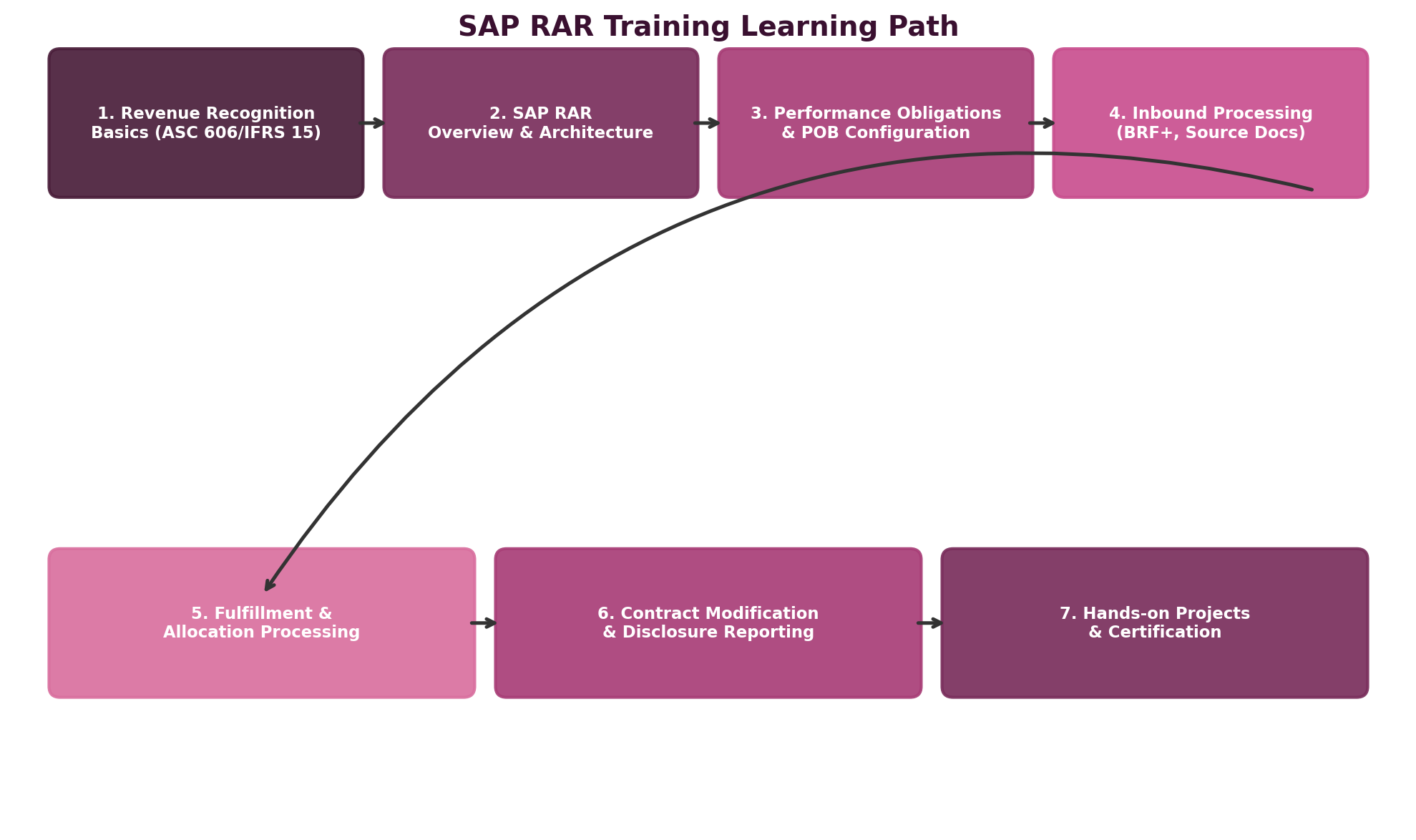
Learners begin with the accounting fundamentals behind IFRS 15 and ASC 606, since SAP RAR is fundamentally a compliance-driven tool and cannot be understood in isolation from the accounting standards it supports. From there, the path progresses into SAP RAR's technical architecture, performance obligation configuration, inbound processing rules, fulfillment logic, and finally contract modification and disclosure reporting — culminating in hands-on capstone projects and certification preparation.
SAP RAR Process Flow (Flowchart)
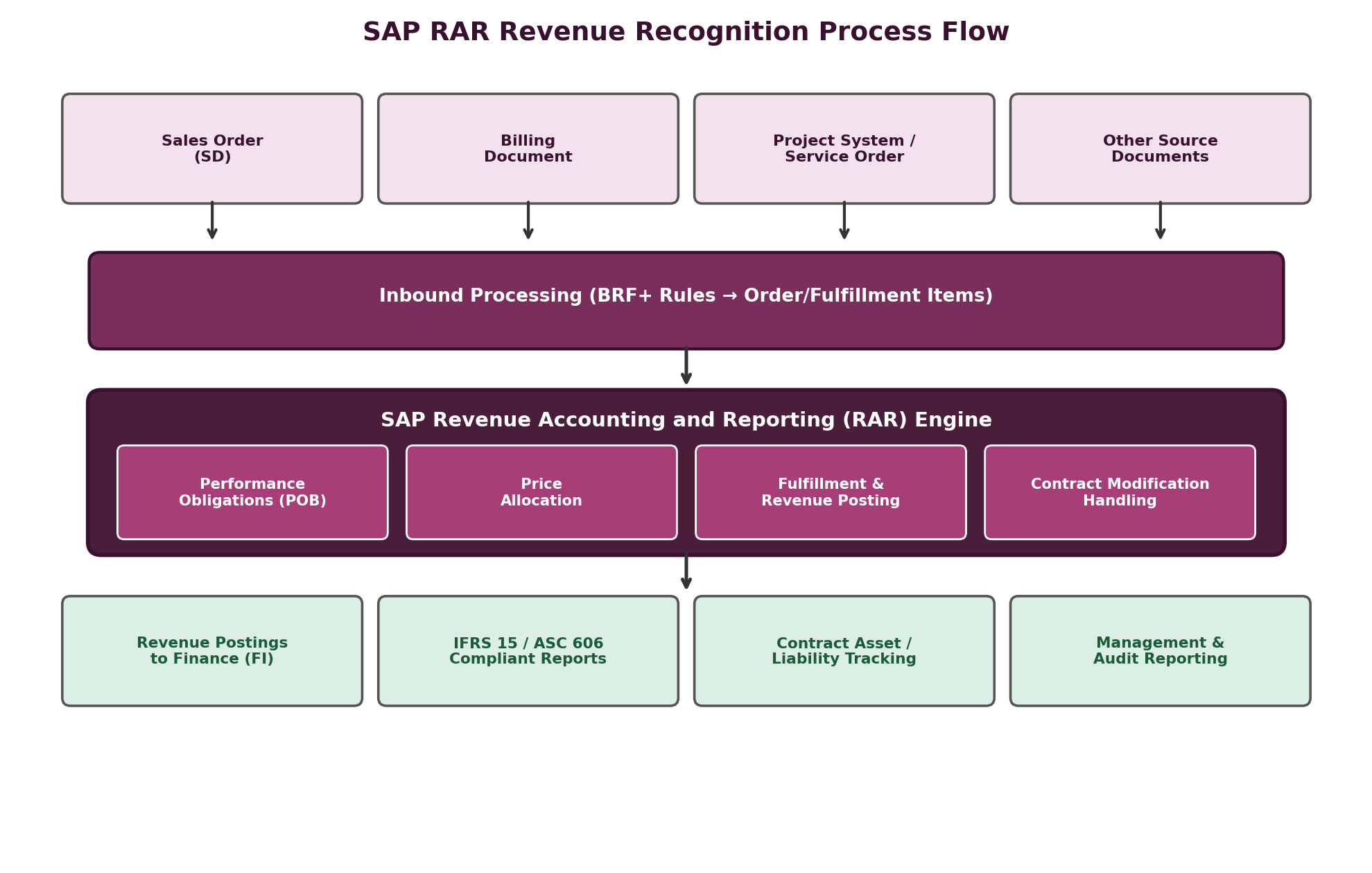
Understanding how data flows through SAP RAR is essential to both configuration work and troubleshooting. The diagram below illustrates the end-to-end revenue recognition process, from source documents to compliant financial reporting.
As shown above, source documents such as sales orders, billing documents, and project or service orders feed into RAR's inbound processing layer, where BRF+ rules convert them into standardized order and fulfillment items. These items then move into the core RAR engine, which manages performance obligations, price allocation, fulfillment-based revenue posting, and contract modifications. The engine's outputs include revenue postings to Finance, IFRS 15 / ASC 606 compliant disclosure reports, contract asset and liability tracking, and management or audit reporting. SAP RAR training programs typically dedicate separate modules to each of these stages.
Real-Time Use Cases of SAP RAR
SAP RAR is not just a theoretical compliance tool — it solves concrete, high-stakes accounting problems in real enterprise environments. Below are numbered real-time use cases commonly discussed in training programs and finance transformation case studies.
1. Software/SaaS: Recognizing Revenue for Bundled Subscriptions
A software company selling bundled subscriptions (license, implementation services, and ongoing support) used SAP RAR to split each contract into separate performance obligations and allocate revenue based on standalone selling prices. This ensured that license revenue was not recognized upfront while support revenue was still being delivered over the contract term, keeping the company fully IFRS 15 compliant.
2. Telecom: Handset and Airtime Bundle Accounting
A telecom operator offering subsidized handsets bundled with airtime plans implemented SAP RAR to correctly allocate contract value between the handset (delivered immediately) and airtime services (delivered over the contract period). This resolved a long-standing compliance gap where handset revenue was previously recognized too early under legacy billing-based processes.
3. Manufacturing: Long-Term Equipment and Maintenance Contracts
A heavy equipment manufacturer used SAP RAR to manage multi-year contracts that combined equipment sales with extended maintenance agreements. The RAR engine tracked fulfillment of each performance obligation separately, allowing revenue from equipment delivery and ongoing maintenance services to be recognized at the correct points in time rather than as a single lump-sum entry.
4. Professional Services: Milestone-Based Project Revenue
A consulting firm delivering large, milestone-based implementation projects configured SAP RAR to recognize revenue progressively as project milestones were completed and fulfilled in the system, replacing a manual spreadsheet-based process that was prone to errors and inconsistent with ASC 606 percentage-of-completion requirements.
5. High-Tech: Contract Modifications and Upsells
A high-tech hardware and services provider used SAP RAR's contract modification handling to manage frequent customer upsells and downgrades mid-contract. The system automatically determined whether each modification required prospective treatment or a cumulative catch-up adjustment, significantly reducing manual accounting rework during quarter-end close.
6. Retail Technology: Multi-Element Arrangements with Free Trials
A retail technology vendor offering hardware plus a free trial period followed by paid software services used SAP RAR to correctly defer revenue during the free trial and recognize it only once paid performance obligations began, avoiding premature revenue recognition that could have triggered audit findings.
These use cases show a consistent pattern: wherever a business sells multi-element, subscription-based, or milestone-driven arrangements, manual or billing-based revenue recognition breaks down — and SAP RAR provides the automated, auditable framework needed to stay compliant. This is precisely the kind of scenario-based problem solving that well-structured SAP RAR training is designed to teach.
Challenges Organizations Face Without Proper SAP RAR Training
Attempting to configure or operate SAP RAR without structured training often leads to compliance risk and rework. Common challenges include:
- Incorrectly defined performance obligations, leading to premature or delayed revenue recognition.
- Misconfigured BRF+ inbound rules that fail to correctly classify order and fulfillment items.
- Inaccurate standalone selling price allocation, resulting in audit adjustments at quarter-end or year-end close.
- Poor handling of contract modifications, causing inconsistent treatment of upsells, downgrades, and cancellations.
- Incomplete disclosure reporting, increasing the risk of audit findings related to IFRS 15 / ASC 606 non-compliance.
Structured SAP RAR training directly addresses these risks by teaching configuration best practices, standard troubleshooting techniques, and the accounting logic behind each setting, reducing costly errors during live implementations and audits.
Benefits of SAP RAR Training
- Stronger compliance readiness — professionals learn to configure revenue recognition in line with IFRS 15 and ASC 606 requirements.
- Higher employability — RAR skills are increasingly listed as mandatory for SAP finance transformation and S/4HANA projects.
- Reduced audit risk — trained consultants can build accurate, auditable revenue postings and disclosure reports.
- Cross-functional value — SAP RAR knowledge bridges the gap between finance/accounting teams and SAP technical teams.
- Premium consulting rates — RAR-certified consultants are in short supply, often commanding higher project rates than general FI consultants.
- Career resilience — as more companies adopt subscription and multi-element business models, RAR expertise remains in long-term demand.
Who Should Enroll in SAP RAR Training?
- SAP FI/CO consultants looking to specialize in revenue accounting and compliance-driven finance projects.
- Finance and accounting professionals responsible for IFRS 15 / ASC 606 compliance and quarter-end close processes.
- SAP SD consultants who want to understand how sales documents feed into revenue recognition downstream.
- Auditors and controllers who need to understand how automated revenue postings are generated and validated.
- Fresh SAP consultants aiming to specialize in a high-demand, compliance-focused niche within SAP Finance.
How to Choose the Right SAP RAR Training Program
Given the technical and regulatory depth of SAP RAR, choosing the right training program matters. Look for programs that combine accounting theory (IFRS 15 / ASC 606) with hands-on system configuration, include real contract scenarios similar to the use cases discussed above, and are taught by instructors with actual implementation experience rather than purely academic exposure. Programs that skip BRF+ rule-building exercises or disclosure reporting walkthroughs tend to leave learners underprepared for live client engagements.
It is also worth confirming whether the training reflects SAP RAR's current integration into S/4HANA Finance, since many older materials still describe RAR only as a standalone bolt-on add-on. Recent, S/4HANA-aligned course content will better prepare learners for the systems they are likely to encounter on real projects.
Typical SAP RAR Training Duration and Format
Most SAP RAR training programs are delivered as a blend of instructor-led sessions covering accounting concepts and hands-on configuration labs, typically spanning six to ten weeks. Shorter, focused tracks that concentrate only on inbound processing and performance obligation configuration can sometimes be completed in three to four weeks, while comprehensive programs that also cover contract modification handling and full disclosure reporting often run closer to two to three months. Corporate training for existing FI consultants is frequently compressed into intensive two- to three-week bootcamps, since participants already understand core SAP finance concepts and only need to build RAR-specific expertise.
Regardless of format, the most effective SAP RAR training programs place heavy emphasis on practice system access. Because RAR configuration decisions have direct downstream accounting consequences, learners benefit far more from repeatedly building and reviewing sample contracts, fulfillment runs, and disclosure reports than from passively reading configuration guides.
Frequently Asked Questions About SAP RAR
SAP RAR, or SAP Revenue Accounting and Reporting, helps companies manage revenue recognition according to accounting standards such as IFRS 15 and ASC 606. It helps businesses recognize revenue based on when goods or services are delivered rather than simply when an invoice is created.
SAP RAR is gaining attention because businesses are increasingly using subscription models, bundled products, and long-term service contracts. These arrangements can make revenue recognition difficult to manage manually, creating a growing need for professionals who understand SAP RAR.
SAP RAR training generally covers inbound processing, performance obligations, price allocation, fulfillment and revenue posting, contract modifications, and disclosure reporting. Good training should also provide practical exercises so learners can understand how these processes work in an SAP system.
SAP RAR can be useful for SAP FI/CO consultants, finance and accounting professionals, SAP SD consultants, auditors, controllers, and fresh SAP consultants. Anyone who wants to build skills in revenue accounting and SAP finance can consider learning it.
SAP RAR is particularly useful in industries where businesses deal with subscriptions, bundled offerings, long-term contracts, or milestone-based services. Common examples include software and SaaS, telecom, manufacturing, professional services, and high-tech industries.
SAP RAR identifies the different performance obligations within a customer contract and tracks when each obligation is fulfilled. Revenue can then be recognized at the appropriate time instead of treating the entire contract as a single transaction.
Yes. SAP RAR can be a valuable specialization for professionals interested in SAP Finance and revenue accounting. The combination of accounting knowledge, SAP configuration skills, and understanding of IFRS 15 or ASC 606 can help professionals work on specialized finance transformation projects.
The duration depends on the depth of the training and the learner's existing SAP knowledge. The article notes that comprehensive programs commonly run for around six to ten weeks, while shorter focused programs and intensive corporate training can take less time.
Conclusion
SAP RAR has moved firmly into the spotlight as businesses everywhere grapple with the demands of IFRS 15 and ASC 606 compliance, subscription-based revenue models, and increasingly complex multi-element contracts. The real-time use cases explored in this article from SaaS bundling to telecom handset accounting to milestone-based project revenue demonstrate that SAP RAR is not an abstract compliance checkbox but an active, business-critical engine driving accurate financial reporting across industries.
This growing relevance is exactly why SAP RAR, and by extension SAP RAR Training, continues to trend among finance and SAP professionals searching for high-value, future-proof skills. Alongside RAR, many professionals are also expanding into broader SAP cloud capabilities and pairing revenue accounting expertise with skills from SAP BTP Training can further strengthen a consultant's profile, since SAP BTP Training increasingly underpins the integration and automation layer connecting finance modules like RAR with the rest of the SAP cloud landscape. Whether your goal is to specialize in compliance-driven finance consulting or to round out a broader SAP cloud skill set, investing in SAP RAR Training today positions you at the intersection of accounting rigor and SAP technical expertise a combination that is increasingly rare, and increasingly valuable.