
SAP RPT: The AI Model That Could Change How Businesses Use Data
Introduction
Businesses have more data than they have ever had before. Every customer interaction, sales transaction, supplier relationship, payment, product movement and business process can generate information. Yet having enormous amounts of data does not automatically mean a company understands what that data is telling it. In many organizations, the real challenge is no longer collecting information but connecting the information in a way that produces useful business insight.
Consider a company trying to understand why sales are declining in one region. The answer may not exist inside a single table or report. It could involve customer purchasing patterns, product availability, pricing changes, inventory levels, promotions and historical transactions. Each piece of information may exist separately, but the business meaning appears when those pieces are connected. This is one reason enterprise data is such an interesting challenge for artificial intelligence.
Most conversations around AI today focus on generative AI, chatbots and large language models. Those technologies are transforming the way people interact with information, but enterprise data presents a different problem. Business systems are filled with structured and relational information where the relationship between records can be just as important as the individual values. SAP RPT enters this conversation by exploring how foundation-model approaches can be applied to relational and tabular data.
The idea behind SAP RPT is therefore bigger than simply creating another AI model. It is about exploring whether AI can become better at understanding the structured information that sits at the center of modern businesses. If successful, this direction could influence how organizations approach predictive analytics, forecasting and other data-driven decisions.
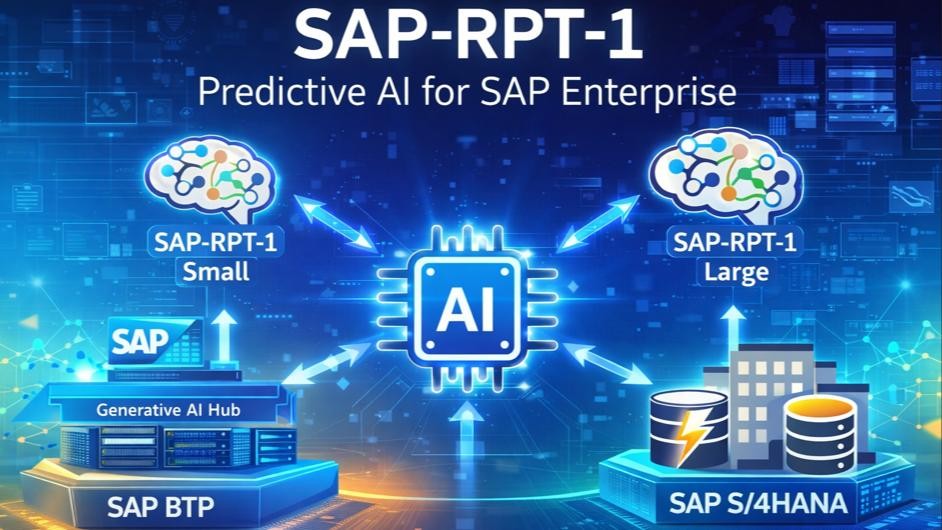
Definition: SAP RPT
SAP RPT, or SAP Relational Pretrained Transformer, is a foundation-model approach designed around relational and tabular data. It explores how transformer-based AI can learn patterns from structured datasets and support predictive and analytical tasks involving enterprise data.
Why Is Enterprise Data Such a Difficult Problem for AI?
Enterprise data looks simple when viewed from a single spreadsheet. There may be rows representing customers, products or transactions and columns containing attributes such as price, quantity, location or date. But the simplicity disappears when the data is viewed from the perspective of an entire organization. A customer can be connected to hundreds of transactions, those transactions can be connected to different products, and those products can be connected to suppliers, warehouses, prices and business units.
The real information is often hidden inside these relationships. A customer who has reduced purchases might appear ordinary when viewed only through a customer table. When purchase history, product preferences, service interactions and payment patterns are considered together, however, the organization may discover a completely different story.
This is what makes enterprise data different from many of the examples people associate with AI. Business information is not simply a collection of independent numbers. It represents activities, relationships and decisions that happen across an organization. Understanding those relationships can be essential when the goal is prediction rather than simply reporting.
Why Isn't Traditional Machine Learning Enough?
Traditional machine learning has already achieved impressive results with structured and tabular data. Businesses have used machine-learning techniques for years to predict demand, identify fraud, segment customers and support operational decisions. Therefore, SAP RPT should not be understood as evidence that conventional machine learning has become obsolete.
The more interesting question is whether foundation-model techniques can provide a new way of approaching structured-data problems. Traditional machine-learning projects are often designed around specific datasets and specific business problems. Teams prepare the data, engineer features, select an algorithm, train the model, evaluate the results and then repeat much of the process when requirements change.
Foundation models introduce a different philosophy. Instead of creating a completely new model for every problem, a pretrained model can learn broader patterns and potentially adapt to different tasks. Large language models demonstrated how powerful this approach can be for language. SAP RPT explores a similar question for relational and tabular data.
The important point is not that one approach automatically replaces another. It is that enterprise AI is developing beyond a single model architecture. Different types of data may benefit from different approaches, and structured business data deserves serious attention because it represents so much of the information organizations depend on.
What Makes SAP RPT Different?
 >
>
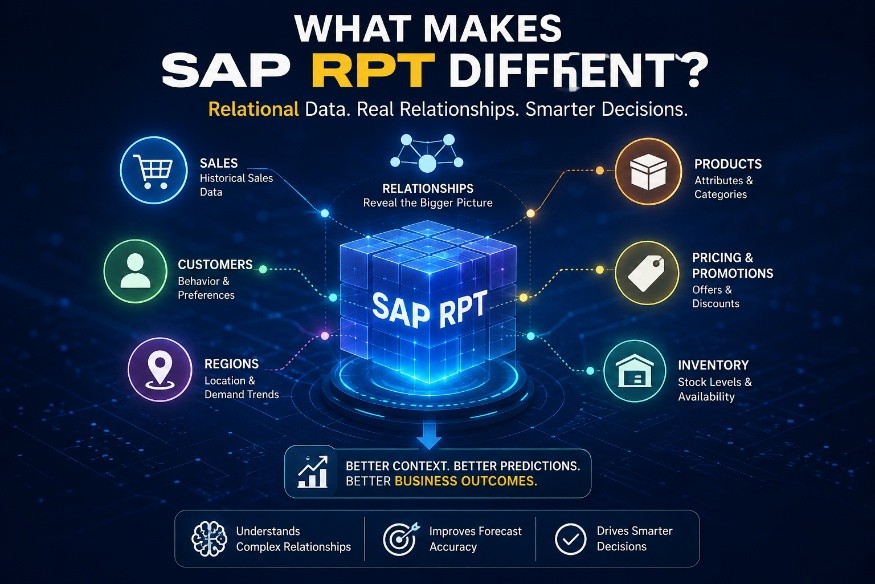
The word "Relational" in SAP RPT is central to understanding the concept. Relational data contains information organized into tables that are connected through relationships. These relationships allow an organization to move from one piece of information to another and understand how different business entities interact.
Imagine a retail company trying to predict whether demand for a product will increase next month. Historical sales are obviously relevant, but they are not necessarily enough. The company may also need to consider product characteristics, customer behavior, regional demand, pricing, promotions and inventory. These factors can exist across different datasets, and their relationships can provide important context.
This is where SAP RPT becomes interesting. Rather than treating structured data as nothing more than a collection of columns, the relational approach focuses on the patterns and relationships contained within business datasets. The objective is to make AI more useful for problems where structured enterprise information is central to the decision.
How Could SAP RPT Work With Business Data?
At a conceptual level, the process begins with structured enterprise information. The data can contain different records, attributes and relationships that represent real business activity. A model can then learn patterns from this information and apply those learned patterns to a particular analytical or predictive task.
The important part is that the model is not simply looking at individual values in isolation. The surrounding context can matter. A particular transaction may have a different meaning depending on the customer, product, location, time period or other related information.
This is particularly valuable when organizations are trying to move from descriptive analytics toward predictive analytics. A dashboard might tell a company that sales declined last month. A predictive system attempts to answer a different question: what could happen next, and what patterns might help explain the outcome?
That shift from looking backward to supporting forward-looking decisions is one of the reasons enterprise AI is becoming increasingly important.
Why Do Relationships Matter in Business Data?
Imagine that a customer purchased fewer products this quarter. On its own, that information might appear to be a warning sign. But now imagine that the customer's preferred product was discontinued and replaced by another product. The customer may actually be continuing the same purchasing behavior, just through a different product.
This simple example demonstrates why relationships matter. Looking at one data point can produce one conclusion, while connecting it with surrounding information can produce another.
Businesses operate through these relationships every day. Customers purchase products. Suppliers provide materials. Warehouses hold inventory. Employees belong to departments. Orders generate invoices. Payments connect to transactions. These relationships form the structure of enterprise operations.
AI that can work effectively with this type of information could potentially provide a different level of business intelligence.
What Could SAP RPT Be Used For?
The potential use cases for SAP RPT are closely connected to problems where structured data plays a major role. Predictive analytics is one obvious area because businesses frequently need to identify patterns that can help estimate future outcomes.
Customer analytics is another possibility. Organizations have extensive information about customer transactions, products, purchasing frequency and interactions. An AI model could potentially help identify patterns associated with customer behavior and support activities such as segmentation or churn analysis.
Forecasting is also an important area. Businesses constantly make predictions about sales, demand, inventory and other operational requirements. These predictions often depend on multiple variables rather than one isolated dataset. A relational approach could potentially help models consider those connections more effectively.
The important point is that SAP RPT should not be presented as a solution that automatically solves every one of these problems. Its value depends on the quality of the data, the business problem, the model's performance and how the organization uses the resulting predictions.
Could SAP RPT Change Enterprise Forecasting?
Forecasting is one of the clearest examples of why structured business relationships matter. A company predicting product demand may begin with historical sales, but demand is influenced by much more than sales history. Pricing, promotions, inventory, customer behavior, geography and seasonality can all affect the outcome.
When those variables are connected, the prediction can potentially become more context-aware. A decline in sales could mean demand is falling, but it could also mean the product was unavailable or its price changed significantly.
This is why enterprise forecasting is difficult. Businesses are interconnected systems, and the variables influencing an outcome can come from different parts of the organization. The promise of relational AI is that it can potentially learn from these structured relationships rather than treating every variable as completely independent.
Can SAP RPT Help Businesses Understand Customers Better?
Customer information provides another useful example. A business might know what a customer purchased, but purchase history alone does not necessarily explain customer behavior. The organization may also have information about purchase frequency, product combinations, service interactions, payment behavior and regional patterns.
When these datasets are connected, they can provide a much richer picture of the customer. AI can potentially identify patterns across large volumes of information that would be difficult for a person to recognize manually.
This could support applications such as customer segmentation, churn prediction and sales prioritization. The goal is not simply to collect more customer data. It is to make better use of the relationships already contained within that data.
How Does SAP RPT Fit Into SAP Business AI?
SAP RPT should be viewed as part of the broader conversation around enterprise AI rather than as a replacement for the entire SAP Business AI portfolio. SAP Business AI covers a much wider range of AI capabilities and business scenarios.
The larger direction is important because enterprise AI needs more than a model. It needs trusted data, appropriate business context, secure access, applications and processes through which the resulting insights can actually be used.
This creates a broader chain: enterprise data provides the foundation, AI models identify patterns, applications deliver the results and business users make decisions. A model becomes valuable when it can participate in this wider business ecosystem.
What Is the Relationship Between SAP RPT and SAP Datasphere?
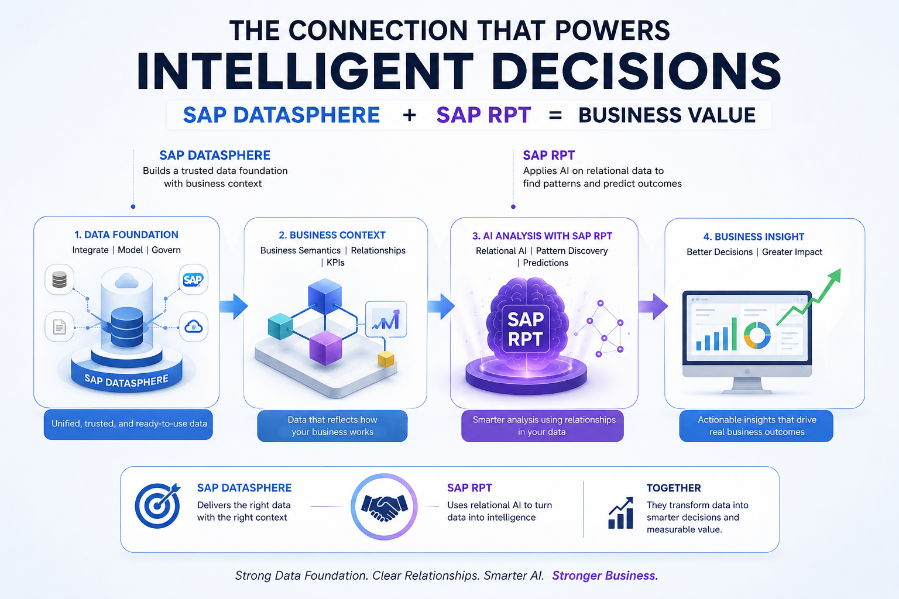
The connection between enterprise data and AI makes SAP Datasphere relevant to this discussion. Data platforms provide organizations with ways to integrate, model and manage information so that it can be used consistently across analytical and business scenarios.
SAP RPT and SAP Datasphere should not be treated as the same technology. They operate at different levels. SAP Datasphere is concerned with the data foundation and business context, while RPT represents an AI approach focused on relational and tabular information.
A simple way to understand the relationship is to think of the process as data foundation, business context, AI analysis and business insight. AI becomes significantly more useful when the underlying data is trustworthy and the relationships between business entities are understood.
This is also why professionals interested in enterprise AI should not focus only on the AI model. Understanding where the data comes from can be equally important.
SAP RPT vs. Generative AI: Are They Solving the Same Problem?
Generative AI and SAP RPT address different types of problems. Generative AI is commonly associated with language, content generation, coding, document analysis and conversational experiences. SAP RPT focuses on relational and tabular information.
That difference does not necessarily mean they compete with each other. They could potentially complement one another.
A specialized model could analyze structured enterprise data and produce a prediction. Generative AI could then help explain that prediction in language that a business user can understand.
In that scenario, one form of AI helps answer what the data indicates, while another helps communicate what the result means. This combination could make AI-driven analytics easier for business users to consume.
Why Does SAP RPT Matter for Business Analysts?
Business analysts have traditionally played an important role in translating business questions into reports, requirements and analytical needs. As AI becomes more capable, their role could increasingly involve asking questions that go beyond what happened in the past.
Instead of simply asking for another report, a business analyst may ask whether the available data can identify patterns associated with a particular outcome.
That requires business knowledge. AI may identify a correlation, but someone still needs to determine whether that relationship makes business sense and whether it should influence a decision.
This means AI does not necessarily reduce the importance of business analysts. In many situations, it can make their understanding of business processes even more valuable.
What Does SAP RPT Mean for SAP Professionals?
SAP professionals are increasingly working at the intersection of applications, data, analytics and artificial intelligence. A consultant may understand the business process but need stronger data knowledge. A data professional may understand the technology but need a deeper understanding of the business process generating the data.
This creates an increasingly valuable combination of SAP knowledge, data skills and AI awareness.
Professionals exploring this area can also connect AI knowledge with process understanding. For example, SAP RPT Training can help professionals understand how business processes are modeled, analyzed and transformed, while enterprise AI concepts can help them think about how data generated by those processes could be analyzed more intelligently.
The most valuable skill may therefore not be memorizing the name of an AI model. It may be understanding when an AI capability is appropriate for a real business problem.
What Skills Should You Build Alongside SAP RPT?
Understanding relational data is an important starting point because enterprise AI depends heavily on the way information is organized. Professionals should understand tables, relationships, keys, data quality and how business entities connect.
SQL and data modeling can also provide a strong foundation because they make it easier to understand what is happening underneath enterprise applications and analytics platforms.
Machine-learning fundamentals are useful as well. Professionals do not necessarily need to become AI researchers, but they should understand concepts such as training data, predictions, model evaluation and the limitations of AI-generated results.
Most importantly, these technical skills should be combined with business knowledge. An AI model can identify a pattern, but understanding whether that pattern matters to the organization requires business context.
What Are the Limitations of SAP RPT?
AI models are not magic solutions for poor data. If information is incomplete, inaccurate or incorrectly structured, the resulting predictions can be affected. Enterprise organizations also need to consider security, privacy, governance, explainability and responsible AI practices.
Another important issue is interpretation. A prediction is not automatically a fact. If an AI system identifies a customer as potentially high-risk, the business should understand the basis and context of that prediction before making an important decision.
This is why human judgment remains essential. The goal of enterprise AI should not be to remove people from decision-making entirely. It should be to give people better information so they can make more informed decisions.
Could SAP RPT Change How Businesses Use Data?
Businesses have spent decades building systems that collect and store information. ERP systems record transactions. Data platforms bring information together. Analytics tools turn that information into dashboards and reports.
The next step is increasingly about making the data useful for prediction.
SAP RPT is interesting because it explores this challenge from the perspective of relational and structured information. Instead of treating enterprise data simply as rows and columns, it asks how AI can learn from the patterns and relationships inside those datasets.
If this direction continues to develop, businesses could increasingly move from asking what happened toward asking what might happen next.
That would represent an important shift in how organizations use their data.
What Could the Future of Enterprise AI Look Like?
The future of enterprise AI may not be about one model doing everything. Different AI technologies may become specialized for different types of information and tasks.
Generative AI can work with language and content. Predictive models can identify likely outcomes. Relational AI can focus on structured business information. Together, these technologies could create more complete AI experiences.
Imagine a business leader asking why sales have declined in a particular region. An enterprise AI system may eventually need to consider customer behavior, product availability, pricing, inventory and historical transactions before producing an answer.
That requires more than language understanding.
It requires business context.
And that is perhaps the most interesting idea behind SAP RPT.
The Bigger Idea: Your Data Already Knows More Than You Think
Businesses do not have a shortage of information.
They have customer records, transactions, products, suppliers, invoices, inventory and financial data. The challenge is understanding how all those pieces fit together.
A customer connects to an order. An order connects to a product. A product connects to inventory. Inventory connects to suppliers. Suppliers connect to purchasing. Purchasing connects to finance.
The enterprise is essentially a network of connected information.
SAP RPT represents an interesting direction because it explores how foundation-model techniques can be applied to this type of relational data.
It does not mean traditional machine learning disappears. It does not mean generative AI becomes irrelevant. And it certainly does not mean businesses can ignore data quality or governance.
Instead, it points toward a future where different AI approaches work together.
Generative AI can communicate. Predictive AI can forecast. Relational AI can learn from structured business relationships.
The real opportunity is not simply to make AI more powerful.
It is to make AI more relevant to the way businesses actually work.
And perhaps that is the biggest reason to pay attention to SAP RPT.
The future of enterprise AI may not just be about understanding more data. It may be about understanding how the data is connected.
Frequently Asked Questions
What is SAP RPT?
SAP RPT stands for SAP Relational Pretrained Transformer. It represents a foundation-model approach focused on relational and tabular data, exploring how AI can learn patterns from structured enterprise datasets and support predictive and analytical tasks.
What does SAP RPT stand for?
SAP RPT stands for SAP Relational Pretrained Transformer. The name reflects its focus on relational data and transformer-based AI techniques rather than primarily focusing on text or other unstructured information.
How is SAP RPT different from generative AI?
Generative AI is commonly used for tasks involving text, code, images and other content. SAP RPT focuses on structured relational data, making it relevant to prediction and analytical problems where relationships between business records are important.
What are the potential use cases of SAP RPT?
Potential use cases include predictive analytics, forecasting, customer analysis and classification of structured business data. The actual value depends on the quality of the data, the specific business problem and how the AI capability is implemented.
Is SAP RPT related to SAP Business AI?
SAP RPT should not be treated as synonymous with the entire SAP Business AI portfolio. It represents a specialized approach to relational data within the broader movement toward using AI across enterprise data, applications and business processes.
Should SAP professionals learn SAP RPT?
SAP professionals working with data, analytics, AI and digital transformation can benefit from understanding relational AI concepts. The strongest foundation combines AI knowledge with enterprise data, SAP platforms and business-process understanding.
Conclusion
The most important question about enterprise AI isn't how many models a company can deploy.
It is what those models can actually help the business understand.
SAP RPT is interesting because it focuses attention on one of the most important forms of enterprise information: structured relational data. Businesses already have enormous amounts of it. The opportunity is to use that information more intelligently by understanding the patterns and relationships hidden within it.
The future will probably not belong to one type of AI alone. Generative AI, predictive models, relational AI, enterprise data platforms and business applications can all play different roles.
And that brings us back to the original problem.
A business doesn't just have data.
It has connected data that tells the story of how the business operates.
The real breakthrough may come when AI becomes better at reading that story.
Because the next generation of enterprise AI may not simply tell businesses what their data contains. It may help them understand what their data is trying to tell them.
About the Author
TechBrainz Consulting
Helping professionals build practical SAP skills for modern enterprise technology and business transformation.