
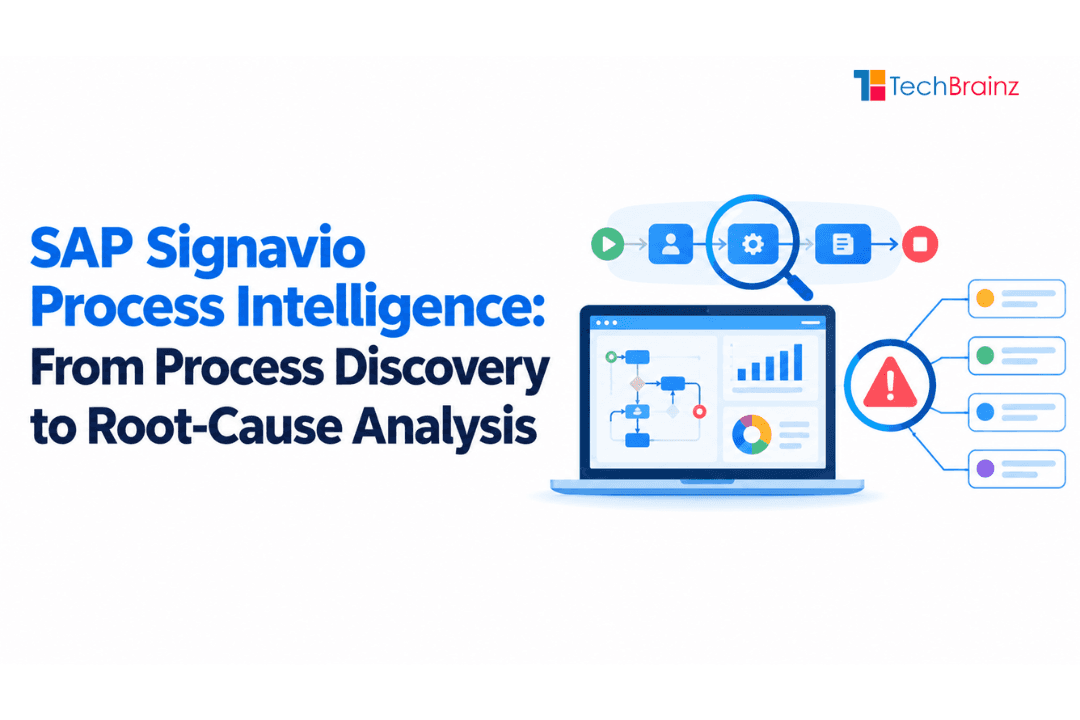
SAP Signavio Process Intelligence: From Process Discovery to Root-Cause Analysis
Introduction: Your Process May Not Work the Way You Think
Every organization has processes. There is a process for creating a sales order, approving a purchase, paying a supplier, delivering a product, closing the books, and handling customer requests. These processes are usually documented, discussed in workshops, and represented through process diagrams. On paper, everything can look perfectly organized. But once the process starts running through real business systems, reality can become very different.
An approval may take longer than expected. A document may be changed several times. An employee may perform a manual workaround because the standard process does not fit the situation. A transaction may follow an unexpected path before finally reaching completion. The result is a familiar business problem: everyone knows that the process is slow, but nobody can clearly explain why.
This is where SAP Signavio Process Intelligence becomes interesting. Instead of looking only at how a process is supposed to work, process mining allows organizations to examine the digital footprints created while the process is actually being executed. SAP describes Process Intelligence as a process mining solution that helps organizations analyze process data, understand process performance, and identify opportunities for improvement.
The real value, however, is not simply creating another process diagram. The bigger opportunity is discovering what is happening behind that diagram and understanding why certain transactions take a different path. That is the journey from process discovery to root-cause analysis.
What Is SAP Signavio Process Intelligence?
SAP Signavio Process Intelligence is a process mining solution that uses process execution data to help organizations discover actual process flows, analyze performance and deviations, investigate potential root causes, and identify opportunities for process improvement.
In simpler language, imagine that your business process leaves behind a digital trail every time someone creates, changes, approves, delivers, blocks, or completes a transaction. Process Intelligence can use that trail to reconstruct what happened. Instead of relying entirely on what employees remember or what documentation says should happen, organizations can examine the process from the evidence contained in their operational data.
This creates a much more useful conversation. Rather than simply asking whether a process is working, teams can investigate where delays occur, which process paths are responsible, which cases behave differently, and what characteristics those cases share. The process therefore becomes something that can be explored through actual execution data rather than something understood only through interviews and documentation.
From Process Mapping to Process Discovery
Traditional process mapping usually begins with people. Process owners describe the way work should happen, employees explain their daily activities, and consultants turn those discussions into process diagrams. This approach is useful because it captures business knowledge and intended process design. However, it can miss something important: the difference between the process people describe and the process people actually execute.
Consider a simple Order-to-Cash process. The expected flow might look straightforward: an order is created, the product is delivered, goods are issued, and an invoice is generated. In reality, some orders may be changed several times, require additional approvals, enter credit checks, encounter invoice blocks, or require manual intervention before completion.
Those additional steps are not necessarily visible in a high-level process map. They are hidden inside the execution history of the transactions.
Process discovery changes the perspective. Instead of starting with the question, "How should the process work?", it starts with, "How did the process actually work?" SAP learning material describes process discovery as a way to visualize actual process execution and identify patterns such as deviations, exceptions, outliers, and critical paths.
That difference is powerful because the actual process can reveal operational behavior that the documented process never captured.
Where Does the Process Data Come From?

Process Intelligence depends on process data because process mining needs evidence of what happened and when it happened. Business applications continuously generate this information as users and systems perform activities. A sales order is created, a delivery is generated, a document is changed, an approval is completed, an invoice is posted, or a payment is received. Each activity contributes to the digital history of the process.
For process mining purposes, this information can be organized into an event log. At a fundamental level, the event data connects an activity to a particular case and a timestamp. The case represents the business instance being followed, while the activity represents something that happened during that instance. The timestamp establishes the sequence and timing of those activities.
For example, an Order-to-Cash case might contain the creation of a sales order, a change to that order, delivery creation, goods issue, and invoice creation. When thousands or millions of these events are analyzed together, patterns begin to emerge.
This is where process data becomes much more than a collection of transaction records. It becomes a way to reconstruct how the business operates.
Finding the Bottleneck: Where Does the Process Slow Down?
Once the actual process has been discovered, the next question is usually more practical: where is the problem?
A process can contain hundreds of thousands of transactions and still appear healthy when viewed through an overall average. Average cycle time may be within an acceptable range, while a smaller group of transactions repeatedly experiences serious delays. If the analysis only looks at the overall number, those exceptions can remain hidden.
Imagine a company processing 100,000 sales orders. Most orders move through the process quickly, but a smaller group repeatedly enters an approval loop or experiences an invoice block. The average process time may not look alarming, yet those specific cases may consume significant operational effort.
Process analysis allows teams to move deeper into the data. Instead of simply asking for the average cycle time, they can investigate which cases take longer, which activities are repeated, which organizational units experience the delay, and which process paths appear most frequently among the slower transactions.
This changes the investigation completely. A bottleneck is no longer just a red section on a process diagram. It becomes a clue that points toward a more specific business question.
Process Variants: The Hidden Complexity Inside One Process
One of the most interesting aspects of process mining is the realization that a process is rarely just one process.
A global organization may have different ways of executing the same business process across countries, plants, company codes, sales organizations, suppliers, customers, or document types. Two transactions may start in exactly the same way but eventually take completely different paths.
These different paths are commonly referred to as process variants.
One variant might represent the standard process. Another might contain an additional approval. A third might include repeated document changes. Another might involve manual intervention or an exception process.
The important point is that process frequency does not automatically determine business importance. A process variant that occurs frequently may create a moderate amount of additional work, while a much less frequent variant could create extremely long delays or significant operational costs.
This is why effective process analysis should not stop with the question, "Which process path happens most often?" A better question is, "Which process paths create the greatest business impact?"
That shift takes process mining from simple visualization toward meaningful business analysis.
Root-Cause Analysis: Moving Beyond "What Happened?"
Finding a bottleneck is useful, but it is only part of the investigation. The more difficult question is usually why the bottleneck exists.
Imagine that a finance team discovers that invoice processing is taking longer than expected. The initial assumption might be that the Accounts Payable team needs to process invoices faster. However, that conclusion may be based on the visible symptom rather than the underlying process behavior.
A deeper analysis may show that delayed invoices are concentrated around certain transaction characteristics. Perhaps specific document types take longer. Perhaps certain organizational units experience additional approvals. Perhaps particular cases repeatedly enter a manual review process.
The question therefore changes from "Why is Finance slow?" to "What characteristics are common among the cases experiencing the delay?"
SAP Signavio Process Intelligence provides analysis capabilities that can help investigate performance metrics against case attributes and filters. This can help teams identify patterns associated with poor performance and narrow down the areas that deserve closer investigation.
However, it is important to make one distinction. A pattern discovered in process data is not automatically proof of a business root cause. Data can reveal strong relationships and useful clues, but business teams still need to validate what those relationships mean.
That is why root-cause analysis should be treated as an investigation rather than a magic button.
A Real Business Scenario: Finding the Reason Behind Invoice Delays

Consider a fictional manufacturing company that has noticed a growing delay between order completion and invoice creation. Management initially believes the finance team is processing invoices too slowly. Before changing the finance workflow, the process team decides to examine the actual execution data.
The analysis reveals that many of the delayed cases contain invoice blocks. That immediately changes the direction of the investigation. Instead of examining only the final invoice activity, the team starts looking at what happened earlier in those cases.
The delayed transactions contain additional document changes and manual intervention. When the team compares different process variants, it discovers that the longer-running cases are concentrated around particular transaction characteristics and organizational conditions.
The original problem was described as "invoice processing is slow." But the deeper investigation shows that the issue is actually connected to a longer process path that occurs before the invoice is finally created.
This example illustrates one of the most valuable ideas behind process mining. Sometimes the activity where you notice the problem is not the activity where the problem actually begins.
A late invoice does not necessarily mean the invoicing step is the root of the problem. The cause may have started much earlier in the process.
Conformance: Does Reality Match the Intended Process?
Process discovery helps answer the question, "What actually happened?" Conformance analysis takes the investigation one step further by asking whether that actual behavior matches the intended process.
Suppose an organization expects a process to follow a simple sequence from creation to approval, fulfillment, and invoicing. In reality, transactions may repeatedly move backward and forward between activities. Documents may be changed after approval, additional approvals may occur, or activities may be performed in an unexpected sequence.
Not every deviation is necessarily a problem. Businesses need exceptions because real-world transactions are not always identical. A deviation may be completely legitimate in a particular business scenario.
The important question is whether a deviation occurs frequently enough, consumes enough resources, creates enough delay, or produces enough risk to deserve attention.
That distinction prevents organizations from falling into another common process mining trap: treating every difference from the standard process as something that must be eliminated.
The objective is not to make every transaction identical.
The objective is to understand which deviations matter.
Process Intelligence Is More Than a Process Map
It is easy to think of process mining as a technology that automatically creates process diagrams from business data. While process visualization is an important part of the experience, it is only the beginning.
Once the actual process is visible, teams can investigate performance, compare process variants, examine deviations, filter specific cases, and investigate the characteristics associated with particular outcomes. This makes the process map a starting point for analysis rather than the final deliverable.
The broader journey can be thought of as a continuous loop. First, the organization discovers what is happening. Then it analyzes the performance and identifies unusual behavior. Next, it investigates the reasons behind that behavior. After that, the organization implements improvements and returns to the process data to determine whether those changes actually produced better results.
This is what turns process mining into process improvement.
The goal is not to create the most complicated visualization. The goal is to discover something useful enough to change the way the business operates.
SAP Signavio Process Intelligence Use Cases
The same approach can be applied across many business processes. In Order-to-Cash, organizations can investigate order changes, delivery delays, invoice blocks, rework, and unusual transaction paths. In Procure-to-Pay, teams can investigate purchase-order changes, approval delays, invoice exceptions, supplier-related patterns, and manual processing.
Finance teams can also use process analysis to understand Record-to-Report activities, closing-related delays, repeated changes, and other execution patterns. Customer-facing processes can be investigated in a similar way when organizations need to understand repeated interactions, escalation paths, or unusually long resolution cycles.
The common factor is not the specific department. It is the availability of a meaningful process question and suitable process data.
Instead of asking, "What can we analyze?", organizations get more value by starting with, "What business problem are we trying to understand?"
How to Start a SAP Signavio Process Intelligence Analysis
A successful process analysis does not need to begin with an enormous transformation project. In many cases, a focused business question provides a better starting point.
Imagine that an organization notices that its Order-to-Cash cycle time has increased. Rather than analyzing every process in the company, the team can focus on that particular process and define exactly what "good performance" means.
Once the relevant process data is available, the team can examine the actual execution paths and identify where the longer cases differ from the normal cases. From there, the investigation can move into process variants, organizational comparisons, and root-cause analysis.
The important principle is to keep the analysis connected to a business outcome.
A process-mining project should not become an exercise in producing impressive diagrams or collecting endless metrics.
The question should always remain visible:
What business problem are we trying to understand?
For professionals looking to deepen their knowledge of the broader SAP Signavio ecosystem, SAP Signavio Training can also provide a structured way to build familiarity with process analysis, process transformation, and related Signavio capabilities.
What Makes Process Mining Valuable for SAP Transformation?
SAP transformation is not simply a technical exercise. Organizations also need to understand how their business processes operate today before deciding what should change tomorrow.
That means understanding where manual work exists, which process variants have developed over time, where bottlenecks occur, and whether different business units are executing supposedly identical processes in very different ways.
Process mining can provide an evidence-based view of this current state. Instead of depending entirely on assumptions about how the business works, transformation teams can examine actual process execution and identify areas that deserve attention.
This is particularly useful when organizations are preparing for process standardization, optimization, or broader ERP transformation. Before asking what the future process should look like, it is useful to understand what the current process actually looks like.
That baseline can make transformation discussions much more grounded.
Common Mistakes to Avoid
One of the biggest mistakes is attempting to analyze everything at once. A large organization can have thousands of processes and millions of events. Trying to understand all of them simultaneously can quickly become overwhelming. A focused business question creates a much clearer starting point.
Another mistake is relying only on averages. Average cycle time can hide problematic variants, repeated activities, and small groups of transactions that create disproportionate business impact.
It is also important not to assume that every process deviation is bad. Some exceptions are necessary and completely legitimate. The objective is to understand the business impact of the deviation rather than simply eliminate anything that differs from the standard path.
Data quality is equally important. Process mining is only as meaningful as the underlying event data. Missing events, inaccurate timestamps, incomplete attributes, or incorrectly defined cases can distort the analysis.
Finally, organizations should avoid stopping at discovery. Identifying a bottleneck is not the same as improving the process. The real value appears when an insight leads to a meaningful change and the organization subsequently measures whether that change improved performance.
From Process Visibility to Process Improvement
The real strength of Process Intelligence is not simply giving an organization more visibility. It is helping people move from vague assumptions toward evidence-based investigation.
Instead of saying, "This process seems slow," teams can investigate which cases are slow.
Instead of saying, "Approvals are the problem," they can examine which approval paths create delays.
Instead of saying, "Finance needs to work faster," they can investigate whether the delay actually begins somewhere earlier in the process.
This shift in thinking can make process improvement conversations much more productive.
The process becomes something that can be continuously examined rather than something documented once and forgotten.
Frequently Asked Questions
What is SAP Signavio Process Intelligence?
SAP Signavio Process Intelligence is a process mining solution that analyzes process execution data to help organizations understand how business processes actually run. It supports analysis of process flows, performance, variants, deviations, and potential root causes so teams can identify opportunities for improvement.
What is process mining in SAP Signavio?
Process mining uses event data generated by business systems to reconstruct actual process execution. Instead of relying only on documented workflows, organizations can examine real transaction paths, timing, repeated activities, process variants, and deviations to understand how work is actually being performed.
What is process discovery in SAP Signavio?
Process discovery is the analysis of process execution data to understand the actual paths followed by business transactions. It can reveal common process flows, exceptions, unusual variants, and other execution patterns that may not be visible in traditional process documentation.
How does SAP Signavio support root-cause analysis?
SAP Signavio Process Intelligence can help teams investigate performance metrics against different case attributes and filters. This allows analysts to identify patterns associated with delays or other performance problems and focus their investigation on the conditions surrounding those cases.
What data is required for SAP Signavio Process Intelligence?
Process mining requires suitable event data that can identify the business case, the activity that occurred, and when that activity occurred. Additional attributes can provide valuable context for analyzing differences between process variants and investigating performance patterns.
Can SAP Signavio Process Intelligence improve business processes?
Yes. Process Intelligence can help organizations identify bottlenecks, understand process variants, investigate deviations, and explore potential causes of poor performance. The actual improvement still depends on business decisions, process changes, implementation, and subsequent measurement of the results.
Conclusion: Don't Just Map the Process. Understand It.
A process map tells an organization what a process is supposed to look like. Process Intelligence can help reveal what actually happens when that process runs through real business systems.
That difference is where meaningful process improvement begins.
With SAP Signavio Process Intelligence, organizations can move from process discovery to performance analysis, from bottleneck identification to process-variant investigation, and from visible symptoms toward a more focused root-cause investigation.
But the technology itself is not the final answer. The real value comes from asking better questions about the data.
Where is the process slowing down? Why are certain cases following a different path? Which deviations actually matter? What characteristics are shared by the delayed transactions? What business change could improve the outcome?
When these questions are connected to reliable process data and measurable business objectives, process mining becomes much more than another analytics capability.
It becomes a practical way to understand how the business actually works—and identify where that process can work better.
About the Author
TechBrainz Consulting
TechBrainz Consulting provides practical SAP insights covering business transformation, process optimization, governance, security, and enterprise technology. Our content focuses on explaining complex SAP concepts through practical, human-centered examples that help professionals understand technology in a real business context.