
SAP Signavio: Your Processes Are Telling You Something
A purchase order that takes three days to approve. An invoice that keeps bouncing between departments. A customer order that requires manual correction before it can move forward. A finance team that spends hours fixing the same type of error every month.
Most organizations see these as individual problems.
But what if they are not individual problems at all?
What if they are messages?
Every time a process slows down, takes an unexpected route, requires rework, or depends on manual intervention, it leaves behind a signal. The problem is that businesses often collect these signals without actually understanding them. ERP systems generate data. Employees generate activity. Applications generate events. Dashboards report numbers. Yet somewhere between all that information, the real story of how work gets done can disappear.
This is where SAP Signavio becomes interesting.
Rather than looking at a business only through reports and isolated KPIs, SAP Signavio is designed around the processes that connect people, systems and business activities. SAP describes the SAP Signavio Process Transformation Suite as a cloud-based platform for understanding, improving and transforming business processes at scale.
The bigger idea is simple: your processes already know where many of your business problems are hiding. You just need a better way to listen.

Definition: What Is SAP Signavio?
SAP Signavio is a business process transformation suite that helps organizations understand, model, analyze, improve and govern their business processes. Its capabilities include process and journey modeling, process analysis and mining, transformation management, collaboration and process governance.
Why Are Your Business Processes More Important Than You Think?
Imagine that a company notices its invoice cycle time has increased.
The traditional reaction might be to look at the finance dashboard, compare this month's numbers with last month's numbers and ask the finance team what happened.
That may explain the symptom, but it does not necessarily explain the process behind it.
Perhaps invoices are being rejected because purchase orders contain incorrect information. Perhaps approvals are taking longer because requests are being routed to the wrong people. Perhaps employees are manually correcting information that should have been captured earlier. Perhaps one business unit is following a completely different process from another.
The number tells you that something changed.
The process can help explain why.
That difference matters because modern business transformation is increasingly about improving how work moves across an organization, not simply replacing one technology with another. SAP's own learning material describes Signavio as a way to close the gap between how organizations think their processes operate and how those processes actually work in practice.
This is why process visibility has become such an important part of transformation.
A business may have excellent employees, modern applications and large amounts of data, but if nobody can clearly see how work moves from one step to another, improvement becomes a guessing game.
And guessing is an expensive way to transform a business.
What Can SAP Signavio Actually Tell You About a Process?
Think about a business process as a journey.
A customer order enters the organization. Someone reviews it. Another team checks availability. A warehouse prepares the goods. Finance creates an invoice. The customer eventually pays.
On paper, the process looks straightforward.
Reality is usually messier.
An order may be changed three times. An approval may be skipped in one region and repeated in another. A document may move between systems. A missing piece of information may send the transaction back to an earlier step.
These variations are where important business signals appear.
SAP Signavio Process Intelligence focuses on analyzing process execution and using process mining to reveal how processes actually run. SAP describes process mining and analysis as providing end-to-end visibility that can help organizations identify inefficiencies, analyze current operations and find opportunities for improvement.
That means a business can move beyond asking, "How long does this process take?"
It can start asking more useful questions.
Where does the delay begin? Which process path occurs most often? Which activities create rework? Which variations produce poor outcomes? Where are manual interventions happening? Which parts of the process are candidates for improvement or automation?
Those questions lead to better decisions because they connect performance with the actual movement of work.
How Does SAP Signavio Turn Process Data Into Something Useful?
The real value of process intelligence is not simply showing a complicated process diagram.
It is turning process data into a story that business teams can understand.
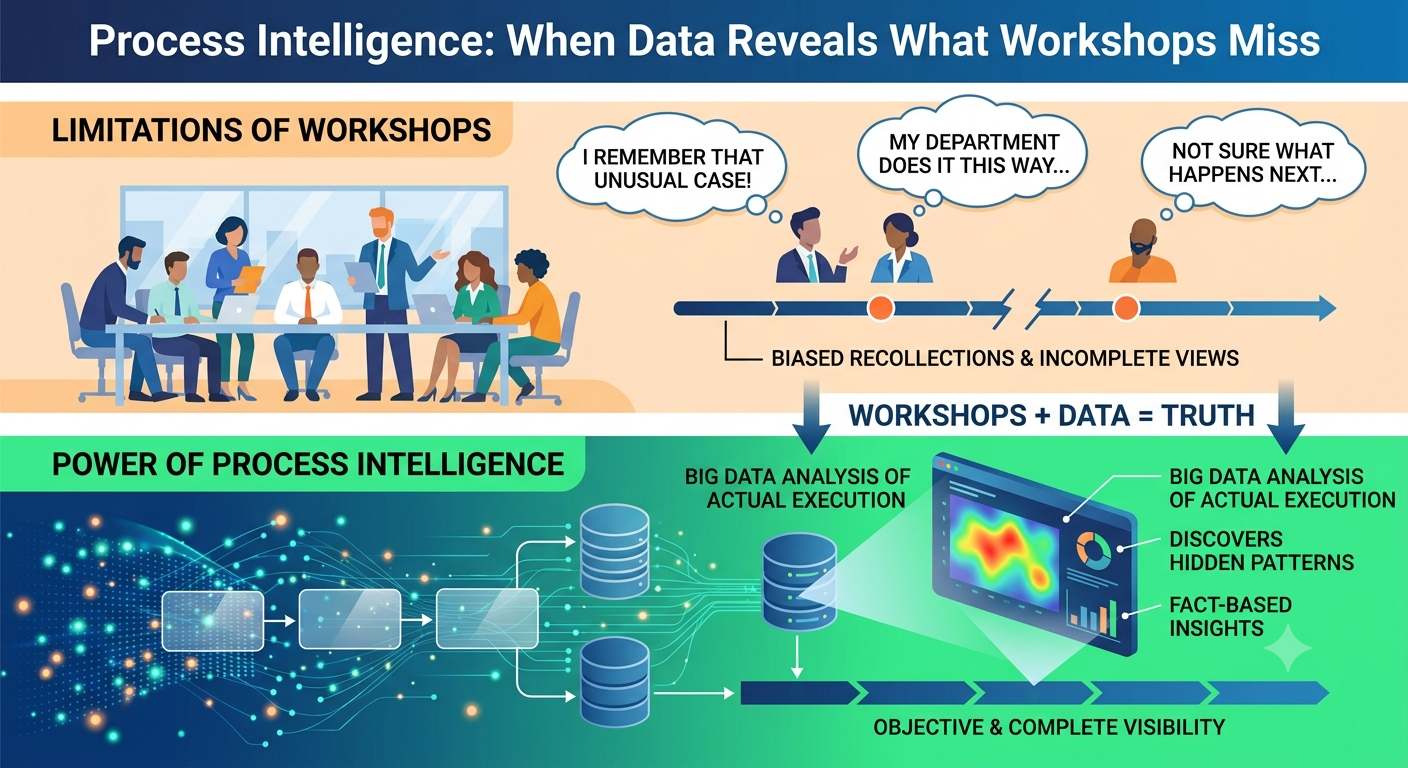
Imagine a procurement process where thousands of purchase orders are processed every month. Management knows that procurement costs are higher than expected, but nobody can agree on the reason.
One department believes approvals are the problem. Another believes suppliers are causing delays. The IT team thinks the issue is system configuration. Procurement believes employees are creating too many exceptions.
Instead of relying entirely on opinions, process analysis can reveal the actual execution patterns.
Perhaps the majority of transactions follow the expected route, but a smaller group repeatedly goes through correction and reapproval. That smaller group may be responsible for a disproportionate amount of delay.
Suddenly, the problem becomes much clearer.
The organization is no longer asking, "Why is procurement slow?"
It is asking, "Why are these transactions entering this particular process path?"
That is a much more actionable question.
The journey can be thought of as observe, understand, improve and transform. SAP's current positioning for the Process Transformation Suite centers on understanding, improving and transforming business processes, with capabilities spanning process analysis, modeling, governance, collaboration and transformation management.
The important point is that technology is not the final destination.
The insight is.
Why Is Process Mining Becoming So Important for SAP Transformation?
There was a time when documenting a business process was often enough.
A consultant could interview employees, draw a process map and get stakeholders to approve it. That model became the reference point for how the organization believed work should happen.
But there is a major problem.
The documented process is not always the actual process.
Employees find workarounds. Systems introduce exceptions. Business units create local variations. Regulations change. Customers behave differently. New applications get introduced. Processes evolve without anyone updating the original documentation.
Process mining changes the conversation because it can analyze event data to reconstruct actual process execution.
This is particularly relevant during large SAP transformation initiatives. A company moving toward SAP S/4HANA, for example, needs more than a technical migration plan. It needs to understand which existing processes should be standardized, redesigned, simplified or retained.
SAP has specifically positioned Signavio for process-centric SAP S/4HANA transformation, including analyzing current-state processes, identifying opportunities and supporting future-state process design.
That makes process intelligence valuable before transformation, during transformation and after transformation.
Before transformation, it helps establish a realistic picture of the current state.
During transformation, it can support decisions about which processes need attention.
After transformation, it can help organizations continue monitoring and improving those processes.
Transformation stops being a one-time project and becomes a continuous process.
SAP Signavio Process Intelligence vs. Process Modeling: Why Do Both Matter?
Process modeling and process intelligence may sound similar, but they answer different questions.
Process modeling is largely about describing and designing how a process should work. SAP Signavio Process Manager, for example, supports collaborative process modeling, documentation, simulation and process design.
Process intelligence is more focused on understanding what actually happened.
That distinction is powerful.
A process model might say that an invoice should move from verification to approval and then payment.
Process intelligence can reveal that, in reality, thousands of invoices are repeatedly sent back for correction before approval.
One describes the intended journey.
The other exposes the real journey.
When organizations bring these perspectives together, they can compare the as-is process with the to-be process and identify the gap between them.
That gap is often where transformation opportunities live.
What Does a Real SAP Signavio Use Case Look Like?
Consider a fictional manufacturing company with a growing problem in its order-to-cash process.
Customers are complaining about delayed orders. Sales believes the warehouse is responsible. The warehouse believes sales is entering incorrect information. Finance believes billing issues are creating the delays.
Everyone has a theory.
The company decides to analyze the process instead of continuing the argument.
The analysis reveals that the process is not failing at one single point. Several orders are being modified after initial creation. Some changes trigger additional approvals. Certain orders then move through a different processing path. The result is a chain reaction.
The warehouse is not necessarily the original problem.
Finance is not necessarily the original problem.
Sales is not necessarily the original problem.
The real issue is the process variation created earlier in the journey.
This is one of the most valuable ways to think about process intelligence.
It shifts the conversation away from who made the mistake and toward what is causing the process to behave this way.
That is a healthier approach to transformation because it focuses on systems, workflows and root causes instead of simply assigning blame.
Can SAP Signavio Help Businesses Find Automation Opportunities?
Automation sounds attractive until a company automates a broken process.
If a process contains unnecessary approvals, repeated corrections and unclear ownership, automating every step does not magically make the process better.
It can simply make the inefficient process move faster.
That is why process understanding should come before large-scale automation decisions.
Process analysis can help organizations identify repetitive activities, manual interventions, bottlenecks and process variations. SAP currently highlights opportunities for improvement and automation discovery as part of its process mining and analysis capabilities.
The smarter sequence is therefore not "automate everything."
It is:
Understand the process. Identify the problem. Decide what should change. Then automate where automation actually creates value.
This distinction becomes even more important as organizations explore AI agents and intelligent automation. AI can execute tasks, but it still needs business context to understand where those tasks belong and what outcome the organization is trying to achieve.
That is one reason SAP is increasingly connecting process intelligence with AI-assisted transformation capabilities.
Why Does SAP Signavio Matter for the Future of Business Transformation?
Business transformation used to be treated as a major event.
A company launched a project, changed its systems, trained employees, went live and eventually moved on.
The problem is that business never stays still.
Customer expectations change. Regulations change. Suppliers change. Technology changes. Employees find new ways to complete work. AI introduces new possibilities.
A process that works well today may become inefficient tomorrow.
This is why continuous process improvement is becoming more important.
SAP's current Signavio portfolio emphasizes continuous transformation, process observability, process intelligence and AI-assisted improvement.
The future is therefore not simply about having a process map stored somewhere in a repository.
It is about creating a living understanding of how the organization operates.
That is a much bigger idea.
Is SAP Signavio a Valuable Skill for SAP Professionals?
For SAP professionals, the interesting opportunity is that process transformation sits between technology and business.
A traditional SAP professional may understand configuration, transactions and system behavior very well.
A process-focused professional asks another set of questions.
Why does the business follow this process? Where does value get created? Where is time being lost? Which activities should be standardized? Which process variations are justified? Which ones are simply legacy habits?
These questions are becoming increasingly relevant as organizations focus on business transformation rather than isolated system implementation.
Professionals who want to develop this combination of SAP knowledge, process thinking and analytical capability can consider SAP Signavio Training as a way to build practical familiarity with process modeling, process analysis, process mining and transformation concepts.
The strongest learning approach, however, should go beyond simply knowing where features are located. A professional should be able to look at a business process, interpret what the data is showing and explain what the organization should do next.
That is where a technology skill becomes a transformation skill.
What Should You Learn Alongside SAP Signavio?
SAP Signavio becomes even more useful when combined with a strong understanding of business processes and the SAP ecosystem.
Knowledge of SAP S/4HANA can help professionals understand the operational environment in which many enterprise processes run. Knowledge of business process management helps explain why processes are designed in particular ways. Process mining knowledge helps interpret execution data. Data and analytics skills help professionals work with evidence rather than assumptions.
An understanding of automation and AI can then take the conversation one step further.
Instead of asking only, "Can this task be automated?"
the better question becomes:
"What should this process look like, and where can technology create the most meaningful improvement?"
That is the mindset that turns process analysis into business transformation.
The Bigger Idea: Your Processes Are Already Telling You Something
A delayed invoice is telling you something.
A repeated approval is telling you something.
A manual correction performed hundreds of times is telling you something.
A customer order that takes twice as long in one region as another is telling you something.
These are not simply operational annoyances. They are signals.
The challenge is learning how to interpret them.
SAP Signavio provides organizations with a process-centric way to understand how work actually happens, analyze where performance breaks down and support improvement and transformation. Its capabilities extend from modeling and collaboration to process mining, analysis, governance and transformation management.
The most important shift is therefore not from one SAP tool to another.
It is a shift in thinking.
Instead of asking only, "What happened?", organizations can ask, "How did it happen?"
Instead of asking, "Who caused the delay?", they can ask, "What in the process created the delay?"
And instead of treating transformation as a one-time project, they can start treating processes as something that should continuously learn, improve and evolve.
Your processes have been telling you where the problems are. SAP Signavio gives you a way to start listening.
Frequently Asked Questions
1. What is SAP Signavio?
SAP Signavio is a cloud-based business process transformation suite designed to help organizations understand, model, analyze, improve and govern business processes. It brings together capabilities such as process modeling, process intelligence, process mining, collaboration and transformation management.
2. What is SAP Signavio Process Intelligence used for?
SAP Signavio Process Intelligence is used to analyze how business processes actually execute using process mining and related analysis capabilities. It can help organizations identify bottlenecks, process variations, inefficiencies and improvement opportunities using process data.
3. Is SAP Signavio only for SAP systems?
No. SAP states that its Signavio process solutions can work with non-SAP solutions as well. This makes the platform relevant for organizations operating complex environments where SAP and non-SAP applications contribute to the same end-to-end business process.
4. How does SAP Signavio support SAP S/4HANA transformation?
SAP Signavio can help organizations understand current processes, identify improvement opportunities and support future-state process design during SAP S/4HANA transformation. This creates a process-focused foundation for making transformation decisions based on actual process behavior rather than assumptions.
5. Who should learn SAP Signavio?
SAP consultants, business analysts, process professionals, transformation consultants, SAP project professionals and professionals working with business process management can benefit from learning SAP Signavio. It is particularly useful for people who want to connect SAP technology knowledge with process analysis and transformation.
6. Is SAP Signavio worth learning for a career in SAP?
SAP Signavio can be a valuable skill for professionals interested in process transformation, process mining and modern SAP transformation projects. The greatest value comes from combining tool knowledge with practical understanding of business processes, SAP S/4HANA and data-driven improvement.
Conclusion
The most valuable information inside a business is not always sitting in a dashboard.
Sometimes it is hidden in the way an order moves, the number of times an invoice gets corrected, the approvals that keep repeating and the process variations nobody has formally documented.
Those patterns tell a story.
SAP Signavio helps organizations turn that story into process insight and use that insight to make better transformation decisions.
For SAP professionals, business analysts and transformation teams, that makes process intelligence more than another technology trend. It represents a different way of looking at enterprise operations: understand the process first, then decide what should change.
And when businesses learn to listen carefully, their processes may have more to say than they expected.
About the Author
TechBrainz Consulting
Helping professionals build practical SAP skills for modern enterprise technology and business transformation.